Custom Enamel for OEM Appliances: 2026 Strategic Guide
Can your current finish survive the 2026 regulatory shift? By December 31, 2026, the EU Drinking Water Directive and new ISO 11997-1 standards will redefine market access for high-heat units. Choosing the right custom enamel coating for OEM appliances is no longer just a design choice; it's a survival strategy for your brand. You've likely seen the frustration of surface peeling on roaster ovens or inconsistent finishes from bulk suppliers that compromise your premium positioning.
We understand that maintaining a flawless, food-safe surface while meeting strict formaldehyde and VOC limits feels like a moving target. This strategic guide explores how custom enamel coating secures long-term durability and ensures your products meet 2026 food safety standards. We'll examine the technical requirements for heat resistance, the benefits of a specialized Malaysia-based manufacturing partner, and how a superior finish justifies a higher market tier for your private label brand.
Table of Contents
The Strategic Value of Custom Enamel Coating for OEM Appliances
The global appliance market is currently bifurcating. Entry-level units compete strictly on price, while premium brands prioritize material integrity and consumer safety. In 2026, the shift toward chemical-free, sustainable surfaces has accelerated significantly. Consumers now actively seek out products that avoid synthetic non-stick chemicals. Integrating custom enamel coating for OEM appliances is the most effective way to address this demand while securing a competitive edge in the high-end segment.
Brand Tiering and Market Positioning
Porcelain enamel transforms a standard metal component into a premium asset. It provides a level of perceived value that justifies a higher MSRP. Unlike organic coatings, a Vitreous enamel overview reveals a material that offers deep, stable colors that won't fade over time or under UV exposure. This visual permanence ensures the appliance maintains its showroom quality long after the purchase. For brands looking to elevate their market tier, choosing enamel is a signal of quality to both the procurement officer and the end consumer. You can see how we apply these principles in our guide on Custom Roaster Oven Manufacturing.
Risk Management in High-Heat Applications
High-heat appliances like BBQ grills and roaster ovens present severe engineering challenges. Standard organic paints and many powder coatings begin to degrade or discolor when exposed to temperatures exceeding 400°F. This degradation often leads to surface peeling, which is a catastrophic failure for consumer trust. When a coating flakes, it renders the appliance unusable and drives up return rates. Using custom enamel coating for OEM appliances mitigates these risks through superior thermal stability.
Thermal Endurance: Enamel maintains its structural integrity at temperatures that would melt or char standard paints.
Permanent Bond: The chemical fusion between the glass and metal prevents moisture from creeping under the surface, stopping rust before it starts.
Warranty Savings: While the initial production cost may be higher than basic paint, the reduction in warranty claims and product returns provides a superior long-term ROI.
Our integrated approach in Malaysia ensures that your high-heat units are built to last. We focus on the practicalities of production to ensure your brand remains a leader in durability. Explore our full range of finishing options on our services page to find the right fit for your next product line.
Technical Engineering: The Glass-to-Metal Fusion Process
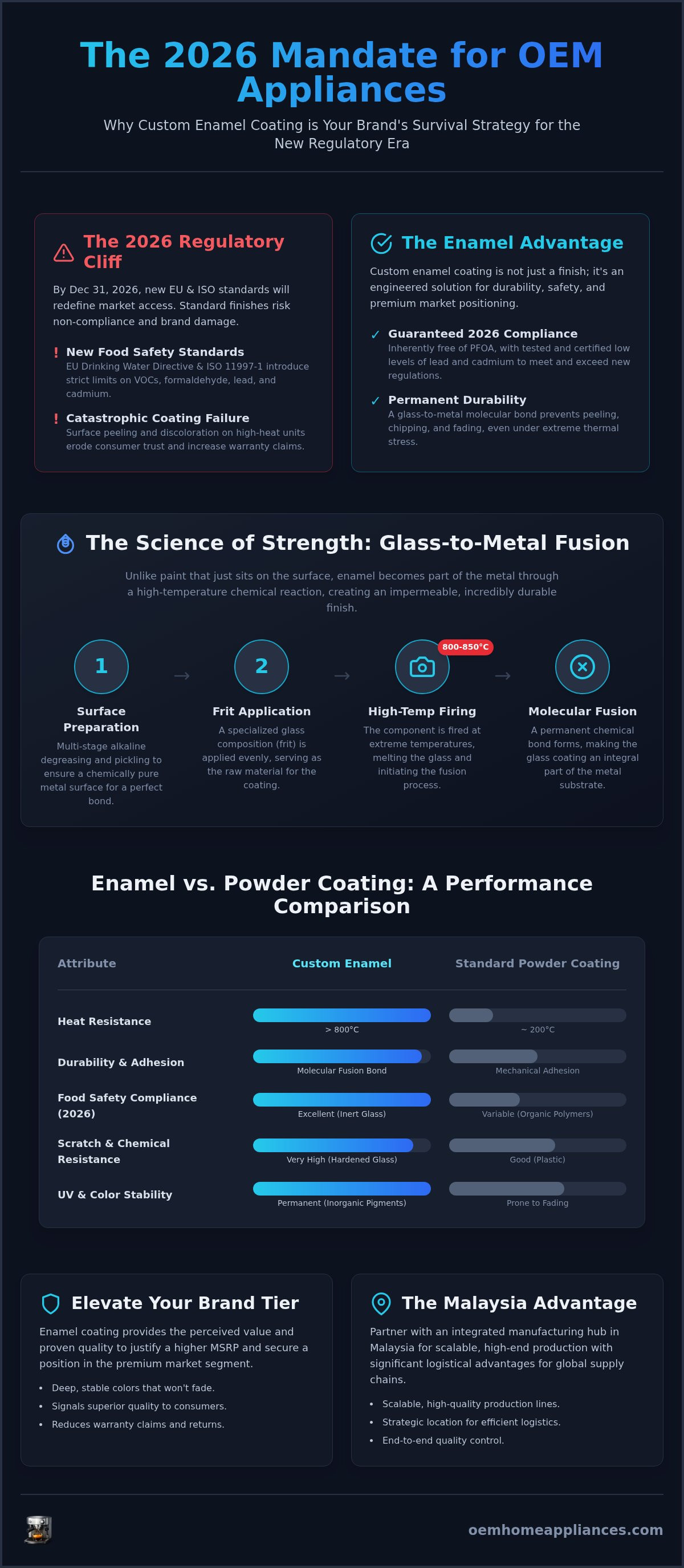
Understanding the science behind custom enamel coating for OEM appliances is essential for procurement and engineering teams. This isn't a mere paint application. It's a high-temperature fusion process. Porcelain enamel is an inorganic glass material fused to a metal substrate at temperatures ranging between 800°C and 850°C. This extreme heat creates a permanent bond that distinguishes enamel from organic finishes like traditional paint or epoxy.
Most coatings rely on mechanical adhesion, where the finish "grips" the surface of the metal. Enamel is fundamentally different. During the firing cycle, a chemical reaction occurs at the interface of the metal and the glass. This molecular fusion makes the coating an integral part of the component. It won't delaminate or peel, even under severe thermal cycling or mechanical stress. This level of durability is why enamel remains the gold standard for high-heat kitchen environments.
Success starts before the furnace. High-end cleaning is the secret to a uniform, defect-free finish. Any residual oils, lubricants, or oxidation will cause outgassing or "fish-scaling" during the firing stage. Our process involves multi-stage alkaline degreasing and pickling to ensure the surface is chemically receptive to the coating. Firing cycles must also be precisely controlled. The ramp-up and cooling phases are as important as the peak temperature. Improper cooling can lead to internal stresses within the glass layer, causing micro-cracking that compromises the finish.
The Firing Process and Bond Strength
The molecular fusion of glass frit to steel creates a surface that is impervious to common kitchen chemicals and acidic food residues. Frit is a specialized glass composition that has been melted and quenched into small grains, serving as the raw material for the 2026 coating process. This material creates a non-porous barrier that prevents corrosion and bacterial growth. If you have specific technical questions about how this applies to your product line, you can speak with our engineering team for a detailed consultation.
Substrate Selection for OEM Success
Choosing the right base metal is critical for a successful finish. We work with cold-rolled steel, cast iron, and aluminum, depending on the appliance's thermal requirements. Metal thickness also plays a vital role; thin gauges may warp at 850°C, while overly thick components require longer firing cycles to achieve full fusion. Balancing these factors ensures structural integrity and a flawless aesthetic. For a deeper look at specific applications, read our guide on the Enamel Coating Process for Roaster Ovens.
Enamel vs. Powder Coating: Choosing the Right Finish
Selecting the optimal finish for your product line involves balancing performance requirements with production budgets. While powder coating is a cost-effective solution for many applications, custom enamel coating for OEM appliances remains the superior choice for components exposed to direct heat or food contact. The 2026 regulatory environment has placed a premium on low-VOC and VOC-free systems. Because enamel is an inorganic glass-to-metal fusion, it's naturally free from the volatile organic compounds often found in polymer-based finishes, helping brands meet the strict 10 g/L VOC limits now required for many indoor applications.
The choice between these two finishes often comes down to the specific environment of the component. Enamel provides a non-stick, chemically resistant surface that can last over 15 years under normal use. Powder coating, while versatile and available in a wider range of textures, doesn't offer the same level of thermal stability. For air fryers, roaster ovens, and BBQ grills, the inorganic nature of enamel ensures it won't off-gas or discolor when temperatures spike, a common failure point for organic powder finishes.
Performance Benchmarks
Enamel excels in hardness and scratch resistance. On the Mohs scale, porcelain enamel typically reaches a hardness of 5 to 6, meaning metal utensils won't leave the deep gouges common on polymer-coated surfaces. This is critical for appliances like rice cookers where cleaning involves frequent abrasive contact. In terms of corrosion, enamel's non-porous surface provides an absolute barrier against moisture. This makes it the standard for outdoor equipment where humidity and salt air would quickly degrade a standard finish. You can compare these metrics against our Durability Standards for Powder Coated Metal Components to determine the best fit for your project.
Cost vs. Value Framework
Procurement officers should look beyond the initial manufacturing cost to the total product lifecycle. While powder coating is generally less expensive to apply, it often leads to higher warranty costs if used in high-heat zones. A strategic "Hybrid" approach is often the best way to optimize the appliance Bill of Materials (BOM). For example, we recommend using powder coating for the exterior chassis and control panels where aesthetics are the priority. Reserve custom enamel coating for OEM appliances for the internal liners, heating elements, and cooking trays. This decision tree should be guided by three factors: operating temperature, expected abrasion, and direct food contact. By mixing these finishes, you achieve a high-end feel without inflating the total production cost.
Quality Standards and 2026 Regulatory Compliance
Regulatory shifts in 2026 are substantial and require proactive manufacturing strategies. The Danish market has established strict limits on lead and cadmium migration for food-contact surfaces, setting a new benchmark for European exports. Implementing custom enamel coating for OEM appliances ensures your products meet these specific requirements because the material is inherently inorganic. Unlike synthetic alternatives, porcelain enamel does not rely on heavy metal stabilizers to maintain its finish under thermal stress. This makes it a reliable choice for brands targeting high-compliance regions.
PFOA-free and PTFE-free certifications have transitioned from marketing advantages to an industry baseline. Synthetic non-stick coatings often release volatile chemicals during their first high-heat cycle, a process known as outgassing. This is particularly problematic for indoor kitchen environments. Porcelain enamel eliminates this risk entirely. It provides a naturally non-toxic surface that remains stable at temperatures far exceeding standard cooking levels. To maintain safety, your OEM partner must provide batch-tested compliance certificates for every production run, ensuring that the "chemical-free" claim is backed by data.
Food Safety and Non-Toxic Standards
Inorganic glass is the safest surface for high-heat cooking because it is chemically inert. It won't react with acidic foods or release harmful fumes if an air fryer or roaster oven is accidentally overheated. This stability is a core requirement for the 2026 consumer market, where health-conscious buyers prioritize material safety. By choosing enamel, you avoid the reputational damage associated with peeling synthetic coatings and potential chemical leaching. We maintain rigorous standards to ensure our finishes exceed the latest food safety protocols.
Global Export Readiness
Global export success depends on a transparent compliance paper trail. Navigating REACH and RoHS requirements is mandatory for North American and EU market entry. As a Malaysia-based partner, we specialize in documenting every stage of the manufacturing process to simplify your import logistics. This transparency is vital for high-volume categories. Our High Capacity Rice Cooker Factory Reference demonstrates how we integrate these safety standards into mass production for global brands. Factory audits serve as the final verification of these standards. We welcome third-party inspections to validate our adherence to international safety and quality benchmarks.
If you need to verify compliance for your specific market or require a detailed technical breakdown, contact our team in Malaysia for a regulatory consultation and quotation.
Partnering for Custom Enamel Coating in Malaysia
Successful execution of a premium appliance line requires more than just high-quality materials. It demands a partnership that bridges the gap between brand vision and industrial reality. Our integrated facility in Malaysia acts as a silent engine for your growth, offering a streamlined path from initial R&D prototypes to high-volume manufacturing. By consolidating custom enamel coating for OEM appliances within the same facility as product design and assembly, we eliminate the common friction points found in fragmented supply chains.
Technical support is a cornerstone of our partnership approach. Transitioning a product from a conceptual design to a mass-produced unit involves complex engineering decisions regarding substrate thickness and firing temperatures. We provide the expertise necessary to ensure that the aesthetic goals of your brand don't compromise the structural integrity of the appliance. This collaborative process ensures that the durability and safety standards discussed in previous sections are consistently met across every unit that leaves our floor.
The Integrated OEM Workflow
In-house coating capabilities provide a significant competitive advantage by reducing lead times and logistics costs. When the finishing process happens under the same roof as assembly, you avoid the risks associated with transporting sensitive metal components between different vendors. This integration is essential for maintaining color consistency across different production batches. Even minor variations in furnace atmosphere or frit composition can lead to visible color drift. Our controlled environment ensures that your brand's signature palette remains stable throughout the entire product lifecycle. For deeper insights into managing these partnerships, see our guide on Private Label Kitchen Appliance Manufacturer Strategies.
Sourcing and Logistics from Malaysia
Malaysia is a strategic hub for global appliance supply chains, offering a robust manufacturing infrastructure and a highly skilled workforce. International brands benefit from established trade agreements and duty advantages that simplify global distribution. Leveraging a Malaysia-based partner reduces supply chain risk by providing a reliable, export-ready manufacturing base that understands the nuances of international shipping and compliance paperwork. This geographical advantage, combined with our 100% B2B focus, ensures that we remain a dedicated partner in your success without ever competing for your retail space.
Contact us today for a comprehensive quotation on custom enamel coating for OEM appliances. Our specialized manufacturing hub in Malaysia provides the integrated design and finishing services you need to secure your 2026 market position. We invite you to reach out for further details on our private label capabilities and scalable production solutions.
Securing Your 2026 Market Position
The transition toward non-toxic, high-durability kitchenware is no longer a future trend. It's a current market requirement. Integrating custom enamel coating for OEM appliances ensures your brand meets the rigorous 2026 food safety standards while providing a surface that justifies a premium price point. By leveraging the superior thermal stability and chemical resistance of porcelain enamel, you eliminate the risks of surface failure and costly warranty claims that often plague lower-tier finishes.
As an expert OEM/ODM manufacturing partner, we provide the industrial backbone needed for global scalability. Our in-house specialized enamel coating facility and strategic hub in Malaysia simplify your logistics and ensure consistent quality across every production batch. This integrated approach allows you to focus on market expansion while we handle the technical complexities of production and global supply chain logistics. Ready to elevate your appliance line with precision finishing? Contact oemhomeappliances today for a custom enamel coating quotation in Malaysia. We look forward to empowering your brand’s growth through meticulous execution and reliable partnership.
Frequently Asked Questions
What is the difference between porcelain enamel and standard paint?
Porcelain enamel is an inorganic glass layer fused to metal at temperatures exceeding 800°C, whereas standard paint is an organic polymer that simply adheres to the surface. This fusion process creates a finish that is significantly harder and more heat-resistant. Unlike paint, enamel will not char, smoke, or release toxic fumes when exposed to high heat. It provides a permanent, scratch-resistant bond that maintains its integrity for the entire lifespan of the appliance.
Is enamel coating safe for food contact at high temperatures?
Yes, porcelain enamel is one of the safest materials for high-temperature food contact. Being inorganic and non-porous, it does not harbor bacteria or leach synthetic chemicals like PFOA or PTFE into food. It remains stable at temperatures far exceeding standard kitchen use, ensuring that no harmful outgassing occurs. This makes custom enamel coating for OEM appliances the preferred choice for health-conscious consumers and premium brand managers in the 2026 market.
How does custom enamel coating affect the final price of an OEM appliance?
Customizing with enamel increases the initial manufacturing cost compared to basic finishes, but it justifies a higher retail price point. The extreme durability of the finish reduces long-term warranty costs and product returns, which often offsets the initial production investment. By elevating the appliance to a premium tier, brands can achieve better margins and stronger consumer loyalty. It is a strategic investment in the product's perceived value and long-term market viability.
Can enamel coating be applied to any metal substrate?
Enamel coating is specifically designed for substrates like cold-rolled steel, cast iron, and certain aluminum alloys. The metal must have a specific carbon content and be thick enough to withstand the 850°C firing process without warping. We evaluate your component's geometry and metal type during the design phase to ensure a successful bond. This careful selection of substrates is what prevents common defects like fish-scaling or poor adhesion in the final product.
What are the 2026 safety regulations for appliance coatings in Europe?
Key 2026 updates include the EU Drinking Water Directive (2020/2184) and ISO 11997-1:2026 standards for cyclic corrosion resistance. There are also specific migration limits for lead and cadmium in the Danish market and new formaldehyde emission caps under Regulation (EU) 2023/1464. Compliance is mandatory for all appliances exported to Europe. Partnering with an expert manufacturer ensures your products meet these evolving global safety benchmarks through rigorous batch testing and documentation.
How do I choose between enamel and powder coating for my brand's appliances?
We recommend using enamel for any surface exposed to direct heat, abrasive cleaning, or food contact, such as oven liners or grill grates. Powder coating is ideal for external decorative panels or control housings where heat is not a factor. This hybrid strategy allows you to maintain a premium look and high performance while optimizing your total manufacturing budget. Our team in Malaysia can help you map out the most cost-effective finish for each specific component.
What is the typical lead time for custom enamel coating services in Malaysia?
Lead times for custom enamel coating for OEM appliances in Malaysia vary based on the project scope and production volume. By utilizing our integrated manufacturing hub, we minimize the logistics delays typically associated with external finishing vendors. This streamlined workflow allows for tighter quality control and more predictable delivery schedules. For a precise timeline tailored to your specific product requirements, we recommend reaching out to our team for a detailed consultation.
Does enamel coating prevent rust on outdoor BBQ grills?
Yes, enamel coating is the most effective solution for preventing rust on outdoor BBQ grills. The glass finish creates a non-porous, airtight seal that prevents oxygen and moisture from reaching the metal substrate. Unlike paint, it will not crack or peel under the thermal expansion caused by frequent heating and cooling cycles. This permanent protection is essential for appliances used in humid or coastal environments where corrosion is a high risk for standard metal finishes.
Ready to secure your 2026 market share with superior appliance finishes? Contact oemhomeappliances today to request a quotation for custom enamel coating services in Malaysia. Our team is available to provide further details on our specialized manufacturing capabilities and how we can support your brand's global expansion.


Comments