Powder Coating for Appliance Parts: 2026 Strategic Guide
In 2026, a single batch of inconsistent finishes can dismantle a decade of brand trust in the competitive kitchen appliance market. You understand the frustration of seeing a premium roaster oven or air fryer suffer from premature peeling or color mismatching across production runs. These failures don't just hurt aesthetics; they compromise the perceived quality of your entire product line. The powder coating process for appliance components has evolved into a critical technical bridge between industrial durability and consumer-facing luxury.
We agree that your brand deserves a finish that withstands intense kitchen heat while meeting strict global regulations, such as the latest EU formaldehyde emission limits. This strategic guide provides the expertise you need to master the technical stages of coating for unmatched durability and aesthetic appeal. You'll learn how to secure a high-gloss, food-safe finish that remains stable under thermal stress. We also preview how a streamlined OEM workflow integrates finishing to eliminate production bottlenecks and ensure regulatory compliance. Let's explore how precision finishing empowers your manufacturing scalability and long-term market growth.
Table of Contents
Foundations of Powder Coating in Appliance Manufacturing
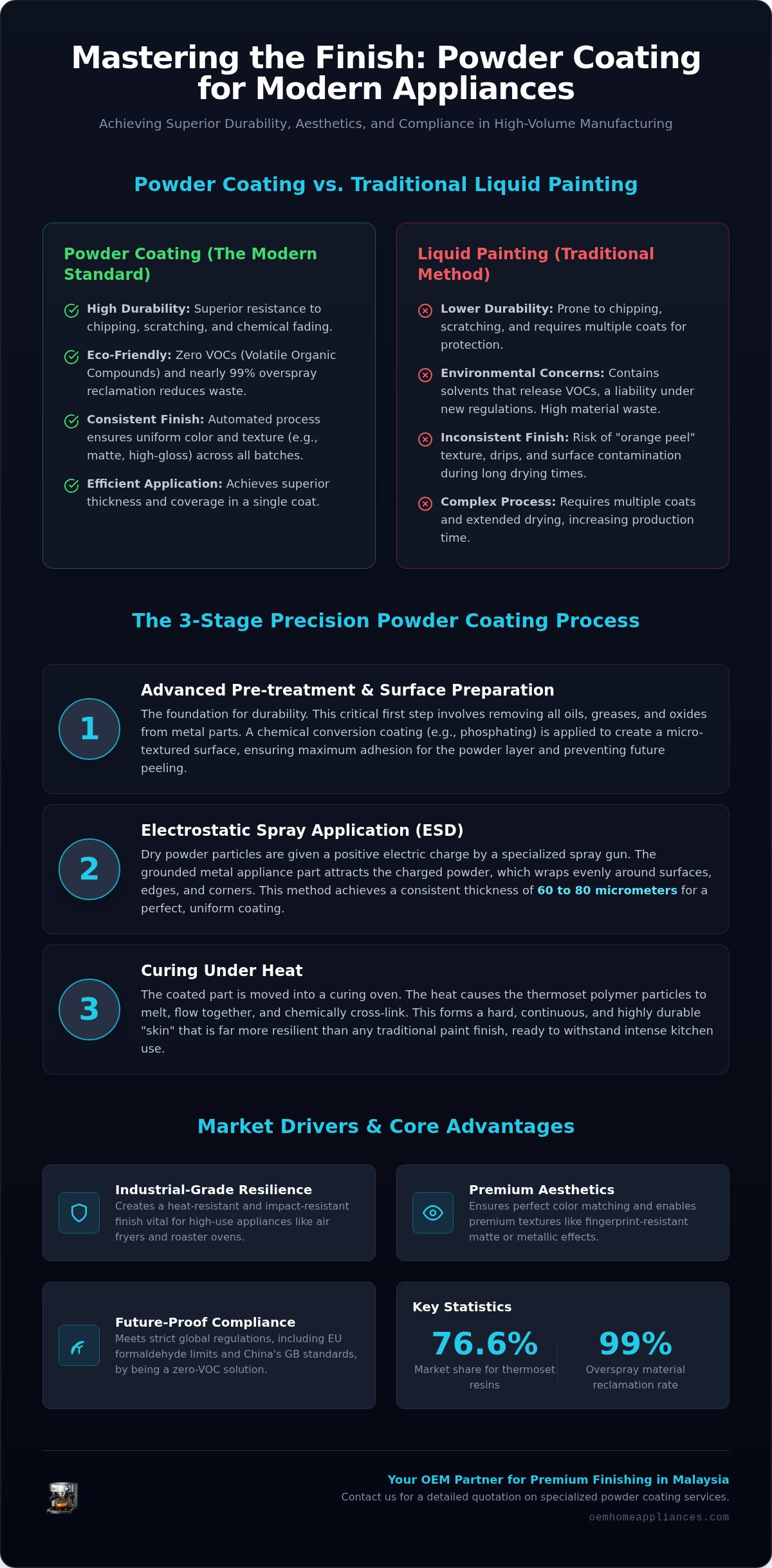
The 2026 appliance market demands more than just basic functionality. It requires industrial-grade resilience paired with a high-end consumer finish. Powder coating has replaced traditional liquid painting as the gold standard for achieving this balance. This dry finishing process uses thermoplastic or thermoset polymers; thermoset resins are expected to account for 76.6% of the market share this year. Unlike liquid paint, the powder coating process for appliance components involves applying electrostatically charged particles to a metal surface before curing them under heat to form a hard, continuous skin.
The shift is driven by a global push for sustainability and strict regulatory compliance. New 2026 regulations, such as China’s GB 30981.2-2025 and the EU's formaldehyde emission limits, make traditional solvent-based systems a liability for global brands. Powder coating offers a zero-VOC solution. It eliminates hazardous air pollutants and allows for nearly 99% overspray reclamation. This efficiency reduces environmental impact while lowering material waste during high-volume production. When your brand adopts these processes, you're not just choosing a finish; you're future-proofing your supply chain against tightening environmental standards.
Powder Coating vs. Traditional Liquid Painting
Liquid painting often requires multiple coats and extended drying times, increasing the risk of surface contamination. Powder coating achieves superior thickness and coverage in a single application. It creates a finish that's significantly more resistant to chipping, scratching, and chemical fading. While liquid paint is prone to the "orange peel" texture if the solvent evaporates unevenly, modern automated powder lines deliver a mirror-smooth surface. This durability is vital for portable cooking equipment that faces frequent handling and high-impact environments.
The Role of Aesthetics in Modern Kitchenware
Consistent color matching is non-negotiable for premium appliance brands. The powder coating process ensures that a roaster oven produced in January matches a batch from June exactly, protecting your brand identity across global markets. Beyond color, texture plays a strategic role in user experience. Matte finishes have gained traction for their superior fingerprint resistance, keeping air fryers and kettles looking pristine in active kitchens. Specialized finishes like metallic effects or sand textures allow you to differentiate your product line in a crowded retail landscape. These aesthetic choices signal quality to the end-user and support a premium brand positioning.
The 3-Stage Powder Coating Process for Metal Components
Precision is the hallmark of a high-volume OEM facility. Maintaining component quality at scale requires a fully automated line with integrated quality checkpoints between every primary stage. The powder coating process for appliance components follows a logical, multi-stage progression designed to ensure structural integrity and cosmetic excellence. Electrostatic spray deposition (ESD) is the primary application method in 2026, utilizing a charged spray gun to propel atomized powder particles toward a grounded metal substrate for a uniform finish.
Stage 1: Advanced Pre-treatment and Surface Preparation
The foundation of any durable finish is the substrate's absolute cleanliness. Technicians must remove all oils, greases, and metal oxides that accumulate during the stamping or casting of appliance parts. Most finish failures in consumer appliances stem directly from improper pre-treatment. To combat this, we use chemical conversion coatings, such as phosphating, to create a microscopic texture on the metal. This surface modification ensures maximum adhesion for the subsequent powder layer. If you have questions about specific substrate preparation for your product line, you can consult with our technical team for tailored advice.
Stage 2: Electrostatic Spray Application
During this stage, a specialized spray gun imparts a positive electric charge to the dry powder particles. As these particles exit the nozzle, they're attracted to the grounded metal part, such as a BBQ grill lid or air fryer housing. This electrostatic attraction allows the powder to wrap around edges and corners, achieving a consistent thickness of 60 to 80 micrometers. Expert technicians must manage the "Faraday Cage" effect, where the electric field prevents powder from reaching recessed areas or tight interior corners. According to The Powder Coating Institute, proper equipment calibration and gun positioning are essential to overcome these physical barriers and maintain a flawless surface.
Stage 3: Thermal Curing and Polymerization
The final stage involves moving the coated parts into a curing oven where they're exposed to high temperatures. This heat triggers a chemical reaction known as polymerization, turning the dry powder into a solid, cross-linked polymer film. Precise temperature control is vital for success. Roaster oven components, for instance, require specific cure cycles to ensure the finish doesn't degrade or discolor under high operating temperatures. Once the curing is complete, controlled cooling protocols prevent surface defects and ensure the long-term structural integrity of the coating.
Engineering Durability: Heat Resistance and Surface Standards
Kitchen environments present a unique set of stressors for appliance finishes. Metal components in roaster ovens and BBQ grills must endure rapid thermal expansion and contraction without compromising their protective layer. The powder coating process for appliance components is engineered to meet these demands by selecting specific resin chemistries based on the part's function. Epoxy resins offer excellent chemical resistance but can chalk under high-heat exposure. Pure polyesters provide superior weatherability and color stability. For most interior kitchen applications, hybrid powders combine these strengths to offer a balanced, cost-effective solution.
There's also a strategic synergy between powder finishes and enamel-coated metal components. While enamel provides unmatched heat tolerance for internal cooking chambers, powder coating serves as the ideal exterior finish for handles, control panels, and side walls. This dual-coating strategy ensures the entire unit meets global safety standards for food-contact proximity and heat dissipation. Achieving this level of precision requires a facility that has expertly organized its powder coating process to handle diverse material requirements simultaneously.
Thermal Stability for Roaster Ovens and Grills
Standard powders typically begin to degrade at temperatures exceeding 200°C. For high-heat equipment like grills and roasters, we utilize specialized silicone-based powders that maintain their integrity up to 550°C. These formulations prevent the unsightly "chalking" or discoloration that occurs when standard resins oxidize. To verify this performance, components undergo rigorous thermal shock resistance testing and salt spray testing. These protocols ensure the finish doesn't delaminate or crack after hundreds of cooking cycles, maintaining the appliance's premium appearance for years.
Chemical Resistance in the Modern Kitchen
Durability isn't limited to heat. Kitchen surfaces face constant exposure to steam, high humidity, and acidic food residues like citric or acetic acid. Modern appliances must also withstand aggressive household degreasers and cleaning agents without losing their gloss. The cross-linked polymer film created during the powder coating process for appliance components acts as a dense barrier. It's a protective shield for the underlying metal that prevents corrosion. Maintaining high gloss levels over thousands of cleaning cycles is a key performance indicator for top-tier appliance brands, as it directly impacts long-term consumer satisfaction.
Strategic Sourcing: Evaluating Coating Quality in OEM Partnerships
Selecting an OEM partner is a decision that defines your product's market longevity. A "Trusted Expert Facilitator" does more than apply a finish; they integrate the powder coating process for appliance components into the entire product lifecycle. This integration is vital for a successful custom roaster oven manufacturing strategy. When the finishing is handled in-house by the manufacturer, you eliminate the risks associated with third-party logistics, such as surface contamination or transit damage. You also gain access to advanced R&D capabilities for bespoke color and texture development, allowing your brand to respond quickly to 2026 design trends.
High-quality coating directly impacts your bottom line by reducing long-term warranty claims and consumer return rates. While a lower cost-per-unit from a secondary vendor might seem attractive, it often masks the hidden costs of finish failure. A dedicated partner prioritizes stability and precision, ensuring that the first unit off the line matches the ten-thousandth perfectly. To ensure your production meets these high standards, you should request a technical audit of our finishing capabilities.
Quality Control Metrics for Procurement Officers
Reliable procurement depends on measurable data rather than subjective visual checks. Your partner must adhere to strict ASTM standards, such as the D3359 cross-hatch test for adhesion, to guarantee the coating won't peel under stress. We utilize digital gloss meters to maintain visual uniformity across different components, ensuring that a plastic handle and a metal chassis share a seamless aesthetic. Furthermore, impact resistance testing is essential. It confirms that your appliances will survive the rigors of global shipping and daily kitchen use without unsightly chipping.
Scalability and Production Efficiency
Efficiency in 2026 is driven by automation. Automated powder lines significantly reduce lead times for large scale appliance production, providing the throughput necessary for global distribution. In-house coating capabilities remove a layer of supply chain complexity, allowing for tighter synchronization between metal fabrication and final assembly. This setup is equally beneficial for small-batch prototyping. It allows for rapid iteration of new designs before committing to high-volume runs. By consolidating these services in Malaysia, you benefit from a strategic manufacturing hub that balances precision with industrial scale.
Premium Powder Coating Solutions for Global Brands in Malaysia
Malaysia has emerged as a premier destination for global appliance brands seeking a balance of technical precision and logistical efficiency. As a sophisticated hub for quality appliance manufacturing, the region provides the industrial strength required for high-volume exports. The powder coating process for appliance components in our Malaysian facility is designed to meet the rigorous demands of international markets while maintaining competitive operational costs. We act as a silent but powerful partner. By integrating manufacturing and finishing in one location, we eliminate the delays and quality risks associated with fragmented supply chains.
Success in the global market requires more than just production capacity. It demands a partner that understands private label kitchen appliance manufacturer dynamics. oemhomeappliances (Keiteq) leverages deep technical expertise to ensure your brand’s standards are met at every stage. We focus on the practicalities of production and distribution, ensuring your air fryers and BBQ grills arrive in North American or European markets with a flawless, durable finish. Our methodical approach ensures that every component reflects your brand's commitment to quality.
Leveraging Malaysian Manufacturing Infrastructure
Our infrastructure provides direct access to advanced coating technologies and a highly skilled technical labor force. This environment allows us to offer pricing structures that compete globally without compromising on the strict quality standards your brand requires. Malaysia’s strategic location also streamlines export logistics. It ensures that high-capacity orders reach their destination with minimal friction. We provide a comprehensive, all-in-one solution that covers everything from metal fabrication to the final powder coating process for appliance components. This synergy reduces lead times and simplifies your procurement process.
Customization and R&D Support
Innovation is the key to market differentiation. We offer dedicated R&D support to develop bespoke finishes for new kitchen appliance prototyping projects. Our team provides technical consultation on material selection to ensure optimal coating performance under extreme kitchen conditions. We translate your brand’s unique aesthetic into a physical product that stands out on retail shelves. Whether you need a specific matte texture for a coffee machine or a high-gloss finish for a roaster oven, we have the flexibility to adapt to your specific requirements.
Contact us today for a detailed quotation on our finishing and manufacturing services. We invite you to reach out to our team in Malaysia to discuss how we can support your brand’s growth through precision manufacturing and expert finishing solutions.
Future-Proofing Your Appliance Line with Precision Finishing
Mastering the powder coating process for appliance components is a strategic necessity for global brands in 2026. By prioritizing advanced pre-treatment and precise thermal curing, you ensure your products withstand the intense heat and chemical stressors of modern kitchen environments. We've detailed how specialized resins provide the thermal stability required for high-performance roaster ovens and BBQ grills. Integrating these technical stages within a single OEM facility in Malaysia reduces supply chain complexity and protects your brand's aesthetic consistency across every production batch.
Our team acts as a trusted expert facilitator, combining advanced R&D for custom metal component development with dedicated manufacturing support. Whether you're refining a prototype or launching high-volume private label lines, our infrastructure is built to deliver industrial-grade durability and premium consumer appeal. We're committed to helping you navigate global regulatory standards while maintaining a competitive edge.
Ready to elevate your brand's durability? Contact our Malaysia-based team for a custom powder coating quotation today. We look forward to building a reliable partnership that drives your brand's long-term growth.
Frequently Asked Questions
What is the difference between powder coating and enamel coating for appliances?
Powder coating uses dry thermoplastic or thermoset polymers to create a durable skin. In contrast, enamel coating is a glass-based finish fused to metal at significantly higher temperatures. While enamel is ideal for the internal cooking chambers of roaster ovens due to its extreme heat resistance, powder coating is the preferred choice for external housings and control panels. We offer both specialized finishes to ensure your appliance line achieves the perfect balance of performance and aesthetics.
Is powder coating food-safe for kitchen appliance components?
Yes, powder coating is food-safe when formulated with compliant resins and pigments. For kitchen appliance components like air fryer baskets or blender bases, we use specific powders that meet international safety standards for food-contact proximity. These coatings are non-toxic and don't leach harmful chemicals under normal operating conditions. Our technical team ensures that all materials used in your private label manufacturing project adhere to the latest 2026 global safety regulations.
How much heat can standard appliance powder coating withstand?
Standard powder coatings typically withstand temperatures up to 200°C without degrading. However, for high-heat equipment like BBQ grills and portable cooking units, we utilize specialized silicone-based powders that remain stable at temperatures reaching 550°C. These advanced formulations prevent the finish from chalking or discoloring during repeated thermal cycles. Selecting the correct resin type during the design phase is essential to ensure your brand delivers long-term durability in high-temperature environments.
Why is pre-treatment so important in the powder coating process?
Pre-treatment is the single most critical stage in the powder coating process for appliance components because it determines finish adhesion. Without removing oils, greases, and metal oxides, the coating can't form a permanent bond with the substrate. We utilize chemical conversion coatings like phosphating to create a microscopic texture on the metal surface. This meticulous preparation prevents premature peeling and ensures the appliance remains resistant to corrosion throughout its entire operational lifespan.
Can I customize the color and texture of my private label appliances?
Absolutely. Our private label manufacturing services include comprehensive R&D support for custom color and texture development. You can choose from a wide range of finishes, including high-gloss, matte, metallic, and sand textures, to differentiate your brand in the retail market. We use digital gloss meters and color-matching technology to ensure consistency across every production run. This flexibility allows you to align your appliance's visual identity with the latest 2026 interior design trends.
How does powder coating improve the lifespan of a roaster oven?
Powder coating acts as a dense, cross-linked polymer shield that protects the underlying metal from environmental stressors. For a roaster oven, this means superior resistance to steam, humidity, and acidic food residues that would otherwise cause rust. The finish is significantly harder than liquid paint, making it resistant to chipping and scratching during daily use. By maintaining the structural integrity of the metal housing, powder coating significantly extends the product's functional life.
What quality tests should I require from my OEM partner in Malaysia?
You should require testing protocols that align with international standards like ASTM. Key metrics include the D3359 cross-hatch test for adhesion and salt spray testing for corrosion. We perform impact resistance tests to ensure parts survive global shipping. Gloss meter readings are also used to guarantee visual uniformity. Partnering with a Malaysian manufacturer that provides these detailed quality reports ensures your brand maintains a reputation for reliability and elite industrial craftsmanship.
Is powder coating more environmentally friendly than traditional painting?
Yes, powder coating is a sustainable alternative to traditional liquid painting. It contains zero volatile organic compounds (VOCs) and produces minimal waste. Overspray can be reclaimed and reused at a rate of nearly 99%. This efficiency aligns with the 2026 global shift toward environmentally compliant manufacturing. By choosing the powder coating process for appliance components, you reduce your brand's footprint while adhering to strict new regulations in major North American and European markets.
For a detailed quotation on our powder coating and manufacturing services in Malaysia, please contact our technical team today.


Comments