2026 Guide: Enamel Coating for Kitchen Appliances
A coating that fails under thermal stress isn't just a manufacturing defect; it's a direct threat to your brand's premium reputation. You already know that as 2026 approaches, the pressure to meet stricter lead and cadmium limits is reaching a critical tipping point. Mastering the enamel coating process for kitchen appliances is now a mandatory requirement for brands aiming to lead the market. It's the technical difference between a product that degrades under heat and one that maintains its integrity through years of intensive use.
This guide explores the precise industrial steps of porcelain enamel fusion. You'll discover how this molecular glass-to-metal bond ensures safety and validates your commitment to PFOA-free and PTFE-free standards. We will break down the high-temperature firing stages that transform raw metal into a durable, premium surface. By the end, you'll have a clear roadmap for selecting a manufacturing partner in Malaysia that can help you outpace low-cost competitors with superior quality and compliance.
Table of Contents
What is the Industrial Enamel Coating Process for Kitchen Appliances?
Porcelain enamel is an inorganic, vitreous coating fused to a metal substrate at extreme temperatures. Unlike standard paints or organic finishes, the enamel coating process for kitchen appliances creates a permanent molecular bond between glass and metal. This fusion ensures the surface won't peel, flake, or blister under the intense thermal stress typical of high-performance cooking equipment. It transforms raw steel or cast iron into a composite material that combines the strength of metal with the chemical resistance of glass.
This "glass-to-metal" bond occurs when atoms from both materials intermingle at the interface during firing. For brands producing roaster ovens and BBQ grills, this process represents the gold standard for durability. While the history of Vitreous enamel stretches back to ancient jewelry, its modern industrial application is essential for meeting the 2026 safety and performance standards required by global markets. Utilizing this technology allows manufacturers to offer products that survive thousands of heating cycles without losing their aesthetic or functional integrity.
The Science of High-Temperature Fusion
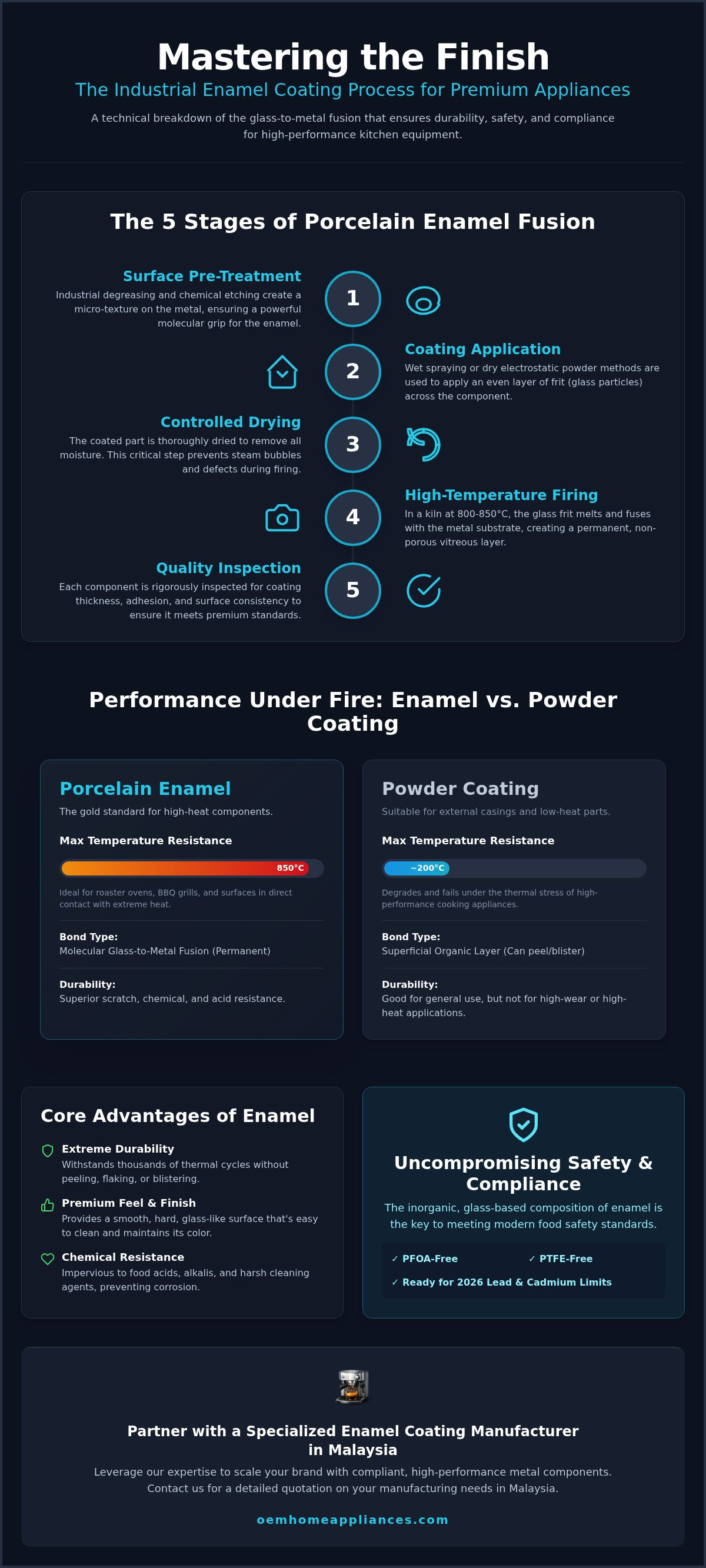
Achieving a high-performance finish requires a firing range between 800°C and 850°C. At these temperatures, the glass particles, known as frit, melt and flow over the steel or cast iron surface. Frit is the foundational material for all enamel coatings, consisting of a specific blend of minerals and glass-forming components. As the kiln reaches its peak temperature, a chemical reaction occurs at the metal's surface. This reaction creates a transition layer that makes the coating an integral part of the appliance body rather than a superficial layer. This thermal stability is why enamel remains the preferred choice for components in portable cooking equipment and roaster ovens.
Enamel vs. Traditional Ceramic Coatings
It's vital to distinguish porcelain enamel from the sol-gel ceramic "non-stick" sprays often found in low-cost cookware. Sol-gel coatings are organic-inorganic hybrids that eventually degrade and lose their properties over time. Enamel is entirely inorganic and offers superior resistance to scratching, chemical abrasion, and acid attacks. Because it's essentially glass, it is naturally PFOA-free and PTFE-free. This makes it the ideal choice for appliance interiors where food safety is a non-negotiable requirement. Brands can leverage this material science to differentiate their premium tiers from competitors using cheaper, less durable alternatives. You can explore our specialized manufacturing services to see how these coatings are applied at scale.
The 5 Key Stages of the Porcelain Enamel Process
Every high-performance kitchen appliance follows a methodical, industrial workflow to ensure long-term reliability. The Porcelain enamelling process isn't just about aesthetics; it's a structural enhancement. This 5-stage workflow ensures the finish survives thousands of thermal cycles without degradation. Consistency is critical for OEM brands looking to scale product lines without batch-wide defects. Quality control isn't a final step; it's integrated into every phase of the enamel coating process for kitchen appliances.
1. Surface Pre-Treatment: The Foundation of Adhesion
The bond begins with intensive chemical preparation. We first use industrial degreasing agents to remove lubricants and oils left over from the metal fabrication stage. Then comes pickling and neutralization. This chemical etching creates the specific micro-texture required for a molecular grip on the steel substrate. If you ignore these chemical nuances, the enamel simply won't adhere. Improper pre-treatment is the primary driver behind "fish-scaling" and immediate chipping. High-end brands cannot afford these failures in the field.
2. Coating Application: Wet vs. Dry Methods
Choosing the right application method depends on the component's geometry and intended use. Wet application, involving dipping or spraying, is ideal for complex shapes like roaster oven liners. It ensures every corner and crevice receives full coverage. For flat or simple geometric metal components, we often use dry electrostatic powder enameling. This method provides high efficiency and uniform thickness across large surfaces. Maintaining a precise, even layer prevents stress points that could crack during the intense firing stage.
3. Drying, Firing, and Quality Inspection
Once applied, the coating must dry thoroughly under controlled conditions. This step removes moisture that would otherwise turn into steam and cause bubbles during fusion. The firing stage takes place in a specialized furnace where the glass-to-metal bond is finalized. After the components cool, they undergo a post-firing inspection. We test for impact resistance, acid resistance, and color stability to ensure every piece meets global brand standards. If you're looking for a reliable partner to manage this enamel coating process for kitchen appliances, you can request a technical consultation with our team in Malaysia.
Enamel vs. Powder Coating: Choosing the Right Finish
Choosing the right finish depends entirely on the operating environment of your appliance component. While powder coating is cost-effective for exterior panels that remain cool, the enamel coating process for kitchen appliances is the only viable choice for high-heat zones. Most industrial powder coatings begin to degrade or discolor when exposed to temperatures exceeding 200°C. In contrast, porcelain enamel remains stable at temperatures far beyond standard cooking ranges. This heat threshold is a critical decision point for procurement officers balancing production costs with long-term product safety.
Chemical safety also distinguishes these two finishes. Enamel provides a non-porous glass surface that is chemically inert. Unlike certain plastics or organic paints that might leach chemicals when heated, enamel maintains a sterile environment. This is essential for brands prioritizing food-contact safety and health-conscious consumers. Using enamel ensures your product remains compliant with the most stringent global safety standards. For a deeper look at our manufacturing capabilities, you can review our full range of services.
Thermal Stress and Performance in Roaster Ovens
Internal liners in roaster ovens must endure sustained high heat and rapid temperature fluctuations. Enameled liners handle this stress without peeling or cracking. Using low-quality powder coatings in these zones creates a significant risk of "off-gassing," where organic compounds are released into the cooking chamber. This can ruin food quality and compromise consumer health. For a detailed breakdown of how we engineer these components, refer to our Industrial Enamel Coating Process for Roaster Ovens. This engineering focus prevents costly product recalls and brand damage.
Aesthetic Customization and Color Stability
Enamel offers a "depth" of finish that industrial paint cannot replicate. The colors are fused into the glass layer, meaning they won't fade even after years of UV exposure or high-temperature cleaning cycles. This permanence is a key branding advantage. You can customize roaster oven exteriors with vibrant, gloss-stable colors that reflect your brand's identity perfectly. The Porcelain Enamel Institute provides extensive documentation on how these materials maintain their visual integrity over decades. This durability justifies the higher initial investment for brands targeting the premium market tier where quality is the primary differentiator.
Meeting 2026 Safety Standards and Compliance
Regulatory compliance is shifting rapidly. By 2026, global standards for food-contact materials (FCM) will enforce significantly lower migration limits for heavy metals. Specifically, the thresholds for lead and cadmium are being drastically reduced. For appliance brands, this means current manufacturing processes must be audited for safety. The enamel coating process for kitchen appliances provides a robust solution to these tightening requirements. Because enamel is essentially a glass-based surface, it doesn't rely on the synthetic polymers or chemical stabilizers found in many non-stick coatings. Using this inorganic finish ensures that your brand stays ahead of legal mandates while prioritizing consumer health.
Lead and Cadmium-Free Enamel Formulations
Modern frit manufacturers have successfully eliminated toxic heavy metals from their formulations. 2026 compliance requires strict batch-testing for metal migration to ensure no hazardous elements leach into food during high-heat operation. This rigorous testing isn't just a hurdle; it's a powerful marketing tool. Brands can now position their products as "Certified Non-Toxic," which provides a massive competitive advantage in the premium market. We recommend auditing your current supply chain to identify any legacy materials that might contain trace amounts of these restricted substances. Transitioning to a lead-free frit is a strategic move that protects your brand from future liability.
Sustainability and the Circular Economy
Enamel supports the circular economy through its 100% recyclability as a glass-based material. Unlike composite plastics or organic resins, enameled metal components are easily reclaimed and repurposed. The longevity of the finish also reduces appliance waste by extending the product's functional life. Durable finishes are the cornerstone of sustainable design. By preventing rust and corrosion in high-moisture environments, enamel ensures that the core metal structure remains intact for decades. Adopting these eco-friendly finishes helps brands align with modern ESG goals and appeal to environmentally conscious procurement officers.
Third-party lab testing has become a non-negotiable standard in OEM appliance production. Reliable manufacturers must provide documentation that proves their coatings meet the latest safety benchmarks. We help brands transition their product lines to meet these upcoming requirements by optimizing the enamel coating process for kitchen appliances within our facility. You can contact our team for a compliance audit to ensure your next product launch is ready for the 2026 landscape. We provide full transparency into our material sourcing and testing protocols in Malaysia.
Partnering with a Specialized Enamel Coating Manufacturer
Fragmented supply chains are a primary source of production delays and quality drift. When you outsource metal fabrication to one vendor and finishing to another, you introduce unnecessary risk into your manufacturing timeline. Choosing a partner with in-house enamel capabilities provides a strategic advantage by centralizing accountability. It ensures that the enamel coating process for kitchen appliances is considered during the initial design phase, not as an afterthought. This integrated approach allows for better control over the final product's structural integrity, resulting in a more durable and reliable appliance.
Our facility integrates finishing directly into the product lifecycle. We don't just apply a coating; we engineer a solution that meets your brand's specific thermal and aesthetic requirements. This level of technical oversight is essential for brands moving into premium tiers where "good enough" isn't an option. By evaluating a factory’s R&D support, you can ensure they have the expertise to troubleshoot complex bonding issues before they reach the assembly line. This proactive mindset is what separates industry leaders from those struggling with high return rates.
Streamlining the OEM Supply Chain
Reducing lead times is a constant priority for procurement officers. By combining metal fabrication and coating in a single facility, we eliminate the logistical lag of transporting semi-finished components between vendors. This consolidation also ensures perfect color consistency across different product lines. Whether you're producing roaster ovens or kettles, the finish remains uniform because the chemical formulations and firing temperatures are managed under one roof. Explore our comprehensive OEM/ODM appliance services to see how we manage these complex workflows for global brands.
Bespoke Solutions for Global Brands
Every brand has a unique identity, and your finish should reflect that. We offer bespoke solutions that allow you to customize enamel thickness and surface texture. Whether your market demands a high-gloss premium look or a rugged matte finish for BBQ grills, we can adjust the enamel coating process for kitchen appliances to match your vision. Prototyping plays a critical role here. We use initial runs to perfect the bond, ensuring the coating can withstand the specific stresses of your appliance's intended use. Once the prototype is validated, our Malaysia-based facility is equipped to scale production from specialized small batches to high-volume global distribution.
Building a reliable product line requires a partner that understands the nuances of industrial finishing and global safety compliance. If you're looking to upgrade your appliance brand with superior heat resistance and 2026-compliant materials, we invite you to reach out for further details. Please contact us for a professional quotation on our specialized manufacturing services in Malaysia. Our team is ready to provide the technical data and pricing you need to make an informed decision for your next product launch.
Future-Proofing Your Appliance Brand with Premium Enamel
The shift toward stricter 2026 safety standards isn't just a regulatory hurdle; it's an opportunity to solidify your brand's position in the premium market. By mastering the enamel coating process for kitchen appliances, you ensure your products deliver the thermal stability and chemical safety that modern consumers demand. We've explored how the molecular glass-to-metal bond outperforms traditional coatings, providing a finish that survives thousands of high-heat cycles without degradation. This technical superiority becomes your primary differentiator against low-cost competitors.
As a dedicated OEM/ODM partner, we specialize in the precision manufacturing of roaster ovens and BBQ grills that meet these rigorous global benchmarks. Our integrated facility in Malaysia streamlines your supply chain by combining fabrication with specialized finishing, ensuring full compliance with the upcoming lead and cadmium limits. We're ready to help you transition your product lines to these superior standards while maintaining high-volume efficiency and consistent quality across every batch.
If you're ready to enhance your product's durability and safety, we invite you to take the next step in our partnership. Request a quotation for your enamel-coated appliance project in Malaysia today to receive a detailed technical consultation. Let's build a reliable and compliant future for your brand together.
Frequently Asked Questions
What is the difference between enamel and porcelain coating?
Porcelain enamel and enamel coating refer to the same vitreous glass-to-metal finish. In the appliance industry, "enamel" is the shorthand term for the inorganic glass layer fused to steel at high temperatures. It provides a non-porous, scratch-resistant surface that organic coatings cannot match.
Is enamel coating safe for high-heat cooking appliances like roaster ovens?
Yes, it's the most reliable finish for high-heat environments. The enamel coating process for kitchen appliances involves firing at temperatures exceeding 800°C, which makes the final surface completely stable during standard cooking. It won't melt, off-gas, or degrade even when used daily in roaster ovens or BBQ grills.
How do 2026 safety regulations affect enamel-coated products?
The 2026 standards focus on reducing heavy metal migration, specifically lead and cadmium. Brands must ensure their manufacturers use lead-free frit formulations to meet these stricter global food-contact safety requirements. Enamel is an ideal material for compliance because it's inorganic and doesn't contain synthetic polymers.
Can enamel coating be applied to any metal substrate?
Successful application requires specific substrates like enamelling-grade steel or cast iron. These metals must have a low carbon content to prevent gas bubbles during the high-temperature firing stage. Using the wrong metal substrate will result in poor adhesion and surface defects like "fish-scaling."
Why does enamel coating sometimes chip, and how is this prevented?
Chipping typically occurs due to poor surface pre-treatment or excessive coating thickness. We prevent this by using a rigorous chemical cleaning process to ensure a perfect molecular bond. Proper engineering of the metal component's geometry also reduces stress points that are prone to impact damage.
How does the cost of enamel coating compare to powder coating for OEM production?
Enamel coating involves higher energy and material costs than standard powder coating. However, for appliances like roaster ovens, it's the only finish that prevents long-term failure under thermal stress. This durability reduces warranty claims and protects your brand's reputation in the premium market.
What are the benefits of sourcing enamel-coated appliances from Malaysia?
Sourcing from Malaysia offers a strategic balance of industrial expertise and logistical efficiency. Our facility provides a specialized enamel coating process for kitchen appliances alongside full OEM/ODM support for global brands. This allows you to scale production while maintaining strict adherence to international safety and quality standards.
Is enamel coating PFOA-free and PTFE-free?
Enamel is naturally PFOA-free and PTFE-free because it is made of inorganic minerals and glass. It doesn't rely on the synthetic chemicals found in many traditional non-stick coatings. This makes it the safest choice for health-conscious consumers and brands prioritizing food-contact integrity.
If you require specific technical data for your next product line, our team is available to assist. Please contact us to request a quotation for our specialized enamel-coated appliance manufacturing in Malaysia.


Comments