Choosing a Reliable Bulk Appliance Supplier: A Guide
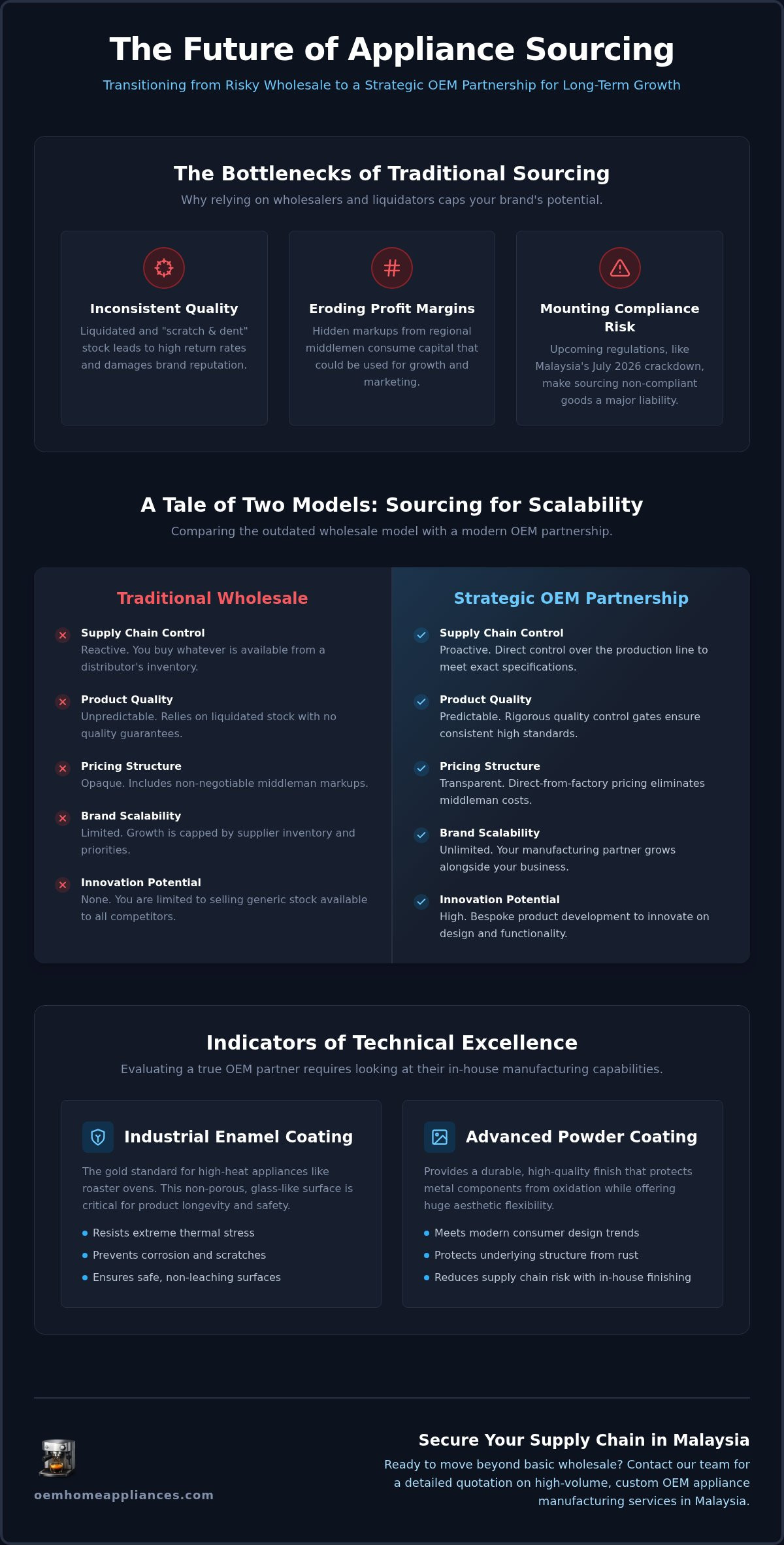
Your current bulk appliance supplier might be the single biggest bottleneck preventing your brand from reaching its next growth milestone. Most procurement officers feel the constant sting of inconsistent quality from liquidators and the frustration of hidden markups from regional middlemen that erode profit margins. You've likely realized that simply buying generic inventory isn't enough to sustain long term expansion in an increasingly regulated market.
We understand that reliability is everything, especially as the Malaysian government's July 2026 crackdown on non-compliant electrical goods raises the stakes for safety and quality. This article will show you how to transition from basic wholesale sourcing to a strategic OEM partnership that secures your supply chain. You'll learn how to unlock direct factory pricing, implement predictable quality control, and leverage bespoke product development to scale your brand effectively. We'll cover the essential steps to moving from a standard buyer to a production partner who grows alongside your business.
Table of Contents
Beyond Wholesalers: Redefining the Role of a Bulk Appliance Supplier
The landscape of high-volume procurement has shifted. In 2026, a bulk appliance supplier is no longer defined by the size of their warehouse but by the depth of their manufacturing integration. Traditional sourcing relied on wholesalers who held finished inventory, often consisting of liquidated stock or "scratch and dent" units. This model is failing modern brands. Today, procurement officers prioritize an Original Equipment Manufacturer (OEM) that provides direct control over the production line. This shift ensures that high-demand items like roaster ovens, rice cookers, and air fryers meet exact specifications rather than whatever happens to be available on a distributor's pallet.
Choosing the right partner requires looking beyond the price tag. You must avoid suppliers that act as direct-to-retail competitors. When your supplier also operates a retail chain, your brand's growth is inherently capped by their internal priorities. A dedicated manufacturing partner focuses solely on your output, providing a secure foundation for scaling while ensuring your proprietary designs remain protected.
The Evolution of Appliance Procurement in 2026
Brand managers are moving away from liquidated stock to secure long-term supply chain stability. Relying on third-party remnants is risky; it offers no predictability for quality or future availability. Modern teams now use a strategic guide to selecting a private label kitchen appliance manufacturer to build sustainable product lines from the ground up. The Direct-to-Factory model serves as the primary driver of 2026 procurement efficiency by eliminating the logistical lag and hidden costs of regional middlemen.
Why OEM/ODM Models Outperform Traditional Wholesale
The financial benefits of removing distributor markups are immediate. In high-volume orders, even a small percentage saved on unit costs translates into significant capital for marketing and expansion. Unlike the "buy what's available" model of wholesale, custom production allows for unique market positioning. You can't differentiate your brand with generic stock that every other vendor is selling. By utilizing specialized OEM/ODM manufacturing services, you gain the ability to innovate on design and functionality. This level of control ensures your brand remains competitive and compliant with the latest safety standards, such as the July 2026 Malaysian government crackdown on non-compliant electrical goods. Working with a dedicated bulk appliance supplier allows you to own the production process rather than just renting space in someone else's supply chain.
Technical Excellence: Evaluating Manufacturing Capabilities in Bulk Sourcing
Evaluating a bulk appliance supplier requires a deep dive into their technical infrastructure. Surface-level aesthetics often hide structural weaknesses that lead to high return rates and brand erosion. In the 2026 market, technical finishes like enamel and powder coating serve as the primary indicators of a manufacturer's capability. These aren't just decorative choices. They're essential for ensuring that appliances like roaster ovens or BBQ grills can withstand extreme thermal stress without degradation. Precision in these finishes directly impacts the long-term reliability of the metal components, preventing the rust and wear that plague cheaper, mass-produced alternatives.
The Impact of Industrial Enamel and Powder Coating
Enamel coating remains the gold standard for high-heat equipment. It creates a non-porous, glass-like surface that resists corrosion, scratches, and chemical damage. For brands specializing in roaster ovens, understanding the enamel coating process for roaster ovens is vital for verifying product longevity. This process ensures the appliance can handle repeated heating cycles without the finish peeling or leaching. Powder-coated metal components offer a different set of advantages. They provide the aesthetic flexibility needed to meet 2026 consumer trends while protecting the underlying structure from oxidation. A bulk appliance supplier with dedicated in-house coating facilities reduces your supply chain risk by keeping these critical finishing steps under one roof, ensuring consistent quality across every batch.
Integrating R&D into the Sourcing Workflow
Technical development is what separates a generic unit from a genuine brand asset. Your supplier should offer factory-level R&D to optimize energy efficiency in rice cookers or motor performance in high-speed blenders. This integration allows you to move seamlessly from a prototype phase to full mass production without losing precision. Adhering to foreign product standards ensures that your custom developments are ready for global distribution and meet the safety requirements of different regions. Technical finishing is not just cosmetic but a structural requirement for appliance longevity. It protects the investment you've made in product design and development by securing the physical integrity of the unit. If you're looking to refine your technical specifications or improve energy performance, you can speak with our technical team to explore how specialized finishes and R&D can elevate your product line. This level of technical depth ensures your brand isn't just selling a product, but a reliable tool that consumers can trust for years.
OEM Manufacturer vs. Wholesale Distributor: The Scalability Comparison
Choosing between an OEM manufacturer and a wholesale distributor is a choice between long-term growth and short-term convenience. Wholesale distributors operate on a "buy what is available" model, forcing your brand to adapt to their existing inventory. This often leads to fragmented product lines and inconsistent availability. A strategic bulk appliance supplier functioning as an OEM allows you to "produce what is needed." This proactive approach is the only way to scale a brand with precision. Relying on scratch-and-dent or liquidated inventory is a gamble with your brand reputation. You can't build a premium identity on the remnants of another company's overstock or damaged goods.
Consistency is the engine of brand trust. The standardized output of a high capacity rice cooker factory ensures that every unit delivered to your customer meets the exact same quality benchmark. This reliability is impossible to find in the fragmented wholesale market. Your manufacturer should also act as a "Silent Partner." A partner that stays out of the retail spotlight avoids competing with you for the same customers, positioning themselves as a backbone for your success rather than a rival in the marketplace. By focusing on your proprietary needs, the manufacturer ensures that their innovation serves your brand's specific goals.
Predictability and Supply Chain Security
Factory-direct partnerships eliminate the "out of stock" risks that plague wholesale marketplaces. When you depend on a middleman, your business is vulnerable to their logistical failures and inventory gaps. Contract manufacturing secures dedicated production lines for high-volume air fryer and blender orders. This stability allows you to create a multi-year roadmap for brand expansion. You aren't just purchasing stock; you're securing a production capacity that guarantees your supply chain remains resilient during market fluctuations. It's the difference between reacting to what a distributor has on hand and dictating exactly what your market requires.
Brand Equity and Private Label Control
Owning the design through OEM/ODM models leads to higher resale value and stronger customer loyalty. Generic distributor stock is easily replicated, which drives prices down and erodes margins. Custom-engineered appliances allow you to own the intellectual property and technical specifications of your products. For brands looking to expand their catalog, consulting kitchen appliance manufacturing solutions offers a strategic roundup of how to maintain a diverse product range. This level of control ensures your brand offers something unique that generic white-label competitors cannot match. This ownership extends beyond the logo; it includes the internal components and performance standards that define your brand's promise to the consumer.
Logistics and Quality Assurance for High-Volume Orders
High-volume orders demand a methodical approach to quality assurance that goes beyond simple final inspections. A reliable bulk appliance supplier must implement a multi-stage Quality Control (QC) framework to prevent defects from scaling. When producing thousands of coffee machines or roaster ovens, even a minor calibration error can lead to a massive recall. Consistency is maintained through automated testing rigs and strict adherence to international safety standards. This systematic approach ensures that the first unit off the line is identical to the ten-thousandth. Supply chain stability relies on more than just manufacturing speed; it requires a logistics partner that understands the nuances of international trade, including the impact of the 10% additional tariff on Malaysian goods effective July 2026.
Implementing Factory-Level Quality Gates
We utilize standardized testing protocols for electric kettle wattage and blender motor durability to verify performance before packaging. For products with technical finishes, enamel thickness and powder coat adhesion tests are non-negotiable quality gates. These steps ensure the product remains durable in high-heat environments and resists corrosion over time. Third-party audits are essential for custom roaster oven manufacturing, providing the transparency needed for global brand expansion. These audits verify that every component, from the heating element to the outer casing, meets the rigorous safety requirements enforced in major markets.
Global Distribution and Landed Cost Optimization
Factory-integrated logistics significantly reduce the landed cost of bulk appliances by removing unnecessary middleman handling. Shipping directly from the production floor to your regional warehouse minimizes the risk of transit damage and eliminates extra storage fees. It also allows for tighter control over lead times, which is critical for meeting seasonal peaks in the kitchen appliance market. 2026 logistics focus on "Zero-Touch" movement from factory to port to ensure maximum speed and cost-efficiency. This model is especially beneficial given the Malaysian government's recent crackdown on non-compliant electrical goods, as it ensures a documented chain of custody from a certified facility. Efficient logistics planning allows you to bypass the volatility of third-party distributors and maintain a predictable inventory flow throughout the year.
If you need to verify our QC protocols or discuss shipping schedules for your next high-volume order, you can request a technical audit summary from our logistics team. This level of transparency ensures your supply chain remains secure and your brand reputation stays intact.
Strategic Advantage: Sourcing from an Appliance Hub in Malaysia
Malaysia is no longer just an alternative; it's a primary destination for brands seeking a sophisticated bulk appliance supplier. The region's home appliance exports are projected to reach $1.73 billion in 2026, reflecting a robust industrial ecosystem that supports high-volume production. While global markets face volatility, Malaysia's household appliances sector maintains a steady growth rate with a projected CAGR of 5.2% between 2026 and 2032. This stability is backed by a government that actively enforces safety standards, such as the July 2026 compliance operations designed to eliminate non-compliant electrical products from the supply chain. Choosing a partner in this region means aligning your brand with a culture of technical precision and regulatory rigour.
Why Malaysia is the Strategic Choice for 2026
The technical proficiency found in Malaysia, particularly in enamel coating and complex metal fabrication, is a significant draw for premium brands. This region offers a rare balance of competitive labor costs and high-tier engineering standards. Unlike other manufacturing hubs that prioritize speed over durability, Malaysian facilities are equipped to handle the intricate finishing requirements of high-heat equipment. The infrastructure supports global shipping routes that facilitate efficient bulk delivery to major ports worldwide. While the 10% additional tariff on Malaysian goods effective July 24, 2026, presents a new cost factor, the region's manufacturing efficiency and high-quality output often offset these expenses compared to lower-tier sourcing options. By centralizing production in a hub with mature logistics, you reduce the "landed cost" through optimized handling and fewer transit delays.
Partnering with oemhomeappliances (Keiteq)
Our commitment is to serve as a "Trusted Expert Facilitator" for your brand. We don't just manufacture products; we provide the industrial backbone necessary for your company to transition from a simple inventory buyer to a dominant brand owner. Accessing our full suite of OEM/ODM services allows you to launch products with confidence, knowing they've been engineered for performance and longevity. We handle the complexities of production, from initial design to final quality gates, so you can focus on market expansion and customer engagement. This partnership model ensures that your proprietary specifications are met with meticulous execution, securing your position in a competitive marketplace.
If you are looking to secure your supply chain and scale your product line with a partner you can trust, we invite you to reach out for further details. Contact us today to request a quotation for our manufacturing and private label services in Malaysia. Let us help you build a resilient and profitable brand through professional manufacturing excellence.
Securing Your Brand's Industrial Future
Transitioning from a standard buyer to a brand owner requires a decisive shift toward manufacturing control. By prioritizing technical excellence through specialized enamel and powder coating, you secure the product longevity that modern consumers demand. Moving away from the unpredictability of regional wholesalers allows your business to own the production process, ensuring that every unit reflects your proprietary specifications. This strategic alignment is the most effective way to eliminate hidden markups and navigate the evolving regulatory landscape of 2026.
Selecting a reliable bulk appliance supplier in a mature hub like Malaysia provides the stability needed for multi-year expansion. Our dedicated B2B OEM/ODM partnership model acts as your brand's silent engine, offering expert manufacturing support that scales with your ambition. We provide the technical infrastructure and logistical precision required to turn your product vision into a market reality without the risks of third-party distribution.
Ready to take the next step in your production journey? Request a Quotation for Your Bulk Appliance Project in Malaysia to see how our specialized facilities can empower your brand. It's time to build a resilient supply chain that supports your long-term success.
Frequently Asked Questions
What is the difference between a bulk appliance distributor and an OEM supplier?
A bulk appliance distributor typically holds finished inventory from various brands, while an OEM supplier manufactures products specifically for your brand. This means an OEM partner allows you to control the production schedule and technical specifications. Working with a manufacturer directly provides the flexibility to adjust designs, whereas a distributor limits you to what's currently in their warehouse. This distinction is critical for businesses looking to scale a unique product line.
How does private labeling work for high-volume roaster oven orders?
Private labeling for roaster ovens begins with selecting a base model and then integrating your brand's unique identifiers, such as logos, color schemes, and custom packaging. A professional bulk appliance supplier coordinates this process during the production run rather than after the units are finished. This ensures the branding is durable and the packaging is optimized for your specific distribution channels. It transforms a generic appliance into a distinct brand asset.
Why should I choose a manufacturer in Malaysia over other regional hubs?
Malaysia offers a strategic balance of high-tier engineering standards and advanced manufacturing infrastructure that many other regional hubs lack. The Malaysian government's 2026 crackdown on non-compliant electrical goods has further strengthened the region's reputation for safety and quality. Choosing a partner here ensures your products are manufactured in a regulated environment with superior technical expertise in finishes like industrial enamel and powder coating.
Can I customize the technical specs, like electric kettle wattage, in bulk orders?
You can absolutely customize technical specifications such as electric kettle wattage or blender motor power when working with an OEM manufacturer. Unlike a standard wholesaler, an OEM partner integrates these adjustments into the initial design and development phase. This allows you to tailor your products to meet the specific voltage requirements or performance expectations of your target market. It ensures your appliances stand out for their performance, not just their appearance.
What quality certifications should I look for in a bulk appliance manufacturer?
You should prioritize manufacturers that hold ISO 9001 certifications and relevant safety standards like CE, CB, or SIRIM for the Malaysian market. These certifications verify that the factory follows rigorous quality management systems and meets international safety benchmarks. Verification of these documents is a non-negotiable step when evaluating a bulk appliance supplier. It protects your brand from the legal and reputational risks associated with non-compliant electrical goods.
How do enamel and powder coatings affect the durability of bulk appliances?
Industrial enamel and powder coatings are fundamental to the structural integrity and longevity of high-heat appliances. Enamel provides a heat-resistant, non-porous surface that prevents rust and chemical degradation in roaster ovens and grills. Powder coating offers a durable, scratch-resistant finish for external metal components while allowing for aesthetic customization. These technical finishes ensure your products can withstand heavy use without losing their visual appeal or functional safety.
What is the typical lead time for a custom OEM appliance production run?
Typical lead times for a custom OEM production run range from 30 to 60 days once the final design and prototypes are approved. This timeline varies based on the complexity of the customization and the total order volume. Establishing a clear production roadmap with your manufacturer helps manage seasonal demand and ensures a consistent flow of inventory. Planning for these lead times is essential for maintaining supply chain stability throughout the year.
How do factory-direct partnerships reduce the total landed cost of appliances?
Factory-direct partnerships reduce the total landed cost by eliminating the multiple markups typically added by regional distributors and middlemen. Shipping directly from the production floor to your warehouse also minimizes handling damage and extra storage fees. This model allows for more efficient logistics planning and volume-based shipping discounts. It provides a more predictable cost structure, which is vital for maintaining healthy profit margins in a competitive retail environment.


Comments