Choosing the Best OEM Appliance Manufacturer for Startups
Updated: Jul 20
A brilliant prototype is only as valuable as your ability to mass-produce it without compromising quality or draining your bank account. Most appliance startups fail not because their ideas lack merit, but because their manufacturing partner lacks the flexibility to scale with them. You've likely faced the frustration of high MOQs that swallow your seed capital or the anxiety of inconsistent quality from unvetted factories. Securing the right source for OEM appliances for startups is the single most critical decision you'll make in your first year of operation.
We understand that you need a partner who treats your intellectual property with absolute care and provides the technical expertise to refine your designs for efficiency. This article outlines the roadmap to transition from a single prototype to global market success by choosing an OEM partner that specializes in startup growth. You'll learn how to leverage Design for Manufacturing (DFM) to lower costs and secure high-quality roaster ovens or air fryers with custom branding that elevates your brand identity. We'll show you how to find a scalable production engine that turns your vision into a shelf-ready reality.
Table of Contents
The Hardware is Hard Reality: Why Startups Need OEM Partners
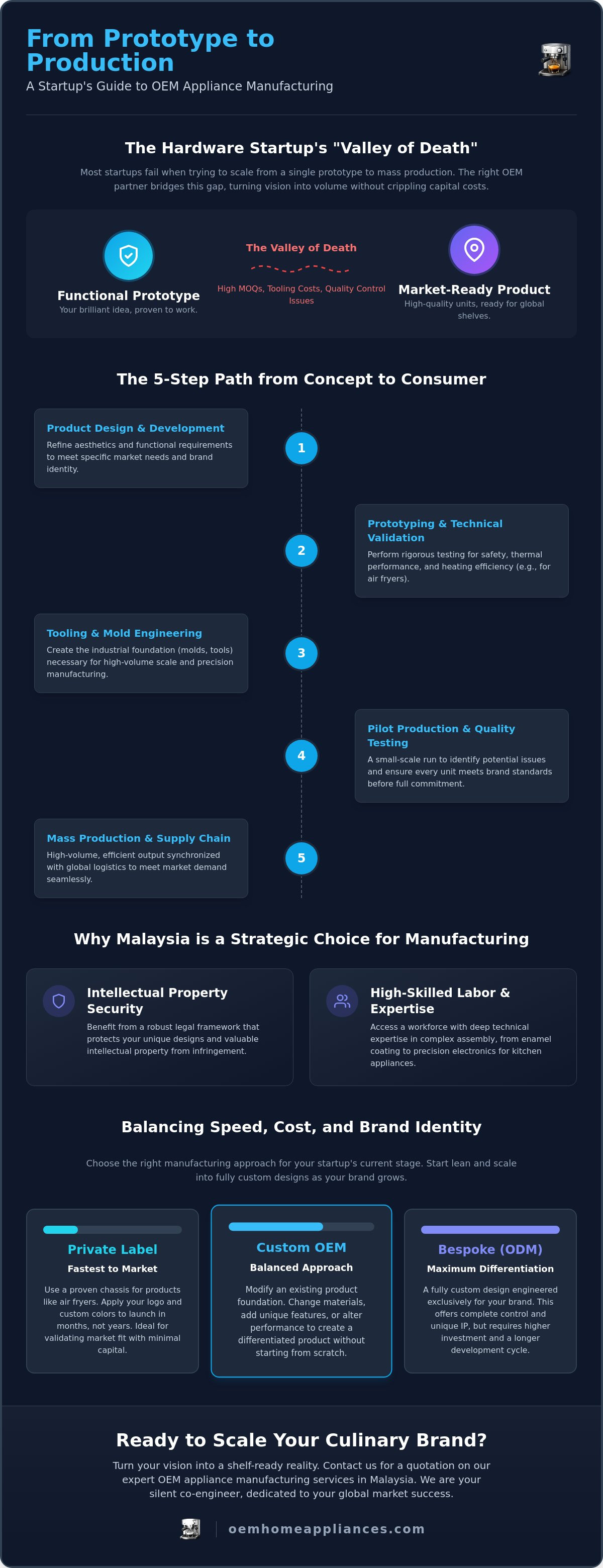
Hardware development is a capital-intensive journey that often ends in the "Valley of Death." This phase occurs when a startup attempts to transition from a functional prototype to a production run of 10,000 units without the necessary industrial support. For most, building a dedicated factory is financially impossible. Instead, smart founders leverage an Original Equipment Manufacturer (OEM) to utilize existing infrastructure and expertise. Choosing the right partner for OEM appliances for startups allows you to focus on marketing and brand building while the manufacturer handles the complexities of the assembly line.
The cost-benefit analysis is clear. Building your own facility requires massive upfront investment in machinery, labor, and compliance. Partnering with an established OEM like Keiteq provides immediate access to specialized processes like enamel coating and powder-coated metal components. These technical solutions aren't just aesthetic; they provide the durability and premium finish required to differentiate a new brand in a crowded marketplace. By utilizing a partner's existing supply chain, you de-risk the entire production cycle and preserve your startup capital for growth.
Bridging the Gap Between Design and Production
A design that works on a workbench might fail on a high-speed production line. This is where Design for Manufacturing (DFM) becomes vital. DFM identifies engineering bottlenecks early, preventing expensive retools after production has already started. Beyond mechanical design, kitchen brands must navigate strict safety standards. Ensuring your products meet UL or CE certifications while using verified food-grade materials is non-negotiable. Utilizing professional kitchen appliance R&D services ensures your product is both safe and scalable from day one.
Reducing Startup Risk Through Private Labeling
Speed is a startup's greatest weapon. Private label manufacturing allows you to enter the market months ahead of competitors by using proven chassis for products like air fryers or roaster ovens. You can apply custom branding and unique colorways to look like an established market leader without the multi-year development cycle. As your brand matures and gains traction, you can transition from these white-label foundations into fully bespoke OEM appliances for startups. This phased approach preserves capital and allows you to validate your market fit before committing to entirely custom molds.
The Lifecycle of Appliance Development: From Concept to Mass Production
Moving from a design sketch to a functional product requires a disciplined five-step engineering lifecycle. This progression ensures that your vision for OEM appliances for startups doesn't just look good in a render but performs reliably in a customer's kitchen. The transition from a prototype to a market-ready unit is where most errors occur, making a methodical approach essential for long-term success.
Step 1: Product Design & Development: Refine the aesthetic and functional requirements to ensure the product meets specific market expectations.
Step 2: Prototyping and Technical Validation: Rigorous testing of thermal performance in roaster ovens or air fryers is essential to ensure safety and heating efficiency.
Step 3: Tooling and Mold Engineering: This stage creates the industrial foundation necessary for high-volume scale and precision.
Step 4: Pilot Production and Quality Testing: A small-scale run ensures every unit meets your brand standards before full mass-production commitment.
Step 5: Mass Production and Supply Chain Integration: High-volume output is synchronized with global logistics to meet market demand seamlessly.
Engineering for Culinary Excellence
Culinary hardware demands precision engineering that generic manufacturers cannot provide. For example, high-performance rice cookers require specific energy efficiency and heat distribution profiles to ensure consistent results. Similarly, OEM air fryer production faces technical challenges regarding airflow optimization and the durability of non-stick coatings. Startups should prioritize enamel-coated products to achieve a premium market position. These materials offer superior heat retention and a high-end feel that differentiates your brand from entry-level competitors. If you're ready to move into technical validation, you can speak with our engineering team about your specific requirements.
Quality Assurance Protocols for Emerging Brands
Your reputation depends on the consistency of the first 10,000 units. Reliable factory audits and in-line inspections are non-negotiable protections for your brand identity. By establishing a Quality Management System (QMS) that scales with your order volume, you ensure that every product, from blenders to kettles, maintains a uniform standard. Leveraging Malaysia's smart manufacturing hub provides access to high-tech testing facilities and a workforce trained in these rigorous protocols. This methodical approach to OEM appliances for startups de-risks the launch and builds long-term consumer trust through reliable performance.
Evaluating Manufacturing Hubs: Why Malaysia is the Strategic Choice for 2026
Global supply chains are undergoing a fundamental shift as startups seek to diversify away from China-centric manufacturing models. While China once dominated on unit price alone, rising geopolitical risks and increasing labor costs have forced brands to look elsewhere. Malaysia has emerged as a premier alternative for 2026, offering a sophisticated balance of technical capability and legal security. For companies sourcing OEM appliances for startups, this region provides a stable environment that prioritizes long-term partnership over transactional volume.
The Malaysian workforce is highly skilled and often English-speaking, which eliminates the communication barriers that frequently derail complex engineering projects. This cultural and linguistic alignment ensures that design specifications are understood correctly the first time. Logistically, Malaysia serves as a central gateway, providing efficient shipping routes to both Asian and Western markets. Keiteq operates as a leading OEM kitchen equipment manufacturer in this hub, leveraging local infrastructure to deliver global-standard products.
Intellectual Property Protection in OEM
Startups live and die by their innovations. Malaysia’s legal framework provides robust protection for proprietary designs and engineering breakthroughs. This environment significantly reduces the risk of "brand leakage," where a factory might produce unauthorized versions of your product for other markets. Intellectual property protection in manufacturing refers to the legal and operational safeguards that prevent unauthorized reproduction or theft of proprietary product designs and engineering specifications. By choosing a professional partner in Malaysia, you ensure your OEM appliances for startups remain exclusively yours.
Cost vs. Quality: The Real ROI of Malaysian Manufacturing
Focusing solely on unit price is a common mistake for early-stage companies. You must consider the total cost of ownership, which includes shipping reliability, lower defect rates, and administrative efficiency. Working with a partner that offers industrial enamel coating services in-house reduces lead times and eliminates the quality variations found in outsourced finishing. Malaysia’s extensive trade agreements also benefit startups shipping to the US or Europe, often resulting in lower tariffs compared to other manufacturing hubs. It's a strategic positioning that allows your brand to maintain healthy margins while delivering a superior product to your customers.
Critical Success Factors: MOQs, Customisation, and Partner Vetting
Minimum Order Quantities (MOQs) are often the primary hurdle when sourcing OEM appliances for startups. Factories set these thresholds based on the high costs of assembly line setup and minimum raw material purchase requirements. For a new brand, the challenge lies in balancing inventory risk with production efficiency. This balance is critical for any hardware-based business model; for instance, Blumenautomat24 helps entrepreneurs calculate the return on investment for specialized automated retail hardware. You don't want to overextend your capital on 5,000 units before validating your market, but you also need a unit price that allows for healthy margins. A partner that offers flexible production tiers or shares their raw material stock can be the difference between a successful launch and a cash flow crisis.
The "Customisation Spectrum" is another critical consideration. It ranges from simple logo placement on a white-label product to full ODM bespoke engineering. Most startups begin with private labeling to minimize R&D costs and move to market quickly. As your brand identity matures, you'll likely require unique aesthetic or functional changes. Vetting your partner's technical capabilities is essential here. Specifically, check if the factory handles enamel and powder coating in-house. Outsourcing these finishing steps often leads to inconsistent quality and extended lead times, which a growing brand cannot afford.
A significant green flag during the vetting process is a factory’s exclusive focus on B2B services. If a manufacturer also sells directly to retail or operates its own consumer brand, they are your competitor. You want a "silent engine" that exists solely to empower your brand. This alignment ensures that their R&D efforts and production priorities are focused entirely on your success rather than their own retail margins.
Negotiating Your First Production Run
Securing a production slot in a high-demand factory requires more than just a purchase order. You need to present a professional growth roadmap. Manufacturers are looking for long-term partners, not one-off projects. By being transparent about your marketing strategy and projected scaling, you build the trust necessary to secure better terms. It's also vital to have a clear agreement with your private label kitchen appliance manufacturer that outlines quality standards and intellectual property boundaries from the start.
Scalability: Planning for Version 2.0
Your manufacturing choice should be based on where you want to be in three years, not just where you are today. Ensure your partner can handle a 10x increase in volume without a drop-off in quality or a spike in lead times. A manufacturer with a diverse portfolio, producing everything from coffee machines to BBQ grills, provides a streamlined path for brand expansion. This allows you to launch new product lines without the friction of vetting new suppliers. If you're ready to discuss your production needs, request a customized manufacturing quotation to see how we can support your growth.
Scaling Your Culinary Brand with Keiteq (oemhomeappliances)
Keiteq functions as the silent engine behind many of the world's most successful kitchen brands. We specialize in the production of high-performance roaster ovens, air fryers, and portable cooking equipment. By offering integrated OEM/ODM services, we provide the industrial backbone that emerging companies need to compete globally. Our commitment to precision engineering ensures that every unit leaving our facility meets the rigorous standards of the modern culinary market. We don't just act as a supplier; we serve as a dedicated partner in your brand's long-term growth.
Finding the right source for OEM appliances for startups requires a manufacturer that understands the nuances of private labeling. Our facility handles a diverse range of products, including rice cookers, blenders, and coffee machines. This variety allows you to expand your product line seamlessly without the friction of managing multiple vendors. We prioritize stability and corporate readiness, positioning ourselves as the dependable backbone for businesses looking to scale. Every product we manufacture is a reflection of our dedication to quality and industrial strength.
Custom Solutions for Modern Kitchenware
Our in-house expertise in enamel and powder-coating is a major differentiator for our partners. These finishes provide the durability and premium feel necessary to elevate a startup's product line from entry-level to high-end. We operate with a strict B2B focus, ensuring that we never compete with our clients in the retail market. This alignment of interests means we grow only when your brand grows. From our manufacturing hub in Malaysia, we offer a streamlined path from local production to global distribution, ensuring your brand is ready for any market.
The Next Step for Your Startup
Early engagement is the key to a successful product launch. By involving our engineering team during your initial design phase, you can avoid the costly retools and production delays discussed earlier in this guide. When you're ready to move toward mass production, preparing a comprehensive Request for Quotation (RFQ) is the next logical step. This document should outline your technical specifications, projected volumes, and branding requirements. We leverage our decades of experience to help you refine these details for maximum industrial efficiency.
If you're ready to transition from a prototype to global market success, we invite you to reach out for a professional consultation. Contact our team today to request a quotation or to receive further details regarding our manufacturing services provided within Malaysia. Let us help you turn your culinary vision into a scalable, high-quality reality.
Secure Your Manufacturing Foundation for 2026
Transitioning from a successful prototype to a global product line requires more than just a factory; it requires a strategic engineering partner. You've seen how leveraging Design for Manufacturing (DFM) and choosing a secure manufacturing hub like Malaysia de-risks your scale-up process. Navigating the complexities of OEM appliances for startups becomes manageable when your partner handles the technical heavy lifting of thermal validation and material durability. Hardware is hard. We make it scalable.
We bring decades of experience in roaster oven and air fryer engineering to every project. Our facility features specialized in-house enamel and powder coating capabilities, ensuring your brand maintains a premium finish without third-party delays. As a dedicated B2B partner, we eliminate channel conflict by focusing entirely on your success rather than our own retail presence. It's time to move beyond the prototype phase with a partner that understands your growth roadmap.
Ready to scale your appliance brand? Request a quotation for our specialized manufacturing services in Malaysia today. We're ready to help you turn your vision into a shelf-ready reality.
Frequently Asked Questions
What is the difference between OEM and ODM for a startup?
An OEM (Original Equipment Manufacturer) produces products based on your proprietary designs, while an ODM (Original Design Manufacturer) provides pre-engineered products that you rebrand. Most startups utilize ODM or private label models initially to reduce upfront R&D costs and accelerate their market entry. As the brand matures, transitioning to a full OEM model allows for deeper product differentiation and unique functional features that set your appliances apart from standard market offerings.
How do I protect my appliance design when working with a manufacturer?
Protecting your intellectual property requires a combination of legal agreements and choosing a manufacturer in a secure jurisdiction. You should execute non-disclosure (NDA) and non-circumvention agreements before sharing sensitive blueprints. Malaysia's robust legal framework provides a significant advantage for OEM appliances for startups, as it offers stronger IP enforcement and lower risks of "brand leakage" compared to other high-volume manufacturing hubs in the region.
What are the typical MOQs for kitchen appliances like air fryers?
Minimum Order Quantities (MOQs) for complex appliances like air fryers typically range from 500 to 1,000 units per production run. These requirements exist because setting up an industrial assembly line and sourcing specialized food-grade materials requires a baseline volume to be economically viable. Some manufacturers offer flexible tiers for startups, but you should always plan your capital around these industrial realities to ensure production efficiency and maintain competitive unit pricing.
Why should a startup choose a manufacturer in Malaysia over China?
Malaysia provides a strategic balance of high-skilled labor, English-speaking management, and stable geopolitical relations. While other hubs may offer lower initial unit prices, Malaysia’s superior IP protection and shipping reliability often result in a higher long-term ROI. For startups, the ability to communicate technical specifications clearly without linguistic barriers reduces the risk of engineering errors that can cause catastrophic delays during the mass production phase.
Can an OEM partner help with the certification process (UL, CE, etc.)?
Professional OEM partners provide essential support throughout the safety certification process for markets like the US or Europe. They ensure that designs meet UL, CE, or GS standards during the early engineering stages, which prevents expensive retools later. By conducting pre-compliance testing in-house, a manufacturer can identify potential failures in thermal performance or electrical safety, ensuring a smoother path through official third-party certification labs.
What technical solutions are available for custom appliance finishing?
Specialized finishing options like enamel coating and powder-coated metal components are the most effective ways to differentiate your product line. These in-house technical solutions provide superior heat resistance and a premium aesthetic that plastic-only models cannot match. Utilizing these finishes for roaster ovens or portable cooking equipment elevates your brand positioning, allowing you to compete in the mid-to-high-end market segments where margins are typically more sustainable for startups.
How long does it take to go from a design concept to a finished product?
The lifecycle from initial concept to a shelf-ready product usually spans 6 to 12 months. This timeline includes critical phases such as prototyping, technical validation, mold engineering, and pilot production runs. Skipping these steps to save time often leads to quality inconsistencies. A methodical approach ensures that your first mass-produced batch meets the exact standards of your brand and performs reliably for your end consumers.
Does oemhomeappliances offer direct-to-retail distribution support?
No, our business model is strictly B2B manufacturing and product development. We do not offer direct-to-retail distribution, third-party brand management, or marketing services. Our role is to function as a silent, highly capable engine that empowers your brand through precision engineering and scalable production. This focus ensures there is never a conflict of interest between our manufacturing priorities and your retail distribution channels.
If you are looking for a reliable manufacturing partner in Malaysia, we are here to help. Contact us today to request a quotation for your next appliance project.
Secure Your Brand's Competitive Edge in 2026
The 2026 manufacturing environment requires a transition from reactive sourcing to strategic foresight. Managing the complexities of kitchen appliance manufacturing logistics involves more than just overseeing shipments; it requires a technical partner who understands the high stakes of appliance durability and global compliance. By diversifying your production into a stable hub like Malaysia and prioritizing specialized enamel coating expertise, you protect your brand from the 25% tariffs on metal derivatives and rising component costs.
A dedicated B2B partnership model ensures your interests are always the priority. You don't have to worry about competing with your manufacturer. Instead, you gain a silent, powerful engine that drives your scalability and precision. It's time to build a…