Industrial Enamel Coating for Cookware: The 2026 OEM Technical Guide

Your cookware's finish isn't just cosmetic. It's the single most critical factor determining whether your product earns a five-star review or a chargeback claim. For OEM brands sourcing at volume, industrial enamel coating for cookware represents a foundational engineering decision, not a surface-level afterthought. Get it wrong, and you're managing chipping complaints, food-safety audits, and a damaged brand reputation. Get it right, and you've built a defensible quality advantage that justifies premium pricing across every SKU in your line.
If you're evaluating enamel for your next roaster oven, BBQ grill, or portable cooking equipment line, you already understand the pressure. Procurement teams need coatings that hold up under thermal cycling, pass FDA and LFGB compliance checks, and scale predictably across high-volume production runs without quality deviation. Those are legitimate, non-negotiable requirements, and this guide addresses each one directly.
Here, you'll find a technical breakdown of industrial enamel performance specifications, manufacturing process benchmarks, and the OEM considerations that separate a reliable coating partner from a costly liability. By the end, you'll have the technical foundation to make a confident sourcing decision for 2026 and beyond.
Table of Contents
What is Industrial Enamel Coating for Cookware?
At its core, industrial enamel coating for cookware is a silica-based glass lining fused permanently to a metal substrate at extreme temperatures, typically exceeding 800°C. The result isn't a coating sitting on top of metal. It's a chemically bonded composite material where glass and metal become a single, unified layer. That distinction matters enormously for OEM procurement decisions, because it determines how the product performs across thousands of thermal cycles, acidic food exposures, and commercial cleaning events.
Understanding industrial enamel (vitreous enamel) coating starts with separating it from decorative applications. Artistic enamel, used in jewelry and decorative metalwork, prioritizes visual brilliance over functional durability. Industrial porcelain enamel, by contrast, is engineered to specification. Layer thickness, hardness ratings, chemical resistance, and thermal expansion coefficients are all controlled variables, not aesthetic choices. For cookware brands building roaster ovens, BBQ grills, or portable cooking equipment, that engineering precision is the product.
Organic non-stick coatings and powder coatings serve a purpose, but they operate within narrower performance envelopes. Non-stick polymers degrade under sustained high heat and score poorly in long-term abrasion resistance. Powder coatings offer surface-level protection but lack the chemical inertness that food-contact applications demand. Enamel eliminates both limitations. It's inherently non-porous, chemically stable, and doesn't leach compounds into food, which directly supports FDA and LFGB compliance pathways that OEM brands can't afford to complicate.
Key Terminology: Frit, Substrate, and Fusion
Frit refers to the raw glass particles ground to a fine powder that form the coating's foundation before firing. The frit's chemical composition determines the final coating's hardness, color stability, and resistance profile. Common metal substrates include cast iron, cold-rolled steel, and aluminized steel, each requiring specific surface preparation and frit formulations to achieve reliable adhesion. During firing, the frit melts and chemically bonds with the oxidized metal surface, creating a layer that cannot be separated without destroying both materials.
Industrial vs. Consumer Grade Enamel
Industrial-grade enamel systems use a two-layer architecture: a ground coat applied directly to the substrate for adhesion, followed by one or more cover coats that deliver the finished surface properties. Ground coats typically contain cobalt or nickel oxides to promote metal bonding, while cover coats are formulated for specific hardness and chemical resistance targets. Industrial cookware enamel commonly achieves a hardness rating of 5 to 6 on the Mohs scale, providing meaningful resistance to metal utensils, abrasive cleaners, and acidic foods like tomatoes and citrus that would degrade organic alternatives over time.
The Technical Enamelling Process: From Frit to Finished Product
Knowing what industrial enamel is matters. Understanding how it's built is what separates procurement decisions that scale from ones that generate defect reports at 50,000 units. Every stage of the enamelling process is a controlled variable. Compromise any one of them, and the consequences compound downstream in ways that are expensive to reverse.
Surface Pre-treatment and Substrate Integrity
Surface purity is non-negotiable. Residual oils, mill scale, or oxidation on the metal substrate will prevent the frit from bonding uniformly, producing weak spots that manifest as chipping or delamination under thermal stress. Chemical degreasing removes organic contaminants, but it's grit blasting that delivers the mechanical anchor profile the ground coat needs to grip. Etching, a controlled acid treatment applied after degreasing, micro-roughens the metal surface to increase the bonding surface area available for the frit to chemically engage during firing.
Metal thickness is equally critical. Panels that are too thin warp under the sustained heat of the firing furnace, distorting geometry and creating uneven coating distribution. For roaster ovens and BBQ grills specifically, substrate gauge selection during the design phase directly determines whether the finished product holds dimensional tolerance through firing. This is a decision that needs to be made at the engineering stage, not corrected at the quality inspection stage.
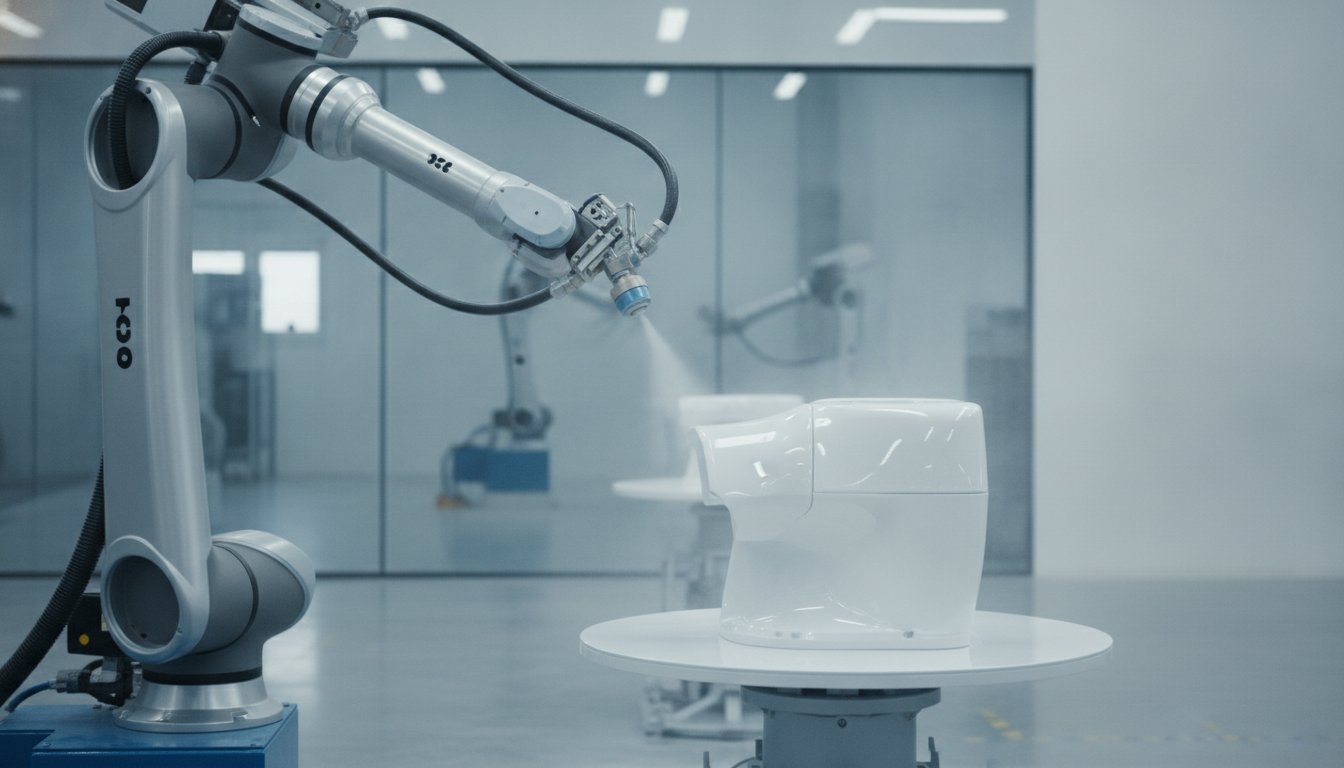
Application Methods: Electrostatic vs. Wet Spray
Two primary methods dominate industrial enamel coating for cookware production: electrostatic powder application and wet spray. Electrostatic systems charge the dry frit powder so it's drawn uniformly to the grounded metal substrate, delivering consistent layer thickness across complex geometries with minimal material waste. Wet spray application suspends the frit in a liquid medium, offering greater control over coverage on deep-drawn forms like roaster pans or grill interiors where electrostatic lines of force can create thin spots at recessed edges. Neither method is universally superior. The substrate geometry and target coating thickness determine the right call for each SKU.
Advanced Firing Techniques in 2026
The firing stage is where chemistry becomes performance. Precision temperature control between 750°C and 850°C is required for optimal glass-metal fusion. Too low, and the frit won't fully melt into a continuous, pore-free layer. Too high, and the substrate risks thermal distortion or the glass develops surface defects. Furnace soak time, the duration the coated part spends at peak temperature, directly influences final gloss level and coating density. Longer soak times generally produce a denser glass matrix with improved chemical resistance, but the window is narrow and substrate-specific.
Cooling and annealing follow immediately. Controlled, gradual cooling prevents the thermal shock that introduces internal stress fractures in the glass layer. Rapid quenching is one of the most common causes of micro-cracking that doesn't appear until the product is already in a customer's kitchen.
For a detailed breakdown of how these process stages apply specifically to roaster oven production, see our enamel coating process for roaster ovens guide.
If you're evaluating whether your current substrate and geometry specifications are optimised for this process, connect with our technical team in Malaysia to review your product requirements before committing to a production run.
Performance Benchmarks: Why Brands Choose Industrial Enamel
Selecting industrial enamel coating for cookware is a strategic decision based on measurable performance thresholds that polymer-based alternatives cannot reach. While organic non-stick layers begin to degrade and release fumes at 260°C, industrial enamel remains structurally stable at continuous temperatures exceeding 450°C. This thermal overhead is essential for BBQ grills and professional roaster ovens where direct flame contact or intense radiant heat is a standard operating condition. Choosing enamel ensures the product won't fail during the high-heat searing or self-cleaning cycles that consumers now expect from premium appliances.
Chemical stability provides a second, equally critical benchmark. Professional kitchens and high-end home users frequently use aggressive alkaline detergents. They also cook with highly acidic ingredients like vinegar, citrus, and tomato-based reductions. Industrial enamel is chemically inert. It won't react, pit, or leach metallic ions into food during long-simmering cycles. This stability ensures the cooking surface maintains its integrity and appearance after years of heavy use, protecting your brand's reputation for quality long after the initial purchase.
Mechanical durability rounds out the performance profile. Because enamel is a glass-hard surface, it offers a level of scratch resistance that allows for the unrestricted use of metal utensils. It's also inherently hygienic. The non-porous nature of the glass layer prevents bacterial growth and ensures that odors from previous cooking cycles aren't retained. This makes it a superior choice for portable cooking equipment where cleaning conditions may be less than ideal.
Thermal Shock and Heat Distribution
Enamel is an efficient radiant heat emitter. In roaster ovens, this property helps produce more even browning and consistent internal temperatures. The technical challenge for OEM production is matching the Coefficient of Thermal Expansion (CTE) between the glass coating and the metal substrate. If these materials don't expand and contract at nearly identical rates, the coating will delaminate when moved from a hot burner to a cold surface. Rigorous thermal shock testing ensures the bond remains intact through these extreme transitions, preventing the chipping issues that plague lower-grade coatings.
Food-Grade Safety and Non-Toxic Standards
As we move into 2026, regulatory pressure on "forever chemicals" like PFAS and PFOA is reaching a tipping point. Industrial enamel is naturally PFAS-free and emits zero Volatile Organic Compounds (VOCs) even when overheated. Our manufacturing processes are already aligned with updated FDA, LFGB, and RoHS 2026 standards, providing a clear compliance path for global brands. Beyond safety, enamel offers a significant sustainability advantage. Its extreme longevity reduces product turnover and waste, positioning your cookware line as a durable, long-life investment rather than a disposable commodity.
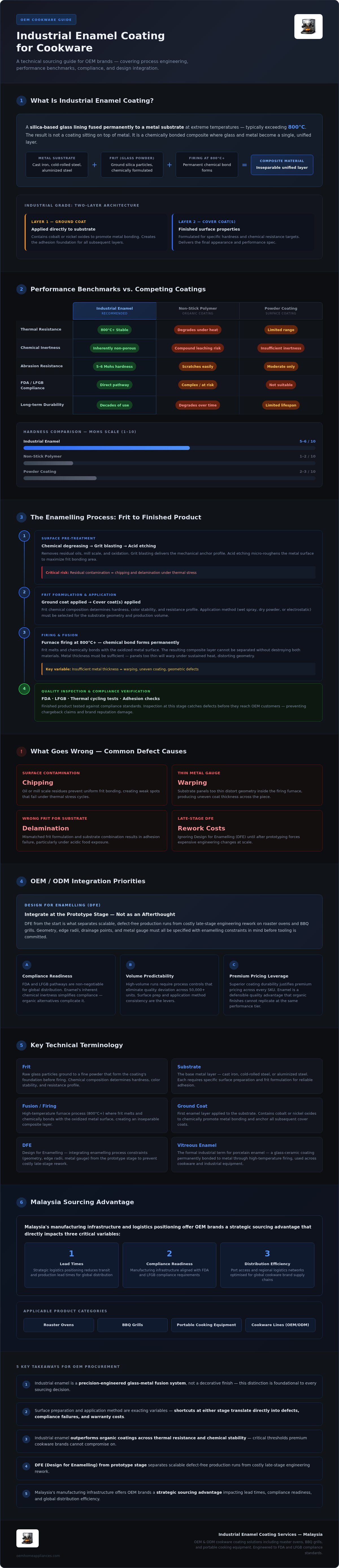
Integrating Enamel Coating into the OEM/ODM Lifecycle
Most coating failures don't originate in the firing furnace. They originate in the CAD file. Design decisions made weeks before a single gram of frit is applied determine whether a production run scales cleanly or generates defect reports that erode margin and delay market entry. Integrating industrial enamel coating for cookware into the OEM/ODM lifecycle means treating the coating as an engineering constraint from day one, not a finishing step applied to a completed design.
Design for Enamelling (DFE) is the discipline that closes this gap. It requires engineering product geometry with the coating process in mind. Sharp internal corners, for example, create stress concentration points where the glass layer is prone to cracking under thermal cycling. Blind holes trap liquid frit during wet spray application, producing inconsistent layer thickness and potential delamination. Recessed edges on roaster pan interiors or BBQ grill grates require deliberate radius specifications to ensure uniform frit coverage across the entire surface. These aren't minor refinements. They're the difference between a prototype that passes testing and a production run that ships.
Prototyping serves a specific function in this context: validating DFE decisions before tooling costs are committed. A prototype cycle for an enamel-coated roaster oven component should include:
Dimensional verification post-firing to confirm the substrate holds geometry through thermal cycling
Cross-section thickness testing using magnetic or eddy-current gauges to confirm uniform coverage at critical points
Impact resistance testing per EN ISO 4532 or equivalent standards to validate the coating's adhesion under mechanical stress
Thermal shock cycling to confirm the CTE match between frit and substrate holds across the product's rated temperature range
Skipping or compressing this stage is a false economy. Engineering corrections after tooling is cut cost significantly more than addressing them at the prototype stage.
Customizing Aesthetics: Colors and Textures
Brand differentiation in premium cookware is increasingly driven by finish consistency. Achieving a specific Pantone-matched color in enamel requires precise frit chemistry calibration, because pigment behavior shifts at firing temperatures. Matte finishes diffuse surface reflectivity and are preferred for professional-grade aesthetics, while gloss finishes offer slightly easier cleaning and stronger visual impact at retail. Private label branding, including logos and product markings, can be applied through silk-screened enamel fired directly into the surface layer, producing permanent identification that won't scratch or peel under commercial use conditions.
High-Volume Production and Supply Chain Efficiency
Scaling from a validated prototype to mass production introduces a different set of variables. Batch consistency across firing cycles, incoming frit quality control, and substrate gauge tolerances all require active management to prevent drift that compounds across high-volume runs. For complex coated components like broiler pans or multi-section BBQ grills, lead time planning must account for the sequential nature of the enamelling process. Each firing cycle is a fixed-duration event. Compressing it to meet a shipping deadline produces defects, not speed.
For OEM brands managing global distribution timelines, supply chain positioning matters as much as process capability. Learn how to choose the right private label kitchen appliance manufacturer to ensure your coating partner's production capacity and logistics infrastructure align with your market commitments.
Our OEM/ODM services are built to support the full product lifecycle, from DFE consultation through high-volume production of enamel-coated cookware and appliances. If you're ready to move from concept to compliant, scalable production, contact our Malaysia-based technical team to discuss your product specifications and production requirements.
Sourcing Industrial Enamel Coating Services in Malaysia
Where you source matters as much as what you source. Malaysia has established itself as a precision manufacturing hub for global appliance brands, and the reasons are structural, not coincidental. Positioned at the intersection of major Asia-Pacific shipping lanes, Malaysian facilities offer direct access to port infrastructure that reduces freight lead times to North American, European, and Middle Eastern markets. For OEM brands managing tight seasonal inventory windows, that logistics advantage isn't a bonus. It's a margin protection mechanism built into the supply chain itself.
Malaysia's industrial base also brings decades of accumulated expertise in metal finishing, component assembly, and precision fabrication. That technical depth translates directly into consistent process execution for industrial enamel coating for cookware, where firing temperature control and substrate preparation require skilled, experienced operators, not just calibrated equipment. The regional talent pool supporting this sector is a competitive asset that newer manufacturing hubs simply haven't had time to develop.
Cost efficiency is real, but it's worth framing correctly. Malaysian manufacturing doesn't compete on price by cutting corners on compliance. It competes by combining lower operational overhead with mature quality systems that already align with FDA, LFGB, and international food-safety standards. For global brands, that combination eliminates the trade-off between affordability and compliance readiness.
Quality Assurance in the Malaysia Facility
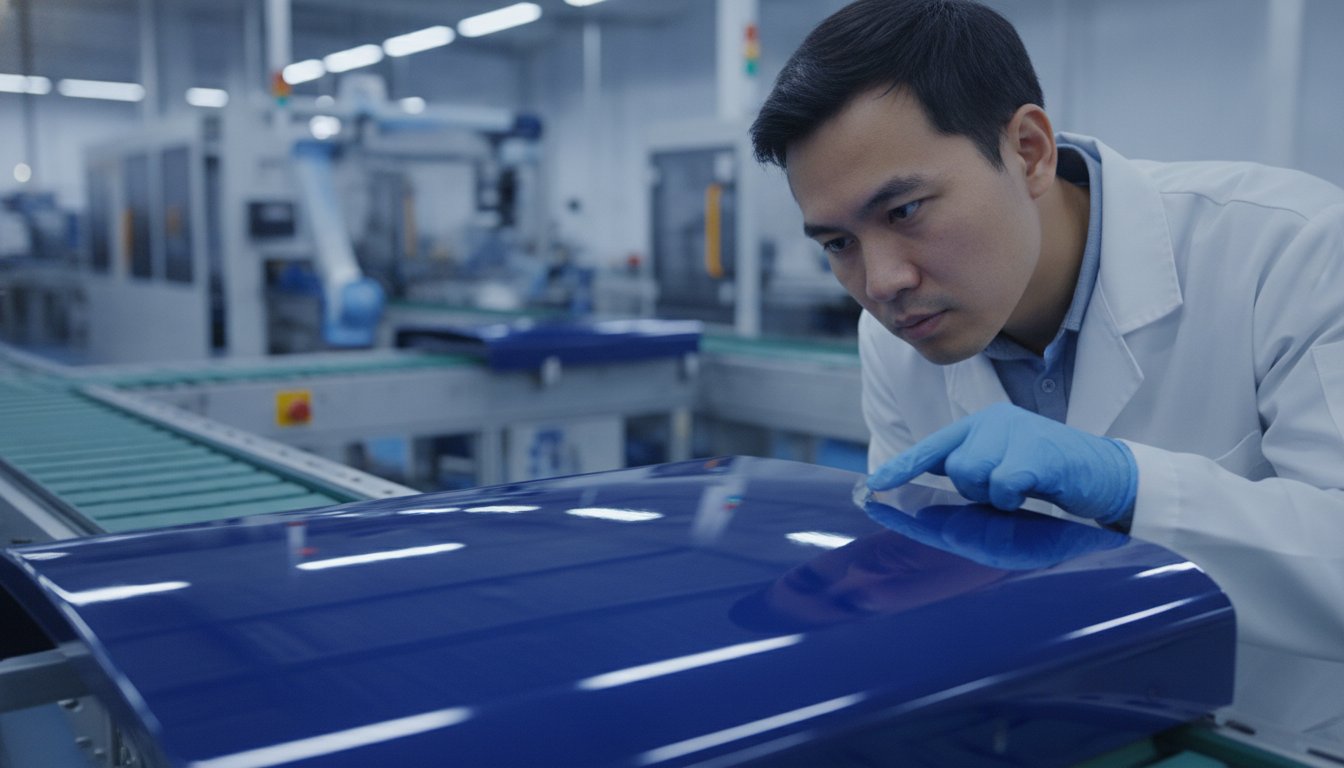
Consistent output at volume requires more than capable equipment. It requires systematic quality controls applied at every process stage. Incoming frit batches are verified for chemical composition consistency before any production run begins. Substrate gauge tolerances are checked against design specifications prior to surface pre-treatment. Post-firing inspection protocols cover coating thickness uniformity, adhesion integrity, and surface defect classification, ensuring that what leaves the facility matches what was validated at the prototype stage. Local technical support is available for regional brands requiring design consultation before committing to tooling, which reduces the risk of costly late-stage engineering corrections.
Partnering with oemhomeappliances
oemhomeappliances operates as a silent partner in your brand's global expansion. The focus is entirely on enabling your product line, from bespoke industrial enamel coating for cookware applications to high-volume production of roaster ovens, BBQ grills, and portable cooking equipment, without competing for the brand equity you're building. Coating solutions are tailored to substrate type, geometry, and target market requirements, whether that means matching a specific finish specification for a premium retail SKU or scaling a validated design across a multi-thousand-unit production run.
Leverage Malaysia's technical expertise and logistics infrastructure for your next cookware product line by reviewing our full OEM/ODM services or contacting our Malaysia-based team directly to discuss your coating specifications, compliance requirements, and production timelines.
Your 2026 Cookware Line Starts with the Right Coating Partner
Industrial enamel coating for cookware isn't a finishing detail. It's a foundational product decision that determines compliance readiness, long-term durability, and the brand reputation you're building with every unit shipped. Get the process right from substrate preparation through firing, and you have a defensible quality advantage. Get the sourcing wrong, and you're managing defects at scale.
Three things matter most when moving forward: choose a manufacturing partner with proven expertise in roaster oven and BBQ grill enamel application, integrate Design for Enamelling early in your product development cycle, and ensure your supply chain is positioned to support global distribution timelines without compromising process integrity.
oemhomeappliances operates as a dedicated B2B partner for global kitchen brands, backed by a high-volume technical facility in Malaysia built specifically for this work. The capability is here. The logistics infrastructure is here. The expertise is ready to support your next product line.
Contact our Malaysia-based team today to discuss your coating specifications and production requirements.
Frequently Asked Questions About Industrial Enamel Coating for Cookware
Is industrial enamel coating safe for high-temperature cookware?
Yes. Industrial enamel is inherently food-safe and thermally stable at continuous temperatures exceeding 450°C. It's naturally PFAS-free, emits zero VOCs even under extreme heat, and doesn't leach metallic ions into food. For OEM brands targeting compliance with FDA and LFGB standards, enamel provides a straightforward path without the regulatory complications associated with polymer-based alternatives.
How does enamel coating compare to PTFE non-stick coatings?
The performance gap is significant at elevated temperatures. PTFE-based coatings begin to degrade above 260°C and carry ongoing regulatory scrutiny due to PFAS concerns. Industrial enamel coating for cookware, by contrast, maintains structural integrity at professional cooking temperatures and offers superior long-term abrasion resistance. For brands building products positioned for durability and compliance longevity, enamel removes the risk that PTFE introduces.
Can enamel coating be applied to aluminum cookware?
This is technically challenging. Aluminum's low melting point (approximately 660°C) conflicts directly with the 750°C to 850°C firing temperatures required for proper glass-metal fusion. Standard industrial enamelling processes are optimized for cast iron, cold-rolled steel, and aluminized steel substrates. OEM brands specifying aluminum components should discuss substrate compatibility with their coating partner before finalizing product geometry and tooling decisions.
What causes enamel to chip, and how is it prevented in manufacturing?
Chipping typically traces back to three root causes: inadequate surface pre-treatment, a mismatch between the Coefficient of Thermal Expansion of the frit and substrate, or rapid cooling after firing that introduces internal stress fractures. Controlled annealing, precise frit formulation matched to the specific substrate, and rigorous post-firing impact testing per standards like EN ISO 4532 are the manufacturing controls that prevent these failures from reaching the end consumer.
Does industrial enamel coating require special cleaning or maintenance?
No specialized maintenance is required. The non-porous glass surface resists bacterial retention and doesn't absorb odors, so standard cleaning methods work effectively. Enamel tolerates alkaline detergents and dishwasher cycles without degrading, which is a meaningful advantage over organic non-stick surfaces. The practical maintenance message for end consumers is straightforward: avoid sharp impacts on the rim or base, where the glass layer is thinnest.
What is the typical lifespan of an enamel-coated roaster oven pan?
A properly manufactured enamel-coated roaster oven pan can last decades under normal use conditions. The glass-metal bond doesn't degrade through repeated thermal cycling the way polymer coatings do. Lifespan is most directly influenced by the quality of surface pre-treatment, frit formulation, and firing process control during manufacturing. Products built to specification and validated through thermal shock cycling consistently outperform organic-coated alternatives across multi-year use cycles.
Can custom colors be created for private label enamel cookware?
Yes, and color customization is a genuine brand differentiation lever in premium cookware. Achieving a specific Pantone-matched color requires precise frit chemistry calibration, since pigment behavior shifts at firing temperatures. Both matte and gloss finish profiles are achievable. Private label markings and logos can be applied through silk-screened enamel fired directly into the surface layer, producing permanent identification that won't scratch or peel under commercial use conditions.
What certifications should I look for in an enamel coating manufacturer?
Prioritize manufacturers whose processes align with FDA and LFGB food-contact compliance standards as a baseline. ISO quality management certification signals systematic process controls rather than ad-hoc production. For brands targeting European markets, RoHS compliance is a non-negotiable requirement. Don't rely on a manufacturer's self-reported claims; request documentation and verify that certification scope covers the specific substrate and product category you're sourcing, not just a general facility approval.
Ready to discuss coating specifications, compliance requirements, or production timelines for your next cookware line? Contact our Malaysia-based technical team to request a quote or review your product requirements with an OEM specialist.

Comments