Custom Kitchen Appliance Design: B2B Guide for 2026
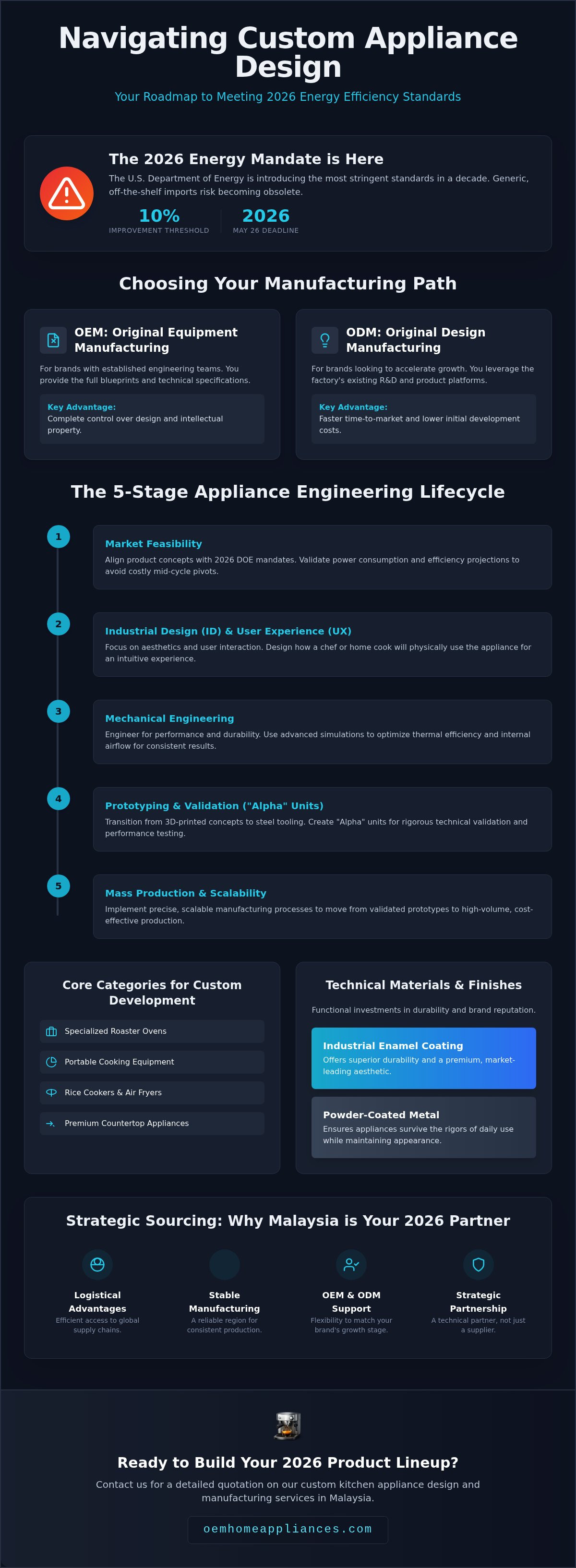
The era of generic, white-label imports is ending as 2026 introduces the most stringent energy efficiency standards in a decade. With the U.S. Department of Energy proposing a 10% improvement threshold for new standards, your brand can't afford to settle for off-the-shelf models. You already know that successful custom kitchen appliance design requires more than just a logo swap. It demands a technical partnership that bridges the gap between ambitious R&D and cost-effective mass production. High development costs and supply chain instability are real threats, but they don't have to stall your brand's growth.
This guide provides a clear roadmap to help you navigate the complexities of engineering, material selection, and manufacturing scalability. You'll learn how to leverage technical options like enamel coating to differentiate your products while effectively managing production risks. We'll preview the journey from initial concept to meeting the May 26, 2026, efficiency deadlines for room air conditioners and other key categories. We also explain why choosing a reliable manufacturing partner in a stable region like Malaysia is the most strategic move for your 2026 product lineup.
Table of Contents
Defining Custom Kitchen Appliance Design for Global Brands
In the B2B sector, custom kitchen appliance design represents a fundamental shift from simple rebranding to deep-level engineering. While consumer-facing customization often ends at selecting a finish or a knob style, professional product development involves a rigorous industrial design process focused on performance, compliance, and scalability. Brands that rely on generic models risk obsolescence as the 2026 regulatory environment tightens. It's no longer enough to offer a standard product; you need a solution that meets specific market requirements from the ground up.
Proprietary designs allow brands to capture market share by addressing specific user pain points that mass-market products ignore. By controlling the internal components and external aesthetics, you ensure your product line meets the specific energy efficiency mandates set for 2026. This level of control is essential for global brands looking to maintain a premium position in a crowded marketplace. It's not just about looking different; it's about owning the intellectual property that makes your product superior. When you move beyond "off-the-shelf" solutions, you eliminate the risk of competing solely on price with identical products sold by dozens of other distributors.
The Difference Between OEM and ODM Models
Choosing the right manufacturing path depends on your brand's internal technical capabilities. Original Equipment Manufacturing (OEM) is the choice for brands with established engineering teams that provide full blueprints and specifications. In contrast, Original Design Manufacturing (ODM) allows you to leverage a factory's existing R&D to bring products to market faster. Our manufacturing services in Malaysia support both models, providing the flexibility needed to scale according to your specific growth stage. You don't have to build a factory to own a unique product line; you just need the right technical partner.
Core Categories for Custom Development
Success in the 2026 market requires a focus on high-demand, high-performance categories. We specialize in developing robust solutions across several key product lines:
Specialized Roaster Ovens: Engineering for precise heat distribution and durability.
Portable Cooking Equipment: Designing for the growing outdoor and compact living markets.
Rice Cookers and Air Fryers: Integrating the latest efficiency standards and user-friendly interfaces.
Premium Countertop Appliances: Developing blenders, kettles, and coffee machines with unique finishes like industrial enamel.
Customization also extends to the material science level. Using powder-coated metal components or specialized enamel coatings ensures your appliances survive the rigors of daily use while maintaining a market-leading aesthetic. These technical choices aren't just aesthetic; they're functional investments in the longevity of your brand's reputation. For global brands seeking a strategic manufacturing partner, we invite you to contact us for a detailed quotation on our custom kitchen appliance design services in Malaysia.
The 5 Stages of the Appliance Design and Engineering Lifecycle
Engineering a market-leading product requires more than aesthetic vision. It demands a disciplined, multi-stage engineering lifecycle that transforms a conceptual sketch into a high-performance machine. The custom kitchen appliance design process begins with market feasibility. For 2026, this means aligning your product's power consumption with the latest DOE efficiency mandates. If your design doesn't project a 10% improvement over existing standards or meet specific energy saving thresholds, it's obsolete before it hits the assembly line. We help you validate these concepts early to avoid costly mid-cycle pivots.
Once feasibility is confirmed, the project moves into Industrial Design (ID) and User Experience (UX). This stage focuses on how a professional chef or a home cook interacts with your roaster oven or air fryer. Mechanical engineering follows, where the focus shifts to thermal efficiency and internal airflow. We use advanced simulations to ensure that heat distribution remains consistent, which is critical for high-capacity cooking equipment. The lifecycle culminates in the creation of "Alpha" units. These prototypes undergo rigorous technical validation to ensure the mechanical and electrical systems perform under stress. This methodical approach is why electronics manufacturing services in Malaysia have become a global standard for brands seeking precision and reliability.
R&D and Technical Appliance Development
Successful R&D integrates energy efficiency directly into the core architecture of rice cookers and ovens. We don't just add features; we select internal components that prioritize durability and heat retention. This reduces the duty cycle of heating elements, extending the product's lifespan while meeting 2026 sustainability goals. Our Kitchen appliance R&D services focus on optimizing the Bill of Materials (BOM) to balance premium performance with manufacturing costs. By selecting high-grade sensors and robust relays, we ensure your custom appliances withstand years of heavy use in demanding environments.
Regulatory Compliance and Safety Testing
Compliance isn't an afterthought; it's a design constraint. Meeting global standards like UL, CE, or Energy Star Version 5.0 requires meticulous documentation and factory audits throughout the development cycle. We perform internal safety stress tests long before the product reaches a third-party lab. This proactive testing identifies potential failure points in electrical insulation or thermal cut-offs early. Technical appliance development is the intersection of safety compliance and functional innovation. If you're ready to move from concept to a compliant prototype, you can discuss your technical requirements with our engineering team in Malaysia today.
Advanced Technical Customization: Materials, Coatings, and Finishes
Material selection defines the boundary between a standard appliance and a market-leading product. While many manufacturers prioritize surface-level aesthetics, professional custom kitchen appliance design focuses on the chemical and physical properties of coatings. These technical choices directly impact heat distribution, food safety, and the unit's ability to withstand industrial-grade cleaning. By choosing advanced finishes like enamel or high-durability powder coating, brands can offer superior performance without compromising on mass-production efficiency.
Industrial Enamel Coating Services
Enamel remains the gold standard for high-heat applications like roaster ovens and premium cookware. It's essentially a glass finish fused to a metal substrate at extremely high temperatures. This creates a surface that's chemically inert, scratch-resistant, and naturally non-stick without the use of PFAS or other controversial chemicals. For a deep dive into the technicalities, see our guide on the Enamel coating process for roaster ovens.
Beyond its safety profile, high-grade enamel provides exceptional thermal retention. This is a critical factor for brands aiming to meet the 2026 energy efficiency standards mentioned earlier. A well-enameled interior requires less energy to maintain cooking temperatures, making it a functional upgrade as much as an aesthetic one. It's a durable solution that doesn't degrade over time, ensuring your appliances maintain their performance for years of heavy use.
Precision in Powder Coated Metal Components
Powder coating offers a versatile solution for appliance exteriors where brand-specific aesthetics meet industrial strength. Unlike traditional liquid paint, powder coating provides a thicker, more uniform layer that resists chipping, fading, and corrosion. We utilize automated lines to ensure consistency across high-volume production runs. This precision is vital for maintaining brand integrity when scaling from hundreds to thousands of units. It's the ideal choice for air fryers, kettles, and coffee machines that need to look as good as they perform.
Brands can choose from a wide spectrum of color matching and texture options, from matte finishes to high-gloss metallic looks. Our testing protocols include salt spray testing for corrosion resistance and adhesion testing to guarantee the coating won't peel under thermal stress. We also perform impact resistance tests to protect the appliance during shipping and daily use. This ensures the exterior remains pristine even in the most demanding kitchen environments.
Beyond external finishes, custom kitchen appliance design involves tailoring internal components for specific cooking performance. This includes selecting high-grade heating elements for roaster ovens or specialized impellers for blenders. Balancing these premium choices with mass-production cost efficiency requires a strategic approach to the Bill of Materials. We help you identify where to invest in high-performance materials and where to optimize for production speed. This ensures your product remains competitive in price while leading in quality and durability.
Strategic Sourcing: Why Design Partnerships in Malaysia are Trending
Global trade dynamics in 2026 demand more than just low unit costs. Supply chain resilience is now the primary metric for procurement officers and brand owners alike. Malaysia has emerged as a stable, high-quality alternative to traditional manufacturing hubs. Unlike regions with volatile trade relations, Malaysia offers a consistent regulatory environment and strong intellectual property (IP) protections. This is critical for custom kitchen appliance design where your proprietary R&D is your brand's most valuable asset. Moving your production to a Southeast Asian hub mitigates the risks of sudden tariff shifts and logistical bottlenecks.
Selecting a Reliable OEM Appliance Supplier
Evaluating a factory requires a deep look at their R&D infrastructure. You need a partner who can translate your specific blueprints into a scalable production model. A key differentiator in this selection process is the manufacturer's business model. A partner who avoids direct-to-retail competition won't undercut your brand in the marketplace. This ensures that their engineering resources are fully dedicated to your success, not their own house brand. For a deeper analysis of these criteria, read our strategic guide to selecting a private label kitchen appliance manufacturer. It's about finding a backend engine that empowers your brand's growth.
The "Made in Malaysia" Quality Advantage
The "Made in Malaysia" label carries a reputation for technical precision and transparent communication. We provide the technical expertise needed for specialized custom kitchen appliance design, ranging from roaster ovens to high-capacity air fryers. Our strategic location offers logistical advantages, connecting your brand to global distribution networks through stable shipping lanes. This proximity to major component suppliers reduces lead time volatility and improves your speed-to-market. Communication is faster and more direct in our B2B partnerships, which is essential for managing complex engineering changes during the development cycle.
Scalability remains a core advantage of the Malaysian manufacturing sector. We offer comprehensive product design and development services that grow with your brand. Whether you're launching a niche line of coffee machines or a mass-market air fryer, our facility provides the industrial strength required for global distribution. If you're ready to diversify your supply chain and protect your proprietary designs, contact our Malaysia-based team for a consultation on your 2026 product roadmap.
From Prototype to Market: Scaling Custom Appliance Production
Scaling custom kitchen appliance design requires a precise transition from engineering files to the factory floor. Finalizing the Bill of Materials (BOM) is the first critical step in this process. Every screw, sensor, and heating element must be sourced and costed to ensure mass-production viability. Once the BOM is locked, we move to tooling and die creation. This is where your design transforms from a 3D-printed prototype into high-precision steel molds. It's a significant investment that ensures consistency across thousands of units, whether you're producing air fryers or roaster ovens. We prioritize precision in this phase to eliminate variances that could compromise product quality or safety.
Kitchen Appliance Prototyping Best Practices
Iterative testing is non-negotiable. The first prototype is never the final version; it's a tool for discovery. We use these early units to identify thermal bottlenecks or user interface friction. Our appliance design & development services prioritize feedback loops that include stress testing and ergonomic reviews. By the time we reach the final "Beta" unit, every component has been validated for performance and compliance with the 2026 energy efficiency standards. This rigorous approach prevents expensive revisions after the steel tooling has been cut. It's about getting the engineering right before the first mass-production run begins.
Scaling with Contract Manufacturing
Transitioning to high-volume production requires a partner who understands the nuances of global supply chains. We manage lead times for bulk roaster oven and air fryer orders by maintaining strong relationships with tier-one component suppliers. Mass production scaling is the bridge between a validated prototype and global retail readiness. For a broader look at operational strategies, see our kitchen appliance manufacturing solutions. We focus on maintaining tight Quality Assurance (QA) protocols, ensuring that the ten-thousandth blender off the line performs exactly like the first. Our facility is equipped to handle the rigorous demands of global brand distribution without sacrificing technical precision.
The final phase of scaling involves inventory management and global shipping logistics. Operating from Malaysia provides a strategic advantage in reaching international markets through stable, well-established shipping lanes. We help you navigate the complexities of container loading and export documentation to ensure your custom appliances arrive on time and in perfect condition. By integrating QA directly into the assembly line, we minimize defect rates and protect your brand's reputation for reliability. This end-to-end support allows you to focus on market expansion while we handle the technical complexities of the factory floor.
Future-Proof Your Appliance Brand for 2026
Success in the upcoming market cycle requires a shift from generic sourcing to deep-level technical innovation. By mastering the five-stage engineering lifecycle, your brand can integrate superior energy efficiency and durability into every unit. Utilizing advanced finishes like industrial enamel and precision powder coating doesn't just improve aesthetics; it provides the functional differentiation needed to capture market share. Selecting a stable manufacturing hub is equally vital for protecting your intellectual property and ensuring supply chain resilience.
Our facility provides specialized custom kitchen appliance design expertise to help you navigate these complexities with confidence. We offer dedicated B2B manufacturing partnerships that prioritize your brand's growth through expert OEM/ODM services and high-performance material science. It's time to move beyond off-the-shelf limitations and build a proprietary product line that leads the industry. Ready to bring your product vision to life? Contact our Malaysia-based team for a custom manufacturing quotation and take the next step in your production journey.
Frequently Asked Questions
What is the typical timeline for custom kitchen appliance design?
The timeline varies based on the complexity of the engineering required for your specific product line. It typically moves through market feasibility, industrial design, mechanical engineering, and prototyping before reaching mass production. Tooling and die creation alone takes several weeks as designs transition from 3D prints to steel molds. We recommend starting the process early to ensure all 2026 energy efficiency benchmarks are met without rushing the critical R&D phase.
What are the benefits of choosing an OEM over an ODM for my brand?
Choosing an OEM model gives your brand complete control over the proprietary blueprints and technical specifications of the appliance. This is ideal for established brands that have their own engineering teams and want to own the intellectual property. In contrast, an ODM model allows you to leverage our existing R&D for a faster market entry. Both paths facilitate high-quality custom kitchen appliance design depending on your brand's specific technical requirements and growth stage.
How does enamel coating differ from standard paint in appliance design?
Industrial enamel coating is a glass finish fused to metal, offering far superior heat resistance compared to standard liquid paint. It's chemically inert and naturally non-stick, making it the gold standard for roaster ovens and premium cookware. Standard paint often lacks the durability required for high-heat environments and may chip or degrade over time. Enamel provides a permanent, high-performance surface that enhances the longevity and premium positioning of your custom appliances.
Can I customize the technical wattage and capacity of air fryers?
You can fully customize technical specifications like wattage, heating element types, and basket capacity during the R&D phase. This flexibility is essential for meeting the strict May 2026 efficiency standards for cooling and cooking equipment. By tailoring the internal electrical architecture, we help ensure your air fryers or roaster ovens provide market-leading performance while staying compliant with global regulations. These technical adjustments are a core part of the engineering lifecycle.
What certifications are required for custom kitchen appliances in 2026?
Appliances manufactured or imported in 2026 must adhere to updated efficiency and safety standards like UL, CE, and Energy Star Version 5.0. Stricter federal efficiency rules for room air conditioners will be enforced for products manufactured on or after May 26, 2026. We conduct proactive safety stress tests and internal audits to ensure every custom product meets these mandatory requirements. Compliance is integrated into the initial design phase to avoid costly late-stage revisions.
How do I protect my intellectual property during the design phase?
Protecting your intellectual property involves choosing a manufacturing partner in a jurisdiction with a strong, transparent legal framework. Malaysia offers robust IP protections, making it a secure hub for proprietary custom kitchen appliance design. We also recommend working with a dedicated B2B partner who doesn't compete with you in the retail market. This alignment ensures that your technical innovations and design files remain confidential and exclusive to your brand.
Why should brands consider Malaysia for custom appliance manufacturing?
Malaysia serves as a stable, high-quality alternative to other manufacturing hubs in the region. Brands benefit from a consistent regulatory environment, a highly skilled technical workforce, and strategic logistical access to global shipping lanes. The region's expertise in electronics manufacturing services ensures that complex appliances like air fryers and coffee machines are built to exacting standards. It's a strategic choice for brands looking to diversify their supply chains and mitigate trade volatility.
What is the role of prototyping in the kitchen appliance development lifecycle?
Prototyping serves as the critical validation bridge between a conceptual design and mass production. It allows our engineers to perform thermal stress tests and identify potential UX friction points before committing to expensive steel tooling. Iterative testing ensures that the final Bill of Materials is optimized for both performance and manufacturing cost. This phase is vital for catching engineering flaws early, which protects your brand from product failures and expensive recalls after launch.


Comments