Custom Rice Cooker Manufacturing: A 2026 Strategic B2B Guide
The global electric rice cooker market is valued at USD 5.56 billion in 2026, yet many brands remain trapped by an over-reliance on a single manufacturing region. If you've faced rigid production lines or quality consistency issues, you know that scaling a premium brand requires more than just a factory. It demands a strategic partner capable of high-level custom rice cooker manufacturing that prioritizes precision and supply chain resilience.
We understand that settling for "good enough" in mass production isn't a sustainable business model. You need the flexibility to innovate with specialized coatings like enamel and the technical R&D to meet modern energy standards. Finding a reliable OEM partner who can deliver these results while diversifying your geographic footprint is the key to maintaining a competitive edge.
This guide provides a strategic roadmap to engineer, scale, and secure your production through expert manufacturing in Malaysia. You'll discover how to leverage specialized industrial coatings, navigate the latest energy efficiency regulations, and build a scalable partnership that empowers your brand's growth. We'll explore the technical development and prototyping capabilities that turn a standard appliance into a market-leading product.
Table of Contents
The Evolution of Custom Rice Cooker Manufacturing for Global Brands
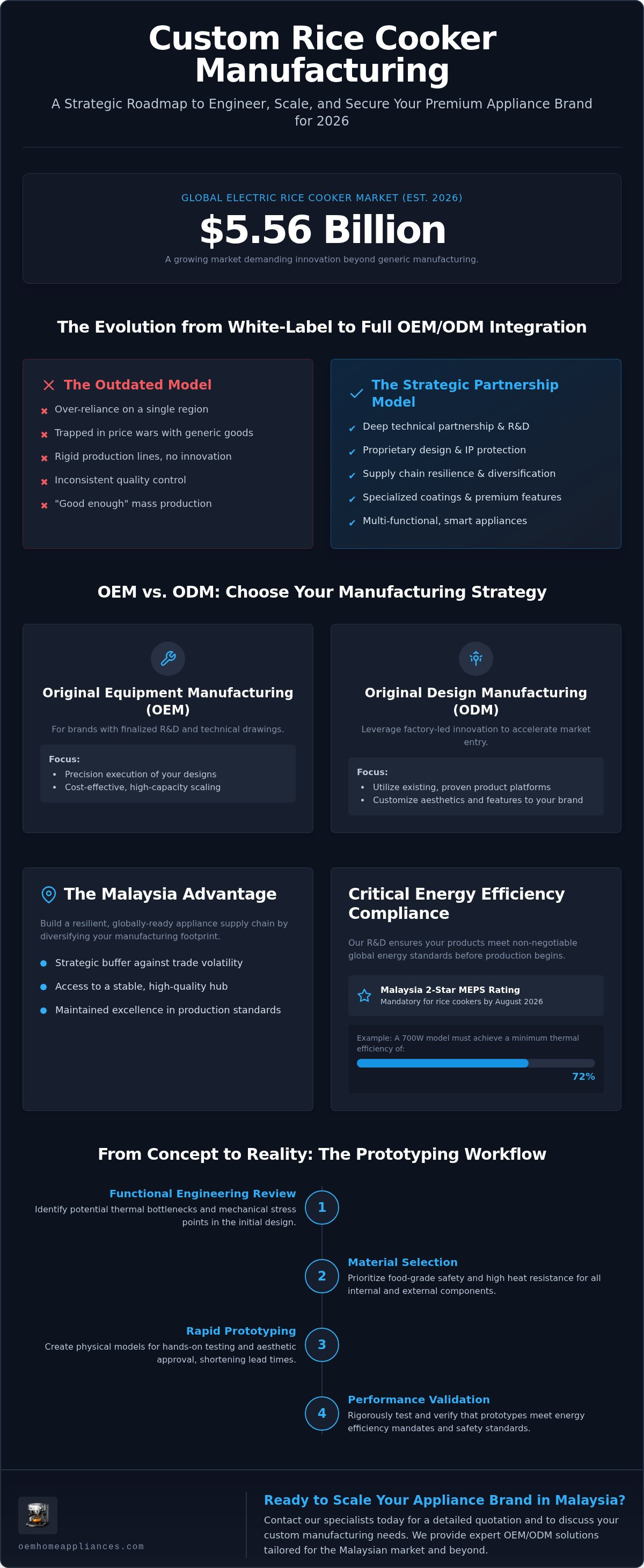
The appliance industry has moved past the era of generic, white-label imports. Today, custom rice cooker manufacturing represents a deep technical partnership where engineering and brand identity converge. Brands no longer just buy factory capacity. They secure intellectual property, specialized industrial coatings, and supply chain stability. While the history of the rice cooker began with simple heating elements and manual switches, the 2026 market demands multi-functional integration and smart connectivity. Consumers want appliances that handle pressure cooking, steaming, and slow cooking within a single, elegant footprint.
Established brands are moving toward bespoke manufacturing because proprietary design is the only way to escape the trap of price wars. A unique aesthetic or a specialized feature, such as an enamel-coated inner pot, creates a barrier to entry that generic competitors cannot match. This shift requires a move from basic procurement to full OEM/ODM integration. Relying on a single manufacturing source is a risk many businesses can no longer afford. Moving production to a resilient hub like Malaysia provides a strategic buffer against trade volatility while maintaining high quality standards.
OEM vs. ODM Models: Choosing Your Strategy
Selecting the right production model is critical for hitting 2026 growth targets. Original Equipment Manufacturing (OEM) suits brands that have already invested in internal R&D and possess finalized technical drawings. This model focuses on precision execution and cost-effective scaling. Conversely, Original Design Manufacturing (ODM) allows brands to leverage factory-led innovation. You can bring a product to market faster by utilizing existing, proven platforms that are then customized to your specifications. Choosing between them depends on your internal engineering resources and your required speed-to-market.
The Role of R&D in Modern Appliance Production
Modern production isn't just about assembly; it's about rigorous research and development. With new regulations like the EU's Ecodesign for Sustainable Products Regulation (ESPR) and Malaysia's 2-star MEPS requirement, energy efficiency is a non-negotiable engineering hurdle. R&D teams must balance these efficiency targets with advanced thermal control to ensure consistent cooking results. Specialized kitchen appliance development serves as a core brand differentiator in a market where technical specs drive purchasing decisions. High-quality custom rice cooker manufacturing requires a partner that can integrate these technical demands with industrial durability. Our product design and development services help brands bridge the gap between complex engineering and high-end kitchen aesthetics.
Technical Customization: From R&D to High-Capacity Production
Execution in custom rice cooker manufacturing depends on a rigorous technical development lifecycle. It isn't enough to have a visionary design; the engineering must be validated at every stage to ensure safety and performance. This process moves from initial concept through functional prototyping before reaching high-capacity assembly. For brands scaling their appliance lines, this methodical approach prevents costly errors in mass production and ensures that every unit meets strict global standards.
The Kitchen Appliance Prototyping Workflow
Prototyping is the bridge between a CAD drawing and a market-ready product. We begin with a comprehensive functional engineering review to identify potential thermal bottlenecks or mechanical stress points. Material selection follows, where we prioritize food-grade safety and high heat resistance for all internal and external components. This is especially critical for rice cookers and blender manufacturing, where friction and heat are constant factors.
Rapid prototyping allows for physical testing and aesthetic approval in a fraction of the traditional lead time. During this phase, we verify that designs meet the latest energy efficiency mandates. As of August 2026, rice cookers sold or manufactured in Malaysia must achieve at least a 2-star MEPS rating. For example, a 700W model must hit a minimum efficiency of 72%. Validating these metrics during the prototyping stage ensures your brand remains compliant with local and international regulations. If you're ready to begin your engineering review, you can discuss your technical specifications with our team.
Engineering for Durability and Performance
Scaling from a handful of samples to high-volume orders requires a stable supply chain and precise component sourcing. We focus on internal components that offer long-term reliability even in high-capacity usage environments. Every unit must maintain consistent wattage and thermal safety across thousands of production cycles. To achieve this, we implement several key strategies:
Component Stress Testing: Subjecting heating elements and sensors to accelerated life testing to simulate years of kitchen use.
Thermal Calibration: Ensuring that thermal cut-offs and sensors operate within tight tolerances to prevent overheating.
Supply Chain Optimization: Sourcing raw materials and electronics locally in Malaysia to reduce lead times and mitigate global shipping disruptions.
By integrating these engineering disciplines early, brands can launch products with confidence. This technical foundation supports a resilient supply chain that can adapt to the growing demand for durable, high-performance kitchen appliances without sacrificing quality consistency.
The Malaysia Advantage: Optimizing Your Appliance Supply Chain
While China has historically dominated the appliance market, 2026 trade dynamics favor geographic diversification. Over-reliance on a single region exposes brands to tariff fluctuations and sudden logistics bottlenecks. Malaysia has emerged as a preferred hub for custom rice cooker manufacturing because it offers a stable legal framework and a mature industrial base that prioritizes intellectual property protection. This stability is essential for established brands that can't afford production halts or supply chain volatility.
Strategic logistics are a core benefit of the Malaysian landscape. The country sits on major global shipping lanes, providing direct access to North American, European, and Asian markets via the Straits of Malacca. Regional trade agreements like the Comprehensive and Progressive Agreement for Trans-Pacific Partnership (CPTPP) and the Regional Comprehensive Economic Partnership (RCEP) facilitate lower duties and streamlined customs for global partners. It's a cost-effective environment for brands that need to move products across borders without the unpredictability often found in other manufacturing regions.
Supply Chain Resilience in Southeast Asia
Reducing geopolitical risk is now a boardroom priority for global appliance brands. By diversifying into Malaysia, companies protect their supply chains from regional trade disputes and shifting international policy. The local ecosystem excels in precision metalwork and electronics assembly. These technical skills are vital for high-end private label manufacturing. Export processes here are highly efficient, allowing for predictable lead times that help kitchen brands maintain lean inventory levels and respond quickly to market demand.
Quality Appliance Manufacturing in Malaysia
Quality consistency is the backbone of any successful B2B partnership. Malaysian factories adhere to rigorous international safety and quality standards, ensuring every unit meets the durability requirements of premium brands. The availability of skilled labor allows for complex assembly tasks that go beyond basic mass production. This expertise is particularly evident in our High Capacity Rice Cooker Factory, where we maintain strict control over every stage of the production cycle. From the initial metal stamping to the final electrical testing, the focus remains on delivering a product that reinforces your brand’s reputation for reliability.
The Malaysian manufacturing sector is built for long-term stability. Businesses looking for a dependable backbone for their product lines find that the combination of technical skill and geographic advantage creates a frictionless path to market. It's about building a partnership that scales with your ambition while mitigating the risks inherent in today's global economy.
Quality Assurance and Material Excellence in Production
High-quality custom rice cooker manufacturing requires a commitment to material excellence that goes beyond basic assembly. Material selection is the primary driver of perceived brand value. In a saturated market, the difference between a mid-market appliance and a premium kitchen tool often lies in the finishing. Specialized coatings don't just improve aesthetics; they extend the operational lifespan of the product. This reduces warranty claims and builds long-term consumer trust. Every component must undergo rigorous testing to ensure it withstands the high-temperature environments of a modern kitchen.
The Value of Industrial Enamel Coating
Enamel is a glass-like finish fused to a metal substrate at high temperatures. It offers superior heat resistance and non-stick properties compared to standard paint finishes. For premium roaster ovens and rice cooker inner pots, enamel provides a hygienic, scratch-resistant surface that does not react with food. It is an ideal choice for brands targeting the high-end market segment where durability is a non-negotiable requirement. Beyond functional performance, enamel allows for a deep, vibrant finish that enhances the product's premium look. You can explore the technical specifics of this application in our Enamel Coating Process guide. These coatings ensure your appliance maintains its appearance and performance even after years of daily use.
Finishing Standards for Metal Components
Corrosion resistance is a critical requirement for metal appliance components. Advanced powder coating provides a thick, protective layer that is more durable than liquid paint. This process is essential for external housings and structural brackets that must resist moisture and heat. Achieving a uniform color and texture across entire product lines is vital for brand consistency. We adhere to strict technical requirements for metal component finishing, ensuring that every batch matches your specific brand palette. This level of precision prevents color drift and ensures that components from different production runs look identical on the retail shelf. If you need to verify the durability of our finishes, you can request a technical consultation for your project.
Rigorous quality control protocols are the final safeguard in large-scale appliance production. Every unit leaving the assembly line must meet exacting standards for electrical safety, thermal calibration, and finish quality. We implement multi-stage inspections, including automated visual checks and manual stress tests. This systematic approach ensures that high-volume orders maintain the same level of precision as the initial prototypes. By focusing on material excellence and strict QA, we provide the industrial strength necessary for your brand to scale with confidence in the global market.
Partnering for Success: Scaling Your Appliance Brand
Scaling a kitchen appliance brand requires more than a simple vendor-client relationship. It demands a partnership-oriented manufacturer that acts as a technical extension of your own operations. Transitioning from a finalized design to high-volume contract manufacturing is where most brands face their greatest risks. A reliable partner mitigates these risks by providing technical oversight, industrial stability, and a clear path to market. Success in 2026 depends on securing a supply chain that is both resilient and capable of precise execution.
Selecting a global OEM supplier shouldn't be a race to the lowest price. Instead, prioritize factories that offer comprehensive technical R&D and scalable production lines. Managing large-scale production cycles requires precise inventory forecasting to avoid stockouts during peak seasonal periods. Your manufacturer should provide the industrial backbone necessary to maintain quality consistency even as order volumes increase. This level of reliability is what separates market leaders from brands that struggle with product failures and delivery delays.
Strategic Sourcing for Private Label Success
Developing a clear roadmap is essential for private label success. You must align factory capacity with your brand's seasonal demand to ensure a smooth supply chain. This involves sharing long-term forecasts and securing production slots well in advance to prevent bottlenecks. For a deeper look at these dynamics, consult our Private Label Kitchen Appliance Manufacturer sourcing strategy. This alignment allows you to focus on marketing and sales while the factory handles the complexities of high-capacity assembly and logistics.
Next Steps for Your Custom Rice Cooker Project
Starting your custom rice cooker manufacturing project begins with a detailed technical brief. This document should outline your R&D requirements, desired materials, and energy efficiency targets. Providing this information early allows the engineering team to conduct an accurate evaluation and provide a realistic timeline for prototyping. Once the technical parameters are set, you can move to the quotation phase for high-capacity manufacturing. A methodical start ensures that the final product meets every brand standard and regulatory requirement.
If you're looking to secure your supply chain with a dependable partner, reach out for a professional consultation. We offer specialized production and R&D support from our industrial hub in Malaysia to help you scale efficiently. Contact oemhomeappliances in Malaysia for custom rice cooker manufacturing quotes to begin your next high-capacity project and secure your 2026 production slots.
Securing Your 2026 Appliance Production Strategy
Success in the kitchen appliance market requires a move away from generic sourcing toward technical innovation and geographic diversification. By prioritizing custom rice cooker manufacturing in Malaysia, your brand gains a significant advantage in supply chain resilience and regulatory compliance. We've explored how technical R&D and performance-validated prototyping ensure your products meet the highest energy efficiency standards, while specialized finishes like industrial enamel and powder coating provide the durability premium brands demand.
As a dedicated B2B OEM/ODM partner, we focus on empowering your brand through precise execution and scalable production. Our Malaysia-based manufacturing hub offers the stability and logistical reach necessary to navigate the global trade dynamics of 2026. Transitioning to a partnership-oriented model ensures that your inventory forecasting and quality control remain consistent as you grow.
Don't leave your 2026 production to chance. If you're ready to engineer a more resilient supply chain, request a manufacturing quotation for your custom rice cooker project in Malaysia. We're ready to help you build a product line that stands out for its quality and reliability.
Frequently Asked Questions
What is the difference between OEM and ODM for rice cooker manufacturing?
OEM (Original Equipment Manufacturing) is for brands that provide their own designs and technical drawings. We execute these specifications with precision. ODM (Original Design Manufacturing) allows brands to utilize our pre-engineered platforms to accelerate market entry. Both models support your 2026 growth targets by offering scalable production. The choice depends on your internal engineering resources and the required speed-to-market for new appliance lines.
Why should a brand choose Malaysia for appliance production over other regions?
Malaysia provides a stable legal framework and geographic diversification that reduces geopolitical risk. It sits on major shipping lanes, providing direct access to global markets via the Straits of Malacca. The country has a mature industrial base with expertise in precision metalwork. This environment is ideal for custom rice cooker manufacturing because it offers predictable lead times and streamlined export processes through regional trade agreements.
What are the benefits of using enamel coating in rice cooker components?
Enamel is a glass-like finish that offers superior heat resistance and a non-stick, scratch-resistant surface. It doesn't react with food, making it a hygienic choice for rice cooker inner pots and roaster ovens. Beyond functionality, it provides a deep, vibrant finish that enhances the premium perception of your brand. This specialized coating differentiates your products from generic competitors that use standard non-stick paints.
How long does the prototyping phase typically take for a custom appliance?
The prototyping workflow starts with CAD design and a functional engineering review. We then move to material selection and physical testing to validate thermal performance. While the duration depends on design complexity, rapid prototyping allows us to approve aesthetics and functionality quickly. This phase is critical for ensuring that custom rice cooker manufacturing projects meet energy efficiency standards, such as the mandatory 2-star MEPS rating in Malaysia.
Can you handle high-volume manufacturing for global appliance brands?
High-volume production cycles are managed for leading global appliance brands at our facility. Our teams handle every stage from initial metal stamping to final electrical safety testing. We implement rigorous quality control protocols to ensure every unit maintains consistent wattage and thermal safety. This industrial strength allows us to scale with your brand's ambition while maintaining the precision required for high-volume kitchen appliance orders.
What quality certifications are standard for Malaysian appliance factories?
Malaysian appliance factories adhere to rigorous international safety and quality standards, including ISO 9001. We also ensure compliance with the Energy Efficiency and Conservation Act, which mandates specific star ratings for appliances. As of August 2026, electric rice cookers must meet a minimum 2-star rating. These certifications ensure that your products are ready for global markets, including regions with strict sustainability requirements like the EU.
Do you provide private label services for other kitchen appliances besides rice cookers?
Private label manufacturing services are available for a wide range of kitchen appliances. This includes air fryers, blenders, kettles, coffee machines, and roaster ovens. Our specialized industrial coatings, such as enamel and powder coating, can be applied across these product lines to ensure brand consistency. We focus on being a comprehensive OEM/ODM partner for established brands looking to expand their small domestic appliance offerings.
How does oemhomeappliances ensure supply chain resilience for its partners?
Supply chain resilience is ensured by sourcing metal components and electronics locally within the Malaysian industrial ecosystem. This strategy reduces lead times and protects your production from global logistics disruptions. We also act as a dedicated partner in inventory forecasting and capacity planning. This collaborative approach helps you manage seasonal demand spikes and maintain a stable supply of products for your global distribution networks.
For a detailed quotation or to discuss our manufacturing services in Malaysia, please contact our team today to secure your production slots.


Comments