Enamel Coating for Appliances: 2026 Manufacturing Guide
Most manufacturers treat surface finishes as a cosmetic afterthought, but for premium appliances, the finish defines the product's lifespan. The enamel coating process for appliances isn't a mere layer of paint. It's a sophisticated molecular fusion of glass and metal that creates a surface harder than the steel it protects. You recognize that your brand's reputation rests on the durability of your products, yet the technical hurdles of chipping and the strict Food (Amendments) Regulations 2026 in Malaysia create significant production pressure.
We understand the need for a finish that withstands extreme heat while remaining environmentally compliant. This 2026 manufacturing guide reveals the technical intricacies of modern enamel application and how it elevates the brand value of your roaster ovens and BBQ grills. You'll gain a clear understanding of the full manufacturing workflow, the economic justification for choosing enamel for premium lines, and the specific criteria for evaluating an OEM partner's technical capabilities in the Malaysian market. By the end of this article, you'll know exactly how to leverage specialized coating to secure a competitive edge in a growing industry.
Table of Contents
Understanding the Enamel Coating Process for High-Performance Appliances
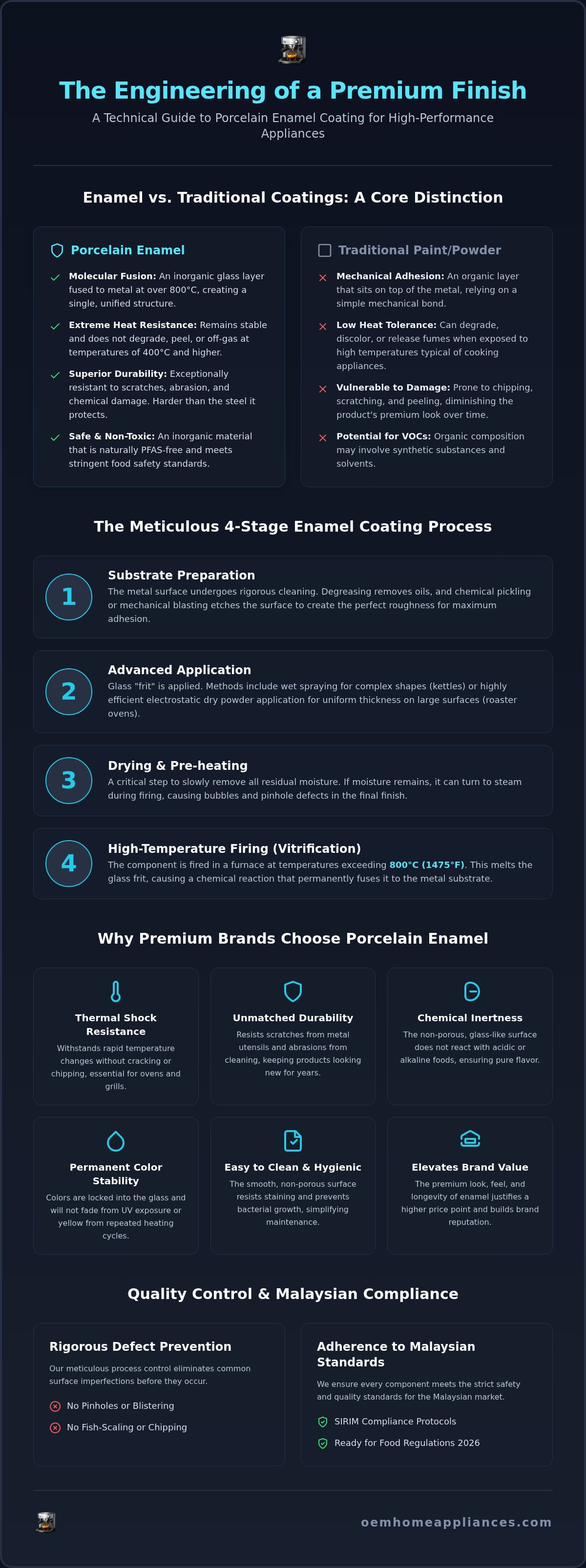
The enamel coating process for appliances isn't just about aesthetics; it's a high-temperature engineering solution. Unlike organic coatings like paint or powder, enamel is an inorganic material. This distinction is vital in 2026 as global regulations tighten on synthetic substances. Many OEM partners now prioritize enamel because it's naturally non-toxic and PFAS-free, meeting the safety expectations of modern consumers. It's the gold standard for high-heat applications like roaster ovens and BBQ grills.
Porcelain enamel is a permanent inorganic finish fused to metal at temperatures exceeding 800°C. This intense heat triggers a transformation where the coating and the metal substrate become a single, unified structure. It provides a level of protection that no liquid finish can match.
The Molecular Bond: Glass Meets Metal
This process begins with "frit," which is granulated glass formulated with specific minerals to achieve desired properties. When heated, the frit melts and reacts chemically with the metal surface. This creates a chemical bond rather than the simple mechanical adhesion found in paint. Vitreous enamel thrives on specific substrates like low-carbon steel and cast iron. These metals offer the thermal stability required to withstand the firing cycle without warping, ensuring a flawless finish for complex appliance components.
Enamel vs. Traditional Paint Finishes
Traditional paints and powders often degrade when exposed to the high operating temperatures of portable cooking equipment. Enamel remains stable. It doesn't off-gas or peel at 400°C. Beyond heat, it offers superior scratch and abrasion resistance. A metal spatula that would ruin a powder-coated surface won't leave a mark on an enameled roaster oven. This durability maintains the product's "new" look for decades. Additionally, enamel provides exceptional color stability. It doesn't fade under UV exposure or yellow after repeated heating cycles. For brands looking to maintain premium aesthetics, our specialized finishing services provide the reliability needed for long-term market success.
The Technical Stages of the Industrial Enamel Coating Process
The industrial enamel coating process for appliances requires a meticulous, multi-stage workflow to ensure the final product meets premium quality standards. It isn't a simple spray-and-dry operation. Each stage, from initial cleaning to the final high-heat vitrification, must be executed with technical precision to prevent long-term defects. This methodical approach ensures that the finish doesn't just look good but performs under the stress of daily kitchen use.
Precision in Substrate Preparation
Adhesion is the foundation of a successful finish. Before any glass is applied, the metal substrate must undergo rigorous cleaning. This involves degreasing to remove oils from the fabrication process and pickling to etch the surface. While mechanical blasting is effective for heavy-duty cast iron BBQ grills, chemical cleaning remains the standard for thin-gauge steel used in rice cookers. Modern factories must manage cleaning byproducts carefully to stay compliant with local environmental standards. Proper surface roughness is essential; a surface that's too smooth won't allow the enamel to bite, leading to chipping later in the product's life.
Advanced Application Methods
Once the surface is ready, the enamel is applied using either wet or dry methods. Wet spraying or dipping is ideal for complex geometries found in kettles and air fryers, ensuring every corner is covered. However, many high-volume roaster oven lines now utilize electrostatic dry powder application. This method is highly efficient, reducing waste and providing a more uniform thickness across large, flat surfaces. According to the Porcelain Enamel Institute, maintaining consistent application thickness is one of the most critical factors in preventing "fish-scaling" and other surface imperfections. Brands looking for consistent quality often discuss technical specifications with their OEM partners to determine the best application method for their specific product design.
After application, components enter the drying and pre-heating stage. This step is critical because any residual moisture can turn into steam during firing, causing bubbles or pinholes in the finish. The pre-heating phase also gradually raises the temperature of the metal, preventing thermal shock when it enters the furnace.
The final stage of the enamel coating process for appliances is firing, also known as vitrification. The parts move through a continuous furnace where temperatures exceed 800°C. At this point, the glass frit melts, flows, and reacts with the metal to form the permanent bond. Precision control of furnace atmosphere and temperature is non-negotiable. Even a slight deviation can alter the color or the chemical resistance of the finish, directly impacting the brand's perceived value.
Performance Advantages: Why Premium Brands Choose Porcelain Enamel
Choosing the right finish is a strategic decision that directly affects a product's market tier. While powder coating is suitable for many entry-level items, the enamel coating process for appliances creates a distinct competitive advantage for premium lines. This inorganic finish offers a combination of physical and chemical properties that organic alternatives simply cannot replicate. For businesses developing high-end roaster ovens or BBQ grills, porcelain enamel remains the gold standard for performance and longevity.
Thermal superiority is the most immediate benefit. Enamel thrives in environments where other coatings fail. It withstands continuous operating temperatures that would cause standard paint to char, smoke, or peel. This makes it indispensable for cooking equipment. Additionally, the porcelain enamelling process results in a surface that's chemically inert. It won't react with acidic foods, alkalis, or harsh cleaning agents. It doesn't stain or absorb odors, ensuring the appliance remains as pristine as the day it was unboxed. This non-porous glass surface also prevents bacterial growth, offering a level of hygiene that consumers increasingly demand in 2026.
Durability in Extreme Conditions
The surface hardness of enamel is exceptional, often ranking between 5 and 7 on the Mohs scale. This makes it nearly impossible to scratch with common kitchen utensils. For outdoor BBQ grills, this durability extends to weather resistance. It doesn't rust or fade under intense UV exposure. End-users appreciate the "easy-clean" nature of the surface. Most burnt-on food residues can be wiped away without abrasive scrubbers, preserving the finish. Our specialized finishing services ensure these durability standards are met through rigorous impact and thermal shock testing.
Aesthetic Versatility for Modern Kitchens
Performance doesn't come at the expense of style. By carefully selecting the glass frit, manufacturers can achieve a wide range of finishes, from high-gloss to sophisticated matte textures. This versatility allows for precise color matching across a full appliance suite, ensuring brand consistency. Enamel-coated components also integrate seamlessly with other premium materials like stainless steel or brushed aluminum. This aesthetic flexibility, combined with its legendary durability, justifies a higher MSRP. It positions the product as a legacy item rather than a disposable commodity, which is essential for building long-term brand value.
Quality Control and Compliance Standards for Enameled Components
Maintaining a high-quality finish requires more than just visual appeal. The enamel coating process for appliances must pass rigorous testing to ensure it survives the lifetime of the product. Visual inspection protocols are the first line of defense. Technicians look for "orange peel" (an uneven surface texture), pinholes (tiny voids), and fish-scaling (small chips that resemble fish scales). These defects aren't just cosmetic; they often signal deeper issues with substrate preparation or firing temperatures that were discussed in previous stages of the manufacturing workflow.
Defect Prevention in the Firing Stage
Consistency is the greatest challenge in high-volume production. We control the furnace atmosphere to prevent oxidation, which can ruin the bond between the glass and metal. Precise temperature ramping and cooling cycles are essential. If a component cools too quickly, internal stresses can lead to immediate or delayed chipping. OEM partners must manage batch consistency by monitoring furnace variables in real-time. This ensures that the thousandth unit off the line matches the first in both color and durability. This level of control is what separates premium roaster ovens from entry-level alternatives.
International Compliance for Global Export
Global market access depends on meeting strict safety and technical standards. ISO 28706 provides the international framework for testing vitreous and porcelain enamels. In Malaysia, the regulatory landscape is shifting to protect consumers. As of August 1, 2026, the Food (Amendments) Regulations 2026 impose strict limits on lead and cadmium release for cooking ware. Specifically, the maximum permitted release is 0.5 mg/L for lead and 0.05 mg/L for cadmium. Manufacturers must also secure SIRIM certification. Since June 2026, the ST-SIRIM safety label must be placed directly on the product itself rather than just the packaging. You can learn more about our manufacturing services to see how we maintain these high standards.
Testing for physical strength is equally critical. The "drop-weight" test is the industrial standard for checking adhesion. It involves dropping a specific weight onto the enameled surface and inspecting the fracture pattern. If the enamel adheres properly, the metal remains covered even if the glass cracks. Finally, consider the environmental impact. Enameled steel is 100% recyclable, unlike many plastic-coated alternatives. This sustainability helps your brand meet the growing consumer demand for eco-friendly appliances in 2026. If you need a partner that understands these technical and regulatory nuances, request a quotation for our Malaysian-based services today.
Strategic OEM Enamel Coating Services in Malaysia
Malaysia has solidified its position as a primary hub for high-tech appliance manufacturing. In June 2026, the Malaysian manufacturing sector reached RM177.0 billion in sales value, a 9.8% increase year-on-year. This growth is largely driven by the electrical and electronics sub-sector, where the enamel coating process for appliances has become a required standard for premium export goods. Brands sourcing from Southeast Asia benefit from a strategic logistical advantage, utilizing Malaysia's robust infrastructure to distribute roaster ovens and BBQ grills to global markets with efficiency and lower transit risks.
Integrated Manufacturing: From Design to Enamel Finish
Working with a partner that combines product design with advanced metal finishing streamlines the entire supply chain. At oemhomeappliances (Keiteq), we integrate the enamel coating process for appliances directly into the assembly workflow. This proximity reduces lead times and eliminates the damage risks associated with transporting semi-finished components between multiple vendors. You can customize your roaster oven lines with brand-specific enamel colors or unique matte textures to ensure your product stands out. For a deeper look at the specific mechanics of this workflow, see our guide on the Industrial Enamel Coating Process for Roaster Ovens.
Scalability and Flexibility for Brand Growth
Flexibility is essential for long-term B2B partnerships. We support our clients through the entire product lifecycle, from small-batch prototyping to high-volume OEM production runs. If your brand is currently using standard powder coats but needs to upgrade for heat resistance, our technical team provides the support needed to transition to high-performance enamel. This shift helps your products meet the mandatory ST-SIRIM safety labels required for the Malaysian market while satisfying international durability expectations. Our focus remains on being the dependable backbone for your brand's expansion.
Our facilities in Malaysia are equipped to handle complex private label projects with precision and industrial scale. If you're looking to enhance your product line with specialized finishing and expert manufacturing, we invite you to contact us for further details. Reach out to our team today to discuss your specific project requirements or to request a quotation for our specialized manufacturing services in Malaysia.
Mastering the Future of Appliance Finishing
The enamel coating process for appliances represents the intersection of material science and premium brand positioning. By moving beyond temporary organic finishes, you ensure your products withstand extreme thermal stress while meeting the rigorous Food (Amendments) Regulations 2026. This guide has detailed how specialized substrate preparation and precision firing create a permanent, hygienic bond that justifies a higher market tier. It's the most reliable way to build a legacy of quality for your customers.
Leveraging a strategic manufacturing hub in Malaysia allows your business to integrate these technical solutions directly into the production line. This synergy reduces logistical risks and guarantees that every unit meets international ISO standards. Partnering with a dedicated B2B expert ensures your brand maintains a competitive edge through scalability and technical excellence. We're ready to act as the silent partner in your brand's success.
Ready to elevate your appliance line with premium enamel finishes? Contact oemhomeappliances for a custom manufacturing quotation in Malaysia today. We look forward to facilitating your brand's growth through industrial-strength manufacturing and precision finishing.
Technical FAQs for Appliance Manufacturers
What is the difference between enamel coating and powder coating for appliances?
Enamel is an inorganic glass-on-metal fusion, while powder coating is an organic plastic resin. The enamel coating process for appliances requires firing at temperatures exceeding 800°C, creating a permanent molecular bond. Powder coating only adheres mechanically and can't withstand the extreme heat of roaster ovens or BBQ grills. Enamel offers superior scratch resistance and chemical inertness, making it the better choice for high-performance kitchen equipment that needs to last for decades.
Is enamel coating safe for food contact surfaces in roaster ovens?
Yes, porcelain enamel is entirely safe for food contact because it's non-porous and won't leach chemicals. In Malaysia, all cooking ware must comply with the Food (Amendments) Regulations 2026, which limit lead release to 0.5 mg/L. Because enamel is inorganic and PFAS-free, it doesn't off-gas at high temperatures. This makes it the ideal surface for roaster ovens and air fryers where food safety and thermal stability are the highest priorities.
How durable is porcelain enamel against chipping and scratching?
Porcelain enamel is exceptionally hard, typically ranking 5 to 7 on the Mohs scale. It resists scratches from metal spatulas and abrasive cleaners that would ruin other finishes. While it's brittle under extreme impact, modern application techniques minimize chipping by ensuring uniform thickness. We use the drop-weight test to verify adhesion strength. This ensures the finish remains intact during shipping and heavy daily use, preserving the appliance's premium appearance and structural integrity.
Can any metal be used for the enamel coating process?
Not every metal is suitable for the high-temperature firing required for enamel. Low-carbon steel and cast iron are the industry standards because they don't warp at 800°C. These metals allow for a strong chemical bond during the vitrification stage. While specialized frits exist for aluminum, most high-performance appliances like BBQ grills and portable cookers rely on steel substrates to ensure the finish doesn't delaminate or crack under repeated thermal cycling.
What are the common defects in the enamel coating process and how are they prevented?
Common defects include:
Fish-scaling caused by trapped hydrogen gas in the steel.
Pinholes resulting from improper moisture removal during drying.
Orange peel from uneven application or incorrect frit viscosity.
We prevent these issues through rigorous substrate preparation, including degreasing and pickling. We maintain strict quality control throughout the enamel coating process for appliances by monitoring furnace variables in real-time to ensure a flawless finish.
How does enamel coating affect the energy efficiency of a rice cooker or oven?
Enamel coating improves energy efficiency by enhancing heat distribution and retention. Its high emissivity allows it to radiate thermal energy more effectively than bare metal or organic coatings. In a rice cooker or oven, this means faster cooking times and more consistent internal temperatures. The smooth, non-porous surface also reflects heat back into the cooking chamber, reducing the energy required to maintain high heat during long cooking cycles.
What is the cost difference between enamel and other appliance finishes for OEMs?
Enamel carries a higher initial cost than powder coating or paint due to the energy-intensive firing process and specialized raw materials. However, for OEMs, this cost is an investment in product longevity and brand positioning. Enamel-coated products command a higher MSRP because they don't rust, fade, or scratch. This durability reduces warranty claims and returns, ultimately providing better long-term value for brands targeting the premium kitchen appliance market in 2026.
How can I find a reliable enamel coating manufacturer in Malaysia?
Finding a reliable partner in Malaysia requires verifying their SIRIM certification and technical infrastructure. Look for an OEM that integrates design with in-house finishing to ensure batch consistency. oemhomeappliances (Keiteq) provides specialized enamel solutions for global brands from our strategic Malaysian hub. We offer the technical expertise needed to navigate the 2026 safety standards while maintaining high-volume production efficiency. Our team is ready to facilitate your brand's growth.
Ready to elevate your appliance line with premium enamel finishes? Contact oemhomeappliances for a custom manufacturing quotation in Malaysia today.


Comments