Expert OEM Kitchen Appliances Manufacturing for Your Brand
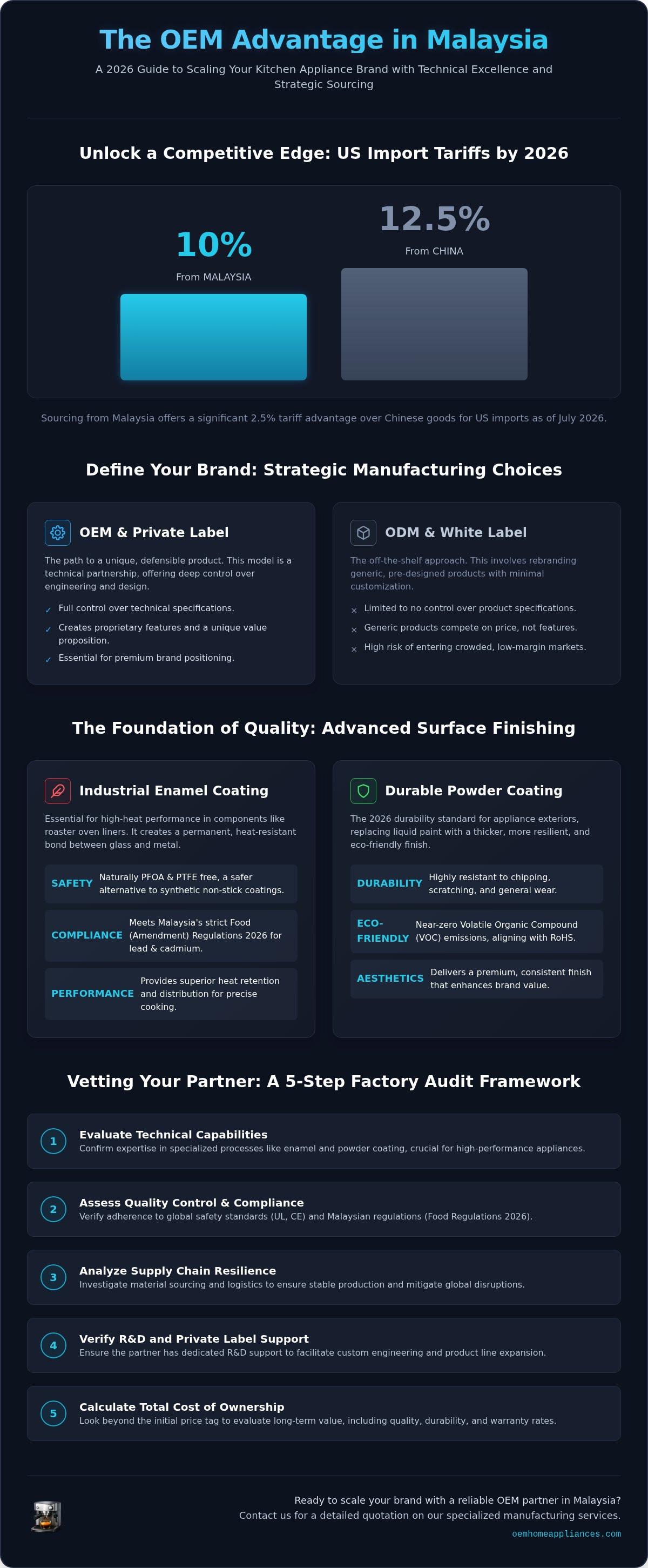
Did you know that shifting your production to Malaysia can lower your US import tariffs to 10% while Chinese goods face a 12.5% rate as of July 2026? For brands scaling in a competitive market, these margins are often the difference between stagnation and growth. You likely agree that sourcing OEM kitchen appliances involves more than just finding a factory; it requires a partner who can manage complex technical requirements like enamel coating and powder-coated metal components without compromising on quality or lead times.
We'll show you how to identify a reliable manufacturing partner and leverage Malaysia's strategic advantages to protect your bottom line. You'll learn how to comply with the new Food Regulations 2026 safety standards and use technical manufacturing solutions to scale your brand effectively. This article previews the essential criteria for selecting a silent partner that prioritizes your brand's reputation through precision, compliance, and industrial scale.
Table of Contents
Understanding the Role of OEM Kitchen Appliances in Brand Expansion
The 2026 kitchenware market is increasingly technical. An Original Equipment Manufacturer (OEM) acts as the industrial backbone for brands that prioritize market share over factory management. While Original Design Manufacturing (ODM) provides ready-made products, the OEM model offers a higher degree of control over technical specifications. This shift from simple rebranding to strategic partnership allows brands to introduce proprietary features without the overhead of maintaining a physical plant.
Established brands are abandoning in-house manufacturing to focus on their core competencies: marketing and customer experience. Managing a factory floor involves massive capital expenditure (CAPEX) and ongoing maintenance costs. By leveraging OEM kitchen appliances, businesses can bypass these financial hurdles. This approach accelerates time-to-market, enabling companies to respond to consumer trends in real-time rather than waiting for internal production lines to retool.
The Strategic Difference Between Private Label and White Label
Private labeling within the OEM framework allows for custom engineering and unique feature sets that distinguish a brand from its competitors. In contrast, white label products are generic, often leading to price wars in a crowded retail landscape. Choosing a private label model requires a higher initial R&D investment but results in a defensible product with a unique value proposition. If your brand aims for premium positioning, custom-engineered solutions are the only viable path. You can explore our manufacturing services to see how we facilitate this customization.
Why Sourcing Specialized Kitchen Equipment Matters
Manufacturing high-heat appliances, such as roaster ovens and BBQ grills, involves significant technical complexity. These products must withstand extreme temperatures while maintaining outer-shell safety. Ensuring compliance with global safety standards like UL or CE is non-negotiable. OEM kitchen appliances are defined as technically customized manufacturing solutions that integrate a brand’s unique design requirements with industrial-grade production standards to create a distinct market identity. Specialized partners manage the intricate details of thermal efficiency and material durability so you don't have to.
Technical Excellence: The Science of Enamel and Powder Coating
Material finish is the primary indicator of quality for the end-user. It signals durability, safety, and brand value. In the role of OEMs in modern supply chains, technical excellence in finishing is often the decisive factor for market success. For OEM kitchen appliances, the surface treatment must perform under extreme conditions. High-quality finishes don't just look better; they reduce warranty claims and build long-term consumer trust by preventing corrosion and wear.
Industrial enamel is essential for high-heat performance. It creates a permanent, heat-resistant bond between glass and metal. This industrial enamel coating is naturally PFOA and PTFE free, making it a safer alternative to synthetic non-stick coatings. As of August 1, 2026, Malaysia's Food (Amendment) Regulations 2026 have tightened migration limits for lead and cadmium in cooking appliances. Using porcelain enamel ensures your products meet these stricter safety standards while providing superior heat retention and hygiene.
Powder coating has replaced liquid paint as the 2026 durability standard for appliance exteriors. It offers a thicker, more resilient finish that resists chipping and scratching. From a manufacturing perspective, powder coating provides near-zero Volatile Organic Compound (VOC) emissions. This aligns with global RoHS directives and PFA reporting requirements. If you're looking to upgrade your product's finish, you can discuss your technical specifications with our engineering team.
Engineering High-Performance Roaster Ovens
Roaster ovens require precise internal temperature regulation. We achieve this through specialized enamel-coated liners that distribute heat evenly. The challenge lies in balancing these high-heat internal components with aesthetic powder-coated exteriors that remain cool to the touch. Custom roaster oven manufacturing remains a high-margin category because it combines these complex thermal requirements with premium design. Our manufacturing services specialize in this technical balance, ensuring your appliance performs safely at maximum capacity.
Advanced Components for Air Fryers and Rice Cookers
Modern air fryers and rice cookers demand precision in every component. Precision-engineered powder-coated metal components provide the sleek, matte, or metallic finishes consumers expect in 2026. These components must house sensitive electronics and smart sensors without compromising the physical integrity of the unit. We integrate durable hardware with modern non-stick requirements, ensuring the component housing remains stable under repeated thermal cycling. This meticulous approach to hardware ensures your OEM kitchen appliances feel premium and operate reliably for years.
Strategic Advantages of OEM Kitchen Appliance Manufacturing in Malaysia
Global brands are rapidly adopting "China Plus One" strategies to mitigate supply chain risks. Relying on a single manufacturing source has become a liability in the 2026 market. Malaysia has emerged as the primary beneficiary of this shift, offering a sophisticated ecosystem for OEM kitchen appliances that rivals traditional hubs. By diversifying production into Malaysia, brand owners protect themselves against regional disruptions and rising labor costs elsewhere.
Financial incentives further strengthen the case for manufacturing in Malaysia. The New Incentive Framework (NIF), implemented in Q1 2026, offers a Special Tax Rate (STR) that can reduce corporate income tax to between 0% and 10% for eligible manufacturing investments. Additionally, Malaysian goods currently enjoy a 10% tariff rate for US imports, providing a clear cost advantage over the 12.5% rate applied to Chinese exports as of July 2026. These margins allow brands to reinvest in R&D or aggressive marketing campaigns.
Logistics and Export Efficiency
Malaysia's geographical position provides direct access to the world’s busiest shipping lanes. Proximity to major distribution centers ensures that large-scale appliance orders reach Western markets with minimal delay. Participation in the Comprehensive and Progressive Agreement for Trans-Pacific Partnership (CPTPP) and the Regional Comprehensive Economic Partnership (RCEP) further eases market access. These agreements reduce duties on raw materials, making the production of OEM kitchen appliances more cost-effective for global distribution.
Quality Assurance and Regulatory Compliance
Adherence to international standards is a hallmark of the Malaysian manufacturing sector. Factories operate under strict ISO guidelines and maintain SIRIM certification, which aligned with the latest IEC 2024 editions earlier this year. This regulatory environment ensures that every product meets rigorous safety and performance benchmarks. Malaysia also maintains robust intellectual property protection laws, providing a secure environment for brands to share proprietary designs.
Maintaining reliable OEM appliance supplier status requires consistent factory audits and transparency. In 2026, SIRIM testing fees for home appliances typically range between $2,000 and $8,000 USD, reflecting the thoroughness of the certification process. This commitment to quality assurance means that products manufactured here are ready for immediate export to highly regulated markets in Europe and North America without the risk of compliance failures.
Partner Evaluation: How to Audit an Appliance Factory
Auditing a potential partner is a critical exercise in risk mitigation. While many procurement officers focus on the initial unit price, sophisticated brands evaluate the total cost of ownership (TCO). This calculation includes logistics, compliance costs, and the potential for warranty claims. To ensure you select a reliable partner for OEM kitchen appliances, follow this 5-step audit process:
Confirm Technical Certifications: Verify that the factory holds valid ISO standards and regional certifications like SIRIM.
Inspect Specialized Infrastructure: Evaluate the quality of enamel and powder coating lines to ensure they meet the durability standards discussed earlier.
Review Quality Control Protocols: Examine both in-line assembly checks and final batch testing procedures.
Assess Supply Chain Resilience: Review the manufacturer’s raw material sourcing and their ability to navigate trade shifts.
Evaluate Communication Standards: Test the responsiveness and technical knowledge of dedicated account managers.
Local presence and regional expertise are vital for effective quality control. A manufacturer that understands the specific regulatory landscape of Malaysia, including the latest safety standards, acts as your eyes and ears on the ground. This transparency reduces the need for expensive third-party inspections. It ensures that production stays on schedule. If you're ready to begin this evaluation, request a factory audit overview from our team to see how we maintain our production standards.
Assessing R&D and Prototyping Capabilities
Your partner should do more than follow instructions; they must provide technical improvements. Evaluate the speed of the initial design-to-prototype phase. Modern manufacturing relies on advanced 3D modeling and CAD tools to identify thermal or structural issues before physical production begins. A capable manufacturer suggests modifications to enamel-coated liners or housing components to improve performance. You can view our full range of product development services to understand how we support this technical refinement.
Scalability and Capacity Planning
Future-proofing your brand requires a partner that scales as you grow. Discuss Minimum Order Quantity (MOQ) flexibility early in the relationship. While large-scale production offers efficiency, the ability to test new appliance lines with smaller batches is a significant competitive advantage. Verify the factory’s annual production capacity to ensure they can handle your projected volume for the next three years. Clear communication regarding seasonal demand and production scheduling prevents the long lead times that often plague oversaturated markets.
Scaling Your Brand with oemhomeappliances in Malaysia
Choosing a manufacturing partner is a decision that defines your brand’s future stability. At oemhomeappliances, we operate as a "Silent Partner" for established global labels, providing the industrial strength necessary to expand your product lines without the risks of in-house production. We don't sell directly to retail. This ensures that we never compete with our clients, allowing us to focus entirely on your success as a dedicated OEM kitchen appliances provider. Our expertise centers on high-precision roaster ovens, rice cookers, and air fryers, where technical durability is paramount.
Success in the premium appliance sector requires more than just a functional product; it requires a superior finish. Our advanced enamel and powder coating facilities provide a level of heat resistance and aesthetic quality that generic manufacturers cannot match. By leveraging our private label kitchen appliance manufacturer strategies, you can introduce custom-engineered features that secure your position in the 2026 market. We combine Malaysia’s geographical advantages with our specialized metal finishing capabilities to deliver products that are ready for immediate global distribution.
Our Bespoke Manufacturing Workflow
We've streamlined our production process to prioritize clarity and speed. Every project begins with a detailed design consultation where we align your brand’s vision with our technical capabilities. Our workflow integrates specialized metal finishing directly into the production line, ensuring that enamel-coated liners and powder-coated exteriors meet your exact specifications. From initial prototyping to the final quality inspection, we maintain a methodical approach to eliminate inconsistencies. You can explore our full manufacturing services to see how we handle branding, packaging, and technical customization at scale.
Request a Quotation for Your Next Project
Starting a consultation for Malaysian manufacturing is a straightforward process. To receive a fast and accurate quote, prepare your technical requirements, including desired MOQs, material specifications, and any specific safety certifications your market requires. Our engineering team reviews these details to provide a comprehensive cost analysis that reflects the total cost of ownership. We invite global brands to experience the precision and reliability of Malaysian engineering firsthand through our dedicated facility.
If you're looking to scale your appliance brand with a reliable partner in Malaysia, reach out to us today. Contact oemhomeappliances for further details on our production capacities or to request a formal quotation for your next project. Our team is ready to provide the technical support and industrial scale your brand needs to thrive in a competitive landscape.
Secure Your Manufacturing Future in Malaysia
Selecting the right partner for OEM kitchen appliances is a strategic decision that defines your brand's market position. Technical precision in enamel coating and powder finishing ensures your products meet the rigorous durability and safety standards required in the 2026 market. By leveraging Malaysia’s position as a global logistics hub, your brand gains access to favorable trade agreements and streamlined export processes that directly protect your bottom line. These regional advantages, combined with a highly skilled workforce, provide the stability needed to navigate complex global supply chains effectively.
We remain a dedicated B2B facilitator with a strict focus on your brand's growth. We don't compete with our clients in the retail space, ensuring your proprietary designs and market share remain secure. Our specialized enamel coating facilities and R&D resources are fully committed to your success. Ready to scale your production with a reliable partner? Contact oemhomeappliances for a manufacturing quotation in Malaysia to discuss your technical requirements. We look forward to building a resilient and profitable partnership with your brand.
Frequently Asked Questions
What is the typical MOQ for OEM kitchen appliances in 2026?
Typical Minimum Order Quantities (MOQs) generally range from 500 to 1,000 units depending on the technical complexity of the appliance. While high-volume production offers the best cost efficiency, we often discuss flexible batch sizes for established partners launching new product lines. This approach helps brands manage their inventory risk while leveraging our industrial scale for mass production.
How does enamel coating differ from standard non-stick surfaces in appliances?
Enamel coating is a permanent glass-to-metal bond that is naturally PFOA and PTFE free, unlike many synthetic non-stick surfaces. It provides superior heat retention and can withstand extreme temperatures without peeling or degrading. For premium OEM kitchen appliances, enamel offers a more hygienic, scratch-resistant surface that meets the strictest food safety standards enforced in 2026.
Why should a brand choose Malaysia over other manufacturing hubs for appliances?
Malaysia provides a significant competitive edge through lower US import tariffs, which sit at 10% compared to 12.5% for Chinese goods as of July 2026. The country’s New Incentive Framework also offers corporate tax rates as low as 0% for eligible manufacturing investments. Brands benefit from a highly skilled workforce and a stable regulatory environment that prioritizes intellectual property protection.
Can oemhomeappliances handle both OEM and ODM project requests?
We provide both OEM and ODM services to accommodate different brand expansion strategies. Our team can manufacture products based on your proprietary technical drawings or provide ready-engineered solutions that require only private label branding. This flexibility allows you to choose between deep technical customization and faster time-to-market for standard appliance categories.
How long does the prototyping process take for a new roaster oven design?
The prototyping phase for a new roaster oven typically takes between 4 to 8 weeks from the initial design consultation. This timeline includes CAD modeling, thermal efficiency testing, and the production of a functional sample with custom enamel liners. We prioritize precision during this stage to identify any structural or performance issues before moving into full-scale mass production.
What safety certifications do your kitchen appliances typically carry?
Our appliances carry globally recognized certifications including UL, CE, and SIRIM, ensuring they are ready for export to regulated markets. These certifications confirm that our products meet the latest IEC 2024 editions and the safety standards introduced in August 2026. We maintain rigorous testing protocols to ensure all OEM kitchen appliances comply with international lead and cadmium migration limits.
Do you offer custom packaging and private label branding services?
We provide comprehensive private label services that include custom logo integration and bespoke packaging designs. Our manufacturing workflow ensures that your branding is applied with precision to the appliance housing and all retail packaging. This results in a product that is fully retail-ready and aligned with your brand’s aesthetic identity upon arrival at your warehouse.
What are the logistics benefits of shipping from Malaysia to global markets?
Shipping from Malaysia offers direct access to major global shipping lanes through world-class ports like Port Klang. Participation in trade agreements such as the CPTPP and RCEP reduces duties on raw materials and simplifies the export process for international brand owners. These logistical advantages result in shorter lead times and more predictable shipping costs compared to landlocked or oversaturated manufacturing regions.


Comments