High Capacity Rice Cooker Factory: A 2026 Global Manufacturing Reference
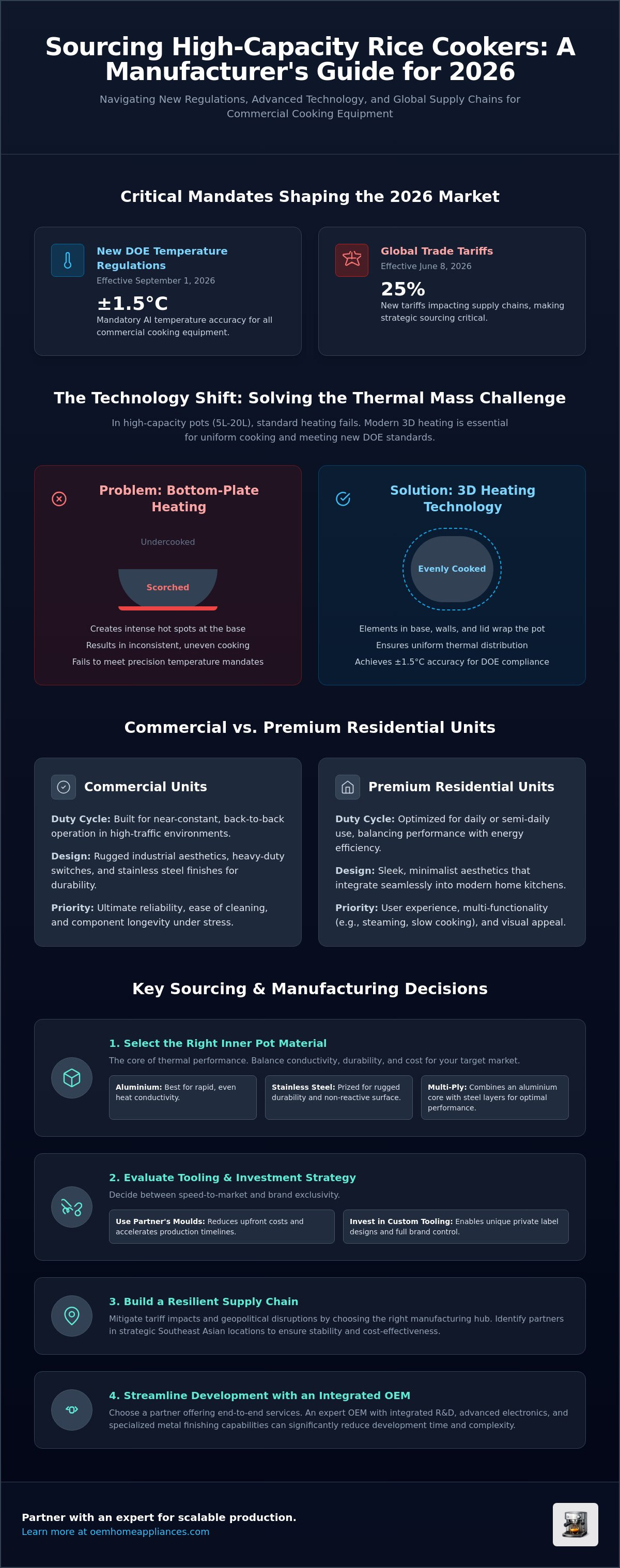
Did you know that as of September 1, 2026, new DOE regulations mandate that commercial cooking equipment must maintain AI temperature accuracy within ±1.5°C? For brands scaling their product lines, this shift transforms production from a simple assembly task into a complex feat of thermal engineering. You likely already understand that inconsistent heat distribution is the silent killer of large-volume pots. Finding a high capacity rice cooker factory that can solve these technical hurdles while navigating the 25% tariffs effective since June 8, 2026, is now a critical competitive necessity.
We recognize the frustration of long lead times from oversaturated hubs and the difficulty of sourcing partners who handle both specialized metal coating and advanced electronics. This article will help you master the technical and logistical requirements for sourcing high-capacity models from a specialized OEM partner. We'll explore essential certifications like NSF and CE, compare the durability of enamel versus non-stick coatings, and outline strategies to build a resilient supply chain that thrives under the latest global trade standards.
Table of Contents
Defining the High Capacity Rice Cooker Manufacturing Landscape
High-capacity rice cookers represent a specialized segment of the kitchen appliance market. While standard units cater to small households, high-capacity models exceed 5L and often reach 10L or 20L for commercial applications. A dedicated high capacity rice cooker factory focuses on the structural and electronic requirements necessary to handle these larger volumes. These units serve three primary B2B markets: the hospitality sector, large-scale catering firms, and premium retail brands targeting large families or meal-prep enthusiasts.
The evolution of rice cooker technology has transitioned from simple heating coils to complex induction systems. This shift is vital for high-capacity units because of the "Thermal Mass Challenge." Larger volumes of rice and water create significant thermal inertia. If a factory uses a standard bottom-plate heating configuration, the bottom layer of rice often scorches while the top remains undercooked. To solve this, 2026 manufacturing standards prioritize 3D heating or multi-zone induction to ensure heat penetrates the entire core of the pot.
Modern buyers also demand versatility. The 2026 market has moved away from single-purpose machines. High-capacity units now integrate steaming, slow cooking, and pressure functions. This multi-functionality allows businesses to maximize counter space and reduce the total number of appliances required in a commercial kitchen. It's a shift toward efficiency that requires factories to integrate sophisticated control boards capable of managing diverse cooking algorithms.
The 5L to 10L Segment: Engineering for Scale
Engineering for the 5L to 10L range requires a significant increase in wattage to achieve rapid boiling. Without sufficient power, the soaking phase lasts too long, resulting in mushy grains. Additionally, a high capacity rice cooker factory must utilize reinforced outer housing. Large pots generate immense internal heat that can cause standard plastic or thin metal casings to warp over time. Steam vent design is equally critical. Larger batches produce massive amounts of starch-heavy steam; vents must be engineered to prevent overflow and spitting that can create safety hazards or messy cleanup.
Commercial vs. Premium Residential High-Capacity Units
The distinction between commercial and residential models lies in both form and function. Commercial units prioritize rugged industrial aesthetics with heavy-duty switches and stainless steel finishes that withstand high-traffic environments. In contrast, premium residential models favor sleek, minimalist designs that fit modern home kitchens. The internal components also differ based on expected usage patterns.
The most critical difference is the duty cycle. The duty cycle is the factory-rated operational frequency for high-capacity units, measuring how many consecutive cycles a machine can run without component failure. Commercial units are built for near-constant operation, whereas residential models are optimized for daily or semi-daily use. Choosing a partner that understands these distinct engineering requirements ensures your brand delivers a product that matches the customer's environment.
Technical Core: Thermal Precision and Enamel Coating Excellence
Achieving consistent results in large-volume cooking requires a departure from standard consumer-grade engineering. A high capacity rice cooker factory must prioritize 3D heating technology over traditional bottom-plate elements. While bottom heaters are sufficient for 1.5L pots, they create hot spots in 10L or 20L units. 3D heating utilizes elements in the lid and around the sidewalls to wrap the inner pot in a uniform thermal field. This ensures that every grain, from the base to the surface, receives identical heat energy. By integrating these advanced thermal systems, manufacturers can meet the 2026 DOE requirement for AI temperature accuracy within ±1.5°C.
The choice of inner pot material serves as the foundation for heat retention. Aluminium remains the industry standard for rapid thermal conductivity, yet stainless steel is increasingly favored for its rugged durability in commercial environments. To bridge the gap, premium models often utilize multi-ply pots that bond an aluminium core between layers of stainless steel. This combination provides the rapid response of aluminium with the non-reactive, easy-clean surface of steel. Selecting the right material is a strategic component of strengthening supply chain resilience, as it reduces the frequency of replacement parts and warranty claims.
Enamel coating has emerged as a superior alternative to standard non-stick PTFE. Unlike traditional coatings that may degrade or peel under high-heat commercial use, enamel is fused to the metal at extreme temperatures. This creates a glass-like surface that is chemically stable and incredibly scratch-resistant. For the exterior, powder-coated housings offer more than just a sleek aesthetic. These coatings improve heat dissipation and provide a tactile, safe-to-touch surface even during extended duty cycles. Brands seeking these technical advantages can consult with oemhomeappliances to explore bespoke configurations tailored to specific market needs.
Advanced Metal Finishing for Premium Appliances
Industrial enamel coating involves a multi-stage process where powdered glass is fused to the metal substrate. This results in a finish that resists acidic foods and heavy scouring, making it ideal for high-volume catering. For private label brands, powder coating provides a versatile palette for branding while maintaining superior resistance to chipping and fading compared to liquid paint. This durability ensures that the appliance maintains its premium look even after years of heavy use.
Electronic Control Systems and Sensor Accuracy
The 2026 generation of high-capacity cookers relies on Fuzzy Logic and AI-driven sensors to monitor moisture levels in real-time. NTC (Negative Temperature Coefficient) thermistors are essential for safety, providing instant feedback to the control board to prevent overheating in units exceeding 5L. These specialized custom roaster oven manufacturing techniques are often applied here, ensuring that electronic housings remain insulated from the intense heat generated by large-scale cooking elements.
Evaluating a Rice Cooker Factory: OEM vs. ODM Models
Selecting a high capacity rice cooker factory requires a strategic choice between OEM and ODM models. In the ODM (Original Design Manufacturing) model, you select a pre-engineered unit from the factory's existing catalog. This path is highly cost-effective because it utilizes existing high-capacity moulds, which represent a significant capital investment. It's an ideal choice for brands prioritizing speed to market. Conversely, the OEM (Original Equipment Manufacturing) model allows you to provide proprietary designs. This is necessary if your brand requires unique features, such as a specific enamel coating thickness or a custom-engineered 3D heating array.
The financial decision often hinges on the cost-benefit of custom tooling. Developing a new mould for a 10L or 20L inner pot is a major undertaking. If your volume projections justify the expense, custom tooling ensures your product remains unique in a competitive market. However, many brands find success by starting with an ODM base and requesting specific modifications to the exterior housing or control interface. Regardless of the model, protecting your Intellectual Property (IP) is paramount. Ensure your manufacturing contract includes clear ownership clauses for any custom-developed logic, specialized sensors, or mechanical designs.
The Prototyping and Tooling Process
Moving from a CAD drawing to a functional sample is a multi-stage journey. In the early R&D phase, 3D printing allows your team to verify the ergonomics of handles and the placement of steam vents without the cost of metal tooling. Once the design is finalized, the factory begins custom mould creation, a process that typically spans 45 to 60 days for large-format components. This culminates in the "Golden Sample" approval. This approved unit serves as the definitive quality benchmark for the entire mass production run.
Factory Audit Checklist for Brand Managers
A reliable partner must demonstrate both technical skill and industrial stability. Use this checklist to evaluate a potential high capacity rice cooker factory before signing a contract:
Mandatory Certifications: Verify ISO 9001 for management quality, alongside CE, ETL, and 3C for global market compliance.
Production Scalability: Assess the monthly unit capacity to ensure the factory can meet peak season demand without extending lead times.
In-house Testing: Confirm the presence of dedicated labs for thermal stress testing and electrical safety verification.
Verifying these capabilities ensures your brand is backed by a facility that can handle the rigors of high-volume appliance production while maintaining strict safety standards.
Global Sourcing Strategy: Navigating Supply Chain Resilience
The global manufacturing landscape has undergone a fundamental shift. In 2026, the "China Plus One" strategy is no longer a theoretical concept; it's a operational necessity for brands scaling their appliance lines. Geopolitical tensions and the 25% tariff on commercial rice cookers (HS Code 8516.60) effective since June 8, 2026, have forced procurement officers to look beyond traditional hubs. Identifying a high capacity rice cooker factory in Malaysia or Southeast Asia offers a strategic advantage. These regions provide a stable regulatory environment and competitive logistics while bypassing the heavy fiscal penalties associated with other manufacturing centers.
Lead time management for bulk orders requires meticulous planning when dealing with units exceeding 5L. High-capacity models involve more complex assembly and longer testing phases than standard consumer units. Managing the volatility of aluminium and steel prices is another critical factor. A seasoned factory partner maintains deep relationships with raw material suppliers to lock in pricing early. This procurement power protects your margins from sudden market spikes in metal costs. If you're ready to diversify your production and stabilize your costs, partner with oemhomeappliances to secure a resilient supply chain outside traditional hubs.
Logistics and Distribution for Large-Scale Orders
Shipping high-capacity units presents unique challenges because they occupy significantly more container space than standard 1.5L models. This increased volume can drive up the landed cost per unit if logistics aren't optimized. Some brands utilize "Knocked Down" (KD) shipping for specific markets, where components are packed flat to maximize container density and assembled closer to the final destination. However, the most effective way to control costs is factory proximity to major deep-water ports. Reducing drayage times and inland freight expenses is essential for maintaining a competitive price point in the hospitality and catering sectors.
Quality Assurance in High-Volume Production
Maintaining quality at scale requires adherence to strict AQL (Acceptable Quality Level) standards. High-capacity appliances undergo intense thermal stress, so your factory must integrate third-party inspections from reputable agencies like SGS or Intertek directly into the workflow. These inspections verify that every batch meets the specialized requirements for commercial use. In 2026, 100% electrical safety testing is non-negotiable for high-capacity units due to the significant power draw required for large-volume cooking. These rigorous checks ensure that every unit leaving the floor is safe, reliable, and ready for the high-duty cycles of a professional kitchen.
Partnering with oemhomeappliances for Scalable Production
Selecting the right high capacity rice cooker factory is a strategic decision that determines your brand's market position. At oemhomeappliances, we operate as a Trusted Expert Facilitator for global brands looking to expand their professional kitchen lines. We provide the industrial backbone needed to turn complex product concepts into scalable reality. Our approach prioritizes stability and long-term partnership over short-term gains. By integrating advanced R&D with specialized metal finishing, we ensure your products meet the rigorous 2026 standards for thermal precision and durability. We remain a dedicated B2B service provider; we do not compete with our clients in direct-to-retail markets or through third-party distribution agents.
Our role is to empower your brand with quiet authority and technical excellence. We understand that high-capacity appliances require more than just larger pots. They demand a deep understanding of electrical safety, material science, and duty-cycle reliability. When you partner with us, you gain access to a seasoned team that manages the practicalities of production and distribution with meticulous execution. We act as your silent partner, providing the flexibility and industrial strength necessary to navigate shifting global trade requirements while maintaining a premium brand identity.
Our Manufacturing Capabilities
Our facility is engineered for high-volume output without compromising on precision. We maintain dedicated production lines for both rice cookers and roaster ovens, allowing for simultaneous scaling of multiple product categories. Our infrastructure includes:
Specialized Metal Finishing: In-house enamel and powder coating facilities provide premium durability and aesthetic versatility for private label branding.
Integrated R&D: Our engineering team handles complex product design and development, moving projects efficiently from initial CAD drawings to mass production.
Advanced Assembly: High-volume lines optimized for the 5L to 20L segment, ensuring consistent quality across large-scale orders.
Your Path to Market with oemhomeappliances
Success in the appliance sector requires a methodical approach to product entry. Our process begins with a professional business consultation to identify your specific manufacturing and customization needs. We provide full supply chain transparency, ensuring you remain informed about raw material sourcing and production milestones. This clarity allows you to manage your inventory and marketing timelines with confidence. We focus on maintaining quality consistency through every batch, utilizing the 100% electrical safety testing and AQL standards discussed previously. Our goal is to provide a frictionless path from design to global distribution.
Future-Proofing Your Appliance Line for 2026 and Beyond
Successful manufacturing in 2026 requires more than just scaling up production. It demands a sophisticated blend of thermal engineering and supply chain resilience. Brands that prioritize AI-driven temperature precision and diversify their sourcing to bypass the latest tariff regulations will lead the hospitality and retail markets. Transitioning to enamel-coated components ensures a level of durability that standard non-stick surfaces simply can't match in high-duty environments. Selecting a specialized high capacity rice cooker factory is the first step toward securing this competitive edge.
At oemhomeappliances, we specialize in enamel and powder-coated metal components, providing the technical expertise needed for premium results. We act as a dedicated B2B private label partner, which means we don't compete with your brand at retail. Our comprehensive product design and development services handle everything from initial CAD prototypes to final mass production. We're ready to help you navigate the complexities of global logistics and technical compliance. Partner with oemhomeappliances for Your Next High-Capacity Project and build a product line designed for long-term growth.
Frequently Asked Questions
What is the standard capacity for a commercial rice cooker?
Standard capacities for commercial rice cookers typically range from 5L to 20L, which translates to roughly 30 to 60 cups of cooked rice. These larger volumes are designed specifically for the hospitality and catering sectors where high throughput is required. Units at the higher end of this scale often feature specialized handles and reinforced bases to support the significant weight of the food during operation.
How do high-capacity rice cookers differ from residential models?
Commercial units are built for a higher duty cycle, meaning they can run consecutive cooking programs without component failure. Unlike smaller residential models, a high capacity rice cooker factory will engineer these units with 3D heating elements or induction technology to ensure even thermal distribution through large batches. The housing is also more rugged, often using stainless steel or powder-coated metal to withstand professional kitchen environments.
What certifications should I look for in a rice cooker factory?
Essential certifications for global market entry include NSF for food safety, CE for European compliance, and ETL or UL for North American electrical standards. You should also verify that the facility maintains ISO 9001 quality management systems. In 2026, mandatory energy efficiency compliance, such as the DOE standby power rule and AI temperature accuracy requirements, is a critical verification point for any reputable manufacturing partner.
Can I customize the inner pot coating for my private label brand?
Yes, private label partners can customize inner pot materials and coatings to align with their brand's health and durability standards. Options range from traditional non-stick PTFE to premium alternatives like ceramic or industrial-grade enamel. Many brands now request PFOA-free or PFAS-free coatings to meet increasing consumer demand for non-toxic cookware and to simplify the regulatory approval process in European markets.
What is the typical MOQ for high-capacity rice cooker orders?
Minimum Order Quantities (MOQs) for high-capacity models generally start between 500 and 1,000 units per production run. This threshold allows the high capacity rice cooker factory to maintain cost efficiencies in raw material procurement and production line setup. If your project requires custom tooling or unique electronic configurations, the MOQ might be higher to offset the initial engineering and R&D costs associated with bespoke designs.
How does enamel coating compare to Teflon in high-volume cooking?
Enamel coating offers superior scratch resistance and chemical stability compared to standard Teflon-based non-stick surfaces. While Teflon is convenient for low-stick properties, it can peel or degrade under the intense scouring and high-heat cycles typical in commercial kitchens. Enamel is a glass-fused surface that doesn't react with acidic foods, making it a more durable, long-term choice for professional-grade appliances that undergo heavy daily use.
What are the lead times for custom appliance manufacturing in 2026?
Standard production lead times typically range from 45 to 60 days once the design is finalized. However, if your project involves custom mould creation or specialized product development, the timeline can extend to three or six months. These timelines account for the rigorous testing phases and the "Golden Sample" approval process required to ensure quality consistency and electrical safety before mass production begins.
Is it better to source rice cookers from Malaysia or China?
Sourcing from Malaysia is often the better strategic choice in 2026 due to the 25% Section 232 tariffs applied to certain traditional manufacturing hubs. Malaysia offers a stable regulatory environment and competitive logistics without the same geopolitical trade risks. While China remains a massive hub, diversifying your supply chain to Southeast Asian partners provides greater resilience against trade disruptions and helps stabilize the total landed cost of your products.


Comments