High Volume Blender Manufacturing: A Comprehensive Guide for B2B Partners
Choosing the wrong manufacturing partner for high volume blender manufacturing doesn't just slow your production timeline. It can compromise your brand's reputation, inflate your costs, and leave you locked into specifications that don't serve your market. It's a risk that too many B2B buyers discover only after contracts are signed.
If you've spent time trying to evaluate manufacturers and found yourself uncertain about quality standards, minimum order volumes, or how much flexibility a supplier will actually offer, you're not alone. These are the precise friction points that derail promising product launches before they begin.
This guide is built to change that. You'll gain a clear understanding of what the manufacturing process actually involves, how to assess a potential partner's capabilities with confidence, and what customization options a reliable manufacturer should be able to provide. From production specifications to private label possibilities, every section is designed to sharpen your decision-making and help you move forward with clarity. Whether you're scaling an existing product line or entering the market for the first time, the right information makes all the difference.
Table of Contents
What to Look for in High Volume Blender Manufacturing
Selecting a manufacturing partner is one of the most consequential decisions a B2B buyer will make. Get it right, and you gain a scalable production engine that supports your brand's growth. Get it wrong, and you're managing quality failures, missed deadlines, and costly rework. Knowing exactly what to evaluate before committing is the difference between those two outcomes.
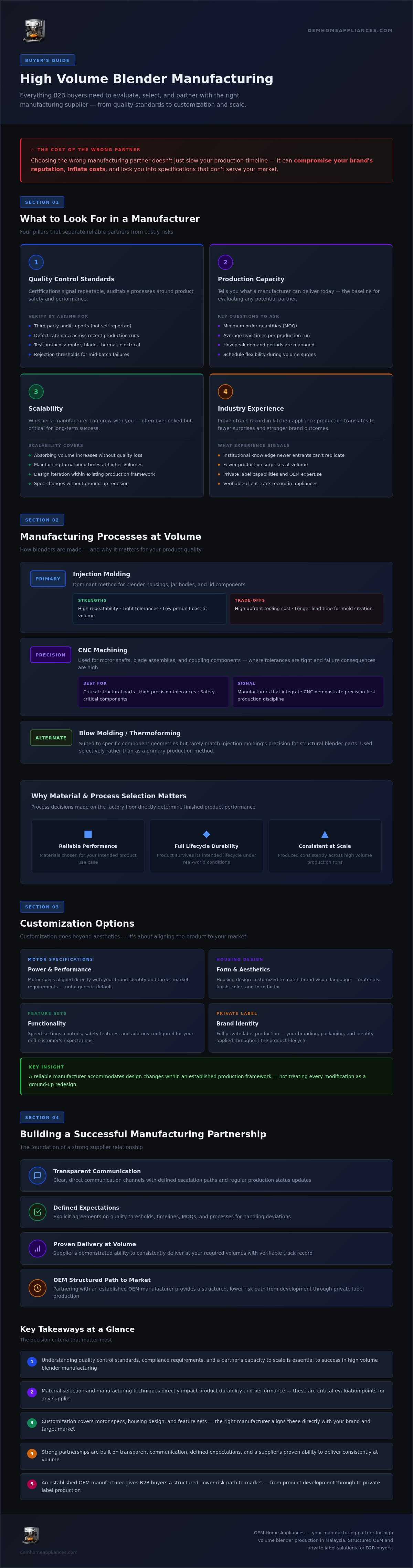
Four evaluation pillars matter most: quality control standards, production capacity, scalability, and industry experience. Each one reveals something different about a manufacturer's ability to deliver consistently at volume.
Quality Control Standards in Manufacturing
Certifications aren't just paperwork. They signal that a manufacturer has built repeatable, auditable processes around product safety and performance. When assessing any partner for high volume blender manufacturing, look for internationally recognized compliance markers and ask specifically how those standards are enforced on the production floor, not just documented in a policy binder.
Key verification steps include:
Requesting audit reports from third-party quality inspections, not just self-reported summaries
Reviewing defect rate data across recent production runs to understand real-world consistency
Confirming test protocols for motor stress, blade durability, thermal performance, and electrical safety
Asking about rejection thresholds and what happens when units fail mid-batch
A manufacturer that can answer these questions with specifics, rather than generalities, demonstrates the kind of operational discipline that protects your brand downstream.
Capacity and Scalability Considerations
Production capacity tells you what a manufacturer can do today. Scalability tells you whether they can grow with you. Both matter, but buyers often focus only on current output and overlook the flexibility question entirely.
Start by asking about minimum order quantities, average lead times, and how production schedules are managed during peak demand periods. A manufacturer with rigid scheduling may hit your initial targets but create bottlenecks when your order volumes increase. The right partner offers structured flexibility, meaning they can absorb volume changes without compromising turnaround times or quality standards.
Scalability also extends to design iteration. As your market evolves, your product specifications may need to shift. A capable manufacturer accommodates those changes within an established production framework rather than treating every modification as a ground-up redesign.
Experience and reputation round out the evaluation. A manufacturer with a proven track record in kitchen appliance production, particularly one with private label capabilities like those offered through OEM Home Appliances' services, brings institutional knowledge that newer entrants simply can't replicate. That depth of experience translates directly into fewer production surprises and stronger outcomes for your brand.
Manufacturing Processes for High Volume Blenders
Understanding how blenders are actually made changes the way you evaluate suppliers. Process decisions made on the factory floor directly determine whether your finished product performs reliably, survives its intended lifecycle, and can be produced consistently at scale. For buyers engaged in high volume blender manufacturing, these aren't background details. They're core commercial considerations.
Common Manufacturing Techniques
Injection molding is the dominant method for producing blender housings, jar bodies, and lid components. It delivers high repeatability at volume, tight dimensional tolerances, and relatively low per-unit costs once tooling is established. The trade-off is upfront tooling investment and longer lead times for initial mold creation. Alternative forming methods, such as blow molding or thermoforming, suit specific component geometries but rarely match injection molding's precision for structural blender parts.
CNC machining plays a different role. It's not a mass-production technique; it's a precision tool used for motor shafts, blade assemblies, and coupling components where tolerances are tight and failure consequences are high. A manufacturer that integrates CNC machining into its production workflow signals a commitment to engineering accuracy that injection molding alone can't guarantee for every component.
Assembly line configuration is where efficiency is won or lost at volume. Well-designed lines separate sub-assembly stages, minimize handling time between stations, and build quality checkpoints directly into the workflow rather than relying solely on end-of-line inspection. Ask any prospective partner to walk you through their line layout. The answer reveals more about operational maturity than any brochure will.
Material Selection for Optimal Performance
Material choices shape product durability, user safety, and long-term brand perception. For blender jars, the decision between BPA-free Tritan copolyester, borosilicate glass, and standard polycarbonate involves trade-offs across impact resistance, thermal tolerance, weight, and cost. Each material performs differently under repeated mechanical stress and thermal cycling, which matters significantly for blenders positioned in commercial or heavy-use consumer environments.
Blade assemblies require stainless steel grades that resist corrosion and maintain edge integrity across thousands of use cycles. Housing materials need to balance structural rigidity with surface finish quality, since the housing is often the first thing an end user evaluates visually and tactilely.
Sustainable material options are gaining traction in kitchen appliance production. Recycled resins and bio-based plastics are increasingly viable for non-structural components, offering a credible environmental story without compromising core performance. Brands entering markets where sustainability credentials influence purchasing decisions should ask manufacturers specifically about their material sourcing options and testing protocols for alternative inputs.
Getting these decisions right from the start reduces costly mid-production adjustments. If you're mapping out material specifications for a new blender line, connect with a manufacturing specialist who can align material choices with your target performance and budget parameters.
Customization Options in High Volume Blender Manufacturing
Customization is where product strategy becomes tangible. For B2B buyers, it's not simply about choosing a color or adding a logo. It's about engineering a product that speaks directly to your target market, reinforces your brand's positioning, and differentiates your offering from what's already on shelf. In high volume blender manufacturing, the depth of customization available to you depends entirely on your manufacturing partner's capabilities and how clearly you've defined your product brief.
Levels of Customization Explained
Customization in blender manufacturing operates across a spectrum. At the surface level, buyers can modify aesthetics: housing color, finish texture, logo placement, and packaging design. These changes are relatively fast to implement and don't require tooling modifications. They're the entry point for private label buyers who want a market-ready product with their brand applied.
Deeper customization involves functional and structural changes. These include:
Motor wattage and speed settings configured to match specific use cases, from personal-use countertop models to heavy-duty commercial applications
Jar capacity and geometry adjusted to suit your target user's portion sizes or kitchen environment
Blade assembly configurations optimized for particular ingredient types, such as hard vegetables, frozen fruit, or dry grains
Control panel design, including preset programs, digital displays, and smart connectivity features
Housing material and structural design tailored to meet specific durability or weight requirements
Determining which level suits your business starts with market positioning. A brand entering the premium segment needs functional differentiation, not just visual distinction. A private label buyer targeting value-conscious consumers may find surface-level customization sufficient. The key is matching your customization investment to the performance expectations your customers will actually have.
Quality must remain non-negotiable throughout. Every design modification should go through the same validation protocols as the base product. Changing a motor spec or jar geometry without re-testing thermal performance and mechanical stress tolerance introduces failure risk that surfaces after launch, not before.
Aligning Features with Brand Identity
The most effective custom blender projects aren't built around what's technically possible. They're built around what the end user expects from that brand. A wellness-focused brand might prioritize BPA-free materials, quiet motor operation, and clean industrial design. A professional kitchen brand might lead with high-wattage output, stainless steel aesthetics, and precision speed control. Both decisions flow from brand identity, not from the component catalog.
Consistency across a product line amplifies this effect. When motor performance, housing design, color language, and packaging all reinforce the same brand story, the product line becomes recognizable as a system rather than a collection of individual SKUs. That coherence builds consumer trust and supports retail placement decisions.
A capable manufacturing partner makes this alignment practical. Explore the full range of customization and private label services available to understand how your product specifications can be developed into a market-ready blender line that reflects your brand from the inside out. For B2B buyers in Malaysia looking to bring a custom blender line to market, reach out for a direct consultation and quotation tailored to your volume and specification requirements.
Building Successful Partnerships in High Volume Manufacturing
A manufacturing contract is the beginning of a relationship, not the end of a negotiation. The difference between a partnership that delivers and one that disappoints rarely comes down to technical capability alone. It comes down to alignment: shared expectations, clear communication channels, and a mutual understanding of what success actually looks like. In high volume blender manufacturing, getting this relationship right from the start protects your production timelines, your quality standards, and ultimately your brand.
Selecting the Right Manufacturing Partner
Due diligence before signing matters far more than troubleshooting after. When evaluating a potential partner, go beyond capability claims and ask questions that reveal operational reality:
What does your production schedule look like during peak demand periods, and how do you protect existing client timelines?
Can you share references from clients with comparable order volumes and product complexity?
How do you handle specification changes mid-production, and what's the typical lead time impact?
What does your defect escalation process look like, and who is the point of contact when issues arise?
Client testimonials and past performance data carry significant weight here. A manufacturer's willingness to connect you with existing clients is itself a signal of confidence in their own track record. Equally important is operational compatibility: do their production minimums, lead time expectations, and communication norms align with how your business actually runs? Cultural fit between buyer and supplier often determines whether a partnership scales smoothly or becomes a source of friction as volumes grow.
Fostering Effective Communication
Communication structures need to be agreed upon before production begins, not improvised once problems surface. Establish a regular cadence of check-ins tied to production milestones, not just delivery dates. Weekly status updates during active production runs help surface issues early, when corrections are still low-cost. Waiting until a shipment is ready to flag a quality concern is expensive for everyone.
Technology supports this process effectively. Shared project management tools, real-time production dashboards, and documented change request workflows reduce the ambiguity that causes costly misunderstandings. When both parties are working from the same data, decisions happen faster and accountability is clear.
Set measurable performance benchmarks from the outset: defect rates, on-time delivery percentages, and response time expectations for issue resolution. Review these benchmarks at defined intervals. A partner that welcomes performance reviews demonstrates the same operational discipline you'd expect to see on the production floor.
Strong partnerships are built on structure, not goodwill alone. If you're ready to explore a manufacturing relationship built on transparent processes and proven production capability, contact OEM Home Appliances to discuss your requirements and request a quotation tailored to your volume and specification needs in Malaysia.
Next Steps: Partnering with oemhomeappliances
Knowing what to look for in a manufacturing partner is only half the equation. The other half is taking deliberate action to initiate the right relationship. For B2B buyers ready to move forward with high volume blender manufacturing, OEM Home Appliances offers a structured path from initial inquiry through to full-scale production, backed by deep expertise in kitchen appliance development and private label manufacturing.
Initiating Your Partnership
The process starts with preparation. Before your first consultation, gather the information that will shape the conversation and accelerate the onboarding timeline:
Target order volumes and your anticipated production frequency
Product specifications, including motor requirements, jar capacity, and any feature priorities you've already defined
Brand guidelines covering color, finish, and any packaging requirements
Market positioning, so the manufacturing team understands the end user and the competitive context your product will enter
Timeline expectations for first production run and any market launch commitments you're working toward
Arriving with this groundwork in place means your first meeting moves directly into substantive discussion rather than preliminary fact-finding. Onboarding follows a defined sequence: specification review, sample development, prototype validation, and then production planning. Each stage has clear deliverables, so you always know where the project stands.
Benefits of Partnering with oemhomeappliances
OEM Home Appliances brings focused expertise in kitchen appliance manufacturing, including blenders, to every client engagement. That institutional knowledge reduces the trial-and-error that often inflates timelines and costs for buyers working with less experienced suppliers. The team understands the material trade-offs, the component sourcing considerations, and the compliance requirements that determine whether a product succeeds in market.
Customization is treated as a core capability, not an exception. Whether you need surface-level private label production or deeper functional specification changes, the manufacturing framework accommodates both without forcing you into a one-size-fits-all production model. Quality controls are embedded throughout the process, not applied only at the end of a production run.
The result is a partnership designed to grow with your business. As your volumes scale and your product line evolves, the production infrastructure scales alongside you.
If you're a B2B buyer in Malaysia ready to explore a structured manufacturing relationship for your blender line, now is the right time to act. Review the full scope of OEM Home Appliances' manufacturing and private label services, then reach out directly to request a consultation and quotation tailored to your specifications and production volumes.
Your Next Move in High Volume Blender Manufacturing Starts Here
Getting high volume blender manufacturing right comes down to three things: choosing a partner with proven production expertise, aligning your product specifications with your brand's market position, and building a relationship structured around clear expectations and consistent quality. Every section of this guide has pointed toward those fundamentals.
The difference between a product launch that gains traction and one that stalls is rarely luck. It's the quality of the decisions made before production begins. Expertise, tailored solutions, and a global commitment to quality are what separate a capable manufacturing partner from a transactional supplier.
OEM Home Appliances brings all three to every client engagement, supporting B2B buyers from initial specification through to full-scale production. If you're ready to move from planning to production, don't wait for the perfect moment. The right partner makes the path forward clearer from day one.
Contact us for a quote on your high volume blender needs and take the first step toward a manufacturing partnership built to support your brand's growth in Malaysia and beyond.
Frequently Asked Questions About High Volume Blender Manufacturing
What is high volume blender manufacturing?
High volume blender manufacturing refers to the large-scale production of blenders through structured industrial processes, typically for B2B buyers such as retailers, distributors, and private label brands. It involves coordinated production lines, standardized quality controls, and supply chain management designed to deliver consistent output across thousands of units per run. The process covers everything from component sourcing and assembly to final inspection and packaging.
How can I ensure quality in high volume manufacturing?
Quality assurance in high volume blender manufacturing starts with selecting a partner that embeds inspection checkpoints throughout the production line, not just at the end. Request documented defect rate data from recent production runs, confirm that test protocols cover motor stress, blade durability, and electrical safety, and ask specifically how failed units are handled mid-batch. A manufacturer that answers these questions with specifics rather than generalities is operating with the discipline your brand requires.
What customization options are available for blenders?
Customization spans two broad levels. Surface-level options include housing color, finish texture, logo placement, and packaging design. Deeper functional customization covers motor wattage, jar capacity, blade assembly configuration, control panel layout, and housing materials. The right level depends on your market positioning and the performance expectations your target customers will have. A capable manufacturer can guide that decision based on your product brief and volume requirements.
How do I choose the right manufacturing partner?
Prioritize partners who can provide third-party audit reports, client references with comparable order volumes, and clear escalation procedures for quality issues. Operational compatibility matters too: confirm that their minimum order quantities, lead time expectations, and communication norms align with how your business runs. A manufacturer with proven experience in kitchen appliance production and private label capabilities brings institutional knowledge that directly reduces production risk.
What are the typical lead times for high volume orders?
Lead times vary depending on order volume, customization depth, and whether new tooling is required. Standard production runs with established specifications typically move faster than orders involving new mold creation or significant functional changes. Initial tooling for injection-molded components can extend early-stage timelines considerably. The best approach is to discuss your launch timeline upfront so your manufacturing partner can structure the production schedule around your market commitments.
Can I get a quote for customized blenders?
Yes. To receive an accurate quotation, prepare your target order volumes, product specifications, brand guidelines, and any timeline commitments before reaching out. Having this information ready allows the manufacturing team to move directly into substantive discussion rather than preliminary fact-finding. OEM Home Appliances provides tailored quotations for B2B buyers in Malaysia looking to develop custom or private label blender lines. Contact the team directly to request a consultation and quotation aligned to your specifications.
What are the benefits of private label manufacturing?
Private label manufacturing lets you bring a market-ready product to market under your own brand without building production infrastructure from scratch. You gain access to established manufacturing expertise, proven component sourcing, and existing quality frameworks, which reduces development time and lowers risk. It's also a scalable model: as your volumes grow, the production relationship grows with you. For brands entering competitive retail categories, private label manufacturing through an experienced OEM partner offers a structured, lower-cost path to differentiated product ownership.


Comments