Industrial Enamel Coating Process for Roaster Ovens: A 2026 Technical Guide
Updated: Jul 21
Is your brand prepared for the 2026 regulatory shift that will render traditional solvent-heavy coatings obsolete? Many manufacturers still rely on standard powder-coated interiors, only to face high return rates when coatings peel under extreme heat. The enamel coating process for roaster ovens isn't just a finish; it's a structural glass-to-metal fusion designed for the highest performance standards.
You likely recognize that consumer expectations for safety and durability are at an all-time high, especially with new EPA VOC limits and REACH formaldehyde caps taking effect this year. This technical guide will show you how industrial enamel ensures 2026 safety compliance while providing a surface that is virtually indestructible. We'll break down the chemical bonding mechanism, compare the ROI against inferior alternatives, and explain why a strategic manufacturing partnership in Malaysia is the key to scaling your premium appliance line with confidence and precision.
Table of Contents
What is the Industrial Enamel Coating Process for Roaster Ovens?
Technical Performance Metrics: Why Roaster Ovens Require Vitreous Enamel
Enamel vs. Powder Coating: A Technical Comparison for 2026 Appliances
Step-by-Step: The Industrial Enameling Workflow in OEM Production
Strategic Sourcing: Why Malaysia is the Hub for Enamel Coating Services
What is the Industrial Enamel Coating Process for Roaster Ovens?
The enamel coating process for roaster ovens is a sophisticated manufacturing technique where inorganic glass particles, known as frits, are fused to a metal substrate. Unlike organic paints or powder coatings that rely on mechanical adhesion, this process creates a chemically integrated surface. It results in a non-porous, rock-hard finish that doesn't harbor bacteria or degrade under intense thermal stress. This glass-on-steel fusion serves as the gold standard for high-performance cooking units, offering a level of durability that traditional finishes simply can't match.
In the manufacturing sector, you'll hear terms like "porcelain enamel" and Vitreous enamel used interchangeably. Both describe the same inorganic material. For roaster ovens, this coating acts as the primary barrier between the heating element and the food. It ensures that no metallic flavors or toxic fumes leach into the meal, providing a food-safe environment that withstands years of aggressive cleaning and high-heat cycles.
Why are brands pivoting toward this technology in 2026? This year marks a significant tightening of global safety regulations. Major appliance brands are moving away from traditional organic coatings to avoid the "forever chemicals" often associated with non-stick surfaces. Enamel is naturally PFAS-free, PFOA-free, and PTFE-free. It provides a future-proof solution for companies that prioritize long-term compliance and consumer health in an increasingly regulated market.
The Science of Glass-to-Metal Fusion
The process involves firing the coated steel in specialized furnaces at temperatures exceeding 800°C. At this heat, the glass frits melt and flow, creating a molecular bond with the iron in the steel. This isn't a layer sitting on top of the metal; it's a transformation of the surface itself. The fusion bond is a permanent chemical integration where the glass and metal become a single, inseparable unit. Because of this, enamel cannot peel, flake, or blister, even when subjected to rapid temperature cycles that would cause standard paints to fail.
Meeting 2026 Global Safety Standards
Consumer safety is no longer a suggestion. It's a strict legal requirement. New regulations, including specific 2026 limits for lead and cadmium in food-contact materials, are forcing a re-evaluation of global supply chains. Enamel is an inorganic material that doesn't emit volatile organic compounds (VOCs) or formaldehyde. By utilizing specialized industrial enamel coating services, brands can ensure their products meet the rigorous Danish and EU safety standards. This regulatory resilience protects your brand from costly recalls and ensures seamless entry into premium global markets.
Technical Performance Metrics: Why Roaster Ovens Require Vitreous Enamel
Selecting the right finish for internal oven components is a decision that dictates long-term brand reputation. The enamel coating process for roaster ovens delivers specific physical properties that organic finishes cannot replicate. For B2B brands, these metrics represent the difference between a high-performing product and a high return rate. A well-executed enamel finish provides a suite of technical advantages:
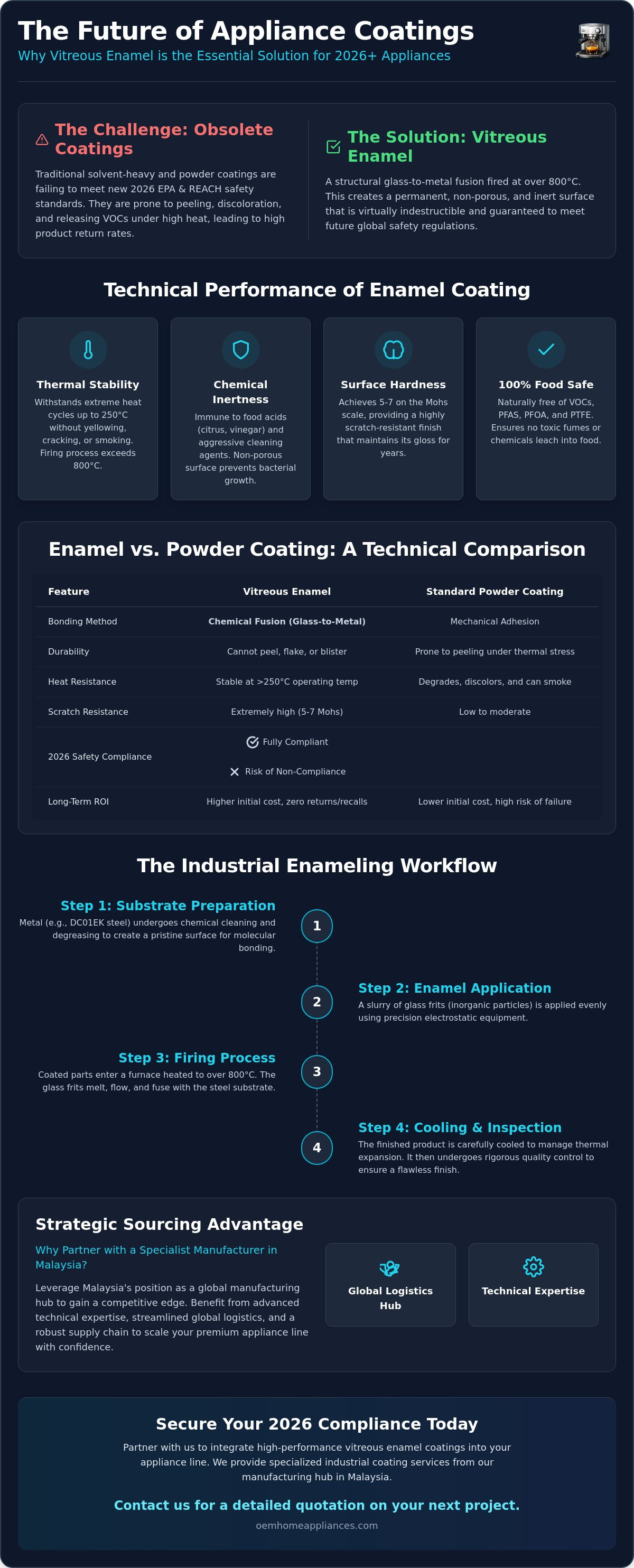
Thermal Stability: Vitreous enamel resists extreme heat cycles. It doesn't yellow, smoke, or crack when temperatures fluctuate between ambient and 250°C.
Chemical Inertness: The surface is immune to acids found in food, such as citrus or vinegar, and resists aggressive industrial degreasers.
Surface Hardness: It typically reaches 5 to 7 on the Mohs scale. This provides a scratch-resistant finish that maintains its gloss even after years of use.
Aesthetic Versatility: Pigments are fired directly into the glass at high temperatures. This ensures permanent color stability that won't fade or peel under intense heat.
High-Heat Performance for Roaster Ovens
Vitreous enamel is the industry standard for roaster oven liners and BBQ grills because of its thermal endurance. A critical part of the manufacturing process involves managing thermal expansion. The enamel frit must be precisely matched to the specific steel grade, such as DC01EK or DC04EK, to prevent stress during heating cycles. If these coefficients aren't aligned, the coating can chip or develop "fishscale" defects. This precision ensures the bond remains stable even during rapid cooling. You can learn more about common misconceptions in our guide on Enamel Coated Metal Components: 5 Industry Myths Debunked.
Hygiene and Easy-Clean Properties
The non-porous nature of glass prevents bacterial growth and odor absorption. This is vital for appliances that handle high-fat foods. Unlike non-stick alternatives that can degrade and release fumes at high temperatures, enamel remains chemically stable. It consistently outperforms other coatings in the "scrub test." The surface tension of the glass minimizes food adhesion, allowing users to wipe away carbonized residue with minimal effort. It's a key selling point for premium brands that prioritize user experience. If you're looking for a partner to help achieve these results, consider discussing your technical requirements with our engineering team.
Enamel vs. Powder Coating: A Technical Comparison for 2026 Appliances
The choice between vitreous enamel and powder coating is a strategic decision that defines an appliance's market tier. It isn't just about aesthetics; it's about engineering for specific environments. While both finishes are essential in modern manufacturing, their technical roles are distinct and non-interchangeable. Powder coating offers excellent impact resistance and a vast array of colors for external chassis components. However, for internal heating chambers, the enamel coating process for roaster ovens is the only viable choice for long-term reliability and chemical stability.
Your product's positioning depends heavily on these material choices. A roaster oven with a powder-coated interior is often perceived as a budget-tier item with a limited lifespan. Conversely, an enamel-lined unit signals premium quality and professional-grade durability. Understanding where each finish excels allows you to optimize manufacturing costs without compromising the user experience:
Durability: Powder coating excels in impact resistance for outer shells; enamel excels in heat and chemical resistance for interiors.
Suitability: Use powder for external decorative panels; use enamel for internal chambers and food-contact surfaces.
Longevity: Powder may chalk or peel over time when exposed to heat; enamel remains stable for the entire life of the appliance.
Thermal and Chemical Limitations of Powder Coating
Most organic powder coatings begin to degrade when exposed to temperatures exceeding 200°C. In a roaster oven, this leads to discoloration, embrittlement, and eventually, the coating peeling away from the steel. There's also a significant risk of outgassing. This occurs when the polymer releases chemical vapors at high temperatures, which is unacceptable in food-contact environments. These limitations make powder coating unsuitable for the high-thermal stress found in roaster liners. For a deeper dive into these material differences, review our guide on Metal Component Finishing for Appliances.
The ROI of Premium Enamel Finishing
The initial manufacturing investment for enamel is higher than powder, but the ROI is found in warranty savings and brand equity. Brands that utilize the enamel coating process for roaster ovens avoid the "peeling paint" crisis that often plagues lower-tier units. You can market a "Lifetime Finish" as a unique selling proposition (USP), justifying a higher retail price point. In Malaysia, our facility provides the scalability needed for bulk OEM production runs. This ensures that high-performance finishes remain cost-effective through optimized supply chains and specialized technical talent.
Investing in specialized protection is a common strategy for maintaining high-value assets; for instance, PFM Performance Auto Group offers professional automotive enhancements that preserve vehicle interiors and electronics through expert installation and quality materials.
Step-by-Step: The Industrial Enameling Workflow in OEM Production
Successful factory-floor integration of the enamel coating process for roaster ovens requires a meticulous, multi-stage workflow. In our Malaysia facility, we treat this process as an exact science rather than a simple finishing step. Every stage, from the initial chemical wash to the final kiln firing, is monitored to ensure the glass-to-metal bond meets international durability standards. It's a complex sequence that demands precision to avoid common defects like pinholing or uneven thickness.
The workflow follows a methodical progression designed for high-volume OEM consistency:
Substrate Preparation: This is the most critical phase. We use a combination of degreasing and pickling to remove industrial oils and create a microscopic surface profile for the enamel to grip.
Coating Application: Depending on the component's geometry, we employ either wet spraying or dry electrostatic techniques. For complex roaster oven interiors, wet application ensures total coverage in hard-to-reach corners.
Drying and Pre-heating: Components pass through a drying oven to remove all moisture. This prevents steam-induced defects during the high-heat phase.
The Firing Process: Parts enter industrial kilns where temperatures are held precisely above 800°C. This triggers the chemical fusion between the glass frits and the steel, transforming the slurry into a smooth, glass-hard surface.
Quality Control: Our technicians conduct thickness testing and color matching using digital spectrophotometers. We also perform impact tests to ensure the finish doesn't chip or crack under extreme conditions.
Technical Solutions for Custom Metal Components
Designing for enamel requires a specific engineering mindset. Sharp edges and tight radii must be avoided because the molten glass tends to pull away during firing, a defect known as "burn-off." We recommend radiused corners and uniform metal thickness to ensure even heat distribution. We work closely with brand managers during the prototyping phase to refine component shapes for optimal coating adhesion. For a comprehensive look at these design requirements, see our Ultimate Guide for Enamel Coating.
Supply Chain Logistics and Batch Consistency
Managing the enamel coating process for roaster ovens at scale requires tight control over raw material volatility. We manage this by maintaining strategic reserves of high-quality frits and working with certified suppliers. Long-term manufacturing partnerships rely on frit stability to ensure that every production run matches the original approved prototype. This consistency is why global brands choose Malaysia as their sourcing hub. If you're ready to integrate this process into your next product line, request a technical consultation with our Malaysia-based production team.
Strategic Sourcing: Why Malaysia is the Hub for Enamel Coating Services
Selecting the right manufacturing location is as critical as the technical specifications of the product itself. Malaysia has emerged as a premier hub for high-quality, cost-effective appliance production, particularly for brands requiring specialized finishes. The enamel coating process for roaster ovens requires a unique combination of heavy industrial infrastructure and refined technical expertise. Malaysia offers this balance, providing access to advanced enameling facilities and a workforce trained in precision metalwork and chemical engineering.
Global appliance brands choose Malaysia to leverage its stable industrial environment and competitive operational costs. Unlike other regions where quality can be inconsistent, Malaysian manufacturers maintain a reputation for B2B reliability and strict adherence to international standards. This reliability is backed by a robust local supply chain that provides high-grade steel and specialized enamel frits. Our commitment at oemhomeappliances centers on providing this stability at scale, ensuring your production remains uninterrupted and your quality remains elite.
Logistics play a decisive role in global market entry. Malaysia's strategic shipping routes and world-class port facilities significantly reduce lead times for North American and European markets. This geographical advantage allows brands to maintain leaner inventories while responding quickly to market demand. By sourcing from a central hub with established trade lanes, you minimize the risks associated with global supply chain volatility.
Efficient logistics and sourcing are equally vital in the automotive industry, where you can discover ELart, UAB for a look at how professional distribution networks manage a vast inventory of spare parts and accessories.
Bespoke Manufacturing for Global Brands
We provide tailored manufacturing solutions for a wide range of products, including roaster ovens, rice cookers, and BBQ grills. Our private label services prioritize your brand's unique design language, ensuring that the final product aligns perfectly with your market positioning. Whether you require specific color matching or custom component geometries, our OEM/ODM services facilitate a seamless transition from concept to mass production. We act as a silent partner, empowering your brand with industrial strength and meticulous execution.
Partnering for Success in 2026
The transition to a premium appliance tier involves more than just a change in materials; it requires a commitment to superior engineering similar to the luxury standards seen in components like Forged Rolls Royce Cullinan Wheels. We help brands move away from standard powder coatings to high-performance enamel, providing the technical guidance needed to avoid common design pitfalls. Our facility offers scalable production capacities that grow alongside your product line, rendering you never outpace your manufacturing partner's capabilities.
In addition to material science, many brands are looking toward automation to manage these high-performance production lines; you can discover EdNex Automation to explore how collaborative robotics are optimizing industrial efficiency for 2026.
If you are looking to enhance your product durability and ensure compliance with upcoming safety regulations, our team is ready to assist. Contact us today to discuss your project requirements or to request a comprehensive quotation for your manufacturing needs in Malaysia. We look forward to establishing a reliable, long-term partnership that drives your brand's success in the global appliance market.
Future-Proof Your Appliance Line with Industrial Enamel
The landscape for kitchen appliances is shifting toward stricter chemical safety and higher durability standards. Implementing a precise enamel coating process for roaster ovens allows your brand to eliminate common failures like peeling and outgassing while ensuring full compliance with 2026 global safety regulations. This transition from standard powder coating to premium vitreous enamel isn't just a technical upgrade; it's a strategic move to secure your position in the premium market tier.
Partnering with a specialized manufacturer in Malaysia provides the technical talent and scalable production capacity needed for global distribution. We offer dedicated B2B support for private label scaling, ensuring that every unit meets the rigorous lead and cadmium limits enforced this year. Our expertise in roaster oven and BBQ grill manufacturing serves as the backbone for brands looking to innovate without the risk of product recalls or high return rates.
Ready to elevate your product line with premium finishing? Contact oemhomeappliances for a custom quotation on industrial enamel coating services in Malaysia today. We're prepared to help you build a more durable, compliant, and successful appliance brand.
Frequently Asked Questions
What is the difference between porcelain enamel and ceramic coating?
Porcelain enamel is an inorganic glass fused to metal at temperatures exceeding 800°C, creating a permanent chemical bond. Ceramic coatings are typically sol-gel based hybrids cured at much lower temperatures. While ceramic coatings offer good heat resistance, they don't match the rock-hard durability and chemical inertness provided by the enamel coating process for roaster ovens.
Is industrial enamel coating safe for food contact in roaster ovens?
Industrial enamel is exceptionally safe for food contact because it creates an inert, non-porous glass surface. It doesn't leach chemicals, absorb food odors, or harbor bacteria even after years of use. This makes it a superior alternative to organic non-stick finishes that may release volatile organic compounds or outgas when exposed to extreme cooking temperatures.
Can any metal be enamel coated in appliance manufacturing?
Enamel is primarily applied to specialized decarbonized steel grades and cast iron to ensure a stable bond. While aluminum and stainless steel can be coated with specific frit formulations, most appliance manufacturers prefer enameling-grade steel like DC01EK. This material prevents defects such as fishscaling and ensures the coating doesn't chip during the intense thermal cycles of a roaster oven.
How much does enamel coating add to the manufacturing cost of an appliance?
Enamel coating requires a higher initial manufacturing investment than standard powder coating due to the specialized kilns and chemical preparation required. However, the long-term ROI is significant for premium brands. It effectively reduces warranty return rates and prevents the brand damage associated with peeling paint, making it a cost-effective choice for high-performance product tiers.
Is enamel coating more durable than stainless steel for cooking liners?
Enamel often outperforms stainless steel in cooking environments because it's harder and easier to maintain. While stainless steel is durable, it frequently discolors or "blues" when exposed to high heat over time. Enamel maintains its original color and gloss indefinitely. It also provides a smoother, non-porous surface that resists the buildup of carbonized food grease better than metallic finishes.
What are the new 2026 regulations regarding appliance coatings?
The 2026 regulatory landscape is defined by new EPA VOC limits and EU REACH formaldehyde caps that restrict solvent-heavy finishes. Furthermore, updated Danish and EU standards have set much stricter limits for lead and cadmium in food-contact materials. Transitioning to the enamel coating process for roaster ovens ensures your products remain compliant with these global safety mandates without requiring further formula changes.
How do I choose between wet and dry enamel application for my product?
Choose wet application if your roaster oven design features complex geometries or deep internal corners that require total coverage. Wet spraying ensures the slurry reaches every crevice for maximum protection. Dry electrostatic application is typically reserved for high-volume production of flatter panels. It offers greater material efficiency and faster processing but requires parts with simpler shapes to avoid uneven coating thickness.
Why should I choose a manufacturer in Malaysia for enamel coating services?
Malaysia provides a unique combination of advanced industrial infrastructure and strategic access to global shipping lanes. Manufacturers here offer deep technical expertise in vitreous enamel while maintaining the scalability required by international brands. By sourcing from Malaysia, you benefit from a stable B2B partnership and a workforce that's highly experienced in meeting the rigorous quality standards of the premium appliance market.


Comments