Kitchen Appliance Prototyping: A Strategic Guide for Appliance Brands in 2026
Updated: Jul 19
The difference between a market-leading product and a costly R&D failure often comes down to a single phase: kitchen appliance prototyping. With the global kitchen appliance market projected to reach over $257 billion in 2026, the pressure to innovate quickly has never been higher. You've likely felt the frustration of a design that looks perfect on screen but fails to meet manufacturing realities. It's a common pain point that drains budgets and delays critical launch windows.
We understand that balancing engineering precision with the reality of the assembly line is your biggest hurdle. This guide will show you how to transform complex kitchen appliance concepts into market-ready prototypes that are built for scale. You'll discover a clear roadmap from concept to functional model, learn strategies to reduce costs during the R&D phase, and find out how to identify a partner who handles both development and bulk OEM production. We'll also look at navigating the 2026 regulatory landscape, including the recently approved 6th edition of the UL 1026 standard, to ensure your innovations are compliant and ready for the global stage.
Table of Contents
What is Kitchen Appliance Prototyping and Why Does it Matter?
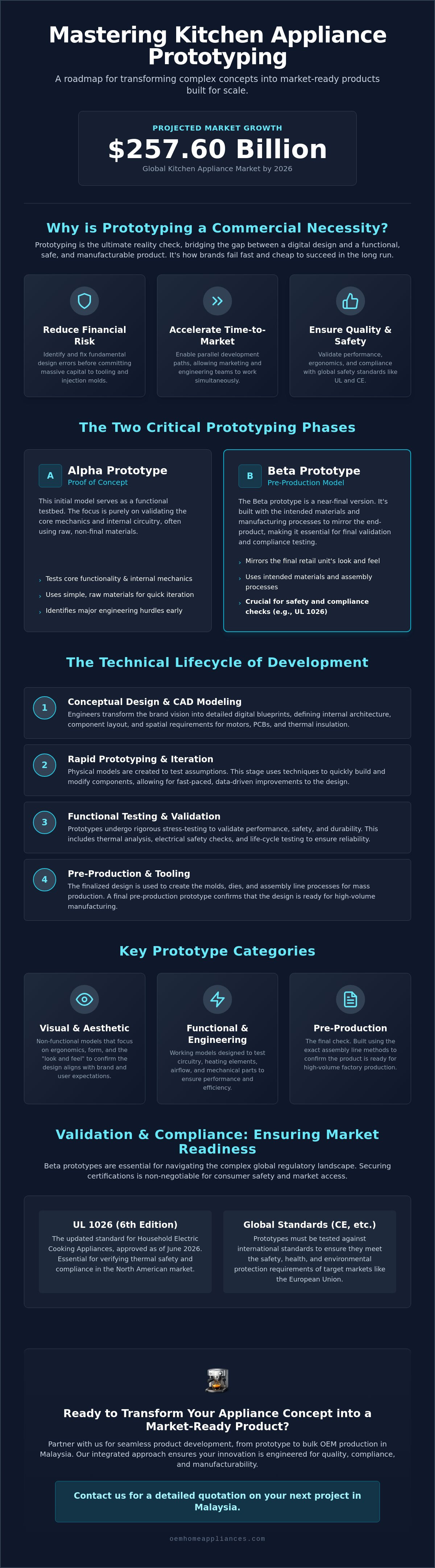
Kitchen appliance prototyping is the iterative manufacturing process of creating functional, physical models to validate design assumptions, safety protocols, and operational performance. It moves a concept from a static digital file into a tangible product that engineers can stress-test. For any appliance brand, this stage is the ultimate reality check. It ensures that a high-performance air fryer or a sleek coffee machine doesn't just look good on paper but actually works in a consumer's kitchen. With the global kitchen appliances market estimated to reach $257.60 billion in 2026, getting the development phase right is a commercial necessity.
The process generally splits into two critical phases. 'Alpha' prototypes serve as a proof of concept. These models focus on internal mechanics and core functionality, often using raw materials that won't appear in the final product. 'Beta' prototypes are pre-production models. They use the intended materials and manufacturing processes to mirror the final retail unit. This distinction is vital for complex thermal appliances like roaster ovens. With the 6th edition of the UL 1026 standard approved as of June 2026, Beta prototypes are essential for verifying compliance with updated safety ratings for household electric cooking appliances. Without this phase, you risk discovering heat distribution issues only after you've invested in expensive injection molds or stamping dies.
Strategic product development services prioritize prototyping to reduce long-term financial risk. Tooling for a new line of blenders or rice cookers requires a massive capital injection. If the design has a fundamental error, the molds become useless. Prototyping allows you to fail fast and fail cheap. It provides the data needed to pivot before the manufacturing process becomes rigid. By the time you reach the assembly line, every component has been vetted for both performance and manufacturability.
The Strategic Value for Home Appliance Brands
Speed defines the modern market. Prototyping accelerates time-to-market for new collections of rice cookers or kettles by allowing parallel development paths. Marketing teams can use visual models for early photography while engineers refine the internal heating elements. For design professionals, leveraging AR tools like ArchKit Design helps visualize how these prototypes will fit into actual kitchen spaces. This process effectively closes the 'innovation gap' between a brand's creative vision and the factory's technical capabilities. When a designer proposes a handle-less kettle, prototyping determines if that design is actually safe for a user to hold. Simply put, kitchen appliance prototyping is the bridge between CAD data and consumer safety.
Types of Prototypes in the Appliance Industry
Different development goals require different physical models. Most brands utilize a combination of these three types to ensure a comprehensive evaluation:
Visual and Aesthetic Prototypes: These focus on the exterior. They test the ergonomics of blenders or the interface of coffee machines. They don't always function, but they confirm the 'look and feel' is right for the target demographic.
Functional and Engineering Prototypes: These are the workhorses. They test the circuitry, heating elements, and airflow of complex items like air fryers. They utilize Rapid Prototyping Techniques to quickly swap out components and improve efficiency without rebuilding the entire unit.
Pre-production Prototypes: These are the final check. They are built using the exact assembly line methods intended for bulk production. This step confirms that the product is ready for the rigors of a high-volume factory environment and meets all quality benchmarks.
The Technical Lifecycle of Kitchen Appliance Development
The path from a designer's sketch to a retail-ready product follows a rigorous engineering sequence. Successful kitchen appliance prototyping requires more than just a 3D printer; it demands a systematic approach that balances aesthetic intent with industrial reality. This lifecycle ensures that every component, from the heating element to the outer casing, performs reliably under stress. Without this structured progression, brands risk discovering fatal design flaws only after they've committed to mass production tooling.
Step 1: Conceptual Design and CAD Modeling. Engineers transform your brand vision into detailed digital blueprints. This stage defines the internal architecture and spatial requirements for components like motors, PCBs, and thermal insulation.
Step 2: Rapid Prototyping. This involves creating the first physical iterations for form and fit testing. It's the moment digital data becomes a tangible object you can hold and evaluate.
Step 3: Component Engineering. We source and test specific hardware, such as high-torque motors for blenders or precision heating coils for air fryers. For manufacturers looking to integrate advanced lighting indicators or aesthetic accents into their designs, you can explore Mitsubishi ESKA Plastic Optical Fibre as a high-performance solution. We verify that these parts meet the technical specifications required for your target performance levels.
Step 4: Functional Testing. Prototypes undergo rigorous trials of core cooking or processing functions. We measure temperature consistency in roaster ovens and motor stability in coffee machines to ensure they meet consumer expectations.
Step 5: DFM (Design for Manufacturing) Review. We adjust the prototype for efficient mass production. This includes optimizing part counts and simplifying assembly steps to reduce labor costs and minimize material waste.
From CAD to First Physical Model
3D printing plays a vital role in rapid concept validation, especially for portable cooking equipment where weight and balance are key. For high-end kettles or BBQ grills requiring structural integrity, CNC machining provides precision metal parts that 3D prints cannot replicate. This phase allows us to catch design flaws early, saving months of lead time. During the DFM review, we refine the kitchen appliance prototyping data to ensure the design is compatible with high-speed assembly lines. If you want to see how this works in a real-world scenario, read our Technical Appliance Development Case Study.
Refining the User Experience (UX)
A prototype must do more than just work; it must feel right. We prototype the entire user interface, including the tactile feedback of knobs, the clarity of digital displays, and the ergonomics of handles. For thermal appliances like roaster ovens, we conduct exhaustive heat distribution tests to ensure even cooking performance. Iterative testing for thermal safety is mandatory to verify that exterior surfaces remain safe to touch. This is especially critical given the regulatory shifts in 2026, such as the July 2nd U.S. Department of Energy proposal regarding efficiency mandates. We ensure your products align with the U.S. Appliance Standards Program while maintaining peak performance. If your current design needs a technical review, you can request a manufacturing consultation in Malaysia to evaluate your prototype's readiness for the global market.
Prototyping for Durability: Enamel and Powder Coating
A prototype's finish is often the most overlooked aspect of technical development. In premium kitchen appliance prototyping, the material coating is a functional requirement, not just a design choice. While many manufacturers focus on plastic housings, high-performance appliances like roaster ovens or BBQ grills require metal substrates with advanced coatings. These finishes must withstand extreme thermal cycles and aggressive cleaning agents without degrading. Selecting the wrong finish early in the process leads to premature product failure and brand damage.
Prototyping with enamel or powder coating is significantly more complex than working with standard plastics. You can't simply 3D print an enamel finish. It requires specialized application and firing processes that mirror final production. This early validation ensures the appliance maintains its integrity over years of use. It also allows engineers to verify that coatings don't interfere with the fit of critical components like heating elements or control knobs. Testing these finishes early prevents costly rework when you transition to bulk manufacturing.
The Role of Industrial Enamel Coating
Industrial enamel is the gold standard for appliances requiring superior heat retention. When we prototype roaster oven liners, enamel provides a non-porous, glass-like surface that handles temperatures exceeding the 250V thresholds outlined in the 2026 UL 1026 standards. We conduct rigorous tests to evaluate the bond strength between the metal substrate and the enamel layer. This prevents chipping or cracking during thermal expansion. For brands looking for specialized finishes, we offer a wide range of OEM/ODM appliance services that include nickel-free and low-quartz enamel options to meet the latest global material safety regulations.
Powder Coating for Aesthetic and Functional Excellence
Powder coating offers a versatile solution for air fryers, blenders, and kettles. During the prototyping phase, precise color matching is essential to maintain brand consistency across different product lines. We test these surfaces for UV resistance and ease of cleaning to ensure they don't fade or stain in a kitchen environment. Scratch durability testing is equally vital; a premium appliance must resist the wear and tear of daily use. Metal component finishing represents the final polish of a successful kitchen appliance prototyping cycle. It transforms a functional machine into a market-ready product that consumers trust. By validating these finishes in Malaysia, you ensure your bulk production meets the highest global standards for durability and aesthetics.
Validation and Compliance: Ensuring Market Readiness
Validation is the final gatekeeper in the kitchen appliance prototyping process. It ensures your product meets the legal and safety requirements of your target markets before you commit to high-volume production. As of June 9, 2026, the 6th edition of the UL 1026 standard for household electric cooking appliances is the mandatory benchmark for North American sales. Failing to meet these standards during the R&D phase leads to catastrophic delays and wasted capital. We subject every prototype to rigorous testing against global standards like UL, CE, and RoHS to ensure your brand is protected from day one.
Thermal safety testing is particularly critical for high-heat appliances like roaster ovens. We measure exterior surface temperatures during peak operation to guarantee they remain safe for consumer handling. For high-wattage units such as kettles and rice cookers, electrical stress testing identifies potential circuitry failures or overheating risks. This phase also includes food-grade material certification. With regulations like the Washington state lead in cookware mandate (effective December 31, 2025), verifying that all contact surfaces are lead-free and non-toxic is a mandatory step in your development cycle.
Safety Certifications in the Prototyping Phase
Fixing a compliance error during the prototype stage costs a fraction of what it would after the injection molds are cut. An experienced OEM partner helps you navigate the shifting landscape of international regulations, including the EU's Right to Repair directive which became enforceable on July 31, 2026. This expertise ensures your technical file is ready for CE marking from the start. For more on selecting a partner with deep regulatory knowledge, see our Custom Roaster Oven Strategic Guide.
Performance Benchmarking
A prototype must do more than just pass safety tests; it must outperform the competition. We benchmark your prototype against industry leaders to evaluate heating speed, energy efficiency, and motor torque. Stress testing is used to simulate years of daily use for rice cookers or blenders, predicting long-term reliability and reducing warranty claim risks. A prototype is only successful when it meets both the brand's vision and the industry's strictest safety benchmarks. If you're ready to validate your next innovation, contact our engineering team in Malaysia for a comprehensive compliance and performance review.
Strategic Prototyping with a Malaysian Manufacturing Partner
Malaysia has solidified its position as a primary global hub for high-quality, cost-effective appliance manufacturing in 2026. The implementation of the New Investment Incentive Framework (NIF) on March 1, 2026, has further enhanced the region's appeal by tying manufacturing incentives to technology transfer and job creation. For brands engaged in kitchen appliance prototyping, this environment offers a unique combination of technical expertise and financial efficiency. With average monthly manufacturing wages in Malaysia at approximately USD 748, compared to the rising hourly rates in other regions, brands can allocate more resources toward iterative R&D without exhausting their budgets. Additionally, the 60% Accelerated Capital Allowance available for qualifying expenditures until December 31, 2026, provides significant relief for brands investing in the specialized machinery required for advanced prototyping.
Partnering with a facility that manages both R&D and bulk production eliminates the friction often found in the hand-off between design firms and factories. Keiteq’s deep expertise in roaster ovens and air fryers ensures that the technical nuances of thermal management are addressed during the earliest stages of development. We leverage local supply chains for specialized metal components and advanced coatings, ensuring that every prototype utilizes materials compatible with mass production. This integrated approach reduces lead times and ensures that the final product maintains the integrity of the original design.
Bridging the Gap to Mass Production
The transition from a validated prototype to full-scale OEM manufacturing is the most delicate phase of the product lifecycle. We focus on creating 'tooling-ready' prototypes that account for draft angles, wall thicknesses, and assembly tolerances. This meticulous attention to detail prevents expensive mold revisions and production delays. By utilizing our product design and development services, global brands can move seamlessly from low-volume testing to high-capacity output. Our Malaysian facility is equipped to handle the complexities of global distribution, ensuring your products are ready for North American and European markets.
Your Next Steps in Product Development
Choosing a partner with in-house technical solutions for enamel and powder coating provides a distinct competitive advantage. It allows for immediate adjustments to finishes based on prototype testing results, rather than waiting for external vendors. Keiteq acts as a trusted expert facilitator, empowering your brand's growth through precision engineering and scalable manufacturing processes. We ensure your innovations are not just functional models but viable commercial assets ready for the 2026 market.
Ready to bring your next kitchen innovation to life? Contact us today for a detailed consultation on your kitchen appliance prototyping needs. Our team in Malaysia is ready to provide a comprehensive quotation and timeline for your project, helping you move from concept to market-ready product with efficiency and precision.
Advancing Your Product Strategy for 2026
The evolution of the global market demands a shift from simple design to technical precision. Successful kitchen appliance prototyping ensures your brand navigates the complex regulatory landscape of 2026, including the latest UL and EU standards, without sacrificing speed or profitability. By validating core functionalities like thermal safety and material durability early in the R&D cycle, you eliminate the risk of late stage manufacturing failures and protect your capital investment.
Partnering with a dedicated B2B manufacturer in Malaysia provides the stability and technical depth required for global expansion. Our facility specializes in the development of roaster ovens and rice cookers, offering integrated enamel and powder coating solutions to ensure your products meet the highest aesthetic and functional benchmarks. We act as your trusted expert facilitator, transforming complex engineering data into market-ready collections built for scale.
Ready to bring your appliance vision to life? Contact us today for a custom quotation on our kitchen appliance prototyping and manufacturing services in Malaysia. We look forward to empowering your brand's success through meticulous production and industrial expertise.
Frequently Asked Questions
How long does the kitchen appliance prototyping process typically take?
The timeline for developing a functional prototype typically spans 4 to 12 weeks. Initial visual models for form testing are often completed within 14 days using rapid techniques. Functional Beta prototypes involving custom heating elements and specific finishes like enamel require additional time for rigorous performance validation. Complex projects for multi-functional appliances may extend this duration to ensure every safety benchmark is met before mass production begins.
What is the average cost of developing a functional appliance prototype?
Development costs depend on the technical complexity and material requirements of your specific design. Factors such as CAD engineering hours, the number of physical iterations, and the use of specialized coatings like powder-coated metal influence the final investment. While rapid prototyping reduces initial R&D expenses, investing in high-quality functional models prevents the much higher costs associated with failed production tooling or global safety non-compliance.
Can I use a 3D-printed prototype for actual cooking tests?
Standard 3D-printed models are not suitable for actual cooking tests due to low thermal resistance. Materials like PLA or ABS will deform or emit toxic fumes when exposed to the high temperatures of air fryers or roaster ovens. For functional testing, you must use metal components or specialized resins that can withstand the specific heat cycles required for kitchen appliance prototyping validation.
What is the difference between an OEM and an ODM prototyping approach?
An OEM approach involves building a prototype based on your original engineering blueprints and unique brand specifications. In contrast, an ODM approach utilizes the manufacturer's existing technical designs, which are then customized for your private label. Choosing between them depends on whether you require a completely bespoke innovation or a faster, more cost-effective path to market using proven internal architectures.
How do I protect my intellectual property during the prototyping phase?
Protecting your intellectual property starts with a comprehensive Non-Disclosure Agreement (NDA) before sharing any CAD data. Partnering with reputable manufacturers in Malaysia provides an additional layer of security due to the country's established legal framework for business contracts. Ensure your partner has clear internal protocols for data handling and limited access to sensitive design files during the development phase.
What materials are best for prototyping heat-resistant kitchen appliances?
Stainless steel and aluminum are the preferred materials for heat-resistant structural components. For premium appliances, enamel-coated steel is essential for interior liners because it offers superior thermal retention and a non-porous surface. These materials ensure that prototypes for roaster ovens or BBQ grills remain structurally sound and safe during extreme temperature stress tests.
Why is Malaysia a preferred location for appliance R&D and manufacturing?
Malaysia is a preferred hub because it balances industrial strength with significant financial incentives for the manufacturing sector. The region offers a mature supply chain for specialized metal finishing and electronics. This provides a comprehensive ecosystem for the entire kitchen appliance prototyping and production lifecycle, ensuring high-quality output at a competitive price point compared to other global hubs.
Does a prototype need to be safety certified before mass production?
While a prototype does not receive a final safety certificate, it must pass pre-validation tests to ensure mass production units will comply with UL or CE standards. Identifying electrical or thermal issues at the prototype stage is significantly cheaper than modifying finished production molds. Every functional model should be tested against the latest benchmarks, such as the 2026 UL 1026 requirements, to guarantee market readiness.


Comments