Kitchen Appliance R&D: 2026 Strategic Guide for Brands

Why do so many kitchen appliance prototypes fail to reach mass production despite having innovative designs? It's a frustrating reality for brand owners who face high failure rates and long lead times in the development cycle. You likely already know that a great concept doesn't guarantee a successful launch. You need a partner to bridge the gap between a 3D model and a functional, scalable unit. Professional kitchen appliance R&D services act as the essential engine behind this transition, ensuring your vision survives the rigors of the factory floor.
This guide reveals how expert R&D transforms raw concepts into market-ready products with optimized manufacturing workflows. We'll explore the strategic advantages of scaling production in Malaysia, including the New Incentive Framework effective March 1, 2026. You'll gain a clear roadmap for navigating specialized finishing like enamel coating and integrating smart connectivity to meet 2026 consumer demands. From technical feasibility to final industrialization, we show you how to build a resilient supply chain that prioritizes transparency and precision.
Table of Contents
What are Kitchen Appliance R&D Services?
Kitchen appliance R&D services represent the technical bridge between a creative concept and a mass-produced reality. While many brands focus on the visual appeal of a product, research and development involves rigorous engineering to ensure that a device functions safely, efficiently, and consistently. This process encompasses everything from material selection and electrical circuit design to thermal management. Historically, the development of home appliances has evolved from simple mechanical tools to complex electronic systems that require precise industrial engineering to meet modern consumer expectations.
There is a significant difference between aesthetic design and industrial engineering for cooking equipment. A designer might create a sleek, modern air fryer, but an engineer ensures the internal airflow reaches 200°C without compromising the external housing or electrical components. Technical development is critical for brand longevity because it addresses safety compliance and reliability before the product hits the market. For instance, new safety standards like BS EN IEC 60335-2-14, published in early 2026, set strict requirements for household kitchen machines that R&D teams must navigate. R&D partners like oemhomeappliances serve as the industrial backbone for private label growth, providing the specialized expertise needed to move beyond generic off-the-shelf models.
The Role of Engineering in Modern Cooking Tech
Modern engineering must balance energy efficiency with high-performance heating. In appliances like rice cookers, this means optimizing induction heating cycles to reduce power consumption without sacrificing grain texture. As consumer demand for connectivity grows, R&D teams are now integrating smart features into traditional roaster ovens and air fryers, allowing for remote monitoring and precise temperature control. Design for Manufacturing (DFM) in the kitchen appliance sector is the strategic process of designing product components so they are easy and economical to produce at scale while ensuring peak performance.
Why R&D is the Backbone of Private Labeling
Custom R&D prevents product homogenization in a crowded market where many brands sell identical white-label units. By investing in strategic kitchen appliance development, brands can introduce unique features or proprietary technology that competitors can't easily replicate. This differentiation is vital for maintaining premium price points and building customer loyalty. Additionally, early-stage material optimization helps reduce long-term costs by identifying the most durable components before mass production begins. For example, selecting specialized enamel coatings for roaster ovens can improve heat retention and ease of cleaning, adding tangible value for the end user. Choosing a partner with specialized kitchen appliance R&D services ensures that your brand remains an innovator rather than a follower.
The 5-Stage Lifecycle of Appliance Prototyping
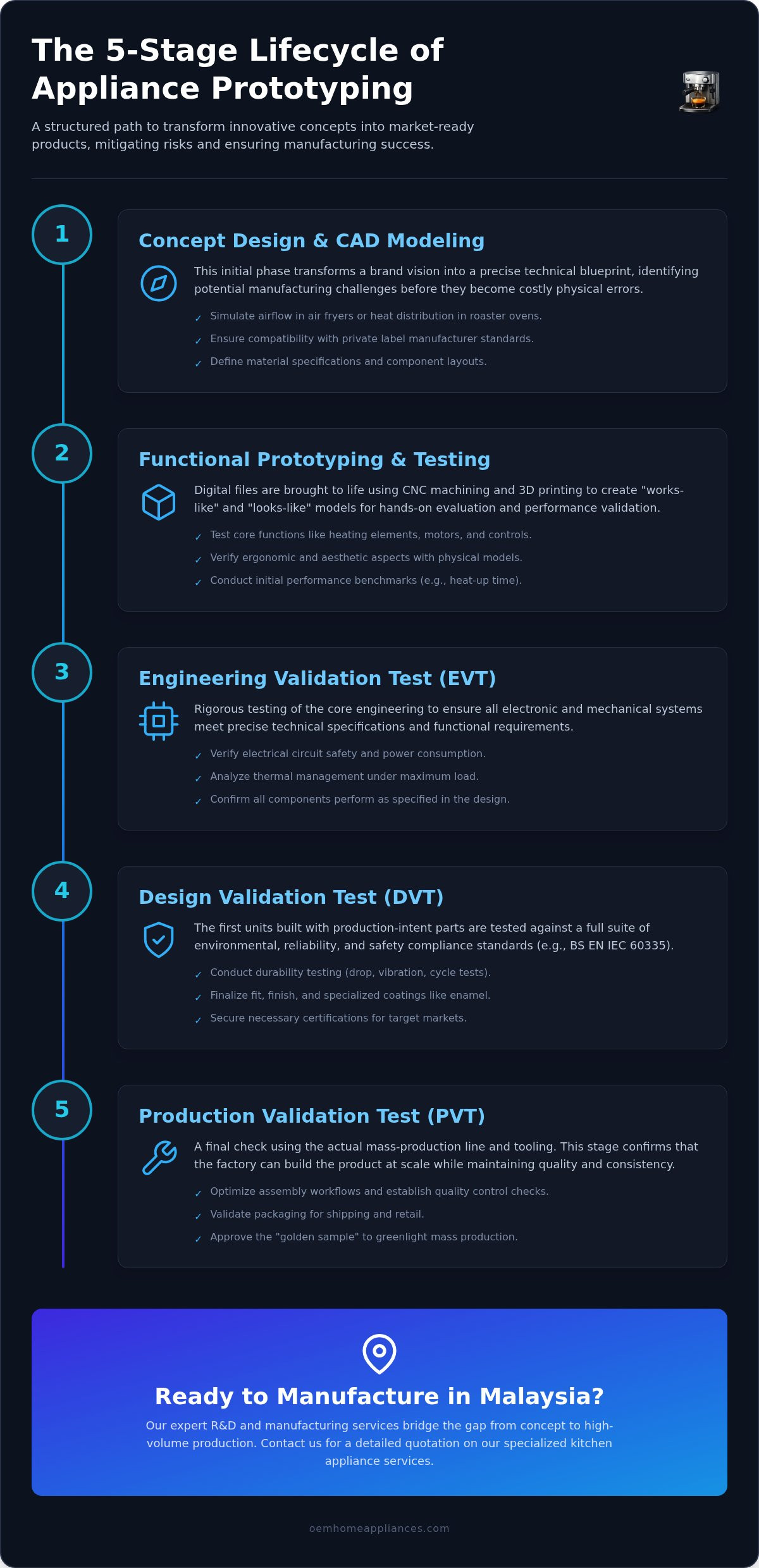
The journey from an initial idea to a high-volume product requires a structured development path. Most brands struggle when they rush from a sketch directly to a factory floor, leading to high failure rates during mass production. Utilizing professional kitchen appliance R&D services provides a disciplined 5-stage framework that mitigates risk at every milestone. This lifecycle ensures that every heating element, circuit board, and housing component is validated before capital is committed to tooling and high-volume assembly.
Concept Design and CAD Modeling
Transforming a brand vision into a viable product starts with technical CAD modeling. This phase is more than just creating a 3D image; it's about identifying potential manufacturing bottlenecks before they become costly physical errors. Digital design allows engineers to simulate airflow in air fryers or heat distribution in roaster ovens. During this stage, it's vital to ensure compatibility with private label kitchen appliance manufacturer standards to streamline the eventual assembly process. If the digital model doesn't account for screw placements or wire routing, the physical production will inevitably stall.
Functional Prototyping and Performance Testing
Once the digital files are finalized, the project moves into physical prototyping. Engineers use CNC machining and 3D printing to create "works-like" and "looks-like" models that represent the final product's utility. This is where innovative cooking technology is put to the test under real-world conditions. For appliances like air fryers, stress testing for thermal consistency is mandatory. We measure internal temperatures at multiple points to ensure even cooking and housing safety. This iterative feedback loop allows for design refinements that improve the final product's efficiency and overall user experience.
The final hurdles involve safety and regulatory testing protocols. Every appliance must meet international standards for electrical insulation and fire safety, such as the safety requirements for kitchen machines updated in early 2026. After a prototype passes these rigorous tests, the project transitions to a pilot production run. This small-scale batch validates the assembly line's efficiency and serves as the final check before full mass production. Navigating these stages requires a partner with deep technical expertise. Comprehensive kitchen appliance R&D services don't just build a model; they build a scalable manufacturing plan. If you are ready to move your concept into the prototyping phase, you can consult with our engineering team to discuss technical specifications.
Technical Solutions: Enamel Coating and Material Innovation
Material selection defines the operational lifespan of any heating appliance. Integrating specialized finishes into kitchen appliance R&D services ensures that products survive the extreme thermal stresses of daily use without losing their structural integrity or aesthetic appeal. Choosing between enamel and powder coating depends on the appliance's thermal profile, intended environment, and target market position. While both finishes offer protection, their technical applications differ significantly in high-heat scenarios.
Enamel provides a glass-to-metal bond that withstands temperatures exceeding 800°C, making it the primary choice for roaster ovens and air fryer interiors. In contrast, powder coating is typically reserved for exterior housings where color variety and impact resistance are the priority. A well-engineered R&D strategy evaluates these materials early in the design phase to prevent coating failure during mass production.
Industrial Enamel Coating for Durability
The science behind enamel involves a high-temperature firing process that fuses glass frit directly to a metal substrate. This creates a non-porous, inert surface that doesn't off-gas or degrade when exposed to consistent heat. Premium brands specify enamel for rice cooker inner pots and roaster liners because it prevents metallic leaching and maintains food purity. Enamel surfaces resist chemical degradation from acidic food residues and harsh cleaning agents, maintaining a hygienic cooking environment over years of service. Understanding the industrial enamel coating process for roaster ovens is essential for brands targeting the high-end market where longevity is a core value proposition.
Powder Coating and Metal Component Finishing
Powder coating offers unparalleled flexibility for brand-specific aesthetics. It allows manufacturers to achieve precise colorways and textures that align with a brand's visual identity. For portable cooking equipment and external appliance housings, powder coating provides excellent corrosion resistance and protection against surface scratches. Integrating these finishing services into the bespoke kitchen appliance manufacturing workflow ensures that quality control remains centralized, reducing the risk of color inconsistency across different production batches.
Heat Resistance: Enamel handles extreme temperatures; powder coating is ideal for external surfaces.
Chemical Stability: Enamel is highly resistant to acids and fats found in kitchen environments.
Aesthetic Range: Powder coating offers a wider spectrum of matte, gloss, and metallic textures.
Lifespan: Specialized coatings significantly reduce the rate of oxidation in metal components.
By leveraging advanced kitchen appliance R&D services, brands can optimize their material choices to balance production costs with product durability. This technical foresight prevents the high failure rates often seen in prototypes that haven't been properly vetted for coating compatibility.
Strategic Advantages of R&D and Manufacturing in Malaysia
Malaysia has established itself as a premier hub for electrical and electronics (E&E) manufacturing. With the implementation of the New Incentive Framework (NIF) on March 1, 2026, the country now offers outcome-based incentives that specifically reward high-value engineering activities. This shift makes it an ideal location for brands requiring sophisticated kitchen appliance R&D services. The global consumer electronics market is projected to reach US$1.03 trillion in 2026, and Malaysia's robust ecosystem is a significant contributor to this growth. In 2025, foreign sources accounted for 86.3% of the investment in the E&E industry, proving the country's status as a trusted global partner for industrial production.
Supply Chain Resilience and Global Logistics
Operating from a Southeast Asian base allows brands to navigate complex global trade dynamics with greater flexibility. Malaysia's strategic location facilitates reduced lead times for both component sourcing and final product assembly. By diversifying your production portfolio here, you insulate your brand from the volatility of single-region supply chains. This resilience is a key advantage for companies working with a private label air fryer manufacturer. Close proximity to specialized raw materials and metal finishing facilities ensures that production remains efficient even during global logistics disruptions.
Regulatory Compliance and International Standards
Meeting stringent international standards like UL, CE, and RoHS is a fundamental part of the R&D process in Malaysia. The local workforce is highly specialized in industrial appliance engineering, ensuring that every design is vetted for global market entry. Rigorous quality assurance protocols are standard for high-volume kitchenware production. These measures provide the stability needed to maintain consistent quality across various kitchen appliance manufacturing solutions. Whether you are developing roaster ovens or rice cookers, the engineering expertise available in Malaysia ensures that your products comply with the latest safety standards, including the 2026 updates for kitchen machines.
If you are looking to optimize your production and leverage Malaysia's industrial strengths, contact our team for a detailed quotation on our R&D and manufacturing services.
Choosing Your R&D Partner: From Concept to Mass Production
Selecting a provider for kitchen appliance R&D services is a strategic decision that dictates your brand's market reliability and profit margins. You need more than a design house; you require an industrial backbone that understands the practicalities of the factory floor. A capable partner demonstrates deep expertise in metal fabrication and specialized finishes like enamel coating, particularly for high-heat products like roaster ovens. Evaluate potential providers based on their ability to manage complex supply chains and their transparency regarding manufacturing workflows. This ensures your concept doesn't just look good on paper but performs consistently in the consumer's home.
Scaling from Prototype to Mass Production
Consistency is the primary challenge when moving from a single validated prototype to thousands of units. In high-volume manufacturing for blenders and rice cookers, even minor deviations in component quality lead to significant failure rates. Your R&D partner must manage the transition between engineering specifications and factory floor execution with meticulous precision. This involves setting up specialized assembly lines and rigorous quality control checkpoints. Executing a pilot production run is a critical prerequisite for full-scale market entry, allowing for final adjustments to the assembly process before mass capital is committed.
Requesting a Quotation for Your Next Project
To initiate a successful partnership, prepare a comprehensive brief of your technical requirements before your initial consultation. This should include target performance metrics, material preferences, and desired regulatory certifications. Choosing a partner with in-house finishing and assembly services reduces lead times and minimizes the risk of communication errors between third-party vendors. By consolidating these steps, you maintain tighter control over the production timeline and final product quality. Consolidating these processes under one roof ensures that the design intent is preserved throughout the industrialization phase.
Ready to transform your appliance concept into a market-ready reality? Request a quotation for our Malaysia-based kitchen appliance R&D services to receive a detailed breakdown of how we can scale your production with precision and reliability.
Accelerating Your 2026 Product Launch
Transitioning from a creative design to an industrial reality requires more than just a blueprint; it demands technical precision and a disciplined approach to the prototyping lifecycle. Professional kitchen appliance R&D services bridge the gap between concept and mass production, ensuring your brand avoids the high failure rates common in unvetted prototypes. By focusing on material innovation and manufacturing feasibility, you can build a resilient product line that stands out in a crowded global market.
We provide comprehensive OEM/ODM services for global brands, with specialized expertise in high-heat cooking equipment like roaster ovens. Our technical solutions in enamel and powder coating ensure your appliances meet the highest standards of durability and safety. Leveraging Malaysia’s strategic manufacturing ecosystem allows your business to scale efficiently while maintaining supply chain transparency. We are ready to act as the dependable backbone for your next successful product expansion.
Contact us today for a professional quotation on our Malaysia-based kitchen appliance R&D and manufacturing services. Let's work together to bring your innovative concepts to the global market with confidence and precision.
Frequently Asked Questions
What is included in kitchen appliance R&D services?
Kitchen appliance R&D services encompass a full spectrum of technical development, starting from initial concept sketches and 3D CAD modeling to functional prototyping. We handle industrial engineering, thermal management, and electrical circuit design to ensure every component is optimized for performance. Our services also include rigorous safety testing and validation against international regulatory standards. This comprehensive approach ensures that your brand vision is transformed into a durable, market-ready product that is ready for high-volume manufacturing.
How long does the prototyping phase typically take for a new appliance?
The duration of the prototyping phase depends on the complexity of the appliance and the specific technical requirements involved. Generally, developing a functional prototype for a standard unit like a rice cooker or air fryer takes several weeks. This timeframe includes iterative design loops, stress testing for thermal consistency, and refinement of internal components. Projects requiring specialized enamel coatings or integrated smart technology may require additional time for performance validation and safety compliance testing.
Why should my brand choose a manufacturer in Malaysia for R&D?
Malaysia is a premier global hub for Electrical & Electronics manufacturing, offering a highly skilled workforce and a robust supply chain. The implementation of the New Incentive Framework on March 1, 2026, provides strategic outcome-based incentives for high-value engineering and R&D activities. Brands benefit from reduced lead times, supply chain resilience, and a strategic location in Southeast Asia. Choosing a partner here ensures your production meets international quality standards while leveraging a stable and sophisticated industrial ecosystem.
Can I customize the coating and finish of my private label appliances?
Yes, we offer extensive customization options for coatings and finishes to match your brand’s specific aesthetic and functional needs. Our kitchen appliance R&D services include specialized enamel coating for high-heat components and precision powder coating for external housings. You can select from a wide range of colorways and textures to differentiate your product in the market. These finishes are tested for heat resistance and durability to ensure they maintain their integrity under daily consumer use.
What types of kitchen appliances can you develop and manufacture?
We specialize in the development and manufacturing of high-performance cooking and heating equipment. Our core offerings include roaster ovens, rice cookers, and air fryers, alongside blenders, kettles, and coffee machines. We also produce BBQ grills and portable cooking equipment designed for durability and efficiency. Our expertise in enamel-coated metal components allows us to create premium appliances that offer superior heat retention and ease of cleaning for the end user.
How do you ensure the quality of mass-produced prototypes?
Quality is ensured through a disciplined Design for Manufacturing (DFM) process and the execution of pilot production runs. Before starting full-scale assembly, we produce a small-scale batch to validate the efficiency of the manufacturing workflow and the consistency of all components. We implement rigorous quality control checkpoints, including stress testing for thermal performance and electrical fire safety. This transition phase allows us to identify and resolve potential bottlenecks, ensuring the final mass-produced units match the validated prototype.
What information do I need to provide for a quotation?
To receive a professional quotation, please provide a detailed brief of your technical requirements and target performance metrics. Include information on preferred materials, desired finishes like enamel or powder coating, and any specific regulatory certifications required for your target market. Details regarding your expected production volume and brand-specific design elements are also essential. A clear technical brief allows our engineering team in Malaysia to assess project feasibility and provide a precise, competitive cost breakdown for your project.


Comments