Malaysia vs China: 2026 Appliance Sourcing Guide
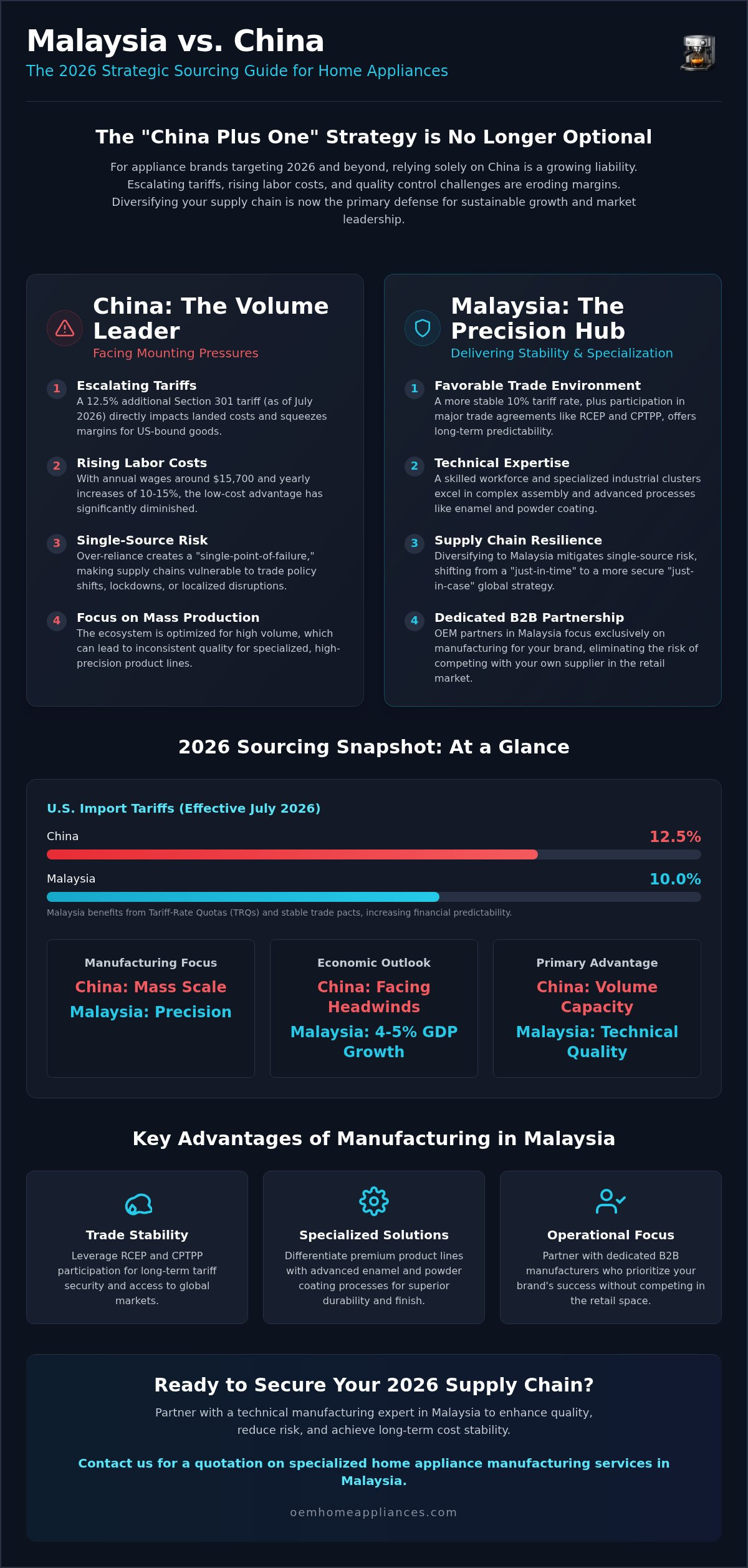
Relying on a single-source manufacturing model in China is no longer a calculated risk; it's a liability for your 2026 bottom line. You've likely felt the pressure of rising Section 301 tariffs, which hit 12.5% for Chinese imports in July 2026, and the ongoing frustration of inconsistent quality in high-volume factories. These trade barriers and supply chain fragilities make it difficult to maintain the margins your business requires for sustainable growth.
This guide analyzes the critical differences in Malaysia vs China appliance manufacturing to help you optimize your 2026 supply chain strategy. By diversifying your production, you can achieve greater trade stability and lower your total cost of ownership. We'll compare the current 10% tariff rate in Malaysia against China's escalating costs and explore how specialized technical manufacturing, such as precision enamel coating, provides a distinct competitive edge. You'll gain a clear roadmap for transitioning to a partnership model that prioritizes technical excellence and logistical reliability over simple mass production. Discover how a "China Plus One" strategy can empower your brand with the flexibility and precision needed to lead the market.
Table of Contents
The Shift in Global Appliance Sourcing for 2026
The "China Plus One" strategy isn't a backup plan anymore; it's the primary defense against margin erosion. China's manufacturing workers now earn approximately $15,700 per year, and labor costs have climbed by 10% to 15% annually over the last decade. These figures mean the low-cost advantage that once defined "Made in China" has largely evaporated for premium kitchen appliances. Brands that fail to diversify their sourcing now face a double threat of rising overhead and diminishing returns on their traditional production investments.
Trade policy has accelerated this shift. As of July 24, 2026, the U.S. imposed a 12.5% additional tariff on Chinese goods. While Malaysia also faces a 10% tariff, the availability of tariff-rate quotas (TRQs) and Malaysia's participation in the CPTPP and RCEP offer a level of economic predictability that China currently lacks. Global trade volatility now directly impacts appliance brand margins, making the lower total cost of ownership in Malaysia more attractive. This creates a clear divide in Malaysia vs China appliance manufacturing strategies for brands seeking to protect their 2026 revenue and maintain competitive pricing in Western markets.
Supply Chain De-risking Strategies
Procurement officers are moving away from single-source models to eliminate "single-point-of-failure" risks. Southeast Asia has emerged as the logical secondary powerhouse, with Malaysia leading the charge in electronics and kitchen appliance assembly. By diversifying production, brands balance immediate cost-efficiency with long-term geopolitical stability. It's a move from "just-in-time" to "just-in-case," ensuring that a disruption in one region doesn't paralyze the entire global supply chain. This approach allows companies to scale production across multiple geographies, mitigating the impact of localized labor strikes or sudden regulatory shifts.
The Rise of High-Value Manufacturing in Malaysia
Malaysia has transitioned rapidly from simple assembly to complex product development. Malaysia's manufacturing sector is now a primary driver of the nation's projected 4% to 5% GDP growth in 2026. The country has invested heavily in industrial infrastructure, attracting specialized technical talent in areas like enamel and powder-coated metal components. This expertise allows Malaysia to handle sophisticated product design and development for roaster ovens, rice cookers, and air fryers. It's no longer just about finding a factory; it's about finding a partner capable of executing bespoke engineering requirements and maintaining elite quality standards at scale.
China vs. Malaysia: Comparing OEM Capabilities
China remains the global leader in sheer manufacturing volume, with its kitchen appliance market estimated at $55.49 billion in 2026. However, the Malaysia vs China appliance manufacturing debate is no longer defined by who can produce the most units. Instead, it centers on who can provide the highest precision for specialized product lines. While China offers unparalleled scale, Malaysia has developed a reputation for technical meticulousness and stable regulatory compliance, making it the preferred hub for brands that prioritize quality over raw quantity.
Infrastructure and Ecosystem Comparison
China's ecosystem is a massive, interconnected network of upstream and downstream suppliers that supports rapid mass production. In contrast, Malaysia utilizes specialized industrial clusters that focus on the integration of high-performance components. Access to raw materials and specialized parts for roaster ovens and air fryers is highly centralized within these regional zones. This geographic concentration reduces internal logistical friction and ensures that component sourcing remains efficient. According to the Global Economic Prospects report, the continued economic stability in the East Asia and Pacific region supports this shift toward specialized manufacturing hubs. Malaysia’s infrastructure is now purpose-built to handle complex assembly and technical coating processes that mass-market factories often overlook.
Workforce and Technical Expertise
By 2026, the technical skill set of the Malaysian workforce has become a primary differentiator for international brands. Engineering teams in the region are increasingly focused on specialized kitchen appliance development, moving beyond basic assembly into full-cycle product design. The management culture in Malaysia often aligns closely with Western corporate expectations, emphasizing transparent communication and rigorous adherence to international quality standards. This cultural alignment reduces the "hidden costs" of manufacturing, such as mismanaged specifications or quality control lapses that require expensive corrections.
Lead times for Western markets also benefit from Malaysia's strategic maritime location. Shorter, more predictable shipping routes help brands maintain leaner inventory cycles. This logistical efficiency, combined with high workforce retention rates, provides a level of operational continuity that is increasingly difficult to find in traditional high-volume hubs. If you are evaluating a transition to more stable production, you can request a technical consultation to see how these capabilities align with your brand's 2026 requirements.
Trade Advantages and Economic Stability
Current geopolitical shifts have made trade stability as important as production capacity. For brands evaluating Malaysia vs China appliance manufacturing, the 2.5% difference in Section 301 tariffs is only the beginning of the cost conversation. As of July 24, 2026, the U.S. imposed a 12.5% additional tariff on Chinese imports, while Malaysian goods are subject to a 10% rate. This gap directly affects the landed cost of every unit. Malaysia offers an additional strategic advantage through pending Tariff-rate quotas (TRQs). These quotas, expected by September 1, 2026, may allow specific volumes of imports to enter at a 0% Section 301 rate, a benefit not currently on the table for Chinese-origin products.
Tariff Mitigation and Market Access
Malaysia's participation in the Comprehensive and Progressive Agreement for Trans-Pacific Partnership (CPTPP) and the Regional Comprehensive Economic Partnership (RCEP) provides a robust framework for international trade. These agreements reduce or eliminate duties on raw materials and components sourced within the member regions. For a brand manufacturing air fryers or kettles, this means lower input costs compared to factories in China that may face retaliatory duties on imported parts. Leveraging these trade networks allows retailers to maintain healthy margins even as global trade volatility persists. It's a structural advantage that provides long-term protection against sudden policy shifts in the US or EU markets.
Political and Economic Predictability
Economic stability is built on the foundation of a reliable legal system. Malaysia offers a familiar legal framework that provides high levels of intellectual property (IP) protection. This is a critical factor for brands investing in custom product design and development. Contract security is significantly higher when disputes can be resolved through established, transparent legal channels. This predictability extends to the nation's physical infrastructure. Malaysia's utility networks are reliable, with consistent energy and water supplies that prevent the production halts often seen in regions with strained power grids. Digital connectivity is equally robust, ensuring that real-time production monitoring and communication with global headquarters remain seamless. This combination of legal and physical reliability makes Malaysia a dependable backbone for a resilient 2026 supply chain.
Specialized Technical Solutions: Enamel and Powder Coating
Specialized finishes have become the primary differentiator for premium appliance brands in 2026. While mass-volume factories often struggle with consistent application at scale, the Malaysia vs China appliance manufacturing landscape shows a clear shift toward technical hubs that prioritize advanced surface treatments. Malaysia has positioned itself as a leader in high-end finishing technologies. This regional expertise provides the precision required for high-heat equipment and aesthetic consumer electronics that stand out in a saturated market. It's no longer enough to offer a functional product; the finish must reflect the brand's commitment to quality and longevity.
Advanced Coating for Durability
Industrial enamel is essential for high-heat cooking equipment. The enamel coating process for roaster ovens involves fusing glass to metal at temperatures exceeding 800 degrees Celsius. This creates a non-porous, corrosion-resistant surface that meets the strictest 2026 food safety standards. Brands can choose from custom color palettes and textures that remain stable under extreme thermal stress. This technical superiority ensures that products don't just look premium on the shelf; they maintain their performance over years of heavy use. It's a level of durability that basic paint or lower-grade coatings cannot provide, especially in the demanding environment of a commercial or high-end home kitchen.
Precision Metal Finishing
For appliances like air fryers and kettles, aesthetics and durability are equally critical. Manufacturing powder coated metal components requires a meticulous electrostatic process followed by controlled curing. Malaysia's specialized clusters utilize automated finishing lines to achieve a level of consistency that manual processes can't match. This automation reduces waste and ensures that every component meets exact specifications. This focus on precision is what sets the Malaysia vs China appliance manufacturing comparison apart for high-end brands. Ongoing R&D in the region is currently focused on developing new antimicrobial and heat-reflective coating applications to meet evolving consumer demands. These innovations allow brands to offer features that are both functional and visually striking, driving higher perceived value for the end consumer.
Achieving this level of precision requires a partner with deep technical expertise and a dedicated B2B focus. You can contact our engineering team in Malaysia to discuss your specific coating requirements and receive a detailed technical assessment for your next product line.
Selecting Your Partner in Malaysia
Choosing a manufacturing partner is the final step in securing a resilient 2026 supply chain. In the Malaysia vs China appliance manufacturing landscape, the decision often rests on the relationship model rather than just the production capacity. A critical criterion for evaluating a private label kitchen appliance manufacturer is their market position. You should prioritize a "B2B-only" partner. This eliminates the risk of retail conflict, ensuring your manufacturer isn't competing against you on global e-commerce platforms. A dedicated partner focuses entirely on your brand's growth and technical requirements.
Assessing R&D and prototyping capabilities is equally vital for successful new product launches. You need a partner that can transition seamlessly from initial design to high-volume global distribution. In Malaysia, the emphasis is on precision engineering and iterative refinement. This allows brands to test the market with pilot runs before committing to full-scale production cycles. It's a flexible approach that protects your capital while ensuring the final product meets elite performance standards.
The Partnership Onboarding Process
The onboarding process starts with a comprehensive technical feasibility assessment. This stage aligns your product specifications with the factory's advanced coating and assembly capabilities. For high-volume high capacity rice cooker factory orders, prototyping and design refinement are mandatory steps to ensure consistency. You should expect rigorous quality assurance protocols and transparent factory audit processes. These steps verify that every unit, from roaster ovens to air fryers, adheres to international safety and durability standards. This methodical progression reduces the likelihood of production delays or quality lapses during the scaling phase.
Maximizing the Malaysia Advantage
Integrating Malaysian production into your existing supply chain allows you to leverage the nation's strategic logistics hubs. Malaysia's maritime infrastructure is optimized for global shipping, providing a stable alternative to the congestion often found in traditional manufacturing centers. By utilizing these hubs, you can maintain leaner inventory levels and respond more quickly to market shifts. This logistical efficiency is a core component of the "China Plus One" strategy, offering the predictability needed for long-term contract security. It's about building a partnership that functions as a dependable backbone for your business.
As you finalize your 2026 sourcing strategy, the next step is obtaining precise technical specifications and pricing. We invite you to contact our organization for further details on our manufacturing capabilities. Reach out to our team to request a quotation for specialized appliance production within Malaysia. Our experts are ready to provide the detailed information you need to optimize your global supply chain with confidence.
Future-Proofing Your Appliance Supply Chain for 2026
The transition toward a diversified manufacturing model is no longer optional for brands seeking to protect their 2026 margins. While China offers scale, Malaysia provides the trade stability and technical precision required for high-end product development. By leveraging Malaysia's membership in RCEP and CPTPP, your brand can navigate the complexities of global tariffs while benefiting from a more predictable regulatory environment. This strategic shift ensures your supply chain remains resilient against geopolitical volatility and rising labor costs.
Success in the Malaysia vs China appliance manufacturing landscape depends on selecting a partner that aligns with your brand's technical and commercial goals. Our facility is strategically located in Malaysia's industrial heartland, offering deep expertise in enamel and powder-coated appliances. As a dedicated B2B OEM/ODM partner, we focus exclusively on empowering global brands without the risk of retail conflict. We're ready to help you scale from pilot runs to high-volume distribution with meticulous quality control at every stage.
Ready to optimize your supply chain? Request a quotation for specialized appliance manufacturing in Malaysia today. We look forward to facilitating your brand's next phase of global growth and technical excellence.
Frequently Asked Questions
Why is Malaysia becoming a preferred hub for appliance manufacturing in 2026?
Malaysia is a preferred hub because it offers a unique combination of trade stability and technical specialization. In the context of Malaysia vs China appliance manufacturing, Malaysia provides a resilient alternative to the rising costs and trade barriers in China. The country's projected 4% to 5% GDP growth in 2026 is driven by a robust manufacturing sector focused on high-value kitchen equipment.
How do labor costs in Malaysia compare to China for appliance OEM?
Chinese manufacturing wages have climbed by 10% to 15% annually over the last decade, eroding their traditional cost advantage. In early 2026, average manufacturing wages in Malaysia were approximately RM3,550. While labor isn't the only factor, Malaysia provides better long-term value through higher technical skill sets and workforce retention. This makes it more efficient for specialized production runs.
What are the trade benefits of sourcing kitchen appliances from Malaysia?
Sourcing from Malaysia allows brands to leverage major trade agreements like the CPTPP and RCEP. These frameworks reduce duties on raw materials and facilitate easier market access to the US and EU. As of mid-2026, Malaysian goods also enjoy a lower Section 301 tariff rate of 10% compared to China's 12.5% rate. This gap directly improves landed cost margins for retailers.
Can Malaysian factories handle high-volume orders for roaster ovens and air fryers?
Yes, Malaysian factories are equipped with the infrastructure to manage high-volume orders for roaster ovens, air fryers, and rice cookers. These facilities utilize automated production lines and specialized industrial clusters to maintain precision during large-scale runs. The country's ecosystem is designed to scale production seamlessly from initial pilot batches to global distribution without compromising on quality or lead times.
What specialized technical services are available in Malaysia that China lacks?
Malaysia excels in specialized surface treatments like industrial enamel and precision powder coating for metal components. These technical solutions are essential for high-heat cooking equipment and premium aesthetics. The region's focus on Malaysia vs China appliance manufacturing advantages highlights this mastery of high-end finishing technologies that many mass-market factories struggle to replicate consistently at scale.
How does oemhomeappliances ensure quality for private label brands?
Quality is maintained through a dedicated B2B partnership model that prioritizes the client's brand reputation. Every private label project undergoes rigorous prototyping and technical feasibility assessments before mass production begins. Strict quality assurance protocols and factory audits ensure that every unit meets international safety and performance standards. This focus on reliability helps brands avoid the inconsistent quality often found in low-cost factories.
Is it difficult to transition manufacturing from China to Malaysia?
Transitioning is a manageable process when following a methodical onboarding framework. It involves initial technical assessments and design refinements to ensure local production lines match your existing specifications. Malaysia's strategic maritime location and reliable digital infrastructure help integrate new production into your current global supply chain. This minimizes disruption while providing a more stable manufacturing base for the future.
What are the lead times for appliance prototyping in Malaysia?
Prototyping lead times in Malaysia are highly competitive due to the concentration of specialized technical talent and component suppliers. While specific timelines depend on product complexity, the efficient R&D ecosystem allows for rapid design iterations. This speed helps brands bring new roaster ovens or air fryers to market faster than traditional single-source models. It's a significant advantage for brands needing to respond quickly to consumer trends.


Comments