Malaysia vs China Appliance Manufacturing: A 2026 Strategic Sourcing Guide
What if the lowest unit price on your spreadsheet is actually the biggest threat to your 2026 profit margins? For years, the default choice for production was simple, but the landscape of Malaysia vs China appliance manufacturing has fundamentally shifted. You’ve likely felt the impact of the 10% tariffs currently hitting Chinese imports, and with potential forced labor investigations threatening to push those rates to 12.5%, the "China-only" model is becoming a strategic liability. It’s a difficult environment to manage when supply chain volatility and quality consistency issues are the new normal for high-volume brands.
We understand that your priority is securing a stable, high-quality production partner that protects your bottom line. This 2026 strategic sourcing guide provides a clear framework for choosing between these two manufacturing hubs. You’ll discover the "all-in" costs beyond just labor, including the 5% corporate tax incentives in Malaysia's new JS-SEZ and the trade benefits offered by the RCEP agreement. We will also identify how to find a reliable OEM partner outside of China that can maintain the precision and scale your appliance brand requires to grow in an unpredictable market.
Table of Contents
The Shifting Landscape: Why Brands Are Re-evaluating Malaysia vs China
The global manufacturing map is being redrawn. For decades, China was the undisputed leader in volume and scale. Today, geopolitical shifts and rising trade barriers have forced a strategic rethink. The decision regarding Malaysia vs China appliance manufacturing is no longer just about the lowest price per unit. It's about protecting your brand from sudden disruption and ensuring long-term resilience in an increasingly volatile market.
The "China Plus One" Strategy in 2026
The China Plus One strategy is a risk-mitigation framework where businesses diversify their production by adding a secondary manufacturing base outside of China. This approach prevents single-point failure. If a trade war or a port closure hits one region, your supply chain remains operational. Within ASEAN, Malaysia has emerged as a premier destination for this diversification. It offers a sophisticated industrial ecosystem that mirrors the technical capabilities of larger hubs but with greater geopolitical neutrality. Brands don't have to abandon their Chinese roots; they simply build a stable backbone in a second location to ensure continuous supply.
Economic Drivers for Regional Relocation
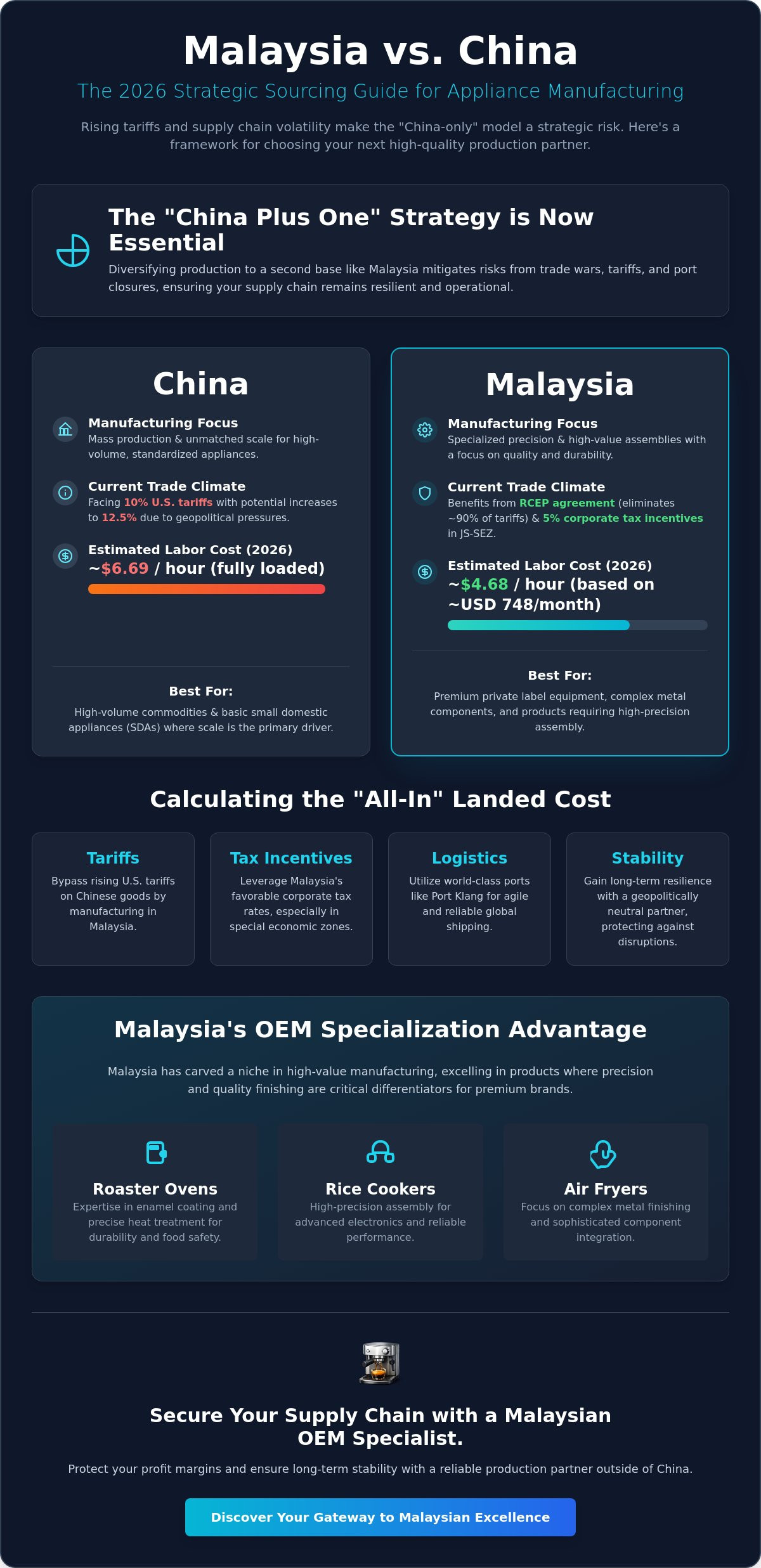
Production costs are evolving rapidly. In early 2026, the average hourly cost for a manufacturing worker in China reached approximately $6.69 when fully loaded with social insurance. In contrast, Malaysia’s manufacturing sector maintains an average monthly wage of RM3,524, which is approximately USD 748. This makes Malaysia highly competitive for precision assembly and complex product builds. The long-standing China-Malaysia economic relations have also paved the way for the RCEP agreement. This trade pact eliminates tariffs on roughly 90% of goods traded within the region. It allows manufacturers in Malaysia to source components from China at low costs while exporting finished appliances with minimal friction.
Infrastructure maturity is another deciding factor. While China excels in massive shipping volume, Port Klang provides world-class logistics that rival major Chinese hubs like Ningbo. This infrastructure, combined with Malaysia’s move up the value chain, allows for greater supply chain agility. You can react faster to market trends without the rigid constraints of ultra-high-volume mass production. Current U.S. trade policies, including the 10% tariff on many Chinese imports and the potential for a 12.5% increase due to forced labor investigations, make this regional shift a financial necessity. Moving production to Malaysia offers a way to bypass these rising costs while maintaining high technical standards.
Technical Capabilities: Mass Production vs. Specialized Precision
Choosing the right production base requires a deep understanding of what each region does best. China is the global engine for high-volume, standardized small domestic appliances (SDA). If your brand strategy relies on moving millions of basic units with minimal variation, the sheer scale of the Pearl River Delta remains unmatched. However, the conversation around Malaysia vs China appliance manufacturing takes a different turn when your products require specialized precision, complex metal finishing, or a more collaborative design process.
While China excels at mass-market speed, Malaysia has carved out a niche in high-value manufacturing and advanced electronics. This regional shift is supported by deepening supply chain linkages between the two nations. It allows Malaysian factories to leverage high-quality raw materials from the region while maintaining a more meticulous assembly environment. For brands that prioritize durability and technical sophistication over raw volume, Malaysia offers a level of oversight that is often lost in high-speed Chinese mega-factories.
The Advantage of Specialized Metal Finishing
Metal finishing is a critical differentiator in the kitchen appliance sector. Enamel-coated products, such as premium roaster ovens, require specific technical environments and precise heat treatment to prevent chipping and ensure food safety. Many high-volume Chinese factories prioritize speed, which can lead to inconsistencies in the curing process. In contrast, Malaysian facilities often specialize in these niche processes, providing a more stable environment for high-grade enamel and powder-coated metal components. These finishes are essential for BBQ grills and portable cooking equipment that must withstand high temperatures and frequent cleaning. You can see how kitchenware private label services leverage these specialized finishes to help brands position themselves in the premium market segment.
R&D and Product Development Cycles
The speed of prototyping is another area where the two regions diverge. Shenzhen is famous for its rapid "shanzhai" style of modification, which is perfect for making minor tweaks to existing off-the-shelf designs. But if you're building a product from the ground up, Malaysia’s R&D culture is built on collaborative engineering. The development cycles are methodical, focusing on long-term reliability rather than just hitting a launch date. This is particularly important for complex appliances like coffee machines or air fryers where internal component layout affects both safety and performance. Partnering with a specialized Malaysian manufacturer ensures that your product design goes through rigorous testing before it hits the mass production line, reducing the risk of costly recalls or quality complaints later on.
China: Best for standardized SDA, high-volume commodity goods, and rapid modification of existing molds.
Malaysia: Superior for specialized metalwork, complex electronic assemblies, and collaborative product development.
Quality Control: Malaysia often provides a higher ratio of QC staff to production workers compared to high-speed Chinese lines.
The "All-In" Cost: Logistics, Tariffs, and Supply Chain Stability
Calculating the true cost of production requires looking far beyond the initial unit price. In 2026, the gap in Malaysia vs China appliance manufacturing is defined by landed costs, which include freight, duties, and the price of potential delays. While Chinese factories often offer lower base quotes, the "hidden" expenses of shipping from Ningbo or Shanghai can quickly erode those margins. You must account for the current 10% U.S. tariff on Chinese imports, which could rise by another 12.5% following ongoing forced labor investigations. These financial pressures have contributed to China’s share of U.S. imports dropping to 13.4%, down from 21.6% just seven years ago.
Tariffs and Trade Barriers
Trade policy is the most significant variable in your 2026 sourcing strategy. Malaysia currently faces a proposed 10% tariff on certain goods, but its participation in the RCEP agreement allows for a much more flexible tax environment compared to China’s isolated trade position. By utilizing Malaysian origin certificates, brands can often optimize their tax exposure and avoid the aggressive anti-dumping duties leveled against Chinese-made appliances. The country of origin for your components determines the applicable duty rate, which directly dictates your final retail price and market competitiveness. This legal clarity provides a level of financial predictability that is currently unavailable in the Chinese market.
Supply Chain Resilience and Lead Times
Logistics efficiency is where Malaysia truly shines for mid-to-high volume brands. Port Klang has established itself as a high-speed alternative to congested Chinese hubs, offering competitive shipping lead times to North American and European markets. Managing component sourcing within Malaysia is also becoming easier as the local ecosystem for electronics and metalwork matures. Choosing to outsource appliance production in this stable environment reduces the risk of sudden port closures or political interference. Many brands now maintain buffer stocks in Malaysian warehouses to hedge against global shipping volatility, ensuring that retail shelves remain stocked even when other regions face lockdowns or labor strikes.
Intellectual Property (IP) protection remains a cornerstone of the Malaysian manufacturing value proposition. Unlike the rapid-copy culture often found in high-volume Chinese industrial zones, Malaysia’s legal framework is modeled on international standards that prioritize the safety of your proprietary designs. This security is complemented by a growing focus on "Green Manufacturing." With global retailers demanding higher sustainability standards, Malaysia’s investment in energy-efficient production processes and carbon-neutral industrial zones offers a long-term branding advantage that goes beyond simple cost savings.
Strategic Selection: Which Region Fits Your Brand Goals?
Strategic alignment is the final piece of the sourcing puzzle. Once you understand the technical and financial variables, you must determine which region supports your specific brand trajectory. The choice between Malaysia vs China appliance manufacturing often comes down to the complexity of your product line and the level of partnership you require. While one region offers unrivaled scale, the other provides the precision and stability needed for premium market positioning.
When to Choose China
China remains the logical choice for high-volume, low-margin "commodity" appliances. If your product is a standardized item with little technical differentiation—such as basic electric kettles or simple blenders—the massive internal component supply chains in Guangdong provide a speed-to-market that is hard to beat. You can leverage existing molds and massive production runs to drive down the cost per unit. However, managing the risks of high-volume mass production requires constant on-site presence. Without strict oversight, quality dilution can occur as factories prioritize throughput over meticulous assembly.
When to Choose Malaysia
Malaysia is the superior option for brands focusing on premium, specialized, or private label kitchen equipment. This is the ideal hub for custom roaster oven manufacturing and other appliances that require specialized metalwork and high-durability enamel finishes. If your product line includes air fryers, coffee machines, or BBQ grills, Malaysia offers a more controlled manufacturing environment with higher quality control ratios. The "human factor" also plays a significant role here. Malaysian project management styles are typically more collaborative and transparent, with high English proficiency facilitating smoother communication during complex product development cycles.
The 2026 Manufacturing Audit Checklist
Before placing your next purchase order, use this checklist to evaluate your potential partner's readiness for the current economic climate:
RCEP Compliance: Does the factory provide documentation to leverage regional trade agreements for component sourcing?
ESG Standards: Can the manufacturer prove compliance with global sustainability and labor standards to avoid 2026 tariff penalties?
Technical Specialization: Does the facility have dedicated lines for specialized finishes like powder coating or enamel?
Prototyping Capability: Is there an in-house R&D team capable of collaborative engineering rather than just "copy-paste" manufacturing?
IP Security: What specific legal frameworks does the factory use to protect your proprietary designs and molds?
Selecting a partner that meets these criteria ensures your brand remains resilient against global supply chain volatility. If you are looking for a stable, high-precision manufacturing base for your next product launch, contact oemhomeappliances today to discuss your production requirements.
Partnering with oemhomeappliances: Your Gateway to Malaysian Excellence
Choosing the right production base is a high-stakes decision that defines your brand’s stability for years to come. As the Malaysia vs China appliance manufacturing landscape continues to evolve, having a boots-on-the-ground partner in Southeast Asia is no longer just an option; it's a competitive necessity. At oemhomeappliances, we serve as a dedicated B2B manufacturing partner for global brands seeking to diversify their supply chains without compromising on technical precision or quality control. We provide the industrial strength of a major hub with the flexibility of a bespoke service provider.
Our Manufacturing Capabilities
Our facility is engineered to handle the complexities of modern kitchen appliance production. We maintain a specialized focus on roaster ovens, rice cookers, and air fryers, ensuring that every unit meets the rigorous durability standards required by premium retail markets. Our advanced production lines are also optimized for portable cooking equipment and BBQ grills, providing the scalability you need to grow your product line efficiently.
Technical expertise in metal finishing is our primary differentiator. We operate in-house enamel coating and powder-coated metal component lines, allowing for total control over the curing and application process. This integration is vital for appliances that must withstand high-temperature environments. By managing these specialized finishes internally, we eliminate the quality inconsistencies often found when outsourcing to third-party coaters. We also commit to regular factory audits and adhere to global quality standards, ensuring that your brand’s reputation is protected at every stage of the assembly line.
Building Your Private Label Success
We understand that a successful manufacturing partnership goes beyond simple assembly. Our team facilitates the entire journey from initial prototype to mass production, acting as a collaborative extension of your R&D department. We specialize in product design and development, helping you refine your concepts into market-ready appliances that stand out on the shelf. Whether you are launching a new line of coffee machines or expanding your range of blenders and kettles, our methodical approach ensures a frictionless transition to scale.
Integrity is at the core of our business model. We maintain a strict "no direct-to-retail" promise. We don't compete with our clients in the retail space or distribute to third-party agents. Our success is entirely dependent on the success of your brand. This transparency fosters a long-term, partnership-driven environment where your intellectual property and market share are always the priority.
The manufacturing shifts of 2026 require a partner who is knowledgeable, efficient, and ready for global distribution. Contact our technical team today to discuss your 2026 sourcing strategy and discover how our Malaysian facility can empower your brand’s growth.
Secure Your 2026 Supply Chain Strategy
The 2026 manufacturing landscape demands a transition from cost-only sourcing to a focus on total supply chain resilience. Deciding between Malaysia vs China appliance manufacturing is no longer a simple unit-price calculation. It's a strategic move to insulate your brand from rising tariffs and mass-production quality issues. By diversifying into Malaysia, you gain access to a stable regulatory environment and specialized technical expertise that high-volume hubs often overlook.
Success in the coming years depends on finding a partner that prioritizes your brand's growth through precision engineering and transparent communication. We provide the specialized enamel and powder coating expertise necessary for premium roaster ovens and air fryers, ensuring your products exceed market expectations. Our strategic location in Malaysia offers the ideal backbone for global distribution and long-term stability.
Partner with a leading Malaysian appliance manufacturer for your 2026 product line and secure your brand's future. We're ready to help you build a more agile and profitable production strategy.
Frequently Asked Questions
Is manufacturing in Malaysia more expensive than in China in 2026?
While unit prices in Malaysia are often slightly higher than in China, the total landed cost is frequently lower due to reduced tariffs and tax incentives. In 2026, China's fully loaded labor cost is approximately $6.69 per hour, whereas Malaysia's average manufacturing wage remains competitive at around USD 748 per month. When you factor in the 10% to 12.5% U.S. tariffs currently applied to Chinese goods, Malaysia often becomes the more economical choice for global distribution.
How does the quality of Malaysian-made appliances compare to those from China?
Malaysian manufacturing is recognized for higher technical precision and stricter quality control compared to high-volume Chinese mass production. While China excels at standardized commodity goods, Malaysia focuses on complex assemblies and specialized metal finishes. This makes Malaysia the preferred hub for premium products that require durability and meticulous oversight, such as air fryers and coffee machines that must meet rigorous international safety and performance standards.
What are the main advantages of the China Plus One strategy for appliance brands?
The primary advantage is supply chain resilience through geographical diversification. By adding a secondary production base in Malaysia, brands mitigate the risk of single-point failure caused by geopolitical tensions or regional port closures. This strategy ensures a continuous supply even if one region faces disruption. It also allows brands to leverage the specific technical strengths of different hubs while optimizing their global tax and duty exposure under current trade policies.
Do Malaysian factories have the same component supply chain as China?
Malaysian factories utilize the RCEP agreement to source components efficiently from across Asia, including China. While China has the world's most concentrated internal supply chain, Malaysia has developed a sophisticated local ecosystem for electronics and specialized metalwork. This regional integration allows manufacturers in Malaysia to maintain high production standards while keeping material costs competitive through duty-free trade with neighboring RCEP member states.
How do tariffs affect the choice between Malaysia and China for US and EU brands?
Tariffs are currently the strongest driver in the Malaysia vs China appliance manufacturing debate for Western brands. U.S. brands face a baseline 10% tariff on many Chinese imports, with potential increases to 12.5% under forced labor investigations. Sourcing from Malaysia allows companies to utilize Malaysian certificates of origin, significantly reducing or eliminating these specific trade penalties and protecting retail margins in both the U.S. and EU markets.
What specialized appliances are best suited for Malaysian manufacturing?
Malaysia is best suited for appliances requiring specialized metal finishing, such as enamel-coated roaster ovens and powder-coated BBQ grills. High-precision electronics like air fryers and coffee machines also benefit from Malaysia's advanced technical infrastructure. Brands looking for private label manufacturing of portable cooking equipment often choose Malaysia for its ability to handle complex assemblies and collaborative R&D processes that high-volume Chinese mega-factories might deprioritize.
How can I verify the quality standards of a Malaysian OEM partner?
You can verify standards by requesting ISO certifications and reviewing third-party factory audit reports. Most reputable Malaysian OEM partners maintain international certifications for quality management and environmental safety. It's also effective to evaluate their technical capabilities in specialized areas like enamel coating. A reliable partner will provide transparent documentation of their QC ratios and invite on-site inspections to demonstrate their commitment to global manufacturing excellence.
What is the typical lead time for appliance production in Malaysia vs China?
Typical lead times in Malaysia are highly competitive, often ranging from 30 to 60 days depending on product complexity. While China has massive throughput, port congestion in hubs like Ningbo can cause unpredictable shipping delays. Malaysia’s Port Klang offers efficient logistics and shorter shipping windows for many global routes. This stability in the Malaysia vs China appliance manufacturing cycle allows brands to manage inventory with greater precision and avoid out-of-stock scenarios.


Tailored Solutions for Diverse Product Lines
We provide custom manufacturing for a wide range of kitchen hardware, including air fryers, blenders, and coffee machines. Our OEM/ODM services allow you to scale your operations without the massive overhead of managing your own facilities. We understand the nuances of kitchenware production, from thermal safety requirements to aesthetic consistency across different SKUs. This deep category expertise ensures your products aren't just manufactured; they're engineered for market success. You focus on your brand, and we handle the industrial execution.