Metal Component Finishing for Appliances: A Comprehensive B2B Technical Guide

A single finish failure on a high-heat component can dismantle years of brand trust in one production cycle. Selecting the right metal component finishing for appliances is a high-stakes engineering decision, not a simple aesthetic choice. You already know that managing multiple finishing subcontractors leads to inconsistent quality and high rejection rates. It's difficult to balance thermal stability with the rigorous food-safety standards required for modern kitchen equipment.
This technical guide provides a clear framework for choosing industrial finishes that enhance durability and protect your brand reputation. We'll explore the performance characteristics of enamel and powder coatings while addressing the latest regulatory shifts, including the January 2026 EPA NESHAP updates and upcoming PFAS wastewater guidelines. You'll gain the technical insight needed to reduce production waste and ensure your products maintain their integrity in the most demanding environments.
Table of Contents
The Strategic Value of Metal Component Finishing in Appliance Manufacturing
Evaluating Finishing Technologies: Enamel vs. Powder Coating vs. Plating
Selecting Finishes Based on Appliance Environment and Functionality
How to Implement a Professional Finishing Quality Control Process
Optimizing Your Supply Chain with Integrated OEM Finishing Solutions
The Strategic Value of Metal Component Finishing in Appliance Manufacturing
Metal component finishing for appliances acts as the primary defense against environmental stressors. It isn't just a cosmetic layer. It's a functional barrier that shields metal substrates from oxidation, mechanical wear, and extreme thermal cycling. High-quality finishes directly extend appliance warranty life. When a finish holds up under pressure, your brand perception remains high. Conversely, a single coating failure can lead to expensive recalls and permanent damage to your corporate reputation. Precision in finishing is a prerequisite for market longevity.
Consider the impact on thermal efficiency in appliances like roaster ovens. The finish must manage heat distribution while resisting high-temperature discoloration. Efficient finishing improves thermal emissivity, which helps maintain consistent internal temperatures. This optimization reduces energy consumption and ensures the appliance performs to its engineered specifications. Without the correct finish, heat-intensive equipment suffers from premature structural degradation and reduced performance.
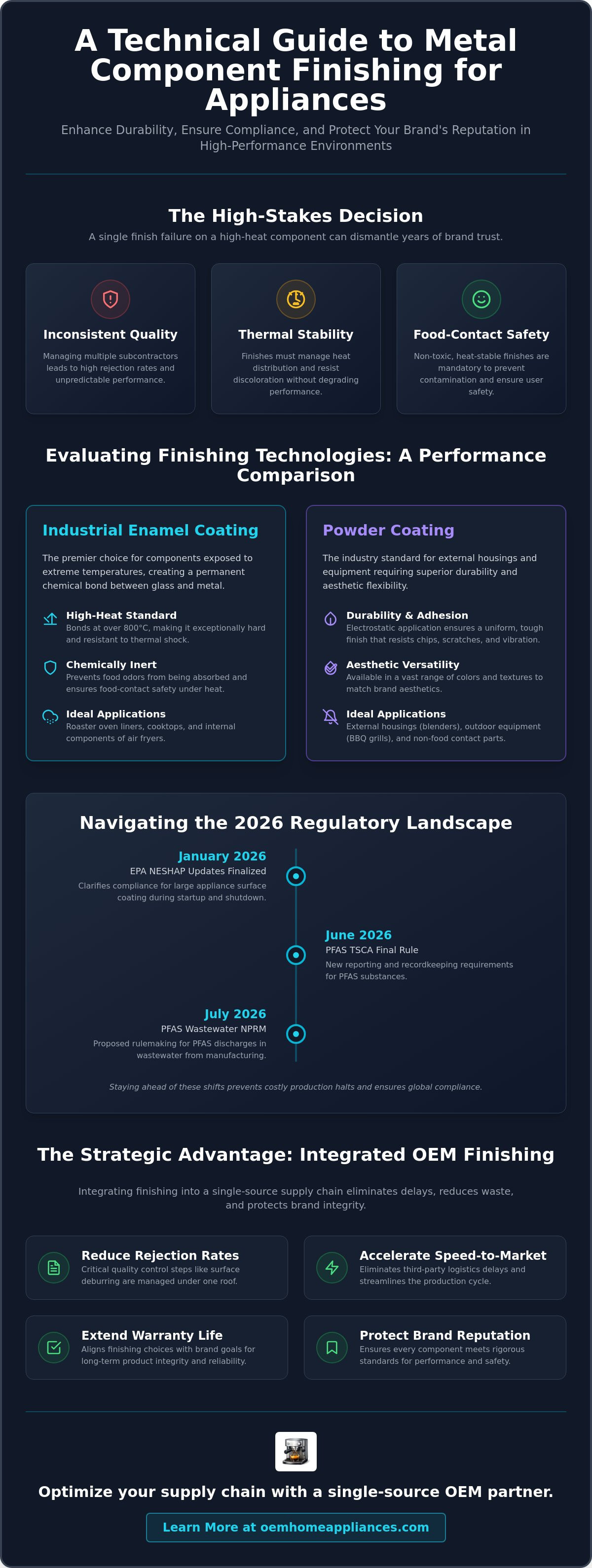
Manufacturers must also track the 2026 regulatory landscape to maintain market access. The EPA finalized amendments to the NESHAP standards for large appliance surface coating on January 13, 2026. These updates clarify compliance requirements during startup and shutdown periods. Additionally, the EPA plans to issue a final rule in June 2026 regarding TSCA reporting and recordkeeping for PFAS. A new Notice of Proposed Rulemaking for PFAS discharges in wastewater is also scheduled for July 2026. Staying ahead of these shifts prevents costly production halts and ensures your supply chain remains compliant with global safety standards.
Durability and Brand Longevity
High-vibration appliances like blenders require finishes with superior adhesion properties. Surface integrity prevents structural fatigue caused by constant micro-movements and mechanical stress. A robust powder coating process ensures that external housings resist chips and scratches during years of heavy daily use. This maintains the "out-of-the-box" aesthetic that consumers associate with premium quality. Industrial finishing represents the precise intersection of material science and consumer experience.
Compliance and Safety Standards
Internal components for rice cookers and air fryers must meet strict FDA food-contact requirements. Non-toxic, heat-stable finishes are mandatory for portable cooking equipment to prevent contamination. In high-heat environments, inferior coatings risk flaking or chemical leaching into the food path. Choosing the right metal component finishing for appliances mitigates these safety risks. It ensures that components remain chemically inert even under extreme stress. Precision in finish selection protects the end-user and the manufacturer's liability simultaneously.
Evaluating Finishing Technologies: Enamel vs. Powder Coating vs. Plating
Selecting the correct metal component finishing for appliances depends on the specific thermal and mechanical demands of the part. Engineers must weigh the benefits of chemical resistance against application costs and aesthetic requirements. Industrial enamel, powder coating, and electroplating each serve distinct roles within the appliance architecture. Understanding these technical distinctions ensures that your product meets performance benchmarks while staying within budget during large-scale production cycles.
Industrial Enamel Coating: The High-Heat Standard
Industrial enamel is the premier choice for components exposed to extreme temperatures, such as roaster oven liners and cooktops. This process creates a permanent chemical bond between glass and metal at temperatures exceeding 800 degrees Celsius. The resulting surface is exceptionally hard and resists thermal shock, making it ideal for the intense heat cycles of cooking equipment. It's also chemically inert, which prevents food odors from being absorbed into the substrate. For a deeper dive into these specifications, see our guide on Enamel Coating for OEM Kitchen Appliances: The Ultimate Guide for Brand Managers. This finish provides a level of heat resistance that organic coatings simply cannot match.
Powder Coating for Durability and Color
Powder coating is the industry standard for external housings and outdoor equipment like BBQ grills. The electrostatic application process ensures uniform coverage even on complex geometries with deep recesses. This method is highly efficient, as overspray can often be reclaimed and reused, reducing material waste. When evaluating finishing technologies, powder coating stands out for its superior UV resistance and weatherproofing. It protects portable cooking gear from the elements while offering a wide range of matte and gloss finishes. These aesthetic options allow brand managers to align product looks with modern kitchen trends without sacrificing surface toughness.
For internal structural components that don't require high-end aesthetics, electroplating with zinc or nickel is often the most cost-effective solution. These finishes provide essential corrosion resistance for internal frames and fasteners in kettles or coffee machines. While plating offers excellent protection for hidden parts, it lacks the thermal stability of enamel or the impact resistance of powder coating. Balancing these technologies across your bill of materials is critical. If you're looking to optimize your production efficiency, partnering with a specialist in private label manufacturing can simplify the selection process for every component in your catalog. Choosing the right metal component finishing for appliances early in the design phase prevents costly re-engineering and ensures long-term reliability.
Selecting Finishes Based on Appliance Environment and Functionality
A "one-size-fits-all" approach to metal component finishing for appliances inevitably leads to premature product failure. Every appliance creates a unique micro-environment that dictates specific coating requirements. While a decorative powder coating might excel on a blender base, it will fail rapidly if applied to the interior of a high-capacity rice cooker or an air fryer basket. Engineers must evaluate environmental stressors like constant steam, abrasive cleaning, and rapid thermal cycling before finalizing a finishing specification.
The decision-making process should follow a functional matrix. High-moisture environments require superior corrosion resistance and passivation. High-heat environments demand thermal stability and chemical inertness. When these factors overlap, such as in coffee machines or roaster ovens, the finish must also withstand the mechanical stress of expansion and contraction. Precision in this selection phase reduces long-term warranty claims and ensures that the appliance maintains its safety profile throughout its lifecycle.
High-Moisture and Steam Environments
Appliances like rice cookers and electric kettles subject metal components to near-constant saturation. Stainless steel components in these units often require specialized passivation techniques to maximize their inherent corrosion resistance. This process removes free iron from the surface, creating a passive oxide layer that prevents pitting corrosion. Without this treatment, steam can penetrate the surface and lead to localized structural weakening. For manufacturers scaling their production, understanding these nuances is vital. You can find more on optimizing these processes in our report on the High Capacity Rice Cooker Factory: A 2026 Global Manufacturing Reference. Proper finishing also prevents mineral buildup from hard water, which can otherwise impede the efficiency of high-wattage heating elements.
Intense Heat and Oil Exposure
Air fryers and BBQ grills present a different set of challenges, specifically the combination of intense heat and carbonized grease. Metal component finishing for appliances in this category must provide a surface that is both non-stick and highly durable. Enamel-coated components are often the preferred solution for air fryer heating element shields and baskets. Enamel's glass-like surface doesn't react with oils at high temperatures, which prevents the "gumming" effect often seen with lower-quality organic coatings. It also allows for aggressive cleaning without stripping the finish. Balancing these non-stick properties with industrial-grade abrasion resistance ensures that the appliance remains functional and hygienic even after hundreds of cooking cycles. This durability is the silent driver of brand loyalty in the competitive portable cooking market.
How to Implement a Professional Finishing Quality Control Process
Executing a flawless finish requires more than high-end equipment. It demands a methodical, five-step quality control workflow that ensures every production batch meets your specific durability benchmarks. By standardizing these steps, you eliminate the variability that often leads to high rejection rates in multi-vendor supply chains. This structured approach moves beyond aesthetics, focusing on the mechanical and chemical integrity of the substrate.
The process begins with surface preparation. Step 1 involves rigorous deburring and degreasing. This removes mechanical burrs and residual machining oils that prevent molecular bonding. Step 2 requires selecting the correct application method, such as electrostatic spraying for complex housings or dipping for internal structural parts. Step 3 focuses on controlled curing, where precise thermal processing stabilizes the finish. Step 4 is the validation phase, utilizing salt spray tests and adhesion cross-hatching to verify performance. Finally, Step 5 employs ultrasonic cleaning to ensure every metal component finishing for appliances is assembly-ready and free of microscopic debris.
Critical Pre-Treatment Protocols
Residual oils are the primary cause of coating delamination. Even microscopic traces of lubricants from the stamping process can create "fisheyes" or bubbles in the final finish. Eliminating these contaminants requires a combination of chemical degreasing and surface etching. Mechanical etching provides a physical profile for the coating to grip, while chemical etching ensures a uniform surface pH. Deburring is a non-negotiable requirement for ensuring user safety and preventing coating delamination on sharp appliance edges. These protocols ensure that the primary layer of metal component finishing for appliances achieves maximum adhesion from the start.
Testing and Validation Standards
Consistency is maintained by utilizing ISO 9001:2026 standards across all finishing stages. Validation isn't limited to simple visual checks. Thermal cycle testing simulates five years of heavy appliance use by subjecting components to rapid temperature swings. This identifies potential fatigue points before the product reaches the consumer. Quality teams also perform color matching and gloss-level verification to ensure that a powder-coated handle perfectly matches an enamel-coated door in multi-component assemblies. If you want to streamline your production with a partner who manages the entire product design and development lifecycle including these QC steps, our engineering team is ready to assist. This level of technical oversight reduces waste and protects your brand's reputation for quality.
Optimizing Your Supply Chain with Integrated OEM Finishing Solutions
Fragmented supply chains create hidden costs and technical risks. When you separate metal stamping from metal component finishing for appliances, you introduce logistical friction and potential quality gaps. Integrated OEM solutions eliminate these inefficiencies. Consolidating manufacturing and surface treatment under one roof gives you total control over the production timeline. This model ensures that technical specifications aren't lost in translation between different vendors, resulting in a more resilient end product.
Speed-to-market is a competitive necessity in the appliance industry. Eliminating third-party coating subcontractors can reduce total lead times by several weeks. This integration also empowers your R&D team. You can develop and test custom finishes during the initial prototyping phase rather than treating them as an afterthought. For brands looking to scale complex, heat-sensitive products, this synergy is essential. Review our Custom Roaster Oven Manufacturing: The 2026 Strategic Partner Guide to see how integrated finishing supports high-heat product lines.
Streamlining Production and Logistics
In-house finishing significantly reduces the risk of transit damage. Moving semi-finished parts between facilities exposes them to moisture and mechanical impacts that can compromise the substrate before it's even coated. When we finish in-house, parts move directly from the stamping press to the pre-treatment and coating chambers. This consolidated accountability means one partner handles every variable from material selection to final inspection. For high-volume orders of enamel-coated products, this scalability ensures consistent quality across thousands of units without the logistics overhead of managing multiple subcontractors.
Partnering with oemhomeappliances for Technical Development
We offer deep expertise in powder-coated metal components and comprehensive product design. Our facility acts as a technical extension of your own engineering department. We provide tailored finishing solutions that help private label kitchen appliance brands stand out in crowded markets through superior durability and refined aesthetics. Whether you need specific abrasion resistance for air fryers or UV-stable coatings for outdoor BBQ grills, our team delivers precision at scale. Consult with our engineering team on your next appliance project to optimize your metal component finishing for appliances and streamline your path to market.
Future-Proofing Your Appliance Production with Precision Finishing
Achieving industrial-grade durability requires a methodical approach to material science and application. You've seen how matching the right finish to specific thermal and moisture stressors prevents premature failure and protects your brand's integrity. By integrating a professional quality control process, you reduce waste and ensure every component is assembly-ready. Transitioning to a single-source manufacturing model further optimizes your supply chain by cutting out third-party delays and transit risks. These steps ensure your products meet the rigorous demands of modern consumers while maintaining compliance with 2026 safety standards.
Precision in metal component finishing for appliances isn't just a technical requirement; it's a strategic advantage that extends product life. We support private label brands with ISO 9001 certified manufacturing processes and specialized expertise in both enamel and powder coating. Our global logistics support ensures your products move efficiently from our production floor to your distribution centers. Request a Technical Consultation for Your Appliance Finishing Needs to see how we can empower your next project. We're ready to help you build appliances that set the industry standard for safety and performance.
Frequently Asked Questions
What is the best metal finish for high-heat kitchen appliances?
Industrial enamel is the superior choice for high-heat applications because it handles temperatures exceeding 800 degrees Celsius without degrading. This inorganic coating creates a permanent bond with the metal substrate, making it ideal for oven liners and heating elements. Unlike organic coatings, enamel doesn't off-gas or lose its structural integrity when subjected to extreme thermal cycling.
How do enamel and powder coatings differ in appliance applications?
Enamel is a glass-based coating designed for extreme heat and chemical resistance, while powder coating is a polymer-based finish used for external durability. Enamel excels in the internal cooking chambers of roaster ovens due to its inert nature. Powder coating provides superior impact resistance and a wider range of aesthetic options for external housings and BBQ grill bodies.
Are all metal finishes for appliances food-safe?
Not all metal finishes are food-safe; you must specify coatings that meet FDA or global food-contact standards for internal parts. Enamel is inherently food-safe due to its non-porous glass composition. Selecting the correct metal component finishing for appliances in the food path is critical to prevent chemical leaching or coating delamination during the cooking process.
Why is deburring important before finishing metal appliance parts?
Deburring is essential because it removes sharp edges and mechanical burrs that cause localized coating failure. These irregularities prevent the finish from adhering uniformly, which creates weak points where corrosion typically begins. In high-end appliances, deburring also ensures user safety and a premium tactile feel by eliminating snag points on internal and external metal parts.
Can custom colors be achieved with industrial appliance coatings?
Custom colors are easily achievable through industrial powder coating processes that match specific RAL or Pantone shades. This allows brand managers to maintain aesthetic consistency across diverse product lines like blenders and air fryers. While enamel offers a more focused color palette optimized for performance, powder coating provides extensive flexibility in gloss levels and textures for modern designs.
How does metal finishing affect the lifespan of a roaster oven?
High-quality metal finishing significantly extends a roaster oven's lifespan by preventing substrate oxidation caused by salt, fats, and steam. The finish acts as a permanent barrier that maintains the appliance's thermal efficiency and structural integrity. Without a robust finish, the metal components would suffer from rapid corrosion and structural fatigue within a few months of heavy use.
What quality tests should I require for powder-coated appliance components?
You should require salt spray testing, cross-hatch adhesion tests, and impact resistance validation to ensure long-term durability. Salt spray tests measure corrosion resistance over hundreds of hours, while cross-hatching verifies that the coating won't peel under mechanical stress. These rigorous checks confirm that the metal component finishing for appliances meets your specific engineering and safety benchmarks.
Does finishing metal components in-house reduce manufacturing lead times?
Finishing metal components in-house reduces manufacturing lead times by eliminating the need to coordinate with third-party subcontractors. This integration removes logistical delays associated with transit and external production scheduling. It also allows for immediate quality oversight, which prevents production bottlenecks and typically accelerates the total manufacturing cycle by several weeks.


Comments