OEM Blender Supplier for USA Brands: 2026 Sourcing Guide
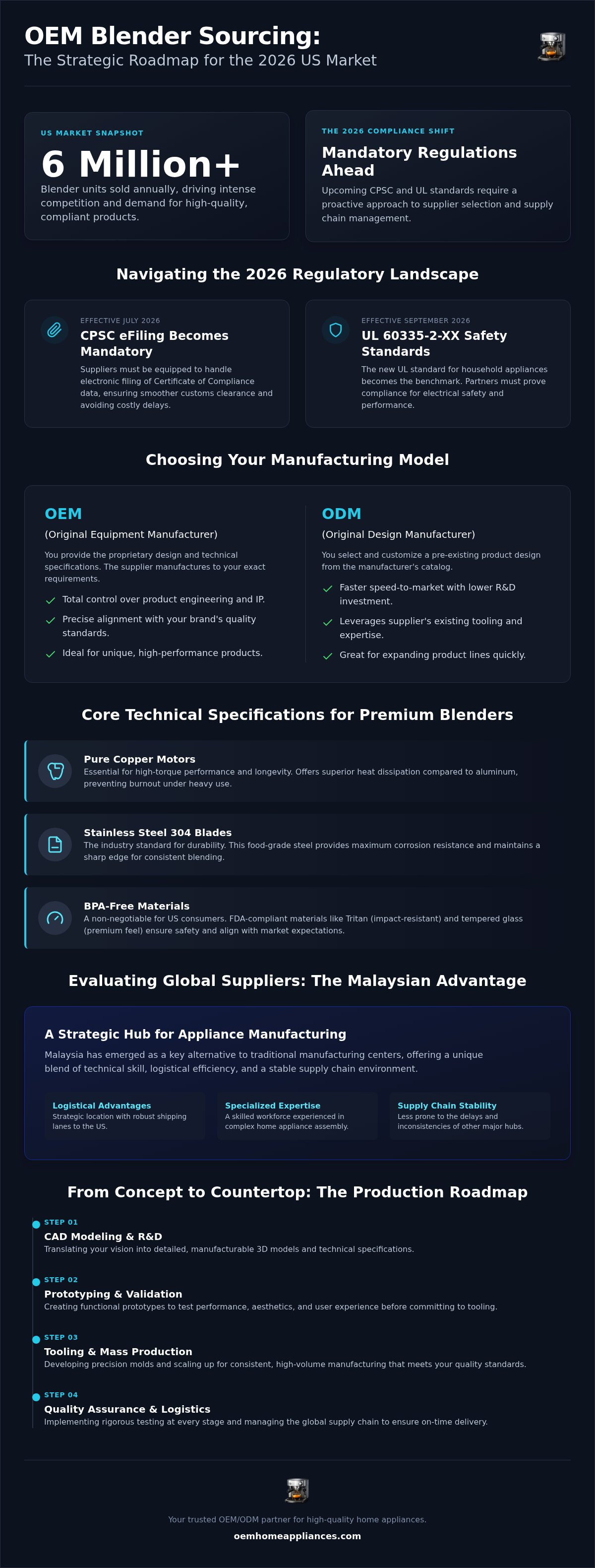
With over 6 million blender units sold annually in the United States, the competition for counter space has never been more intense. However, as of July 2026, simply having a great product isn't enough. Mandatory CPSC eFiling and the September 2026 shift to UL 60335-2-XX safety standards mean your supply chain must be as precise as your engineering. Finding the right OEM blender supplier USA brands can trust requires moving beyond generic factories toward partners who master both technical compliance and premium aesthetics.
You likely know the frustration of receiving a batch with inconsistent build quality or struggling to find a manufacturer that offers specialized finishes like enamel or powder coating. It's exhausting to manage communication barriers while your launch dates slip. This guide provides a clear roadmap for the 2026 market. You'll discover how to secure a scalable partnership that balances high-grade materials with reliable production timelines. We'll examine technical engineering requirements, custom design differentiation, and the logistics of global supply chain stability to ensure your brand stands out in a crowded market.
Table of Contents
The Landscape of OEM Blender Sourcing for US Brands in 2026
The US blender market in 2026 is no longer satisfied with off-the-shelf solutions. Brand managers are pivoting toward specialized manufacturers to escape the "race to the bottom" pricing found in traditional low-cost hubs. A reliable Original Equipment Manufacturer (OEM) provides the technical depth needed to survive this shift. It's about securing a long-term partner that understands your brand's specific engineering needs rather than just a vendor selling a catalog item. Choosing an OEM blender supplier USA brands can rely on means prioritizing technical expertise over the lowest possible unit cost.
This transition reflects a broader move away from generic white-labeling. Consumers now demand high-performance machines with unique finishes and smarter features. Traditional sourcing hubs often struggle with these bespoke requirements, leading to inconsistent quality and supply chain delays. By contrast, a strategic partnership focuses on scalability and material integrity, ensuring that every unit reflects your brand's reputation for excellence.
Defining the Professional OEM vs. ODM Model
The choice between OEM and ODM depends on your specific market strategy and technical resources. In an OEM model, the brand retains total control over the technical specifications, allowing for precise brand alignment. This is essential for companies that have proprietary designs or specific motor performance requirements. Conversely, the ODM model supports rapid market entry by utilizing existing manufacturer designs that are then customized for your brand. Many established distributors use this to fill gaps in their product lines quickly. Selecting a private label kitchen appliance manufacturer that offers both capabilities ensures you have the flexibility to scale your product development as your brand grows.
US Market Standards: Safety and Performance Compliance
Compliance is the most critical hurdle for any US brand in 2026. New regulations require rigorous adherence to energy efficiency and electrical safety. You must ensure your manufacturer is prepared for the mandatory UL 60335-2-XX series certification and ENERGY STAR v4.0 labeling requirements that took effect in September 2026. Beyond basic safety, performance standards have risen. High-tier manufacturers prioritize specific components to meet these expectations:
Pure Copper Motors: These offer superior heat dissipation and longevity compared to aluminum-wound alternatives, supporting the high-torque needs of professional-grade blending.
Stainless Steel 304 Blades: This grade ensures maximum corrosion resistance and maintains a sharp edge under heavy use.
BPA-Free Materials: FDA-compliant Tritan or tempered glass jars are non-negotiable for US consumer safety expectations.
Failure to meet these technical benchmarks doesn't just risk customs delays; it damages your brand's credibility in a market that values durability and safety above all else.
Technical Specifications and Customization Capabilities
Engineering a high-performance blender starts with the motor. For US brands, a high-torque pure copper motor is the standard for professional-grade results. These motors provide the necessary power to handle frozen ingredients and fibrous vegetables without overheating. As an experienced OEM blender supplier USA brands look to for durability, we prioritize thermal protection systems that prevent motor burnout during peak usage. This focus on internal engineering ensures that the product performs consistently under the heavy-duty cycles typical of American kitchens.
Material selection defines the product's market positioning. BPA-free Tritan offers the clarity of glass with the impact resistance of plastic, making it ideal for high-volume households. Tempered glass provides a premium feel and superior scratch resistance, while stainless steel jars are the gold standard for commercial durability and thermal retention. Your choice of material should align with your target demographic's lifestyle and safety expectations. Each material requires specific molding and sealing techniques to maintain a leak-proof environment during high-speed operation.
Customization extends to the user interface and smart capabilities. Brands can choose between traditional tactile rotary knobs for a classic professional look or sleek digital touchscreens with pre-programmed cycles. Integrating smart technology, such as Bluetooth connectivity for recipe syncing or weight sensors, helps your product fit into the modern connected kitchen ecosystem. If you are ready to explore these technical options, you can request a technical consultation to discuss your specific requirements.
Specialized Metal Finishing: Enamel and Powder Coating
Standard plastic housings often feel cheap to discerning US consumers. Utilizing enamel coated metal components for the blender base provides a high-end, retro aesthetic that is virtually indestructible. Powder-coating offers another robust alternative, providing a thick, protective layer that resists chips and corrosion in high-moisture environments. These finishing techniques allow for precise color matching, ensuring your product line perfectly reflects your brand’s visual identity across different retail channels.
Blade Engineering and Jar Ergonomics
Blades are the engine of the blending process. Multi-plane blade configurations ensure a homogenous blend by creating a vortex that pulls ingredients down toward the cutting edge. This engineering minimizes "dead zones" where food remains unblended. Additionally, noise reduction is a major differentiator for the US market. Advanced housing insulation and vibration-dampening feet can significantly lower decibel levels during operation. All designs must adhere to U.S. safety standards to ensure user protection and minimize operational hazards. Thermal resistance is also critical, especially for models designed to handle both ice-cold smoothies and boiling soups without compromising the integrity of the jar or the seal.
Evaluating Global Suppliers: The Strategic Advantage of Malaysia
Diversifying your supply chain is no longer a luxury; it's a strategic necessity for US brands. While traditional hubs have dominated the landscape for decades, the 2026 manufacturing environment favors regions that offer stability and technical maturity. Malaysia has emerged as a premier destination for high-end appliance production due to its sophisticated industrial infrastructure and skilled engineering workforce. For any brand seeking a reliable OEM blender supplier USA companies can trust, the Malaysian market provides a unique balance of cost-efficiency and high-grade technical output.
The shift toward Southeast Asia is driven by more than just labor costs. US brand managers are increasingly wary of the geopolitical risks and volatile tariff structures associated with older sourcing models. Malaysia's government incentives for the manufacturing sector and its strategic location for global export make it a stable backbone for your product line. Keiteq facilitates these global production standards by acting as a bridge between complex US market requirements and precise manufacturing execution. We ensure that every blender produced meets the rigorous durability and performance benchmarks expected by American consumers.
Supply Chain Resilience and Logistics
Logistical efficiency is a primary driver for selecting a Malaysian partner. The country's well-developed port systems allow for streamlined shipping routes to both US coasts, helping you maintain lean inventory levels. In 2026, navigating US import duties requires a partner who understands the evolving trade landscape. By positioning production in Malaysia, brands can often bypass the heavy punitive tariffs that affect other regions. This geographic advantage is a core part of modern kitchen appliance manufacturing solutions, ensuring that your landed costs remain competitive without sacrificing quality.
Quality Assurance and Technical Oversight
Maintaining consistency across high-volume orders requires a rigorous approach to quality management. We implement ISO-standard systems that govern every stage of the assembly process, from component sourcing to final packaging. On-site inspections and third-party auditing are standard protocols, providing the transparency US brands need to manage their reputation. Technical oversight isn't just about catching defects; it's about ensuring mass production consistency. Whether you're ordering 5,000 or 50,000 units, the motor performance, blade sharpness, and finish quality must be identical across the entire batch. This level of precision is what separates a professional manufacturer from a generic factory, giving your brand the reliability it needs to scale in a competitive retail environment.
The Roadmap from R&D to Mass Production
Moving a product from concept to the kitchen counter involves a rigorous technical journey. As an elite OEM blender supplier USA brands trust for execution, we begin with a deep-dive consultation. We evaluate your design's manufacturing feasibility against US consumer expectations and regulatory requirements. This initial alignment prevents engineering bottlenecks; it ensures that your unique brand vision is buildable at scale without compromising on performance or safety.
The R&D phase translates ideas into technical reality. Our engineers develop precise CAD models and technical drawings that define every component, from the internal drive socket to the jar's ergonomic handle. We prioritize component sourcing that meets the high-performance standards your customers expect. By selecting specific motor wattages and blade alloys during this phase, we lock in the performance profile that will define your product in the retail market. This methodical approach to component selection is the backbone of a successful product launch.
Appliance Prototyping and Technical Solutions
Prototyping serves two distinct purposes: verifying function and perfecting aesthetics. Functional prototypes allow us to stress-test motor longevity and thermal protection systems under continuous load. This is critical for meeting US safety compliance standards like UL 982. Simultaneously, aesthetic prototypes help brand managers evaluate the tactile feel and visual appeal of the product. During this phase, we refine powder coated metal components to ensure the finish is consistent and durable. If you have a specific design in mind, you can contact us for a technical consultation to begin your prototyping journey.
Scaling Production for Market Entry
Transitioning to mass production requires a methodical shift from pilot runs to high-volume assembly. Pilot runs identify any assembly-line friction before the full manufacturing commitment. As your chosen OEM blender supplier USA partner, we manage complex sub-assembly logistics and component inventory to ensure that production timelines remain reliable. The final stage involves the integration of your private label branding. We ensure that logos, packaging, and instructional materials are applied with precision. This comprehensive approach ensures that the first unit off the line is as perfect as the ten-thousandth, allowing your brand to enter the US market with confidence.
Partnering for Scalable Success in the US Market
Scaling a brand in the US requires more than a one-off transaction. It demands a dedicated backbone capable of supporting rapid growth and shifting consumer preferences. As a specialized OEM blender supplier USA brands rely on, we focus on providing the stability needed for multi-year expansion. This partnership model ensures that technical engineering, supply chain reliability, and aesthetic differentiation are handled by experts; this allows brand managers to focus on marketing and distribution.
Efficiency in communication is the cornerstone of these relationships. We streamline the process for US-based procurement teams by providing clear documentation, transparent production timelines, and direct access to engineering leads. This removes the friction often associated with overseas manufacturing, ensuring your product development remains on schedule for critical retail windows. By acting as a trusted facilitator, we bridge the gap between complex design requirements and mass production execution.
Exclusive B2B Focus: Protecting Your Brand
One of the most significant risks in the appliance industry is a manufacturer competing directly with its clients. We maintain an exclusive B2B focus, which means we don't engage in direct-to-retail sales. This policy protects your market share and ensures our interests are fully aligned with your brand's success. Your intellectual property and unique designs remain confidential, secured by robust internal protocols and legal frameworks. This level of protection is essential for established brands looking to scale multi-category appliance lines without the threat of internal competition.
Leveraging Technical Expertise for Premium Positioning
Commoditization is the enemy of high-margin growth. To stand out in the 2026 market, brands must offer something beyond basic functionality. Our expertise in specialized finishes, such as enamel and powder-coated metal components, allows you to elevate your blenders from standard kitchen tools to premium lifestyle products. These finishes don't just look better; they signal durability and quality to the end consumer. They provide a tactile sense of luxury that plastic housings cannot replicate.
Successful launches in the US market often hinge on these subtle but impactful differentiators. By integrating technical solutions like high-torque motors with superior aesthetics, we help your brand capture the premium segment. The next step in your growth strategy is to move from generic sourcing to a technical manufacturing partnership that prioritizes your brand's unique identity and long-term scalability. This approach ensures your products remain competitive as consumer expectations continue to evolve.
For a quotation or to discuss your specific OEM blender requirements for the Malaysian market, please contact us for more information.
Mastering the Complexities of the 2026 US Market
Building a successful blender brand in the United States requires more than a standard manufacturing agreement; it demands a strategic technical alliance. Success in the 2026 retail environment hinges on your ability to balance high-torque performance with premium aesthetics while maintaining total compliance with evolving safety standards. By choosing a dedicated B2B partner, you ensure that your brand remains the priority, protected from the risks of manufacturer-led retail competition.
Selecting the right OEM blender supplier USA brands can trust is the first step toward building a scalable product line. It's about securing a reliable backbone for your business growth. Leverage our specialized enamel and powder coating solutions to differentiate your products and utilize our expert R&D and prototyping services to move from technical drawings to mass production with precision. We focus on the engineering so you can focus on your customers.
Ready to scale your brand? Contact oemhomeappliances in Malaysia for a technical consultation and OEM blender quotation today. We're ready to help you build a durable, premium brand that captures the American consumer's attention and stands the test of time.
Frequently Asked Questions
What is the typical MOQ for OEM blender manufacturing?
Minimum Order Quantities (MOQs) depend on the level of technical customization and tooling required for your project. Standard private label orders using existing molds typically have more flexible thresholds than fully bespoke OEM designs. We focus on providing scalable solutions for established brands looking to grow their product lines. Please contact our procurement team to discuss your specific volume needs and how our Malaysian production cycles can align with your inventory strategy.
Do you provide UL or ETL certification support for the US market?
We offer comprehensive support for obtaining UL and ETL certifications to ensure full compliance with US safety standards. As a technical OEM blender supplier USA brands trust, we ensure all components meet the rigorous requirements of the UL 60335-2-XX series. Our engineering team assists with the necessary documentation and testing phases to navigate the mandatory safety and energy efficiency standards that took effect in September 2026.
Can I request custom enamel or powder coating for my blender housing?
Yes, we specialize in premium metal finishes including industrial enamel and powder coating. These specialized solutions elevate your product's aesthetic and provide superior durability in high-moisture kitchen environments. Powder-coated metal components offer excellent resistance to chips and corrosion. We provide precise color matching services to ensure your blender line perfectly reflects your brand’s established visual identity and stands out in a competitive retail landscape.
How does oemhomeappliances handle R&D and prototyping for new designs?
Our R&D process begins with a technical consultation to align your design vision with manufacturing feasibility. We develop detailed CAD models and technical drawings before moving to the prototyping phase. We produce both functional and aesthetic prototypes to test motor longevity, thermal protection, and user ergonomics. This iterative testing ensures that every design choice is validated for performance and safety before we proceed with mass production tooling and molds.
What are the logistics advantages of sourcing blenders from Malaysia?
Sourcing from Malaysia provides a strategic advantage by diversifying your supply chain and reducing exposure to volatile tariff structures. Malaysia’s advanced port infrastructure and strategic geographic location allow for streamlined shipping routes to the United States. This helps brand managers maintain reliable production timelines and competitive landed costs. Additionally, the country’s skilled industrial workforce ensures a high level of technical precision that meets the sophisticated demands of US consumers.
Do you offer private label services for existing blender models?
We provide expert private label manufacturing for our established range of high-performance blenders. This service allows brands to customize proven designs with unique logos, specific colorways, and bespoke packaging. It is an efficient path to market entry for distributors who want to expand their portfolios without the long lead times of full R&D. Every private label unit benefits from our rigorous quality control protocols and technical oversight.
How do you ensure quality consistency in high-volume production?
We maintain quality consistency through a multi-tier inspection process and adherence to ISO-standard quality management systems. Every batch undergoes on-site testing to verify motor performance, blade sharpness, and finish integrity. By serving as a dedicated OEM blender supplier USA partner, we provide the technical oversight necessary to ensure mass production consistency. This methodical approach guarantees that every unit shipped meets your brand's reputation for reliability and excellence.
What materials are used for the blender blades and jars to ensure FDA compliance?
We use high-grade, FDA-compliant materials to ensure consumer safety and product longevity. Blender blades are manufactured from stainless steel 304 for maximum corrosion resistance and durability. For jars, we offer options including BPA-free Tritan, tempered glass, and stainless steel. Each material is selected for its thermal resistance and impact strength. These components are rigorously tested to meet US food-contact safety standards and handle heavy-duty blending cycles.
For a quotation or to discuss your specific OEM blender requirements for the Malaysian market, please contact us for more information.


Comments