OEM Kettle Safety Certifications: The 2026 Technical Guide for Global Compliance
A single outdated test report can trigger a total shipment seizure at the border, turning months of production into a massive liability. For brand owners, securing valid OEM kettle safety certifications is no longer just a legal checkbox. It's a critical version control challenge where certificates must align perfectly with every internal component. You likely find the overlap between CE, ETL, and SIRIM marks confusing, especially when manufacturers claim compliance without providing the underlying data.
We understand that regulatory stability is the backbone of your brand's growth. This technical guide provides a clear roadmap to mastering global safety standards and auditing factory reports with precision. You'll learn the specific requirements of the IEC 60335-2-15 7th edition and the updated 2026 UL 1026 standards. We'll also establish a framework for verifying that your manufacturer's paperwork matches the high-wattage product in the box, ensuring your private label launch remains compliant and profitable.
Table of Contents
The Critical Role of Safety Certifications in OEM Kettle Procurement
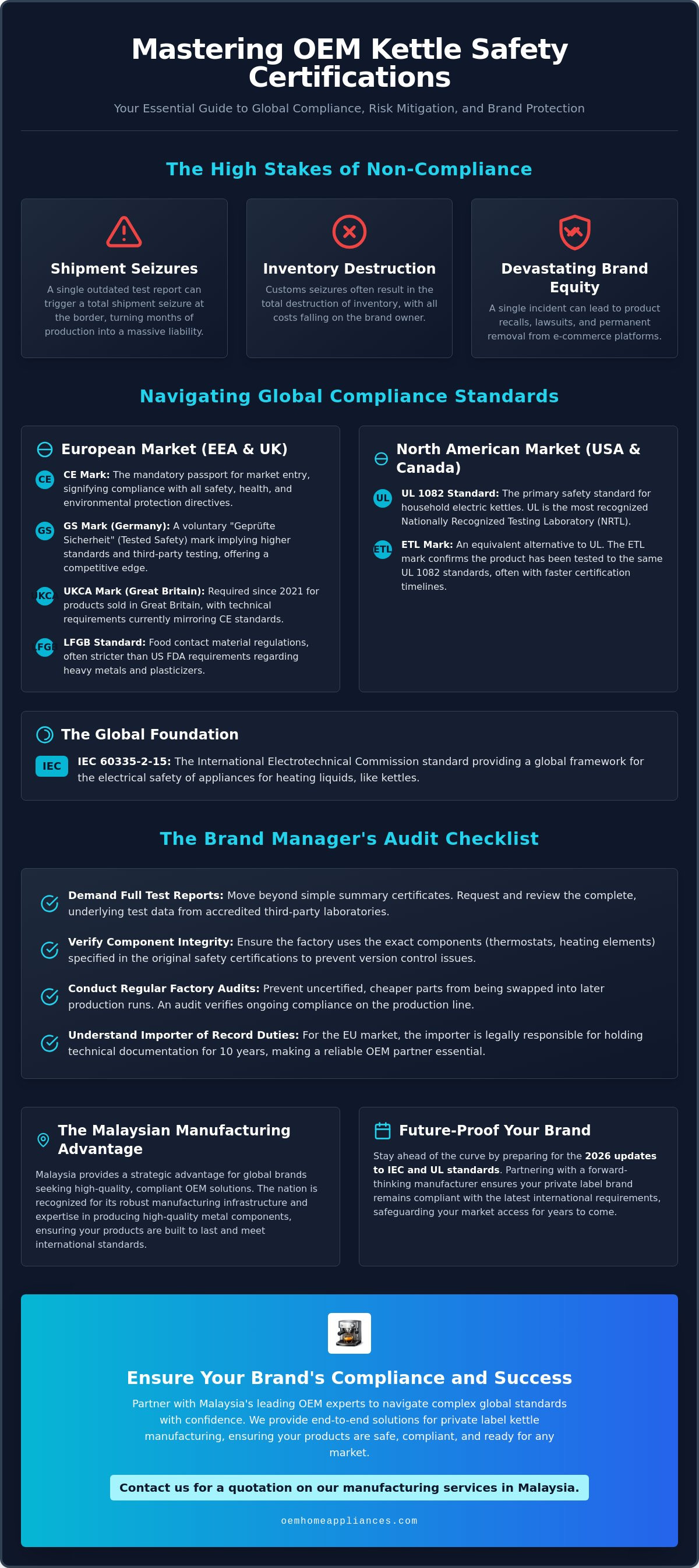
Safety marks are the non-negotiable baseline for global market entry. Without them, your product is legally invisible to major retailers and customs authorities. The primary goal of obtaining specific OEM kettle safety certifications is to validate that your product won't fail under high-wattage stress. If your kettle lacks these marks, you face the very real risk of customs seizures. These seizures aren't just delays; they often result in the total destruction of inventory at your expense.
Beyond the border, the hidden costs of non-compliance include product recalls that can devastate brand equity. A single fire incident caused by an uncertified thermostat can lead to lawsuits and permanent removal from e-commerce platforms. Protecting your brand requires moving beyond the "self-declaration" model. While some manufacturers simply sign a paper claiming compliance, elite partners provide third-party validation from accredited laboratories. This independent verification ensures that the safety claims are backed by empirical test data and rigorous laboratory stress tests.
Regulatory Foundations for Kitchen Appliances
Every electric kettle must comply with the Low Voltage Directive (LVD) to manage the risks associated with heating elements and internal wiring. Technical benchmarks for these appliances are established by the International Electrotechnical Commission (IEC), providing a global framework for electrical safety. Electromagnetic Compatibility (EMC) is also vital; it ensures that the kettle's high-wattage startup doesn't disrupt other household electronics. Finally, food-grade material safety is mandatory for any component touching water. This includes the stainless steel body, silicone seals, and even the plastic filter housing, all of which must be certified free from harmful leaching agents.
B2B Risk Mitigation Strategies
Shifting liability is a core component of a professional procurement strategy. By sourcing products through established private label manufacturing channels, you ensure that safety is engineered into the product from day one. In the EU market, the importer of record is the legal entity responsible for ensuring the product meets all applicable safety directives and must maintain the technical documentation for ten years. Factory audits play a critical role here. They verify that the production line continues to use the exact components specified in the original OEM kettle safety certifications, preventing version control issues where cheaper, uncertified parts are swapped in during later production runs.
Global Compliance Standards: Navigating CE, ETL, and RoHS
Entering a new market requires more than a high-quality product; it requires the correct legal credentials. OEM kettle safety certifications vary significantly between the European Economic Area, North America, and Asia. Using the wrong mark can lead to immediate product rejection by retailers or expensive delays at port. Every region has a specific baseline for electrical safety that must be met before any commercial activity begins.
For the European market, the CE mark acts as a mandatory passport. It signifies that the manufacturer has met all official CE marking requirements regarding safety, health, and environmental protection. However, the CE mark alone isn't always enough for specialized markets. Germany often requires the GS mark, which stands for "Geprüfte Sicherheit" (Tested Safety). This is a voluntary mark that implies higher safety standards and independent third-party testing, providing a competitive edge for premium brands.
European Market Requirements
A valid Declaration of Conformity (DoC) is the foundation of European compliance. This document lists every directive the kettle meets, from electrical safety to food contact. Regarding materials, Europe follows LFGB standards, which are often stricter than US FDA requirements for heavy metals and plasticizers. Since 2021, products sold in Great Britain must also carry the UKCA mark, though technical requirements currently mirror CE standards. You must ensure your technical file is updated to reflect these regional shifts.
North American and Global Marks
In the United States and Canada, UL 1082 is the specific safety standard for household electric kettles. While UL is the most recognized name, the ETL mark is an equivalent alternative that many importers prefer for its faster certification timelines. Both marks confirm the product has been tested to identical safety standards. For brands targeting multiple continents, the CB Scheme is an essential tool. It allows a manufacturer to use a single test report to obtain national certifications in over 50 member countries, significantly reducing testing costs.
Environmental compliance is equally critical for long-term brand stability. RoHS (Restriction of Hazardous Substances) limits the use of lead, mercury, and cadmium in electrical components. REACH focuses on a broader list of chemical substances to protect human health and the environment. Ensuring your supply chain adheres to these standards prevents long-term legal exposure. If you need assistance determining which marks are required for your target region, you can consult with our compliance team for a detailed regulatory assessment.
Engineering for Compliance: How Electric Kettle Wattage Impacts Safety
High wattage is a performance feature that complicates the engineering required for OEM kettle safety certifications. While a 1500W kettle is standard in some regions, the European and Australian markets often demand 2400W to 3000W for rapid boiling. This increased power draw creates significant thermal stress on the internal circuitry. Engineering for this level of performance requires a precise balance between heating speed and component longevity. It isn't just about speed; it's about managing the heat generated by the massive flow of current.
Dielectric strength testing is a critical part of this process. It ensures the appliance's insulation can withstand peak power without electrical breakdown. For high-wattage units, this test is often conducted at voltages significantly higher than the operating level to guarantee a safety margin. If a unit fails, it's usually due to poor component quality or insufficient spacing between live parts and the kettle's exterior housing. Correcting these issues in the design phase prevents costly failures during final certification audits.
Wattage and Thermal Control Systems
Rapid-boil kettles reaching 3000W require specialized control systems, such as those from Strix or Otter. These systems are engineered to handle high current without melting the contact points. Effective boil-dry protection is also a mandatory feature for certification. It's a fail-safe that cuts power if the kettle is switched on without water. Managing heat dissipation is particularly important for different materials; enamel-coated metal bodies, a specialty in our private label manufacturing, offer superior thermal durability compared to standard plastic alternatives.
Electrical Component Standards
The 'rated current' for safety testing is calculated by dividing the maximum rated power by the minimum rated voltage. This figure dictates the required gauge for internal wiring and the capacity of the power cord. For example, a 3000W kettle on a 230V circuit draws approximately 13A, necessitating heavy-duty power cords and 1.5mm² internal wiring to prevent overheating. If you use a lower gauge wire, the resistance increases, leading to dangerous temperature spikes during the boiling cycle.
Grounding is another non-negotiable safety feature for high-wattage metal appliances. A robust grounding pin ensures that if an insulation failure occurs, the current is safely diverted, preventing electric shock. Compliance with North American standards often involves obtaining an ETL Listed Mark, which confirms that the appliance has been rigorously tested for these specific electrical risks. Higher wattage inevitably leads to more stringent testing protocols, making component selection the most important decision when pursuing OEM kettle safety certifications.
The Brand Manager’s Audit: Verifying Manufacturer Certification
A one-page summary certificate isn't proof of compliance; it's merely a cover letter. To truly verify OEM kettle safety certifications, you must demand the full test report, which often exceeds 50 pages of technical data. This document contains the actual laboratory results for temperature rise, moisture resistance, and abnormal operation tests. Relying on a summary leaves your brand vulnerable to "version control" issues where the certified prototype bears little resemblance to the mass-produced unit arriving at your warehouse.
Your audit must also scrutinize the issuing laboratory's credentials. Ensure the lab holds ILAC (International Laboratory Accreditation Cooperation) or CNAS (China National Accreditation Service) accreditation. Without these, customs authorities in the EU or North America may reject the paperwork entirely. Finally, match the Bill of Materials (BOM) in the test report against the actual components used in production. A common manufacturer shortcut involves swapping a certified thermostat for a generic alternative to save costs, a move that immediately voids the product’s safety standing.
The Document Verification Workflow
Systematic verification prevents costly legal errors. Follow these three steps for every new production run:
Step 1: Check alignment. Confirm the model number and technical specifications on the certificate exactly match your purchase order and product packaging.
Step 2: Verify the holder. Cross-reference the factory address on the certificate with the actual manufacturing site. Discrepancies here often indicate "certificate borrowing" from another facility.
Step 3: Database validation. Use the issuing body’s online portal to confirm the certificate is authentic and currently active.
Common Certification Pitfalls
The "expired certificate" trap is a frequent hurdle for new importers. Safety reports for high-risk appliances like kettles often require annual factory inspections to remain valid. If the manufacturer missed an inspection, the certificate is effectively void. For more detailed advice on vetting suppliers, see our private label electric kettle manufacturer guide.
Another risk is component swapping during mass production. A factory might use high-quality components for the certification sample but switch to uncertified parts for the actual order. We recommend conducting random "golden sample" testing. Pull a unit directly from the assembly line and send it to an independent lab to ensure it still meets the original OEM kettle safety certifications. This proactive approach ensures your brand remains protected against manufacturing drift. If you want to review our documented testing procedures, you can request a sample compliance report from our technical team.
Partnering for Compliance: Malaysia-Based OEM Kettle Solutions
Malaysia has emerged as a premier hub for global appliance distribution, offering a sophisticated logistics infrastructure and a stable regulatory environment. For brands looking to diversify their supply chains, sourcing from a Malaysia-based partner provides a strategic hedge against the volatility found in traditional manufacturing hubs. We operate as a dedicated B2B manufacturer, which means our interests are entirely aligned with yours. We don't compete with our clients in the retail space; instead, we focus on intellectual property protection and the technical execution of your product vision.
Our commitment to excellence is reflected in our specialized production of enamel-coated and powder-coated metal components. These materials offer superior thermal durability and a premium aesthetic that differentiates your brand in a crowded market. Navigating the complexities of OEM kettle safety certifications is a standard part of our partnership. We manage the technical heavy lifting, ensuring that every design iteration is built to pass the latest 2026 safety audits before mass production even begins.
Technical Solutions for Premium Brands
Our technical team provides comprehensive custom kettle design and prototyping services to ensure your vision is both marketable and compliant. We integrate advanced sensors and thermal cut-offs into bespoke roaster ovens and kettles, ensuring every product meets the rigorous 2026 standards. This proactive R&D approach streamlines the path to certification and reduces the risk of costly redesigns. For a broader perspective on our production capabilities, you can read about high volume blender manufacturing to see how we manage scale without compromising quality.
Scalability and Supply Chain Security
Stability is the foundation of a successful long-term manufacturing partnership. Malaysia offers a secure environment for business operations, backed by a workforce that is highly skilled in electrical assembly and metal finishing. We leverage this local expertise to maintain high production standards and consistent quality control across all product lines. By choosing a partner in this region, you gain access to a resilient supply chain that prioritizes compliance and technical precision. Keiteq facilitates seamless global market entry by managing the entire compliance lifecycle, from initial R&D to the final issuance of OEM kettle safety certifications.
If you're ready to expand your product line with a reliable manufacturing partner, contact us today for a detailed quotation. We invite you to reach out for further details regarding our Malaysia-based private label services and technical capabilities.
Securing Your Global Market Entry
Mastering the technical requirements for high-wattage appliances is the only way to ensure long-term brand stability. You've learned that valid OEM kettle safety certifications require more than just a summary certificate; they demand a rigorous alignment between wattage, internal components, and accredited test data. By auditing factory reports and verifying lab credentials, you eliminate the risk of customs seizures and protect your brand equity from the hidden costs of non-compliance.
Our facility in Malaysia serves as a dependable backbone for businesses looking to scale their product lines with precision. We combine technical expertise in enamel coating with a strategic location to optimize your global supply chain. As a dedicated B2B partner, we focus on the practicalities of production so you can focus on growth. Our streamlined R&D process ensures that your bespoke designs meet international standards before they reach the assembly line.
Request a quotation for certified OEM kettle manufacturing in Malaysia to begin your compliance-led expansion. We invite you to contact our technical team for further details on how we can streamline your path to global market readiness.
Frequently Asked Questions
What are the most common safety certifications for electric kettles in the EU?
CE marking is the mandatory baseline, but GS (Geprüfte Sicherheit) is often required by German retailers for higher safety assurance. These marks confirm compliance with the Low Voltage Directive (LVD) and Electromagnetic Compatibility (EMC) standards. For premium brands, achieving these OEM kettle safety certifications ensures the product meets the strict 2026 IEC 60335-2-15 requirements for heating liquids. This dual-layer approach provides both legal compliance and a competitive quality advantage.
Does a higher electric kettle wattage require different safety certifications?
Higher wattage doesn't change the type of certification required, but it significantly increases the rigor of the testing protocols. Kettles reaching 3000W must undergo more intensive dielectric strength and temperature rise tests compared to 1000W models. The certification body will scrutinize the internal wiring gauge and power cord capacity to ensure they can handle the 13A current without overheating. High-performance models require more robust components to pass these expanded safety margins.
How can I verify if a manufacturer's CE certificate is authentic?
You must validate the certificate number through the online database of the issuing laboratory, such as TUV, Intertek, or SGS. Authentic certificates must list the exact model number and factory address of your manufacturer. Don't rely on a PDF scan alone; request the full technical test report to ensure the data behind the certificate is current and matches the physical components in your product. This verification step prevents issues with certificate borrowing between factories.
What is the difference between UL and ETL marks for the US market?
UL and ETL marks are functionally identical in the eyes of US regulators and retailers because both are issued by Nationally Recognized Testing Laboratories (NRTLs). Both marks prove the kettle meets the UL 1082 safety standard. While UL is the original testing body, the ETL mark is often preferred by OEM brands for its faster turnaround times and more flexible service models during the initial testing phase. Both signify that the product is safe for North American consumers.
Is RoHS certification mandatory for selling kettles in North America?
RoHS is not a federal legal requirement in the United States, but it's effectively mandatory for any brand with global ambitions. Most major North American retailers require RoHS compliance as part of their internal quality standards to ensure products are free from hazardous substances like lead and mercury. Maintaining this certification simplifies your supply chain by allowing you to use a single bill of materials for both EU and US markets. It's a critical baseline for modern appliance brands.
Do I need to re-certify my kettle if I change the exterior colour or finish?
Minor aesthetic changes like a new powder coating colour usually don't require full re-certification if the base material remains the same. However, you must file a technical update with the certification body to add the new model variant to your existing file. If you switch from a plastic housing to an enamel-coated metal body, full re-testing is mandatory because the thermal properties and grounding requirements change. Always consult your technical partner before finalizing a major material shift.
What is the CB Scheme and how does it help with global kettle distribution?
The CB Scheme is an international system that allows a single safety test report to be recognized by over 50 member countries. By obtaining a CB Test Certificate, you can bypass the need for redundant laboratory testing when entering new markets like Brazil or Australia. This process significantly reduces the cost and time required to obtain national OEM kettle safety certifications for each specific region. It's the most efficient path for brands targeting rapid global distribution.
Are food-grade material certifications separate from electrical safety marks?
Yes, food-grade certifications like LFGB or FDA are distinct from electrical safety marks like CE or UL. While electrical marks focus on fire and shock prevention, food-grade testing ensures that materials touching water don't leach harmful chemicals at high temperatures. Every component, including the stainless steel body and silicone seals, must have its own valid test report to satisfy customs authorities. These reports confirm that the appliance is safe for daily food and beverage preparation.
If you're looking for a reliable partner to manage these complexities, we can help. Request a quotation for certified OEM kettle manufacturing in Malaysia today. Our team provides the technical expertise and strategic location needed to ensure your brand meets all international compliance standards with precision.


Comments