Private Label Air Fryer Manufacturer: A Strategic Resource for Brand R&D in 2026
The global private label market is projected to reach $1,019.23 billion in 2026, yet many brands still struggle with generic designs that fail to stand out on the shelf. You likely understand that the era of simply slapping a logo on a basic model is over. When supply chain instability meets a lack of technical innovation, even the most ambitious brands face quality control issues and stalled growth. Finding a private label air fryer manufacturer that offers more than just assembly is now a baseline requirement for market success.
Choosing a partner with advanced R&D capabilities and technical engineering expertise can turn these logistical challenges into a competitive advantage. This article shows you how to select a strategic manufacturing partner in a stable region like Malaysia. You'll learn how to access custom R&D, secure a resilient supply chain, and implement high-end finishes like durable enamel coating. We'll examine the technical and logistical benchmarks that will define the most successful kitchen appliance brands throughout 2026 and beyond.
Table of Contents
What Defines a Top-Tier Private Label Air Fryer Manufacturer?
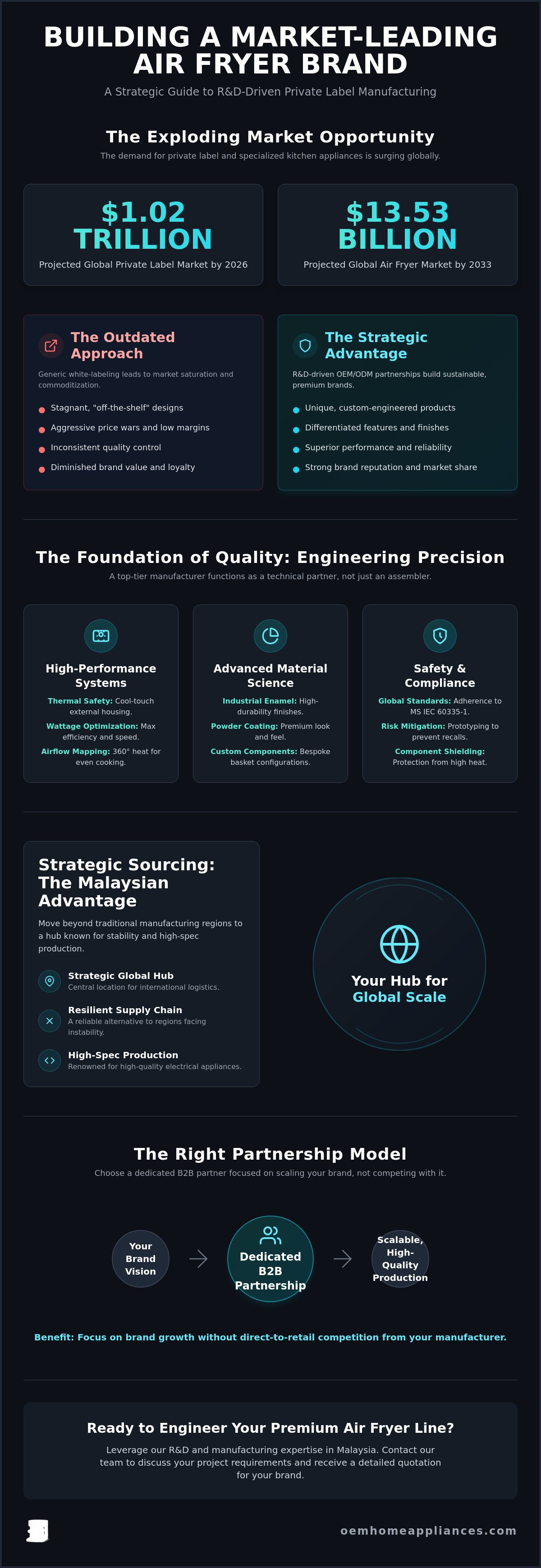
Success in the competitive kitchen appliance sector requires more than a standard supplier. The global air fryer market is projected to grow significantly, reaching an estimated USD 13.53 billion by 2033. To capture this growth, brand managers are moving away from generic models that offer little market differentiation. A top-tier private label air fryer manufacturer functions as a technical facilitator, providing the industrial-scale production and engineering depth needed to build a sustainable brand. They offer a backbone of stability and precision, especially when operating from resilient manufacturing hubs like Malaysia.
The Shift from Generic White Label to Custom OEM/ODM
White-labeling often results in market saturation where multiple brands sell identical units. This leads to aggressive price wars and diminished brand value. In contrast, OEM (Original Equipment Manufacturer) and ODM (Original Design Manufacturer) partnerships allow for deep customization. OEM services enable you to specify unique technical requirements, such as custom basket configurations or high-end enamel finishes. ODM solutions provide pre-developed, unique designs that allow for rapid market entry without the risk of selling common "off-the-shelf" clones. These professional manufacturing services give you control over the product identity and technical specifications.
Why R&D is the Foundation of a Successful Air Fryer Brand
Engineering precision is the primary defense against product recalls and consumer dissatisfaction. R&D teams analyze the physics of heat distribution to ensure consistent results. Understanding the mechanics of how air fryers work using high-speed convection is essential for developing energy-efficient models that outperform generic competitors. This technical focus ensures that every unit maintains performance standards over years of use, protecting your long-term reputation.
A reliable private label air fryer manufacturer integrates current trends into the initial design phase. This includes the growing demand for dual-basket configurations and smart features like mobile app connectivity. By utilizing bespoke prototyping workflows, manufacturers can test these innovations before committing to mass production. This process mitigates risk and ensures the final product meets global safety standards, including MS IEC 60335-1. The result is a high-performance appliance that supports your brand's reputation for quality and reliability.
Comprehensive Kitchen Appliance R&D Services for Air Fryers
Research and development services represent the bridge between a brand's vision and a commercially viable product. While many suppliers focus solely on assembly, a specialized private label air fryer manufacturer invests heavily in engineering to ensure every unit performs under rigorous daily use. This process involves more than just aesthetics. It requires a deep understanding of thermal dynamics, material science, and electronic control systems. A dedicated engineering team provides the expertise needed to solve complex mechanical challenges before they become expensive production errors. By prioritizing technical R&D, brands can reduce long-term manufacturing costs through optimized component selection and lower defect rates.
Engineering High-Performance Heating and Airflow Systems
The core value of an air fryer lies in its ability to simulate deep-frying through rapid air technology. Engineering teams must calculate the precise relationship between wattage and fan velocity to maintain convection consistency. If the airflow is uneven, the product fails the consumer. Technical experts test for heat distribution across multiple zones within the cooking chamber to prevent cold spots. This level of precision is a hallmark of Malaysia's manufacturing sector, which has become a global hub for high-spec electrical appliances. Engineering teams typically focus on:
Thermal Safety: Ensuring external housing remains cool during operation.
Wattage Optimization: Balancing power consumption with cooking speed for maximum efficiency.
Airflow Mapping: Designing internal structures that facilitate 360-degree heat circulation.
Safety standards also remain a priority. Engineers must ensure that all electronic components are shielded from high internal temperatures to prevent premature failure. This technical rigor ensures that the final appliance meets both consumer expectations and international safety certifications.
Prototyping and Lifecycle Management
Moving from a concept to a retail-ready product requires a methodical approach to kitchen appliance prototyping. Early-stage physical models allow brand managers to evaluate the tactile feel of mechanical dials or the responsiveness of digital touch interfaces. Iterative testing during this phase identifies potential mechanical failures before they reach the assembly line. It's much more cost-effective to adjust a design during the prototyping stage than to issue a product recall later.
Effective lifecycle management ensures that the transition to mass production is seamless. This involves refining the user interface (UI) to ensure intuitive operation for the end consumer. It also includes rigorous stress testing of moving parts, such as basket handles and locking mechanisms. A dedicated private label air fryer manufacturer manages these variables to protect the brand's reputation for durability. Technical solutions, such as selecting high-grade internal components that require less maintenance, help reduce the total cost of ownership for the brand. If you are ready to explore how custom engineering can elevate your product line, you can consult with our technical team for a detailed feasibility analysis. This partnership-driven approach ensures that functional performance always matches your brand's aesthetic goals.
Strategic Sourcing: Why Brands Choose Malaysia for Private Label Production
Global supply chain diversification is no longer a luxury but a fundamental necessity for maintaining market share. As brands look beyond traditional manufacturing hubs, Malaysia has emerged as a premier destination for high-tech appliance production. Implementing a successful strategy for private-label brands requires a partner that offers more than low-cost labor; it demands regional stability and technical maturity. Choosing a private label air fryer manufacturer in Malaysia provides a strategic buffer against the geopolitical volatility and trade barriers that often disrupt production in other regions.
Diversifying Beyond China: The Malaysia Advantage
Geographical diversification helps brands mitigate the risks of over-reliance on a single country. Malaysia offers a sophisticated infrastructure specifically geared toward electronics and small domestic appliances. In April 2026, Malaysia exported MYR 7.38 million in domestic electric housewares, with the United States serving as a top destination. This industrial readiness is supported by clear ethical standards. The nation enforces a nationwide minimum wage of RM1,700 and has recently reduced maximum weekly working hours to 45. These regulations ensure a stable, motivated workforce that aligns with the corporate social responsibility (CSR) requirements of global retail partners.
Tariff landscapes are also a critical factor for international brands. For example, the 10% tariff on Malaysian goods imported into the US under Section 122 is scheduled to expire around July 24, 2026. This makes the region an increasingly cost-effective alternative for North American distributors. By leveraging specialized OEM services in this region, brands can navigate complex trade agreements while maintaining high production standards.
Supply Chain Resilience and Global Logistics
Logistical efficiency is the lifeblood of any scaling appliance brand. Malaysia's strategic position in Southeast Asia facilitates streamlined shipping routes to both European and North American markets. Supply chain resilience is further strengthened when your private label air fryer manufacturer manages critical upstream processes. Factories that handle their own metal component production, including powder coating and enamel application, reduce dependency on external vendors. This localized control minimizes lead times and ensures that raw material quality remains consistent across every batch.
Localized supply chains also protect against the bullwhip effect often seen in global logistics. When a manufacturer controls the engineering of metal components and final assembly in one location, communication errors decrease. This integrated approach allows brands to respond faster to market shifts, such as the 2026 trend toward dual-basket and smart-enabled air fryers. The result is a more agile, resilient business model that prioritizes long-term growth over short-term savings.
Customization and Technical Standards in Air Fryer Manufacturing
Advanced customization separates market leaders from generic resellers. While many suppliers offer basic logo placement, a professional private label air fryer manufacturer provides the engineering depth required for complex OEM air fryer production. This process involves selecting materials that withstand temperatures exceeding 200 degrees Celsius without degrading or releasing harmful particulates. High-volume production demands a rigorous approach to material science to ensure that every unit maintains its structural integrity and performance over thousands of cooking cycles.
Advanced Coatings: Enamel vs. Powder Coated Metal Components
The choice of coating directly impacts product longevity and consumer safety. Enamel-coated products are particularly effective for internal components like air fryer baskets. This inorganic, glass-like finish is fused to the metal at high temperatures, creating a surface that's exceptionally resistant to scratches and chemical corrosion. It doesn't peel or emit odors when exposed to intense heat, making it a premium choice for high-end appliance lines.
Powder-coated metal components are often preferred for the external housing. This finish provides a wide range of aesthetic options while offering superior protection against impact and moisture. Unlike traditional liquid paint, powder coating creates a thick, durable layer that resists chipping and fading. A manufacturer that handles both coating processes in-house can ensure a seamless match between functional internal parts and the brand's visual identity. You can explore these specialized finishing services to determine which material best fits your product tier.
Meeting Global Safety and Quality Compliance Standards
Compliance with international standards is non-negotiable for brands targeting global markets. Certifications such as CE, UL, and RoHS serve as proof that the appliance meets strict safety and environmental requirements. In Malaysia, manufacturers adhere to MS IEC 60335 standards, which align with global benchmarks for household electrical appliances. This commitment to safety is supported by evolving local laws, such as the Food (Amendment) Regulations 2026, which come into effect on August 1, 2026. These regulations establish stricter limits for lead and cadmium migration in cooking appliances, ensuring that all food-contact surfaces are non-toxic and safe for long-term use.
Reliable partners implement multi-stage quality control (QC) protocols during the mass production phase. This includes functional testing of heating elements, calibration of digital sensors, and stress testing of mechanical locking mechanisms. Factory audits are essential for brand managers to verify that these QC steps are consistently applied. If you need to ensure your next product line meets these rigorous technical benchmarks, you can request a technical consultation with our engineering team in Malaysia. This focus on standardized excellence protects your brand from the financial and reputational risks associated with product failures.
Partnering with oemhomeappliances for Scalable Production
oemhomeappliances, operating under Keiteq, functions as a dedicated B2B partner for brands that require industrial strength and technical precision. We don't compete with our clients in the retail space. Instead, we act as a silent but powerful engine for your brand's growth. As a specialized private label air fryer manufacturer, we provide the infrastructure needed to transition from a conceptual design to a market-ready appliance. Our Malaysia-based facilities offer the stability and logistical advantages necessary for global expansion, ensuring your supply chain remains resilient in an unpredictable trade environment.
Our comprehensive services cover every stage of the product lifecycle. We manage the complexities of engineering, material sourcing, and assembly so you can focus on marketing and distribution. This integrated approach ensures that the technical standards discussed in previous sections, such as high-grade enamel coatings and precise convection mapping, are consistently applied at scale. By centralizing production in Malaysia, we help you avoid the common pitfalls of fragmented supply chains.
From Design to High-Volume Production
Efficiency is critical when launching new product lines. We've streamlined our workflow to reduce time-to-market without compromising on technical rigor. Our production capacity is designed to scale rapidly, allowing your brand to meet seasonal demand spikes during peak shopping periods. We provide more than just the appliance; we offer a turnkey experience that includes customized packaging and branding solutions. This ensures that every unit arrives at your warehouse ready for the retail shelf, reflecting your brand's aesthetic and quality standards.
Reliable Partnership and Long-Term Technical Support
A successful manufacturing relationship extends beyond the first shipment. We offer ongoing R&D support to help you iterate on existing models and develop next-generation appliances. This long-term technical support ensures that your product line stays ahead of market trends, such as the shift toward smart-connected features or energy-efficient heating systems. Transparent communication and dedicated account management are the pillars of our partnership model. We provide regular updates on production status and technical benchmarks, ensuring you have the data needed for informed business decisions.
If you're looking for a reliable partner to scale your kitchen appliance brand, we're ready to assist. Contact us today to request a quotation or to discuss a tailored manufacturing solution for your project. Our team provides expert guidance on production and distribution directly from our facilities in Malaysia. Let's build a durable, high-performance product line that empowers your brand's success.
Future-Proof Your Brand with Strategic Manufacturing Partnerships
Success in 2026 depends on moving beyond basic product rebranding. Brands that prioritize engineering precision and regional supply chain resilience are better positioned to capture a share of the projected USD 13.53 billion air fryer market. By integrating advanced R&D and bespoke prototyping, you ensure your products deliver consistent performance and comply with evolving global safety standards. This technical foundation is essential for maintaining consumer trust and long-term brand equity.
oemhomeappliances serves as a dedicated B2B partner, offering specialized expertise in enamel and powder coating to enhance product durability. Our Malaysia-based global supply chain provides a stable alternative to traditional manufacturing hubs, helping you navigate shifting tariffs and logistical challenges with confidence. Selecting a technically proficient private label air fryer manufacturer allows you to focus on market expansion while we handle the complexities of industrial-scale production. We act as the silent engine behind your success, ensuring every unit meets your exact specifications.
Ready to scale your brand with a reliable partner? Request a quotation for our air fryer manufacturing services in Malaysia today. We look forward to empowering your brand's growth through industrial excellence and reliable partnership.
Frequently Asked Questions
What is the difference between OEM and ODM in air fryer manufacturing?
OEM (Original Equipment Manufacturer) involves production based on your brand's specific blueprints and technical designs. ODM (Original Design Manufacturer) provides pre-developed models that you can rebrand with minor modifications. Both pathways allow for high levels of customization, though ODM typically offers a faster route to market for brands that don't have proprietary engineering teams.
What are the typical MOQs for a private label air fryer?
Typical minimum order quantities for entry-level private label kitchen appliances range from 500 to 1,000 units. For mid-range models or units requiring significant technical customization, the requirement often moves to between 1,000 and 3,000 units. These thresholds ensure the production run is economically viable while covering the costs of specialized tooling and engineering setup.
Why should a brand choose a manufacturer in Malaysia over China?
Malaysia provides a strategic buffer against geopolitical volatility and trade barriers often associated with other manufacturing regions. As of July 2026, the country offers a stable labor environment with a nationwide minimum wage of RM1,700 and reduced weekly working hours. These factors, combined with favorable US tariff schedules, make it a resilient hub for global appliance brands.
How long does the R&D and prototyping phase take for a new air fryer model?
The R&D and prototyping phase usually requires several weeks of iterative testing to refine the heating and airflow systems. This timeline depends on the level of customization requested, such as unique basket configurations or digital interfaces. A
private label air fryer manufacturer
with integrated metal processing can often accelerate this phase by managing component production in-house.
Can I customize the coating and materials of my private label air fryer?
Customization extends to specialized finishes like enamel and powder coating for both internal and external components. Enamel is preferred for high-heat food contact surfaces due to its durability and non-toxic properties. Powder coating offers aesthetic flexibility and impact resistance for the external housing, allowing you to align the product with your brand’s visual identity.
What safety certifications are required for selling air fryers in the US and Europe?
Selling in the US and Europe requires compliance with CE, UL, and RoHS standards to verify safety and environmental protection. Additionally, appliances must meet strict food-grade safety requirements. In Malaysia, manufacturers adhere to MS IEC 60335 standards, which ensure that air fryers meet the rigorous technical benchmarks demanded by international distributors and retailers.
Does oemhomeappliances help with the design and engineering of new appliances?
oemhomeappliances offers comprehensive product design and development services to support brands from the initial concept to mass production. We act as a silent partner, providing the engineering depth and technical expertise needed to create high-performance appliances. Our team focuses on thermal safety, energy efficiency, and mechanical reliability to empower your brand’s market success.
How does the factory ensure quality control during high-volume production?
Factories implement multi-stage quality control protocols that include functional testing of heating elements and digital sensor calibration. Every unit undergoes rigorous inspection to ensure it meets the Food (Amendment) Regulations 2026, which establish strict limits for material migration. These QC steps prevent product failures and protect your reputation during high-volume global distribution as a
private label air fryer manufacturer
.


Comments