Strategic Appliance Manufacturing Partner for Established Brands: The 2026 Guide
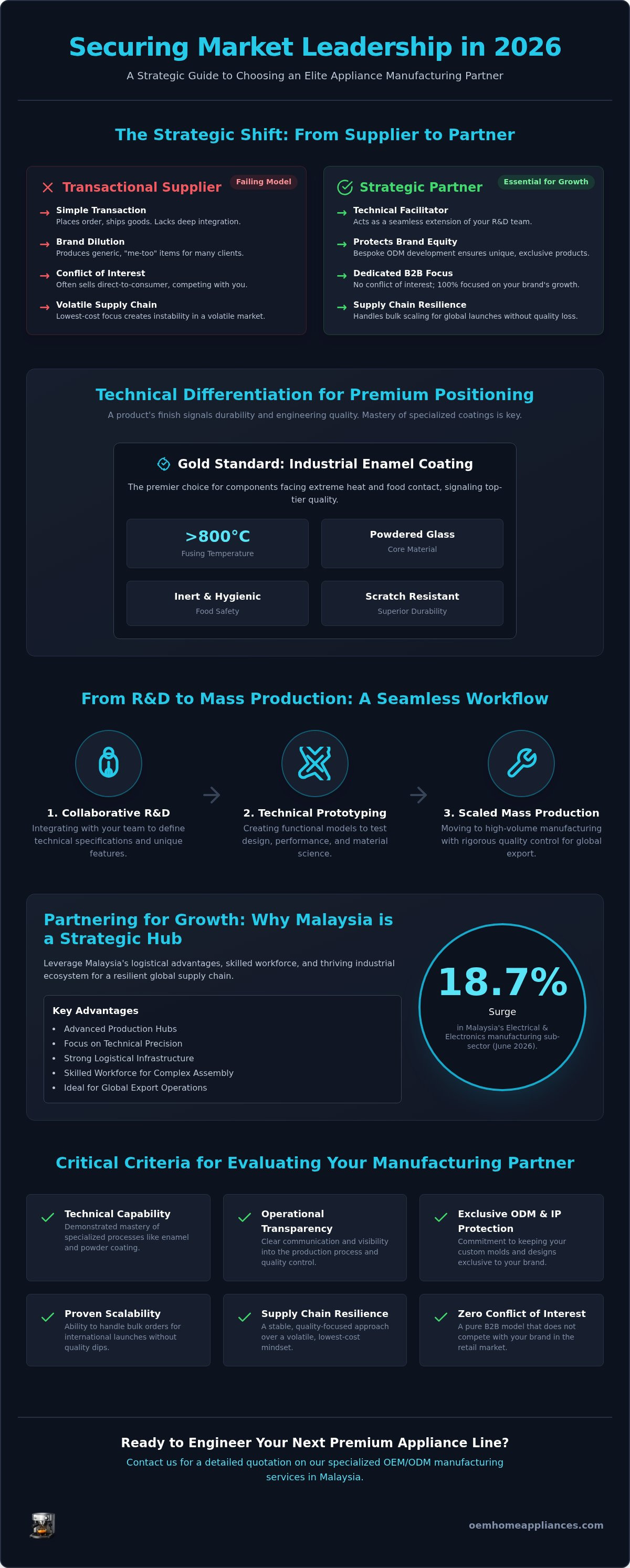
Did you know that Malaysia's electrical and electronics manufacturing sub-sector surged by 18.7% in June 2026? This growth reflects a strategic shift toward advanced production hubs that prioritize technical precision. You've likely felt the constant pressure of maintaining brand equity while fighting supply chain volatility and generic product saturation. It's difficult to find a reliable appliance manufacturing partner for established brands that actually understands the technical nuances of premium finishes like enamel or powder coating. You need more than a factory. You need a technical facilitator that acts as a seamless extension of your own R&D team.
This guide shows you how to secure market leadership by integrating specialized OEM/ODM partnerships into your 2026 strategy. We'll explore scalable manufacturing workflows and advanced finishing techniques that transform standard appliances into high-value brand assets. You'll learn how to leverage industrial strength in Malaysia to solve scaling difficulties and protect your market position with precision-engineered products. The path to a more resilient supply chain starts with choosing a partner that values quality as much as you do.
Table of Contents
The Strategic Shift: Why Established Brands Need an Elite Manufacturing Partner
Technical Differentiation: Leveraging Enamel and Powder Coating for Premium Positioning
Critical Selection Criteria: Evaluating Your Appliance Manufacturing Partner
Partnering for Growth: Why Malaysia is the Strategic Choice for Appliance Brands
The Strategic Shift: Why Established Brands Need an Elite Manufacturing Partner
Traditional manufacturing often feels like a simple transaction; you place an order, and the factory ships the goods. For high-equity brands, this model is failing. A true appliance manufacturing partner for established brands functions as a technical facilitator rather than just a vendor. They integrate with your R&D to ensure every product reflects your specific standards. This is the core of the Original Equipment Manufacturer (OEM) relationship in 2026. It moves beyond basic assembly toward a collaborative model that prioritizes long-term brand health over short-term cost savings.
Established brands are increasingly abandoning generic "me-too" suppliers. These factories produce identical items for dozens of clients, which dilutes your brand value and leads to price wars. If a customer sees your flagship air fryer under five different brand names on a marketplace, your premium positioning evaporates. Specialized engineering for complex products like roaster ovens requires a partner who can handle intricate heat distribution and material science. This expertise ensures your product performs better and lasts longer than generic alternatives.
A critical advantage of an elite partner is the total absence of a conflict of interest. Many global factories now sell direct-to-retail via e-commerce platforms, essentially competing against their own clients. A dedicated B2B partner avoids this entirely. By focusing solely on empowering your brand's growth, they ensure that their innovations and capacity are always at your disposal, not used to launch a competing house brand.
Protecting Brand Equity through Exclusive ODM
White-labeling is no longer enough for market leaders who want to maintain a premium edge. Bespoke ODM development allows for unique industrial designs and proprietary features that set you apart. Protecting your intellectual property is vital in this process. A strategic appliance manufacturing partner for established brands ensures that your custom molds and aesthetic signatures remain exclusive. When developing a premium air fryer line, the focus isn't just on the heating element; it's about creating a unique visual language and a tactile user experience that competitors can't easily replicate.
Supply Chain Resilience and Global Readiness
The lowest-cost mindset is a liability in a volatile global market. Stability and quality are the new benchmarks for success. Established brands need a partner capable of handling bulk scaling for international launches without compromising on quality control. This requires sophisticated logistics and a diverse product portfolio. Whether you're expanding into rice cookers, kettles, or BBQ grills, having a single, reliable point of contact simplifies your supply chain. This stability ensures that seasonal demand spikes don't lead to stockouts or quality regressions, keeping your brand's reputation intact across all territories.
Technical Differentiation: Leveraging Enamel and Powder Coating for Premium Positioning
Technical differentiation is the primary driver of premium market positioning in the 2026 appliance landscape. For established brands, a product's exterior finish is not merely aesthetic; it is a signal of durability and engineering quality. Choosing an appliance manufacturing partner for established brands that masters specialized coatings ensures your product stands up to rigorous kitchen environments while maintaining its visual appeal. High-heat appliances like roaster ovens and portable grills require specific material treatments to prevent degradation and ensure consumer safety.
The Science of Enamel-Coated Products
Enamel remains the gold standard for components subjected to extreme heat and frequent food contact. The industrial enamel coating process involves fusing powdered glass to a metal substrate at temperatures exceeding 800°C. This creates a surface with exceptional thermal shock resistance and superior hygiene properties. Unlike chemical non-stick coatings, enamel is inert and scratch-resistant, making it ideal for the interior of roaster ovens and premium cookware. However, the application process is technically demanding. It requires precise temperature control and specialized kilns that many generalist factories lack. An expert partner manages these challenges to deliver a finish that won't peel or off-gas during high-temperature cooking.
Precision in Powder-Coated Metal Components
While enamel excels in heat resistance, powder coating is the preferred solution for achieving durable and high-quality finishes on exterior metal components. This process allows for exact color matching across diverse product lines, ensuring that your air fryers, kettles, and blenders share a consistent brand identity. For any appliance manufacturing partner for established brands, maintaining these standards requires automated robotics to handle complex geometries and ensure consistent coating thickness. Modern powder coating is also a more sustainable choice for eco-conscious brands. By 2026, the industry has shifted toward low-temperature curing and advanced recovery systems that minimize waste. These finishes offer high chemical stability and scratch resistance, protecting the appliance from the daily wear of a busy kitchen.
The choice between enamel and powder coating depends on the specific thermal and mechanical demands of your product. If you are looking to refine your current product line with these advanced finishes, you can consult with our technical team to determine the best material strategy for your brand. This level of technical oversight is what separates a standard vendor from a strategic manufacturing ally.
Managing the Product Lifecycle: From R&D to Mass Production
Managing an appliance product lifecycle requires a methodical approach that balances innovation with industrial reality. An elite appliance manufacturing partner for established brands doesn't just execute orders; they guide the entire technical journey from initial concept to global distribution. This process begins with collaborative R&D, where factory capabilities are aligned with your specific brand design standards. By identifying potential manufacturing hurdles early, you prevent costly redesigns during the later stages of development.
Technical prototyping is the next critical phase. For complex products like private label air fryers, this involves rigorous testing of airflow dynamics and heat distribution. Once the prototype is validated, tooling and mold development begin. Precision at this stage is non-negotiable, as even a minor deviation can compromise the integrity of mass-produced components. Pilot runs then serve to validate these molds and the assembly process, ensuring that the final output meets every performance benchmark before the factory scales to high-volume production.
Bespoke R&D and Prototyping Solutions
Established brands often leverage a manufacturer's R&D department to reduce their own internal engineering overhead. This allows your team to focus on high-level strategy while the partner handles the technical complexities of material science and mechanical engineering. Rapid prototyping has become a baseline requirement in the competitive small kitchen appliance market. It allows for faster iteration and quicker market entry. We also specialize in integrating smart technology and digital controls into traditional cooking equipment, ensuring your product line remains relevant to modern consumers.
Strict Quality Control for Global Compliance
Navigating international safety standards such as UL, CE, and RoHS is a complex but necessary part of the production phase. Gaining a deep understanding of Malaysia's business and consumer environment provides a clear advantage, as the region's infrastructure is built to support these global compliance frameworks. We don't rely solely on final inspections; instead, we implement rigorous in-line testing. Established brands require 100% testing for critical components in products like blenders and kettles to maintain a zero-defect reputation. This systematic oversight ensures that the first unit off the line is identical in quality to the ten-thousandth, protecting your brand's standing in every market you serve.
Critical Selection Criteria: Evaluating Your Appliance Manufacturing Partner
Selecting an appliance manufacturing partner for established brands requires a shift in perspective. You aren't just buying a product; you're securing a critical link in your global supply chain. The first benchmark is technical capability. Does the factory possess the specialized equipment for high-end finishes like enamel and powder coating? Generalist factories often outsource these processes, which introduces quality risks and lead-time variability. An elite partner maintains these capabilities in-house to ensure total control over the final output. Financial stability is equally important. Your partner must have the capital strength to invest in the bespoke tooling and high-precision molds required to sustain your brand's growth over several years.
Operational transparency is the second pillar of a successful partnership. You need the ability to conduct deep factory audits and access real-time production tracking. This level of visibility ensures that your quality standards are met at every stage of the assembly line. Experience with other established brands is also a strong indicator of reliability. A manufacturer that's already managing high-volume, high-equity product lines understands the unique pressures of global retail, from strict compliance deadlines to the necessity of zero-defect shipments.
Audit Readiness and Transparency
When you conduct an on-site factory visit, focus on the integration of the Quality Management System (QMS) with the actual shop floor. Look for specific metrics like first-pass yield rates and the calibration frequency of their testing equipment. Labor practices and Environmental Social Governance (ESG) standards are now essential for maintaining a modern brand's reputation. A transparent communication flow between your internal R&D and the factory's engineering team is vital. This direct line of contact allows for rapid troubleshooting and prevents the "information silos" that often lead to production delays.
Scalability and Portfolio Diversity
A partner offering a wide range of kitchen appliance manufacturing solutions provides superior long-term value compared to single-category vendors. This diversity allows you to scale your brand by adding rice cookers, kettles, or BBQ grills under a single, trusted manufacturing umbrella. You should also assess the factory's "Bulk Capacity." The ability to scale production quickly for peak retail seasons is what allows you to capture market share while competitors are stuck in backorder. A flexible manufacturer can pivot their production lines to meet shifting consumer trends without compromising on quality or delivery speed.
If you're looking for a partner that meets these rigorous standards, you can request a technical consultation and facility audit to evaluate our Malaysian manufacturing operations firsthand. This transparency is the foundation of the long-term trust we build with our global brand partners.
Partnering for Growth: Why Malaysia is the Strategic Choice for Appliance Brands
Malaysia's manufacturing sector reached RM1.03 trillion in cumulative sales for the first half of 2026, marking a 7.4% growth from the previous year. This industrial momentum makes it a premier location for an appliance manufacturing partner for established brands. The electrical and electronics products sub-sector specifically drove this expansion with a robust 18.7% growth rate in June 2026. These numbers represent a highly stable and mature ecosystem designed for global export. Keiteq leverages this infrastructure to provide a dependable backbone for international brands, ensuring that supply chain volatility doesn't disrupt your market leadership or brand equity.
The country's strategic position is bolstered by favorable trade agreements and a business environment that prioritizes international standards. Access to a highly skilled technical workforce is a significant advantage. Our teams are proficient in specialized metal finishing, which is essential for premium products. By operating in this environment, we ensure that every roaster oven or rice cooker meets the rigorous durability standards expected by high-equity brands. This stability allows you to plan multi-year product roadmaps with total confidence in your supply chain's resilience.
Malaysia vs. Traditional Manufacturing Hubs
Shipping logistics from Southeast Asia to North America and Europe have become increasingly streamlined. Malaysia offers a "Quality First" culture that sets it apart from lower-cost, high-volume regions where consistency often fluctuates. By diversifying production to a Malaysian hub, brands reduce their over-reliance on a single geographic sourcing point. This effectively mitigates geopolitical risks. This strategic shift ensures that your inventory remains stable regardless of regional disruptions elsewhere. The focus here is on precision and reliability, not just the lowest possible unit cost.
Engaging with a Trusted Malaysian Partner
Starting an OEM or ODM project involves a clear and methodical onboarding process. We provide customized technical solutions for enamel-coated and powder-coated metal components. This ensures every product meets your brand's unique aesthetic and performance requirements. Whether you're looking for specialized roaster oven production or high-volume air fryer manufacturing, our facility is equipped to handle complex metal finishing. We act as a silent but powerful partner in your success, focusing on the practicalities of production while you focus on market expansion.
If you're ready to secure your 2026 production capacity, contact us today to discuss our specialized manufacturing services within Malaysia. We invite you to request a quotation for your upcoming product lines or reach out to our team for further details on how our Malaysian facility can support your brand's long-term growth.
Securing Your Competitive Edge for 2026 and Beyond
Maintaining market leadership requires a transition from transactional sourcing to a dedicated B2B partnership model. We've explored how technical differentiation through expert enamel and powder coating solutions protects your brand equity and ensures long-term product durability. By leveraging specialized technical expertise in Malaysia, you can navigate supply chain volatility while accessing a highly skilled workforce and robust industrial infrastructure. This strategic shift allows your brand to focus on high-level innovation while we handle the complexities of precision manufacturing.
Choosing the right appliance manufacturing partner for established brands is the most critical decision for your 2026 growth strategy. Our facility in Malaysia acts as a seamless extension of your R&D team, providing the scalability and quality assurance your high-equity brand demands. We're committed to your success through operational transparency and engineering excellence. Ready to scale your brand with a reliable Malaysian manufacturing partner? Request a quotation for your custom appliance project today or contact us for further details on our specialized services in Malaysia. We look forward to empowering your brand's next phase of global growth.
Frequently Asked Questions
What are the benefits of choosing an appliance manufacturing partner in Malaysia?
Malaysia provides a highly developed industrial ecosystem with a manufacturing sector that recorded RM524.8 billion in sales value during the second quarter of 2026. Choosing an appliance manufacturing partner for established brands in this region ensures access to a workforce of 2.4 million skilled professionals. The country's stable trade environment and strategic location facilitate efficient global exports. This infrastructure is specifically optimized for high-tech production and reliable supply chain management.
How do you ensure IP protection when outsourcing appliance production?
We prioritize intellectual property protection by operating as a dedicated B2B partner that avoids direct-to-retail competition. This means your proprietary designs for roaster ovens or air fryers aren't used to launch competing house brands. We implement strict operational transparency and exclusive ODM workflows to safeguard your custom molds and aesthetic signatures. This professional readiness ensures that your brand's unique assets remain secure throughout the entire production lifecycle.
What is the difference between OEM and ODM for kitchen appliance brands?
OEM involves producing appliances based on your brand's specific engineering designs and blueprints. ODM allows you to leverage our internal product design and development expertise to create bespoke appliances from the ground up. For established brands, the ODM model is often preferred as it reduces internal R&D overhead while ensuring that the final kitchen appliance meets high performance and durability standards. Both models benefit from our specialized metal finishing capabilities.
Why is enamel coating preferred for roaster ovens and high-heat appliances?
Enamel coating is the industry standard for high-heat cooking equipment because it offers exceptional thermal shock resistance and superior hygiene. This finish involves fusing glass to metal at temperatures exceeding 800°C, creating a surface that is inert and scratch-resistant. Unlike chemical non-stick surfaces, enamel doesn't off-gas at high temperatures. This makes it ideal for the interior of roaster ovens and premium cookware where food safety and long-term durability are critical.
Can you handle high-volume production for global retail launches?
Our facility is engineered for high-volume production to support major global retail launches. Since sales in export-oriented industries increased by 10.6% year-on-year by mid-2026, our infrastructure is optimized for bulk scaling and international shipping. We provide the capacity needed to secure market share during peak seasonal demand. This scalability ensures that established brands can maintain consistent inventory levels across multiple international territories without compromising on quality assurance or technical finishing standards.
What quality certifications should a reliable appliance manufacturer hold?
A reliable manufacturer must demonstrate compliance with international safety and quality frameworks. This typically includes ISO certifications for facility management alongside product-specific standards like UL, CE, and RoHS for global market entry. These certifications verify that the factory's assembly lines and critical components meet rigorous safety benchmarks. Established brands should prioritize partners that implement 100% inspection protocols for high-equity products like blenders and kettles to ensure zero-defect shipments.
How do established brands manage the prototyping phase with an offshore partner?
Managing the prototyping phase involves a collaborative R&D approach where factory engineering teams align with your brand's design standards. We use technical prototyping to test airflow dynamics in air fryers or heat distribution in roaster ovens before moving to mass production. This phase includes creating precision molds and conducting pilot runs to validate performance. This methodical process reduces the risk of costly redesigns and ensures the final product reflects your brand's specific quality requirements.
What specialized finishes do you offer for metal appliance components?
We provide expert enamel and powder-coated metal components designed for both aesthetic appeal and industrial strength. Powder coating is ideal for achieving consistent brand colors and scratch resistance on exterior appliance housings. Enamel is reserved for high-heat areas requiring maximum thermal stability. As a dedicated appliance manufacturing partner for established brands, we use automated spraying equipment to ensure uniform finish thickness and chemical stability across diverse product lines, including BBQ grills and portable cooking equipment.


Comments