Strategic Guide to Choosing an OEM Appliance Manufacturing Partner in 2026
In 2026, a manufacturing contract is a strategic liability if your partner lacks the technical depth to navigate shifting global regulations and volatile material costs. Choosing the wrong OEM appliance manufacturing partner doesn't just lead to delays; it compromises your brand's reputation in an increasingly competitive global market. You've likely experienced the frustration of inconsistent product quality or the bottleneck of long lead times that prevent you from scaling. Finding a facility that can master specialized processes, such as high-quality enamel or powder coatings, remains a significant hurdle for many growing brands today.
We understand that you need more than a factory; you need a silent partner that empowers your success without competing for your retail space. This guide teaches you how to identify and secure a partnership built on technical transparency and industrial strength. We'll preview the essential evaluation metrics for the current year, including how to leverage Malaysia's 4% to 5% GDP growth and the new safety standards for ceramic kitchenware effective August 1, 2026, to your advantage. By the end, you'll have a clear roadmap to transition from a simple supply chain to a high-performance manufacturing engine.
Table of Contents
Defining the Role of an OEM Appliance Manufacturing Partner
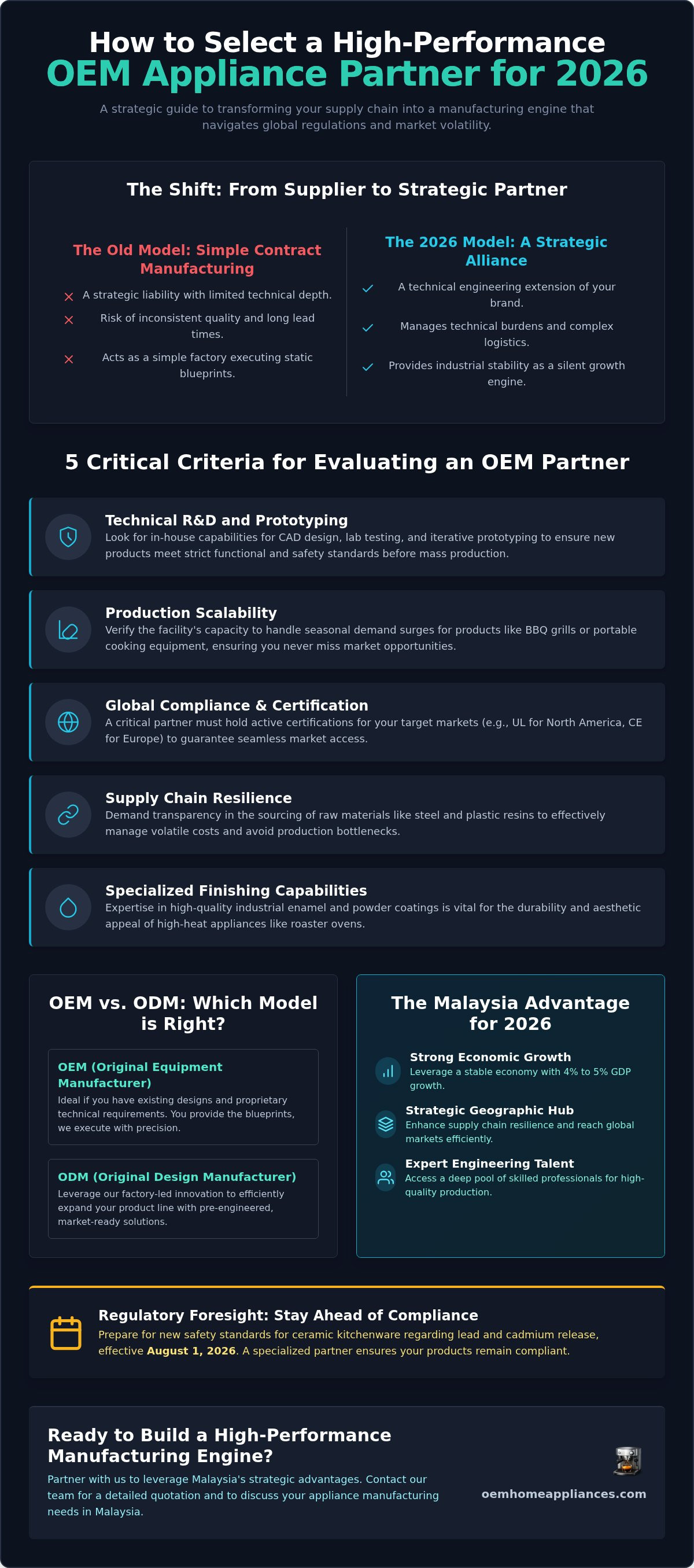
The concept of an Original Equipment Manufacturer (OEM) has undergone a significant transformation. It's no longer just about finding a factory to assemble components based on a static blueprint. In the 2026 market, a strategic OEM appliance manufacturing partner acts as a technical engineering extension of your brand. This shift from simple contract manufacturing to a collaborative partnership means the manufacturer absorbs the technical burden of production. They handle the complexities of material science and supply chain logistics, allowing you to focus on market positioning and brand equity.
An expert partner manages the entire production ecosystem, from sourcing raw materials like steel to implementing specialized finishes. This is critical for established brands that require high-performance output without the overhead of maintaining their own massive industrial facilities. These brands prioritize partners with dedicated B2B models because they need a silent engine for growth. You don't want a manufacturer that competes with you on the same retail shelves; you want a reliable backbone that provides technical transparency and industrial stability.
OEM vs. ODM: Which Model Fits Your Brand Strategy?
Choosing the right engagement model depends on your internal design resources. OEM is the preferred route if you already have existing designs and proprietary technical requirements. You provide the blueprints, and the factory executes the production with precision. Conversely, Original Design Manufacturing (ODM) lets you leverage factory-led innovation. This is an efficient way to expand your product line with pre-engineered solutions for items like air fryers or coffee machines. You can explore our full range of OEM/ODM services to determine which path best supports your scaling efforts.
The Value of a Specialized Kitchen Appliance Focus
Generalist factories often fail when faced with the rigorous standards of the kitchenware industry. Specialized categories like roaster ovens or BBQ grills demand specific expertise in thermal dynamics and food-safe coatings. A partner with a narrow focus on kitchen appliances maintains higher quality control because their production lines are purpose-built for these products. This specialization results in better yield rates and ensures your brand remains compliant with evolving regulations. For example, staying ahead of the new safety standards for ceramic kitchenware regarding lead and cadmium release, effective August 1, 2026, requires a partner who understands the nuances of the manufacturing process.
5 Critical Criteria for Evaluating an Appliance Manufacturing Partner
Identifying a high-performance OEM appliance manufacturing partner requires a multi-dimensional evaluation. It's no longer sufficient to judge a factory solely on its assembly line speed. In 2026, the complexity of kitchen appliances, from air fryers to coffee machines, demands a partner that integrates technical R&D with industrial scale. You need a facility that acts as a technical extension of your brand, ensuring every unit meets your exact specifications and safety requirements.
Consider these five essential pillars during your selection process:
Technical R&D: Look for in-house prototyping capabilities that allow for iterative testing before mass production begins.
Production Scalability: Ensure the facility can handle seasonal surges, particularly for products like BBQ grills or portable cooking equipment that see peak demand in specific months.
Global Compliance: The partner must hold active certifications for your target markets, such as UL for North America or CE for Europe.
Supply Chain Resilience: Transparency in sourcing steel and plastic resins is critical to managing the volatile material costs seen in the current market.
Specialized Finishing: Expertise in enamel and powder coating is vital for the durability and aesthetic appeal of high-heat appliances like roaster ovens.
Assessing Technical Engineering Depth
A reliable partner should offer comprehensive CAD design and in-house laboratory testing. These facilities are necessary for verifying heat resistance, electrical safety, and functional longevity. When you evaluate a potential facility, ask to see their testing protocols for cooking equipment. This technical depth ensures that your brand avoids the quality inconsistencies common with generalist manufacturers. For a deeper look at these requirements, read our Strategic Guide to Selecting a Private Label Kitchen Appliance Manufacturer. If you have specific technical questions about your design, you can reach out to our engineering team for a consultation.
Compliance and Quality Standards in 2026
Compliance is a moving target. For instance, new Malaysian safety standards for ceramic kitchenware taking effect on August 1, 2026, impose strict limits on lead and cadmium release. Your partner must be proactive in meeting these evolving regulations. High-volume production runs require consistent factory audits to maintain brand integrity. By leveraging Malaysia's electrical and electronics ecosystem, brands can access a manufacturing environment that is already aligned with international safety standards like RoHS and UL. This alignment reduces the risk of costly recalls and ensures your appliances perform reliably in every kitchen.
Advanced Technical Capabilities: The Enamel and Powder Coating Edge
High-performance appliances require more than just functional internal components; they need protective surfaces that withstand extreme thermal stress and daily wear. A sophisticated OEM appliance manufacturing partner differentiates your brand by offering specialized finishing techniques that generalist factories often outsource. These in-house capabilities ensure tighter quality control, better yield rates, and a more resilient final product. When your manufacturing partner controls the coating process, they can guarantee that the finish is as engineered as the heating element itself.
Industrial Enamel Coating for Premium Performance
Industrial enamel is the gold standard for high-heat environments. The process involves fusing a specialized glass-like layer to a metal substrate at temperatures often exceeding 800 degrees Celsius. This creates a chemical bond that provides superior heat distribution and incredible scratch resistance. It's essential for roaster oven interiors and cookware where durability and food safety are paramount. For a detailed breakdown of this methodology, see our Industrial Enamel Coating Process for Roaster Ovens. This finish ensures your products maintain their aesthetic longevity and functional integrity even after years of intensive use.
Powder Coating for Modern Appliance Aesthetics
While enamel handles the interior heat, powder-coated metal components provide the exterior's first line of defense. This technique offers a uniform finish that resists corrosion, chipping, and fading much more effectively than traditional liquid paint. In 2026, market trends are shifting toward textures and colors inspired by nature, moving away from the sterile, clinical aesthetics of the past decade. This allows private label brands to create a distinct identity through varied finishes:
Durability: High resistance to impact and thermal expansion prevents unsightly cracking.
Consistency: Automated application ensures every unit in a high-volume production run looks identical.
Customization: The ability to match specific brand pantones with matte, gloss, or specialized textured finishes.
Environmental responsibility is no longer optional in modern manufacturing. The industry is rapidly adopting powder coatings because they emit virtually no volatile organic compounds (VOCs) and produce significantly less hazardous waste compared to liquid alternatives. By choosing a partner that prioritizes these sustainable, water-based, and powder processes, you align your brand with global emission reduction goals. This combination of technical performance and ethical production is what secures long-term consumer trust in a crowded marketplace. It's a strategic choice that protects both your product's lifespan and your brand's reputation.
Navigating the OEM Product Development Lifecycle
A successful product launch depends on a methodical development lifecycle. Your OEM appliance manufacturing partner should provide a clear roadmap from the initial concept to the final assembly line. This process begins with Computer-Aided Design (CAD) and engineering analysis. We translate your brand's vision into technical blueprints that account for thermal efficiency, electrical safety, and material durability. This stage is where we address potential manufacturing bottlenecks before they become costly errors. It's about ensuring every component is optimized for mass production without compromising the original design intent.
Precision tooling and mold creation follow the design phase. This is a critical investment in mass production efficiency. High-quality molds ensure that every component, from a blender's housing to a roaster oven's lid, remains identical across thousands of units. Quality assurance isn't a final step; it's integrated into every checkpoint of the assembly process. We use automated monitoring and manual inspections to verify that every unit meets your brand's specific tolerance levels.
R&D and Prototyping for Kitchen Innovation
Iterative testing is vital for functional cooking equipment. You can't guess how heat will distribute in a new rice cooker or how air will flow in a high-capacity air fryer. We collaborate with your brand's engineers to optimize performance through multiple prototyping rounds. This allows us to refine the internal mechanics and user interface based on real-world data. For instance, testing air fryer airflow ensures consistent crisping without cold spots. You can learn more about this collaborative process in our article on being a Private Label Air Fryer Manufacturer: A Strategic Resource for R&D. This technical transparency builds the trust necessary for a long-term partnership.
Scaling to High-Volume Production
Transitioning from a prototype to a 10,000+ unit run requires an OEM appliance manufacturing partner with significant industrial strength and logistical precision. Managing bulk orders for roaster ovens and blenders means maintaining component consistency throughout the entire production cycle. We monitor material batches and assembly tolerances to ensure the last unit is as perfect as the first. This consistency is what protects your brand's reputation in the global marketplace.
Our facility handles the complexities of container loading and global distribution. We ensure your products are packed efficiently to minimize transit damage and maximize shipping costs. If you're ready to move from design to distribution, request a production quotation to see how our Malaysian facility can support your global expansion. We provide the technical backbone your brand needs to scale with confidence and precision.
Why Malaysia is the Strategic Hub for Appliance OEM in 2026
Malaysia's emergence as a top-tier manufacturing destination isn't accidental. In the first quarter of 2026, the manufacturing sector attracted RM24.1 billion in approved investments, signaling massive global confidence. For any brand seeking a reliable OEM appliance manufacturing partner, this region offers a unique blend of industrial maturity and strategic trade access. As a member of both the Regional Comprehensive Economic Partnership (RCEP) and the CPTPP, Malaysia provides preferential market access to over 20 countries. This connectivity is vital for brands looking to maintain supply chain resilience during periods of global geopolitical shifts.
Economic stability further strengthens the case for Malaysian production. With an annual inflation rate of just 1.9% in mid-2026, the cost of doing business remains predictable. The manufacturing sector employs 2.4 million people, providing a deep talent pool of engineers and technicians. While the statutory minimum wage is RM1,700, the average salary in the manufacturing sector is approximately RM3,547 per month. This investment in skilled labor ensures that technical processes, such as the application of specialized enamel and powder coatings, are executed with precision and care.
Leveraging the Malaysia Manufacturing Advantage
Production in Malaysia effectively mitigates trade risks associated with other regional hubs. The country’s infrastructure is specifically designed for high-tech metal finishing and complex assembly. This is particularly beneficial for products like roaster ovens and air fryers that require durable, heat-resistant components. Partnering with a local expert allows your brand to tap into a sophisticated ecosystem that understands international safety standards and export requirements. You gain the benefit of competitive cost structures without the quality compromises often found in lower-cost, less regulated markets. Strong intellectual property protections also mean your proprietary designs remain secure throughout the partnership.
Ready to Scale Your Appliance Brand?
Success in the appliance market requires a partner that prioritizes technical transparency and brand security. We invite you to initiate a factory audit or technical consultation to see our capabilities firsthand. Our team is ready to help you navigate the transition from design to global distribution with efficiency and industrial strength. To take the next step in your production journey, contact our Malaysia-based team for a manufacturing quote today. We provide the tailored engineering support and scalable production capacity your brand needs to lead the market with confidence.
Securing Your Brand's Industrial Future in 2026
Selecting an OEM appliance manufacturing partner is a decision that defines your brand's scalability and product integrity. You've seen how technical expertise in expert enamel and powder coating solutions differentiates premium kitchenware from budget competitors. You also understand why Malaysia's industrial ecosystem provides the stability and regulatory compliance necessary to navigate the complexities of the global market. Transitioning from a simple supplier to a strategic technical partner ensures your brand remains resilient against supply chain volatility.
Our facility offers specialized manufacturing for roaster ovens and rice cookers, backed by a dedicated B2B partnership model. We focus exclusively on empowering our clients' growth, which means we never compete with you for retail space or brand recognition. This commitment to technical transparency and brand security is what makes us a trusted facilitator for your business expansion. We're ready to translate your design concepts into high-performance products that meet international standards.
Take the next step in your manufacturing journey today. We invite you to Request a Quotation for Your OEM Appliance Project in Malaysia. Our engineering team is standing by to provide the industrial strength and precision your brand deserves. Let's build a resilient, high-growth future for your appliance line together.
Frequently Asked Questions
What is an OEM appliance manufacturing partner?
An OEM appliance manufacturing partner is a professional entity that produces goods based on your brand's proprietary designs and technical specifications. Unlike a simple assembly line, a strategic partner manages the entire production lifecycle, from material sourcing to final quality control. They act as a technical extension of your brand. This allows you to scale production without investing in your own industrial facilities or managing complex manufacturing logistics.
How do I evaluate the quality of an OEM factory?
Begin by verifying their international compliance certifications, such as UL, CE, or RoHS. Conduct a physical or third-party factory audit to assess their quality management systems and production consistency. Evaluate their technical depth by reviewing their in-house testing laboratories and specialized finishing capabilities. A high-quality partner provides full technical transparency and maintains rigorous documentation for every production run to ensure your brand's integrity remains intact.
What are the benefits of manufacturing appliances in Malaysia?
Malaysia offers a strategic geographic location that enhances global supply chain resilience and provides preferential market access through regional trade agreements. The country possesses a highly skilled engineering workforce and a robust infrastructure for high-tech metal finishing. Brands benefit from competitive cost structures and strong intellectual property protections. This environment supports the production of high-performance kitchen appliances while mitigating global trade risks and ensuring long-term industrial stability.
Can an OEM partner help with product design and R&D?
Yes, a sophisticated OEM appliance manufacturing partner provides comprehensive product design and development services. They leverage in-house CAD engineering and prototyping to optimize your appliance's performance before mass production. This collaborative R&D process includes testing for thermal efficiency, electrical safety, and functional durability. By using their technical expertise, you can refine your product concepts and ensure they meet the specific needs of your target market.
What is the difference between private label and OEM manufacturing?
OEM manufacturing involves producing appliances based on your brand's proprietary designs and unique specifications. Private label manufacturing allows you to select pre-engineered products from a manufacturer's existing catalog and rebrand them as your own. OEM is ideal for brands requiring bespoke innovation and technical differentiation. Private labeling offers a faster path to market for standard appliances like rice cookers or blenders without the need for extensive design investment.
How do enamel and powder coatings improve appliance quality?
Specialized coatings provide critical protection and aesthetic appeal for kitchen appliances. Enamel coatings offer superior heat distribution and scratch resistance, making them essential for high-heat environments like roaster oven interiors. Powder-coated metal components resist corrosion, chipping, and fading more effectively than traditional liquid paint. These finishes ensure your products maintain their functional integrity and premium appearance over years of intensive use, directly enhancing consumer trust in your brand.
What are the typical MOQs for OEM appliance production?
Minimum Order Quantities (MOQs) vary depending on the complexity of the appliance and the level of customization required. While some specialized items might have lower entry points, high-volume production runs often start at 1,000 to 3,000 units per order. These thresholds ensure manufacturing efficiency and help maintain competitive unit pricing. Discussing your specific scaling needs with your partner allows for a tailored production schedule that aligns with your seasonal market demand.
How long does the prototyping process take for new appliances?
The prototyping phase typically spans four to twelve weeks, depending on the design's complexity. Initial CAD modeling and 3D printing happen quickly, while functional prototypes for cooking equipment require extensive thermal and safety testing. This iterative process ensures that every heating element and airflow system performs correctly before you commit to expensive tooling. Investing time in rigorous prototyping prevents costly manufacturing errors and guarantees a high-performance final product for your customers.


Comments