Strategic Guide to Outsource Appliance Production in 2026
Updated: Jun 24
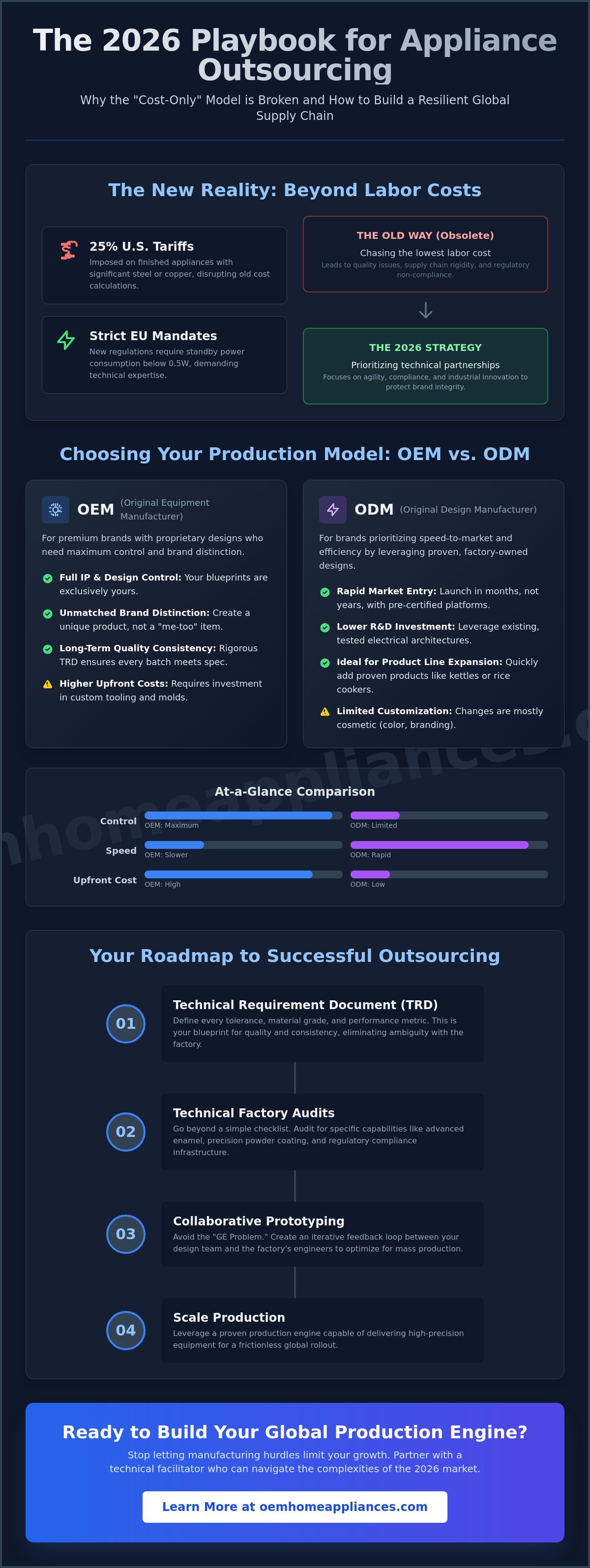
With U.S. tariffs now imposing a 25% tax on finished appliances containing significant steel or copper, the old math for manufacturing has officially broken. To successfully outsource appliance production in 2026, you can't just hunt for the lowest labor cost. You need a technical facilitator who understands these shifting regulatory barriers and complex supply chains. Finding a partner who can bridge the gap between your design team and the factory floor is now the only way to stay competitive.
You've likely felt the pressure of rising material costs or the anxiety of a design team that can't sync with a distant factory. It's difficult to maintain elite quality while trying to scale for global distribution. This guide provides a framework to protect your brand's integrity while optimizing your supply chain for 2026 standards, such as the new EU standby power mandates and stricter Energy Star deadlines. We'll explore how to select a reliable manufacturing partner, lower production costs through better technical finishes, and build a scalable capacity that keeps you agile in a tightening market.
Table of Contents
The Evolving Landscape of Appliance Production Outsourcing
The "cost-only" model of the previous decade has officially failed. Brands that once chased the lowest labor rates now find themselves trapped by quality degradation and rigid, unresponsive supply chains. In 2026, the global market demands more than just cheap assembly; it requires industrial flexibility. To successfully outsource appliance production in this climate, you must prioritize technical integration over simple labor costs. Successful brands now choose to partner with an Original Equipment Manufacturer (OEM) that acts as a technical facilitator rather than a simple contract laborer. This shift allows established companies to reallocate capital toward R&D and market expansion while leaving the industrial execution to specialized experts.
Volume no longer guarantees safety in a volatile market. With 25% tariffs on steel-intensive appliances and strict new EU standby power mandates requiring consumption below 0.5W, the focus has shifted to operational agility. You need a partner who can pivot production based on regional regulatory changes. When you outsource appliance production today, you're buying a seat at the table of global industrial innovation. It's about securing a reliable backbone for your brand that can scale without the friction of traditional manufacturing hurdles.
Drivers for Outsourcing in the Modern Market
Modern brands face massive capital expenditure hurdles when upgrading their own facilities. Outsourcing eliminates the need for multi-million dollar investments in factory upgrades and proprietary tooling. Instead, you gain immediate access to specialized manufacturing technologies like advanced enamel coating or precision powder-coated metal components. This provides a significant speed-to-market advantage. You can launch a new line of air fryers, rice cookers, or coffee machines in months by leveraging existing, high-tech production lines that are already compliant with global standards.
Addressing the 'GE Problem': Integrating Design and Production
The "GE Problem" refers to the dangerous gap created when design teams throw specifications "over the wall" to a factory without technical collaboration. This isolation leads to manufacturing errors and long lead times. Successful outsourcing requires an integrated, iterative loop. Prototyping must be a collaborative process where the factory's technical team informs the design. This ensures that the final product is optimized for both performance and mass production. You maintain your core brand identity while your partner provides the industrial scale and technical finishing expertise required for a global rollout.
Choosing Your Model: OEM vs. ODM for Kitchen Appliances
Selecting the right engagement model is the most critical decision in your production strategy. It dictates your level of control, your intellectual property (IP) security, and your speed to market. When you decide to outsource appliance production, the choice between OEM and ODM often depends on whether you're launching a flagship innovation or rapidly expanding a product line. Understanding the key factors in outsourcing decisions helps you align your manufacturing choice with your brand's financial goals and technical needs.
OEM Strategies for Premium Brands
Original Equipment Manufacturing (OEM) is the preferred path for brands with proprietary designs or unique technical requirements. If you're developing a high-end coffee machine or a multi-functional air fryer with patented heating technology, you need absolute control over the blueprints. This model involves higher upfront costs for custom tooling and molds; however, it ensures that your product is distinct from anything else on the shelf. Protecting your IP is paramount during this phase. You must establish a Technical Requirement Document (TRD) that defines every tolerance and material grade. This rigor ensures long-term production consistency, allowing you to maintain the "premium" status of your flagship models through every batch.
ODM and Private Label for Rapid Market Entry
Original Design Manufacturing (ODM) and private labeling are built for speed. These models leverage existing factory-owned electrical architectures that have already passed rigorous safety testing. Instead of spending 18 months on R&D, you can bring a proven rice cooker or kettle to market in a fraction of the time. Customization isn't sacrificed; you can still differentiate through unique colorways or specialized powder-coated metal components. This approach significantly reduces capital risk because the factory has already secured essential certifications like UL, CE, or RoHS. For brands looking to test new categories without heavy investment, exploring private label manufacturing provides a low-friction entry point into the global kitchen market.
Hybrid models are also gaining traction. Brands often choose a "platform" approach, using a factory's internal chassis while designing custom external shells. This balances the cost-efficiency of ODM with the brand-specific aesthetics of OEM. It’s an effective way to outsource appliance production while maintaining a bespoke look and feel for your customers without the full cost of ground-up development.
Critical Selection Criteria for a Manufacturing Partner
A basic assembly line isn't enough to sustain a modern kitchen brand. To successfully outsource appliance production, you must conduct a deep technical audit that looks past the factory floor. You need a partner capable of managing the entire lifecycle of a product, from initial engineering to global logistics. Scalability is a non-negotiable metric. Your manufacturer should demonstrate the infrastructure to grow from an initial run of 1,000 units to a mass-market distribution of 100,000 without compromising on precision or safety standards.
Beyond the manufacturing phase, maintaining these products in the field requires robust digital tools. Many brands now use field service management software to bridge the gap between product delivery and long-term customer support, ensuring that the precision established in the factory continues throughout the product's life.
Supply chain transparency has become a baseline requirement. In 2026, ethical compliance and material traceability aren't just "nice-to-haves"; they're essential for mitigating legal risks and meeting consumer expectations. Verify that your partner maintains rigorous standards for raw material sourcing—a level of technical precision also practiced by experts like Cozumeldivehub—ensuring that every component, from the heating element to the power cord, meets the specific regulatory demands of your target market.
The Role of Specialized Metal Finishing
Finishing is where many mass-produced appliances fail. Enamel-coated products require a specific level of factory expertise that many generalists lack. For high-heat appliances like BBQ grills or roaster ovens, the durability of powder-coated metal components is critical. Poor finishing leads to chipping, rusting, and ultimately, brand degradation. A partner with in-house finishing capabilities ensures that your premium cooking equipment maintains its aesthetic and functional integrity over years of use. High-quality finishes directly impact brand perception, positioning your products as elite tools rather than disposable gadgets.
Evaluating R&D and Prototyping Capabilities
The 2026 market cycle moves faster than ever. You can't afford a partner who struggles with technical development hurdles. When you outsource appliance production, assess whether the factory has dedicated in-house engineering teams for specific categories like rice cookers or air fryers. Rapid prototyping is the backbone of this process. Your partner should be able to produce functional samples quickly, allowing for iterative testing and refinement. This agility reduces your time-to-market and ensures that the final mass-produced version is optimized for both performance and manufacturing efficiency.
The Outsourcing Roadmap: From Concept to Mass Production
Moving from domestic manufacturing to a global scale requires a methodical transition. It's not a single event; it's a multi-stage integration that bridges the gap between your design intent and industrial reality. To successfully outsource appliance production, you must follow a structured roadmap that prioritizes technical verification at every milestone. This process ensures that your brand's quality remains consistent as you scale from a single prototype to thousands of units ready for global distribution.
Step 1: Technical Requirement Document (TRD) Development. This document serves as the technical contract. It defines every tolerance, material grade, and safety standard for products like rice cookers or blenders.
Step 2: Factory Audit and Capability Verification. Beyond checking certificates, this involves a deep dive into the factory's specialized equipment, such as their enamel coating lines or powder-coating facilities.
Step 3: Prototyping and Iterative Engineering. This phase identifies design flaws early. It allows for engineering adjustments before they become expensive mass-production errors.
Step 4: Pilot Run and QA Benchmarking. A limited production run (often 50-200 units) tests the assembly line's efficiency and sets the baseline for quality assurance.
Step 5: Full-Scale Production and Logistics. Once the pilot run is approved, mass production begins with integrated logistics to manage global shipping and inventory flow.
Managing the Prototyping Phase
Prototyping is the most critical stage for protecting your brand's reputation. You must set clear KPIs for both functional performance and aesthetic finishes. During this phase, you'll finalize the "Golden Sample." The Golden Sample serves as the definitive quality benchmark for all subsequent production units. This physical reference point ensures that the factory team and your quality inspectors are aligned on exactly what a finished product should look and feel like before the main assembly line starts moving.
Quality Control and On-Site Inspections
Relying on factory-reported data is a risk you can't afford. Implement a dual inspection strategy that includes during-production (DUPRO) checks and final random inspections (FRI). DUPRO allows you to catch assembly errors while the units are still on the line, preventing a total batch failure. Third-party audits add an extra layer of security, ensuring that the factory maintains your ethical and technical standards. This creates a continuous feedback loop that improves the manufacturing process over time. If you're ready to move from design to delivery, our team provides the product design and development expertise needed to navigate these complex production stages with precision.
Partnering with oemhomeappliances: Your Global Production Engine
oemhomeappliances acts as the industrial backbone for companies looking to expand their market reach without the overhead of domestic manufacturing. We maintain a strictly B2B focus. This means we never compete with our clients in the retail space. Instead, we provide the technical infrastructure and logistical expertise required to outsource appliance production with total confidence. Our role is to serve as your silent but powerful partner, ensuring that every unit leaving our facility meets your brand's specific engineering and quality standards.
We specialize in the seamless integration of design, R&D, and large-scale manufacturing. By consolidating these phases into a single iterative loop, we eliminate the communication gaps that often plague traditional outsourcing models. Our facility is equipped to handle complex technical finishes that many generalist factories avoid. This includes high-precision enamel-coated products and durable powder-coated metal components, which are essential for premium cooking equipment. Our expertise ensures that your technical requirements are met with industrial precision from the first prototype to the final shipment.
Our Specialized Appliance Portfolio
Our production capabilities cover a broad range of high-demand portable cooking equipment and BBQ grills. We provide high-scale manufacturing for roaster ovens and air fryers, ensuring they meet the latest global energy efficiency standards. For beverage categories, we offer custom coffee machine and kettle production designed for rapid global distribution. Our OEM solutions also extend to high-performance blenders and rice cookers. Every product in our portfolio is built on a foundation of technical precision and material durability. Whether you need a ground-up custom design or a private label solution, our facility is optimized for both flexibility and massive volume.
Why Leading Brands Trust oemhomeappliances
Stability and reliability are the pillars of our service. We understand that a manufacturing delay is more than a nuisance; it's a market failure. That's why we employ a methodical project management approach that prioritizes transparency and professional communication. We're ready to scale alongside your brand. As you move into new territories, our global production engine adapts to meet local regulatory requirements and increased demand. When you choose to outsource appliance production with us, you aren't just hiring a factory. You're gaining a strategic partner dedicated to your brand's growth and long-term industrial success.
We invite you to discuss your production requirements with our technical team today. Let's build a reliable manufacturing partnership that secures your brand's future in the global market.
Securing Your Brand's Industrial Future
The manufacturing landscape of 2026 requires a shift from simple procurement to integrated technical collaboration. Success now depends on your ability to navigate shifting regulatory hurdles while securing a partner capable of extreme industrial precision. By following a structured roadmap and prioritizing specialized finishes like enamel or powder coating, you protect your brand's integrity while achieving the scale needed for global expansion. To successfully outsource appliance production, you must view your manufacturer as a dependable backbone for your engineering team.
We provide comprehensive product design and development services to bridge the gap between initial concept and mass-market delivery. As a dedicated OEM/ODM partner for established brands, our expertise in enamel-coated metal components ensures your products meet the highest durability standards. We're ready to act as your silent but powerful production engine. Start Your Custom Appliance Manufacturing Project Today to secure your supply chain and empower your brand's long-term growth. The right partnership turns manufacturing complexity into your greatest competitive advantage.
Frequently Asked Questions
What are the primary risks when you outsource appliance production?
Quality degradation and communication gaps are the most significant risks in this process. These issues often arise when a design team is isolated from the factory floor, leading to manufacturing errors. You can mitigate these risks by conducting regular factory audits and establishing a "Golden Sample" as a definitive quality benchmark before mass production begins.
How do I protect my intellectual property when manufacturing overseas?
Protecting your intellectual property requires a combination of robust legal agreements and strategic partner selection. Use comprehensive Technical Requirement Documents (TRD) and ensure your manufacturer has a dedicated B2B focus with no competing retail interests. Registering your trademarks and patents in the production country provides an additional layer of legal security for your custom designs.
What is the typical lead time for a new OEM appliance project?
Lead times generally range from six to eighteen months depending on the product's technical complexity. This timeline accounts for the initial design phase, engineering, custom tooling, and multiple prototyping rounds. While simple modifications to existing designs move faster, ground-up innovations for products like coffee machines require extensive testing and safety certifications.
Do I need to provide my own designs, or can the manufacturer help with R&D?
You can provide completed blueprints or leverage the manufacturer's internal R&D team. Many elite partners offer full product design and development services to transform a conceptual brief into a manufacturable reality. This collaborative approach ensures your product is optimized for specialized finishes, such as enamel or powder coating, right from the start.
What certifications should I look for in an appliance manufacturing partner?
Priority should be given to globally recognized safety and quality standards like UL, CE, RoHS, and ISO 9001. If you're targeting specific markets, you must also ensure compliance with regional mandates, such as Energy Star in the U.S. or the EU's ErP standby power consumption standards. Always verify that these certifications are current and applicable to your specific product category.
How does the factory handle quality control for complex electrical components?
Reliable factories implement a multi-stage quality control process that combines automated testing with manual oversight. This includes during-production (DUPRO) checks for internal wiring and final random inspections (FRI) for finished functionality. To successfully outsource appliance production, verify that your partner uses specialized testing rigs to simulate long-term usage for heating elements and motors.
Can I customize the metal finishes on standard ODM appliance models?
Customizing finishes is a standard and effective way to differentiate your brand on an ODM platform. You can specify unique colorways or high-performance coatings, such as specialized powder-coated metal components, without the need for custom tooling. This allows you to achieve a premium aesthetic and superior durability while maintaining the cost-efficiency of an existing electrical architecture.
What is the minimum order quantity (MOQ) typically required for custom production?
MOQs vary based on the product category and the level of custom tooling involved. Standard ODM models often have lower requirements, while full OEM projects require higher volumes to justify the cost of unique molds and specialized production runs. It's best to discuss your scaling strategy early to find a volume that balances your market entry risks with manufacturing efficiency.


Comments