Strategic Guide to Private Label Energy Efficient Rice Cookers in 2026
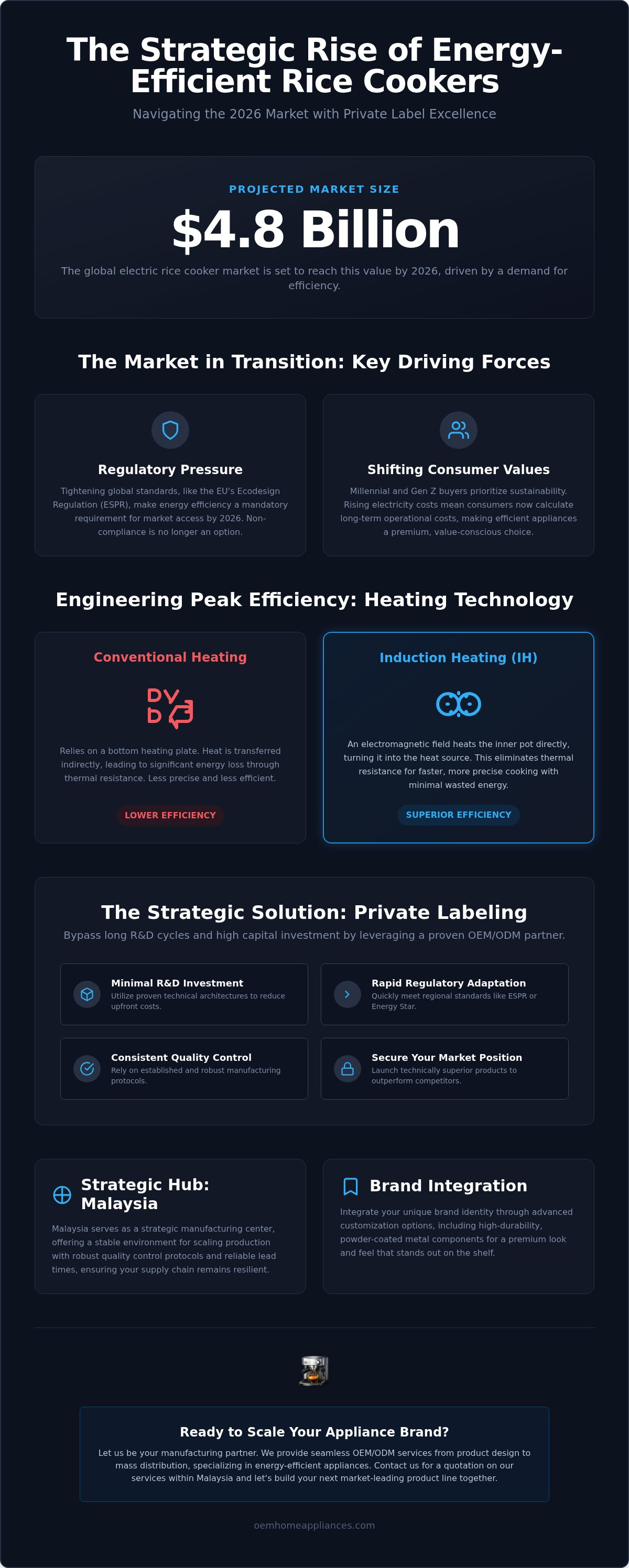
With the global electric rice cooker market projected to hit $4.8 billion in 2026, the industry has shifted from simple utility to high-stakes energy compliance. Brands that ignore the tightening EU Ecodesign regulations risk losing market access entirely. Launching a line of private label energy efficient rice cookers is now a strategic necessity rather than a luxury. You need a product that meets strict energy consumption limits while maintaining the premium aesthetics your customers demand.
We understand that finding a partner who balances technical precision with reliable manufacturing lead times is often the hardest part of scaling. It's frustrating to manage supply chains that can't keep up with evolving efficiency standards or design requirements. This guide shows you exactly how to engineer, customize, and scale a high-performance appliance line through expert OEM/ODM partnerships. We'll examine the process of securing technically superior products and establishing a seamless integration with a dependable manufacturing partner in Malaysia. By the end of this article, you'll have a clear roadmap for building a sustainable, profitable brand in the competitive 2026 landscape.
Table of Contents
The Business Case for Private Label Energy Efficient Rice Cookers
The 2026 small appliance market is defined by a shift toward environmental accountability. While the global market is expected to grow to $4.8 billion this year, the real opportunity lies in high-efficiency models. Rising electricity costs have fundamentally changed how households view kitchen power consumption. Consumers now calculate the long-term operational cost of an appliance before making a purchase. For brands, offering private label energy efficient rice cookers is the most direct way to capture this value-conscious demographic. Efficiency isn't just a technical specification; it's a premium brand differentiator that justifies higher retail margins and builds long-term customer trust.
Consumer Trends Driving the Efficiency Shift
Demographic shifts are accelerating this transition. Millennial and Gen Z buyers prioritize the "sustainable kitchen," seeking products that minimize their carbon footprint. Retailers are responding by giving preferential shelf placement to appliances with transparent energy ratings. Understanding how rice cookers work from a thermal efficiency perspective is crucial for brand managers. Models that utilize advanced insulation and precise temperature control reduce waste heat, making them more attractive to eco-conscious retailers. Multi-functional designs also play a role. A single unit that replaces multiple appliances reduces the total energy footprint of the home, which is a major selling point for urban dwellers with limited space.
Private Labeling as a Strategic Growth Lever
Developing a product from scratch requires massive capital and time. Established brands use private labeling to bypass these hurdles. By leveraging existing OEM platforms, you reduce R&D overhead while maintaining control over the final brand identity. This approach ensures brand consistency across your entire catalog. Working with a specialized partner for product design and development services allows you to hit the market faster than competitors stuck in the prototype phase.
Scaling your brand with private label energy efficient rice cookers provides the flexibility to adapt to new regulations. The EU's Ecodesign for Sustainable Products Regulation (ESPR), which entered into force in 2024, makes efficiency a requirement for market entry by July 2026. Partnering with a reliable manufacturer in Malaysia ensures you meet these standards without the risk of managing your own factory floor. Key benefits of this strategic path include:
Minimal R&D investment by using proven technical architectures.
Rapid adaptation to regional energy standards like ESPR or Energy Star.
Consistent quality control through established manufacturing protocols.
Protection of market position through technically superior product offerings.
This streamlined approach allows you to focus on marketing and distribution while your manufacturing partner handles the complexities of energy-saving engineering and supply chain logistics.
Engineering Efficiency: Technical Standards for OEM Rice Cookers
Technical excellence in private label energy efficient rice cookers starts with the heating architecture. Unlike standard models that rely on thermal conduction from a bottom plate, high-end OEM units use sophisticated power management systems to reduce draw. Engineering private label energy efficient rice cookers requires a methodical approach to active heat control rather than passive heating. Aligning with global Department of Energy conservation standards ensures your brand meets 2026 performance benchmarks while reducing operational costs for the end-user.
Induction Heating (IH) and Precise Energy Management
Induction heating represents the pinnacle of efficiency in modern rice cookers. An electromagnetic coil creates a magnetic field that interacts directly with the inner pot, effectively turning the vessel itself into the heat source. By eliminating the thermal resistance of a traditional heating plate, IH technology converts energy into heat with significantly higher efficiency than conventional conduction models. Balancing high-speed cooking with low-wattage standby modes is critical for achieving top-tier energy ratings. Manufacturers must engineer these units to minimize "phantom draw" when the device is plugged in but not active.
Smart Logic and Power Optimization
Micom (micro-computerized) technology, often referred to as 'Fuzzy Logic,' acts as the brain of the appliance. These algorithms don't just turn heat on or off; they make minute adjustments to the temperature based on the cooking stage. Integrated sensors detect rice volume and moisture levels in real-time. This prevents the energy waste associated with over-boiling or excessive steaming. Engineering for durability is equally important. Efficiency shouldn't degrade over the product lifecycle, so we focus on high-quality components that maintain precise thermal calibration for years. If you're looking to integrate these technical standards into your product line, you can consult with our engineering team for specific OEM configurations.
The efficiency of the heating element is only half the story. Thermal insulation standards determine how well the unit maintains temperature during the "keep warm" cycle without excessive energy draw. Double-walled vacuum insulation or high-density foam layers are essential for retaining heat. Material science also plays a vital role in the inner pot's construction. Multi-layer pots featuring high-conductivity metals ensure even heat distribution. This prevents hot spots that waste energy and ensures every grain is cooked uniformly. High-quality inner pots with non-stick enamel or specialized coatings improve thermal transfer and durability, ensuring the appliance remains efficient throughout its lifespan.
Customization and Brand Integration for Private Labels
Turning a base manufacturing platform into a market-ready brand requires a deep focus on aesthetic and functional differentiation. For private label energy efficient rice cookers, customization allows you to align technical performance with your specific brand identity. This process transforms a standard appliance into a signature product that resonates with your target audience. It's not just about adding a logo; it's about selecting materials and interfaces that reflect your brand's core values of quality and sustainability.
Advanced Coating and Metal Finishing
Durability and heat management are directly linked to the finishes you choose during the design phase. We utilize industrial enamel coating for inner components to maximize heat retention and energy stability. For the exterior, applying powder-coated metal components provides a premium, matte finish that resists scratches and wear in high-traffic kitchens. This finish is particularly effective for brands looking to move away from the traditional white plastic look. It offers a sophisticated industrial aesthetic that signals high-end engineering. You can also specify specialized coatings for inner pots to support PFAS-free marketing claims, meeting the 2026 consumer demand for safer cookware.
Functional Customization: Beyond White Rice
Your firmware is a powerful tool for brand positioning. You can incorporate multi-cooker settings such as quinoa, steaming, or slow cooking directly into the Micom logic. This versatility increases the product's value proposition without requiring expensive hardware changes. Control panels can range from minimalist analog dials for budget-friendly lines to advanced digital touchscreens for premium collections. Designing intuitive control panels is essential for global market penetration. Each touchpoint, from the tactile feel of the buttons to the clarity of the LCD, reinforces brand reliability. We also customize localized notification sounds and LED display colors to ensure the appliance matches your brand's unique voice.
The integration process concludes with custom packaging designed for global distribution. A well-engineered out-of-box experience reinforces the quality of your private label energy efficient rice cookers. From protective sustainable inserts to high-fidelity print finishes, every detail must reflect your corporate standards. Our manufacturing facility in Malaysia handles the entire assembly and packaging process. This ensures that your products arrive retail-ready and consistent with your brand’s global image. By focusing on these touchpoints, you create a cohesive product line that stands out in a crowded marketplace.
Strategic Sourcing: Navigating the OEM Partnership in Malaysia
Sourcing is the foundation of brand stability. In 2026, the reliance on traditional manufacturing hubs has shifted toward regional diversification. Malaysia has emerged as a premier destination for brands looking to produce private label energy efficient rice cookers without the logistical bottlenecks of other regions. This shift is driven by a combination of technical expertise, trade-friendly regulations, and industrial infrastructure. A partnership with a private label kitchen appliance manufacturer in Malaysia provides the stability needed to scale a premium product line globally.
The Malaysian Manufacturing Advantage
Malaysia's location near key shipping lanes provides a significant logistical edge. Faster transit times to European and North American markets reduce the capital tied up in floating inventory. Beyond logistics, the region offers deep expertise in specialized finishing. Access to high-quality raw materials and advanced coating facilities for enamel and powder-coated metal components ensures your products meet premium durability standards. Technical support and project management are conducted in English. This clarity prevents the costly misunderstandings often associated with cross-border manufacturing. It allows for precise execution of complex design specifications during the development phase.
Quality Assurance and Factory Audits
Selecting a high capacity rice cooker factory requires a rigorous evaluation of their quality control protocols. In-house testing for energy efficiency compliance is a critical metric. A reliable partner must verify that every unit meets the promised wattage ratings and thermal retention benchmarks. Factory audits should focus on ISO certifications and the ability to maintain precision during mass production. Managing lead times is equally vital. We coordinate production schedules to align with your seasonal demand, ensuring your inventory levels remain optimal without overextending your warehouse capacity.
The transition from ODM prototyping to mass production is where many brands face challenges. It requires a methodical approach to ensure that the energy-saving features developed in the lab are successfully replicated on the factory floor. Our facility manages this process through strict pilot runs and component stress testing. This resilience is essential in the 2026 landscape, where supply chain disruptions are common. By sourcing raw materials locally within Malaysia, we insulate your production from global volatility. If you're ready to secure your supply chain, you can request a manufacturing consultation to discuss your specific production requirements.
Scaling Your Appliance Brand with oemhomeappliances
oemhomeappliances acts as the industrial backbone for your brand. We provide comprehensive kitchen appliance manufacturing solutions that allow you to scale without the burden of facility management. Our B2B-only model is a critical advantage; we don't compete with our clients in the retail space. This focus ensures that our engineering resources are entirely dedicated to your success. By specializing in private label energy efficient rice cookers, we help you meet the 2026 market demand for sustainable technology with precision and speed.
Comprehensive R&D and Prototyping
Our product development cycle moves quickly from concept sketches to functional, energy-efficient prototypes. We specialize in solving technical challenges related to complex enamel-coated metal components and precise thermal calibration. Engineering teams work collaboratively with your brand to ensure every unit meets regional energy standards, such as the EU's Ecodesign requirements. This phase includes rigorous stress testing to guarantee that efficiency doesn't degrade over the product's lifespan. We don't just build appliances; we engineer high-performance tools that define your brand's technical authority.
Partnering for Long-Term Success in Malaysia
Choosing a manufacturing partner is a long-term commitment. Our facility in Malaysia offers scalable production capacities that grow alongside your market share. Professional project management ensures that every stage, from initial design to final delivery, remains on schedule. We handle the complexities of supply chain logistics and quality assurance so you can focus on brand strategy. This partnership-oriented approach is built on transparency and technical excellence. It's the most reliable way to maintain a competitive edge in the small appliance sector.
Getting started with your 2026 product line is a straightforward process. We invite you to request a quotation for your private label rice cooker project in Malaysia. Our team is ready to provide the technical expertise and industrial scale required to bring your vision to market. Contact us today to discuss your specific manufacturing needs and discover how our specialized private label energy efficient rice cookers can anchor your brand's growth.
Secure Your Position in the 2026 Appliance Market
The transition toward sustainable kitchen technology represents a permanent structural shift in the global market. Success in this landscape requires more than just a logo; it demands a partner capable of delivering high-performance engineering and reliable supply chain logistics. By prioritizing technical customization and regulatory compliance, your brand can navigate upcoming efficiency standards while capturing premium market share. We provide the stable, industrial backbone needed to turn complex engineering requirements into retail-ready products.
Leveraging our specialized B2B focus and expertise in energy-efficient engineering ensures your product line remains competitive and technically superior. Our high-capacity Malaysian manufacturing facility is designed to support your growth from initial prototyping through mass distribution. If you're ready to scale your line of private label energy efficient rice cookers, we are here to facilitate your expansion with precision and reliability. Contact our Malaysian team for a private label manufacturing quotation to begin your 2026 product development journey. We look forward to building a long-term partnership that drives your brand's success.
Frequently Asked Questions
What is the difference between OEM and ODM for rice cookers?
OEM involves manufacturing a product based on your brand's specific design or utilizing a factory template with your labeling. ODM is a collaborative process where the manufacturer handles the product design and development based on your functional requirements. Both models allow for the creation of private label energy efficient rice cookers, but ODM offers deeper customization of internal components and heating logic to meet unique market needs.
How much energy do induction heating (IH) rice cookers save?
Induction heating models are more efficient than conventional conduction models because they eliminate thermal resistance. By turning the inner pot into the heat source via electromagnetic fields, energy transfer is nearly instantaneous. While specific savings vary by usage, IH technology significantly reduces heat loss during the cooking cycle. This efficiency makes them a preferred choice for brands targeting markets with strict energy consumption limits, such as those defined by 2026 EU regulations.
Can I customize the inner pot coating for my private label brand?
Yes, customizing the inner pot coating is a standard part of our private label service. You can select from various materials, including high-durability enamel or specialized non-stick coatings. Many brands in 2026 are opting for PFAS-free ceramic coatings to align with consumer health and safety trends. These customization options allow you to differentiate your product line while ensuring the inner pot maintains optimal thermal conductivity for maximum energy efficiency.
What are the typical MOQs for private label energy-efficient rice cookers?
Minimum Order Quantities depend on the level of customization and the specific model selected. Standard private label configurations typically require higher volumes to justify the setup of mass production lines and custom tooling. For highly specialized private label energy efficient rice cookers involving custom firmware or unique metal finishes, MOQs ensure production efficiency and cost-effectiveness. We discuss specific volume requirements during the initial consultation phase to align with your brand's growth strategy.
How does oemhomeappliances ensure quality consistency in Malaysia?
Quality consistency is managed through a multi-stage verification process at our Malaysian facility. We conduct rigorous in-house testing for energy efficiency compliance and component durability. Every production run includes pilot stages and stress tests for critical parts like the Micom controllers and heating elements. Our B2B-only focus ensures that our quality control protocols are strictly aligned with professional standards, protecting your brand's reputation in the global marketplace.
What certifications are required for energy-efficient appliances in 2026?
In 2026, compliance with the EU's Ecodesign for Sustainable Products Regulation (ESPR) is essential for European market access. This framework mandates strict requirements for energy efficiency, repairability, and recyclability. In the United States, ENERGY STAR specifications remain the benchmark for consumer trust. We ensure that our manufacturing processes and product designs are capable of meeting these regional standards, providing the necessary documentation for your brand's regulatory filings and retail placement.
Is it possible to develop a multi-cooker under a private label?
Developing a multi-cooker is a highly effective way to expand your product catalog. By customizing the Micom firmware, we can integrate diverse cooking functions like steaming, slow cooking, or specialized grain cycles into a single unit. This multi-functionality reduces the total energy footprint of a kitchen, which is a major selling point for modern consumers. Our engineering team assists in designing intuitive interfaces that make these advanced features accessible to your target audience.
How long is the typical lead time from design to mass production?
Lead times vary based on the complexity of the design and the required certifications. The process generally moves through stages of conceptual design, prototyping, and rigorous safety testing before entering mass production. Working with an established partner in Malaysia often reduces these timelines compared to starting from scratch. We provide a detailed project roadmap during the consultation phase to ensure your product launch aligns with seasonal market demands and retail schedules.


Comments