Strategic Guide to Selecting an OEM Electric Kettle Manufacturer in 2026
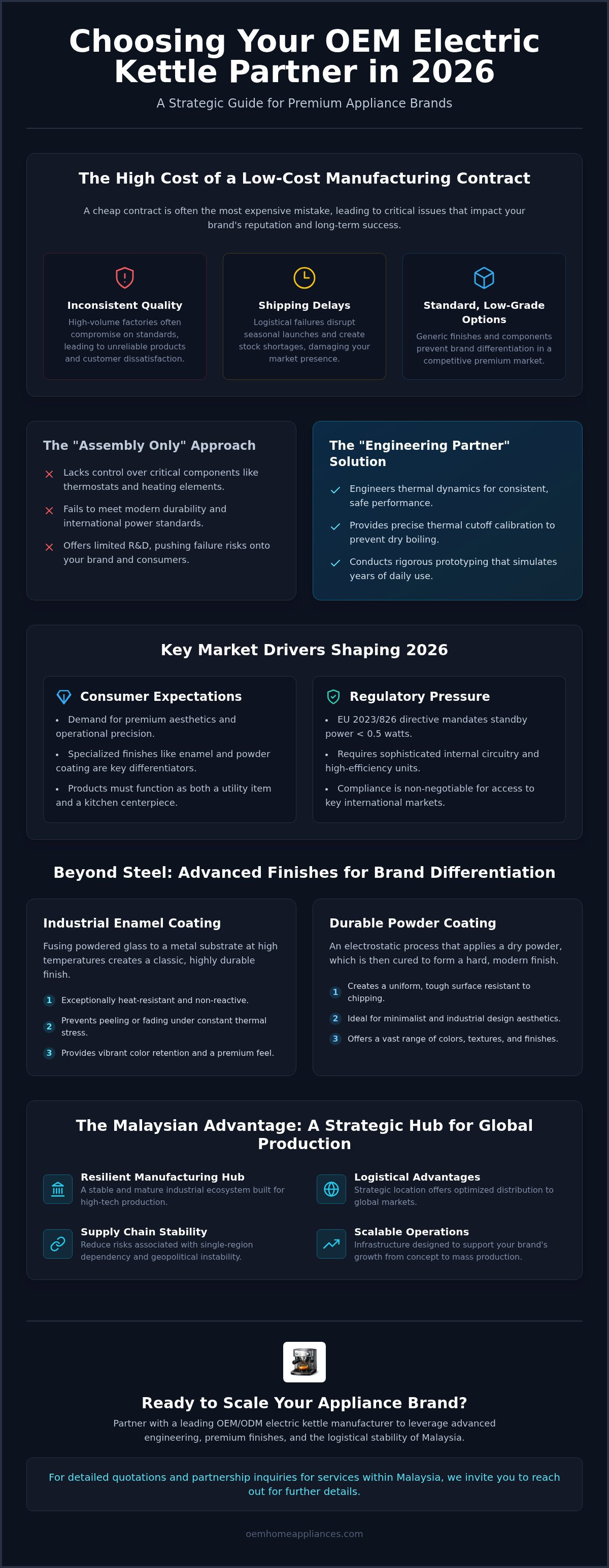
A low-cost manufacturing contract is often the most expensive mistake a premium appliance brand can make. In 2026, the gap between a market leader and a struggling label is defined by technical durability and supply chain stability. Selecting the right OEM electric kettle manufacturer is no longer a simple procurement task; it's a high-stakes decision that impacts your brand's reputation for years. You're likely tired of inconsistent quality from high-volume factories or shipping delays that disrupt your entire seasonal launch. It's a common pain point for businesses that need specialized finishes like durable enamel or precision powder coating but find themselves stuck with standard, low-grade options.
This guide provides a strategic framework to identify a manufacturing partner that balances engineering precision with global logistics reliability. You'll discover how to leverage the stability of Malaysian manufacturing hubs to optimize your distribution and scale your operations. We'll also examine the material standards and energy efficiency requirements, such as the latest EU standby power mandates, that define the competitive landscape this year. By the end of this article, you'll have the roadmap needed to establish a scalable, long-term partnership that prioritizes both design and durability.
Table of Contents
The Strategic Landscape of OEM Electric Kettle Manufacturing
The 2026 kitchen appliance sector demands more than a simple supplier; it requires a technical partner. Modern brands have moved past generic white-label sourcing because consumers now prioritize specialized features and aesthetic longevity. A professional OEM electric kettle manufacturer acts as the silent backbone of your brand, managing the complexities of production while you focus on market growth. This shift toward specialized contract manufacturing ensures that your product line isn't just another commodity on a crowded shelf. It's about building a brand-first identity through precision engineering.
The Difference Between Assembly and Engineering
Many factories offer assembly services, but few provide true engineering depth. Simple assembly-only facilities often fail to meet modern durability standards because they lack control over critical components. Reviewing the history of the electric kettle reveals that the most significant advancements have always centered on the heating element and the thermostat. These components are the "heart" of the appliance. If they aren't engineered for high-wattage stability, the product won't last.
Our R&D teams focus on preventing common failure points before they reach the consumer. We don't just put parts together. We engineer the thermal dynamics to ensure consistent performance. Professional engineering offers several key benefits for your brand:
Precise thermal cutoff calibration to prevent dry boiling and overheating.
High-grade internal wiring capable of handling 2026 international power standards.
Rigorous prototyping that simulates years of daily use before mass production begins.
Market Trends Driving Kettle Innovation
Consumer expectations have shifted toward premium aesthetics and operational precision. In 2026, a kettle's finish is just as important as its boiling speed. High-end brands now demand specialized enamel and powder coating to differentiate their offerings. These finishes provide a tactile quality and durability that standard plastic or brushed steel cannot match. It's a technical advantage that turns a utility item into a kitchen centerpiece.
Regulatory pressure is also a major driver of innovation. The EU 2023/826 directive mandates standby power consumption of less than 0.5 watts, a standard that requires sophisticated internal circuitry. Leading brands integrate these high-efficiency units into comprehensive kitchen appliance manufacturing solutions to maintain a cohesive ecosystem. Partnering with a specialized OEM electric kettle manufacturer allows you to meet these technical requirements without investing in your own factory infrastructure. This approach provides the scalability and precision necessary to dominate the premium market.
Advanced Technical Solutions: Enamel and Powder Coating
Standard stainless steel is no longer enough to capture the high-end market. In 2026, material science has become the primary tool for brand differentiation. While raw metal remains a staple, premium brands are turning to specialized industrial finishes to create products that feel substantial and unique. A top-tier OEM electric kettle manufacturer must master these applications to help clients stand out in a saturated retail environment. These advanced finishes don't just improve aesthetics; they fundamentally change the consumer's perception of quality and durability.
Industrial Enamel Coating for Premium Kettles
The application of enamel coating involves fusing powdered glass to a metal substrate at high temperatures. This process creates a surface that is exceptionally heat-resistant and non-reactive. Unlike traditional paints, enamel won't peel or fade under the constant thermal stress of a boiling cycle. It allows for vibrant color retention and a smooth, easy-to-clean finish that mimics the classic look of traditional stovetop kettles. Professional roaster oven technology has paved the way for this application in the kettle market, offering a tactile quality that feels permanent and premium.
Powder Coating for Modern Appliance Design
Powder coating offers a different set of advantages, particularly for brands targeting a minimalist or industrial aesthetic. This process uses an electrostatic charge to apply a dry powder that is then cured under heat. It's a highly efficient method that produces zero Volatile Organic Compounds (VOCs), making it an environmentally responsible choice for modern manufacturing. Precision powder coating allows for matte, satin, or even textured finishes that hide fingerprints and resist scratches better than polished steel. These powder-coated metal components ensure that the appliance maintains its visual integrity even in high-traffic kitchen environments.
By utilizing Malaysia's electronics manufacturing cluster, brands can access these advanced finishing technologies within a stable and highly skilled industrial ecosystem. These coatings do more than just look good; they extend the life of the appliance by providing an extra layer of protection against corrosion and impact. This technical edge is what separates a standard appliance from a professional-grade product. If you want to explore how these finishes can elevate your product line, you can consult with our technical team regarding specific material requirements for your next project.
Malaysia: A Strategic Hub for Global Kettle Production
The choice of a manufacturing base directly dictates your supply chain's vulnerability. As global small kitchen appliances market trends shift toward decentralized production, Malaysia has emerged as a premier destination for high-tier manufacturing. The country's home appliance exports are projected to reach $1.73 billion in 2026, driven by a robust Electrical and Electronics (E&E) sector that accounted for 44.3% of total exports in 2025. This established industrial ecosystem provides a stable, resilient alternative to traditional sourcing hubs that are currently facing rising costs or geopolitical volatility. Partnering with a Malaysia-based OEM electric kettle manufacturer allows you to tap into an infrastructure designed for international scale and precision.
Supply Chain Resilience and Global Export
Malaysia's New Incentive Framework (NIF), effective March 1, 2026, has transformed the manufacturing landscape into a performance-driven system. This framework prioritizes technology transfer and supply-chain development, making it easier for global brands to establish long-term operations here. Our facility leverages these national advantages to offer reduced shipping lead times and efficient logistics. Local sourcing for specialized metal components and high-grade plastics further minimizes external disruptions. By maintaining a localized supply chain for critical parts, we ensure that production schedules remain consistent even when global freight markets fluctuate. You can explore our full range of production capabilities through our manufacturing services.
Quality Standards and Regulatory Compliance
The "Made in Malaysia" label has become a symbol of reliability in the premium appliance market. This reputation is built on a foundation of strict regulatory compliance and frequent industrial audits. For instance, SIRIM certification updates for 2026 now mandate that ST-SIRIM safety labels must be placed directly on the product itself, not just the packaging. This level of transparency protects your brand from liability and ensures consumer trust. Our manufacturing processes are aligned with international standards including GS, CE, and ETL. Meeting these requirements within a Malaysian framework simplifies the entry into Western markets. It's a strategic move that combines cost-efficiency with the rigorous safety protocols expected of a top-tier OEM electric kettle manufacturer.
Framework for Evaluating a Private Label Kettle Partner
Price is often a deceptive metric in high-volume manufacturing. A low unit cost usually masks hidden expenses like high failure rates, shipping delays, or poor material quality. When selecting a private label kitchen appliance manufacturer, your focus should remain on the total cost of ownership and the protection of your brand's reputation. A critical factor in this evaluation is the manufacturer's business model. You should prioritize partners with a dedicated B2B focus. Factories that also sell direct-to-retail often prioritize their own house brands over client orders during peak seasons. A pure OEM electric kettle manufacturer acts as your silent engine, ensuring your inventory and quality standards are the top priority.
Technical Capabilities and R&D Support
Speed to market depends on the efficiency of the R&D cycle. Prototyping is not just about aesthetics; it's about refining the technical performance of the heating element and the internal wattage calibration. You must verify if the factory can handle bespoke designs that include complex metal component finishing, such as the specialized enamel or powder coating mentioned in previous sections. High-wattage appliances require precise engineering to meet 2026 global safety standards. Ask for specific lead times for functional prototypes. A partner that can move from concept to a tested sample in a matter of weeks provides a significant competitive advantage. You can view our full range of technical support on our services page.
Audit Readiness and Transparency
Reliability is built on transparency and rigorous documentation. A high-tier partner should be audit-ready at all times, maintaining essential certifications like ISO 9001 and BSCI. These aren't just badges; they're evidence of a systematic approach to quality control and ethical labor practices. Beyond certifications, evaluate the communication rhythm of the organization. Do you have a dedicated project manager? Is there a clear protocol for reporting production milestones? In the 2026 market, established brands require a "Trusted Expert Facilitator" who proactively identifies potential supply chain bottlenecks before they impact your seasonal launch. Transparency during the production cycle is the only way to ensure long-term scalability.
If you're ready to move beyond basic vendors and build a scalable production line with a partner that understands the nuances of the global market, request a technical consultation and quotation from our Malaysia-based facility today.
Scaling Your Brand with oemhomeappliances (Keiteq)
Scaling a global brand requires an engine that matches your ambition. oemhomeappliances (Keiteq) provides the industrial strength needed for significant market expansion. As a dedicated OEM electric kettle manufacturer, we prioritize your brand's growth over our own visibility. This B2B-only focus ensures that we never compete with you in the retail space. We function as a flexible extension of your engineering team. By removing the burden of production management, we allow your organization to focus on marketing and distribution strategy.
We offer deep customization options that go beyond basic rebranding. Our services include precise calibration of heating elements and wattage to meet specific regional regulations and performance targets. We also specialize in the technical application of enamel and powder coatings, providing the aesthetic differentiation discussed earlier in this guide. This versatility allows you to launch specialized product lines that target niche premium segments without the need for multiple vendors. It's a comprehensive approach to product line expansion.
From Concept to Mass Production
Our R&D process is methodical and data-driven. We move through prototyping phases quickly to ensure every technical specification is met before large-scale production begins. This includes rigorous testing of enamel-coated and powder-coated metal components for thermal resistance and impact durability. For established brands, this precision is vital for maintaining market leadership. It reduces the risk of post-launch technical failures and ensures a consistent consumer experience. We provide the technical backbone that allows your designs to thrive in a competitive marketplace.
Seamless Integration into Your Supply Chain
Operating from our Malaysia facility, we manage large-scale production runs with high efficiency. Our infrastructure is built to handle the industrial requirements of global brands. We don't just manufacture products; we provide technical solutions that fit into your existing logistics framework. Initiating a partnership for custom kettle development starts with a clear alignment on your brand's technical and aesthetic goals. We provide the stability and industrial strength needed to scale your operations across multiple international markets.
For more information on our Malaysia-based manufacturing capabilities or to request a formal quotation for your next project, please contact our team today. We are ready to help you develop a high-performance kettle line tailored to your specific market requirements.
Securing a Competitive Advantage in the 2026 Appliance Market
Selecting a high-tier OEM electric kettle manufacturer is a strategic decision that defines your brand's market trajectory. Success in 2026 requires a technical partner that masters specialized enamel and powder-coated metal components to ensure product differentiation. By leveraging Malaysia's industrial stability and resilient supply chain, your organization can launch high-performance product lines that withstand global volatility. This geographical advantage provides a reliable alternative to traditional hubs, ensuring consistent production schedules.
As a dedicated B2B manufacturing partner under the Keiteq brand, we empower established labels through engineering precision. Our expertise extends across roaster ovens, rice cookers, and premium kettles, ensuring your designs are backed by industrial strength. We act as a silent but powerful engine, providing the R&D support and mass production capacity needed for long-term scalability. This professional focus ensures your inventory remains the top priority without the risk of direct-to-retail competition.
Take the next step in securing a reliable, high-quality production line. We invite you to contact oemhomeappliances for a custom manufacturing quotation in Malaysia. Let's build a durable partnership that drives your brand's growth across global markets.
Frequently Asked Questions
What are the benefits of choosing an OEM kettle manufacturer in Malaysia?
Malaysia offers a stable manufacturing environment supported by a robust Electrical and Electronics (E&E) sector. The March 2026 New Incentive Framework provides significant tax benefits for high-value technology transfer, making it a cost-effective choice for global brands. As a professional OEM electric kettle manufacturer in this region, we provide supply chain resilience and logistical advantages that bypass the volatility often found in other Asian sourcing hubs.
How does enamel coating differ from standard stainless steel for electric kettles?
Enamel coating provides a non-reactive surface and superior heat resistance compared to raw stainless steel. It allows for vibrant color retention and a smooth finish that won't peel or fade under thermal stress. This technical solution, derived from our roaster oven manufacturing expertise, turns a utility appliance into a premium kitchen centerpiece. It offers a tactile quality and durability that standard metallic finishes simply cannot achieve.
Can a private label manufacturer help with the R&D of a new kettle design?
A high-tier manufacturer acts as a trusted expert facilitator during the product development phase. This includes full R&D support to refine internal wattage, thermal dynamics, and safety calibration. By managing the prototyping and technical validation, we ensure your product meets 2026 international standards before mass production begins. This methodical approach allows your brand to focus on marketing while we handle the complexities of appliance engineering.
What is the typical lead time for a custom OEM kettle prototype?
Prototyping lead times vary depending on the complexity of the design and the required material finishes. Custom requirements like specialized enamel or powder coating might need additional technical validation to ensure thermal stability. We prioritize efficient iteration cycles to help brands meet their seasonal launch windows. This phase is vital for verifying performance and safety compliance before committing to large-scale production runs at our Malaysia facility.
Why is a B2B-only manufacturing focus important for my brand?
A B2B-only focus ensures your manufacturer is a partner, not a retail competitor. Factories that sell direct-to-retail often prioritize their own house brands during peak seasons, which can lead to production delays for external clients. By functioning as a silent, powerful manufacturing engine, we ensure your orders and quality standards remain the absolute priority. This exclusivity protects your supply chain and maintains the integrity of your brand's market position.
What quality certifications should I verify when auditing an appliance factory?
You should verify ISO 9001 for quality management and BSCI for ethical labor standards. For the Malaysian market, ensure compliance with 2026 SIRIM updates, which mandate that safety labels be placed directly on the product itself. For global exports, check for GS, CE, and ETL certifications. These standards demonstrate a systematic approach to production and safety, protecting your brand from liability and ensuring long-term consumer trust.
How does powder coating improve the durability of kitchen appliances?
Powder coating creates an impact-resistant and scratch-resistant finish that exceeds the performance of traditional liquid paint. This process uses an electrostatic charge to apply dry powder, which is then cured under heat to form a durable protective layer. It's an environmentally responsible choice because it produces zero Volatile Organic Compounds (VOCs). These powder-coated metal components ensure your appliances maintain their visual integrity even in high-traffic kitchen environments.
What is the difference between OEM and ODM services for electric kettles?
OEM services involve manufacturing a product based on your specific designs and technical requirements. In contrast, ODM services allow you to leverage the factory's existing R&D and pre-developed designs, which can then be customized for your brand. Both models benefit from Malaysia's advanced manufacturing technology and skilled labor. Selecting the right model depends on whether you require a completely bespoke design or a faster path to market.
For more information on our specialized manufacturing services in Malaysia or to request a detailed quotation for your next project, please contact our team today. We are ready to help you scale your appliance line with precision and reliability.


Comments