Technical Appliance Development: An Engineering Case Study in OEM Innovation

With the global household appliances market projected to surpass $567 billion in 2026, the margin for error in high-volume production has disappeared. You likely agree that a beautiful concept means nothing if it fails during a 10,000-unit run or struggles to meet the latest energy efficiency standards. Launching a new line often brings valid fears regarding engineering timelines and manufacturing defects. Success in technical appliance development requires a disciplined approach to R&D that integrates thermal engineering and material science from the very first prototype.
This article explores the end-to-end engineering lifecycle of modern kitchen appliances and how technical R&D transforms concepts into scalable, high-performance products. You'll gain a clear understanding of the R&D to production workflow, providing the confidence needed to select a manufacturing partner with true technical depth. We'll also share specific insights into material durability and thermal engineering. Discover how precision processes ensure your next product launch is both aesthetically pleasing and technically superior.
Table of Contents
The Scope of Technical Appliance Development in 2026
Technical appliance development is the systematic engine that drives a product from a conceptual sketch to a high-performance reality on a global scale. It encompasses the rigorous engineering, prototyping, and testing phases required to ensure household devices are ready for mass production. In 2026, this process has moved far beyond basic assembly. It now requires the precise integration of thermal systems, sensor technology, and energy-efficient power management to meet strict new regulatory standards. Brands that prioritize technical depth in their R&D phases secure long-term market reliability and consumer trust.
Success in this field depends on a manufacturing partner who acts as a "Trusted Expert Facilitator." This role is critical because the complexity of modern appliances has increased significantly. For instance, new U.S. federal energy efficiency standards for various appliances took effect in May 2026, placing immense pressure on engineering teams to optimize power consumption without sacrificing performance. A partner with deep technical expertise provides the industrial strength necessary to scale these complex concepts while maintaining high quality across thousands of units.
From Mechanical Basics to Smart Systems
The history of home appliances shows a steady progression from manual tools to automated machines. Today, portable cooking equipment like air fryers, rice cookers, and roaster ovens have undergone a digital revolution. Modern kitchenware now integrates digital controls and safety sensors that monitor internal temperatures in real-time. This evolution requires a delicate balance. You must maintain user interface simplicity while managing increasingly complex internal engineering. Users expect a one-touch experience, but delivering that requires sophisticated technical appliance development to handle the underlying thermal dynamics and power cycles effectively.
Why Brands Outsource Technical Development
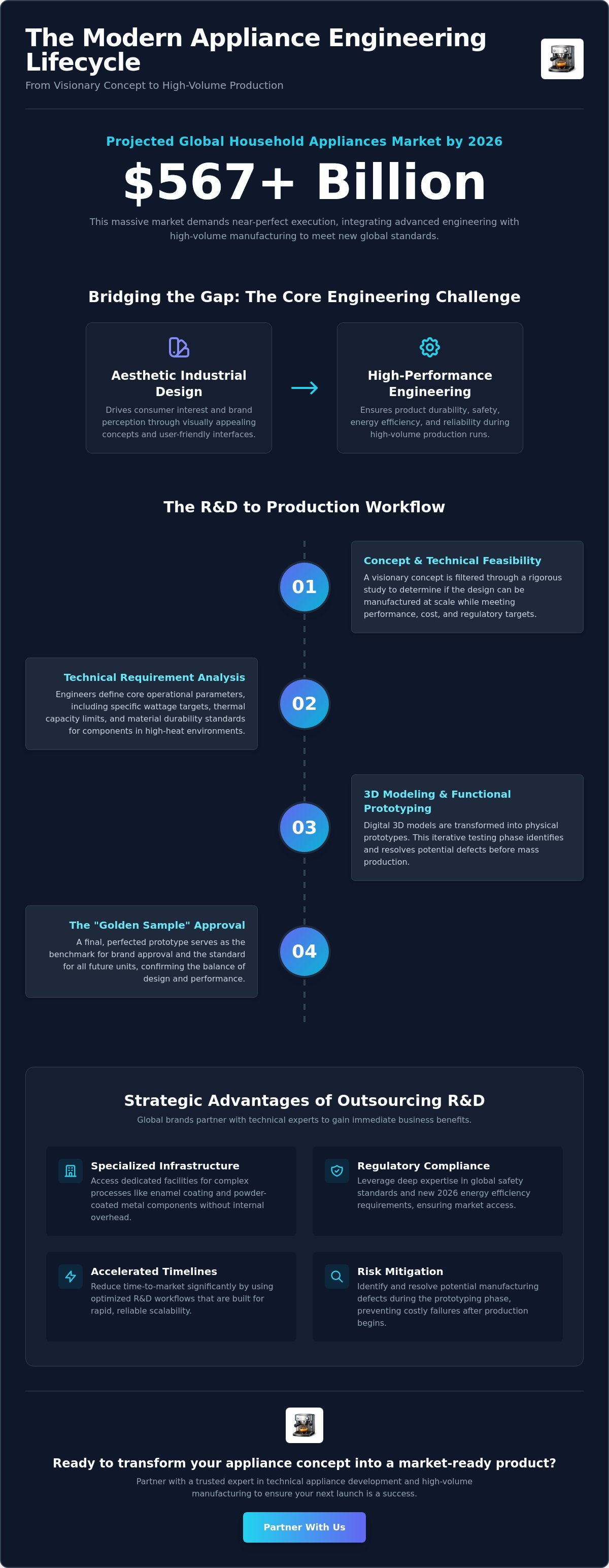
Global brands often outsource their R&D to specialized partners to access advanced production capabilities that are difficult to build in-house. This strategic move provides several immediate business benefits:
Specialized Infrastructure: Access to dedicated facilities for enamel-coated products and powder-coated metal components.
Regulatory Compliance: Leveraging manufacturer expertise in global safety standards and the latest 2026 energy efficiency requirements.
Accelerated Timelines: Reducing time-to-market through established R&D workflows that have been optimized for rapid scalability.
Risk Mitigation: Identifying potential manufacturing defects during the prototyping phase rather than after high-volume production begins.
Outsourcing technical development allows your brand to focus on marketing and distribution while the technical backbone remains stable. By leveraging a partner's existing R&D infrastructure, you can introduce innovative features like AI-integrated ecosystems or predictive maintenance alerts without the overhead of building a massive engineering department from scratch. This collaborative model ensures that your products are not just "smart-capable" but are engineered for peak performance and durability in a competitive market.
The Engineering Lifecycle: From Concept to Prototyping
Every successful appliance begins with a rigorous technical feasibility study. This phase acts as the filter between a visionary concept and a manufacturable product. It's where you determine if a design can actually survive the heat of a kitchen or the rigors of high-volume production. Bridging the gap between industrial design and mechanical engineering is often the most challenging part of the process. While aesthetics drive consumer interest, technical performance ensures the product doesn't fail in the field. Effective technical appliance development requires an iterative testing approach to identify and resolve potential manufacturing defects before they become costly liabilities. For designers working on curved enclosures or lightweight structural prototypes, experts like GM ORFIN provide the flexible and ultralight plywood necessary to realize these complex industrial forms.
Transitioning from a digital 3D model to a functional "golden sample" is the ultimate goal of this lifecycle. This physical prototype serves as the benchmark for brand approval and the standard for all future units. It proves that the engineering team has successfully balanced visual appeal with the internal components needed for peak performance. A methodical progression through these stages ensures that the final product is not only beautiful but also durable and compliant with global safety standards.
Step 1: Technical Requirement Analysis
The engineering team starts by defining the core operational parameters. This includes setting specific wattage targets, thermal capacity limits, and material durability standards. For products like roaster ovens or air fryers, engineers must account for Appliance Efficiency Regulations to ensure the product remains competitive and legal in key markets. During this stage, we identify the need for specialized finishes like enamel or powder-coated metal components. Establishing a precise bill of materials (BOM) at this point is essential for cost-effective scaling and supply chain stability.
Step 2: Prototyping and Thermal Testing
Design meets data during the prototyping phase. We use advanced CAD software and R&D simulations to predict heat distribution patterns within roaster ovens and portable cooking equipment. These simulations allow engineers to adjust heating element placement before a single piece of metal is cut. Once physical prototypes are built, they undergo extreme stress-testing. This includes continuous operation cycles and high-heat exposure to verify the longevity of electrical components in coffee machines and kettles. If you're looking to refine your next product's performance, our team at oemhomeappliances.com can help navigate these complex engineering requirements.
Step 3: Tooling and Pilot Production
The final step in the lifecycle involves developing custom molds and dies for high-volume metal stamping. This is where the assembly line process is refined for maximum efficiency. We run pilot production batches to test the tooling and finalize quality control (QC) benchmarks. This ensures that every unit coming off the line matches the "golden sample" in both performance and finish. By the time full-scale manufacturing begins, the technical foundation is solid, reducing the risk of defects and ensuring a smooth market launch.
Case Study: Engineering Thermal Efficiency in Roaster Ovens
In a recent technical development project for a high-capacity roaster oven, the primary engineering challenge centered on heat uniformity. Large cooking surfaces often suffer from inconsistent thermal zones, leading to uneven results for the end user. Achieving uniform heat distribution across a large enamel-coated surface requires more than just high wattage. It demands a sophisticated understanding of thermal bridging and convection currents. This project highlights why technical appliance development must prioritize the synergy between internal component layout and external material properties.
The engineering team addressed this by designing a custom heating element placement that compensated for natural heat loss at the oven's perimeter. We paired this with specialized, high-density insulation to minimize thermal leakage. These refinements resulted in a 15% reduction in energy consumption compared to earlier benchmarks, all while maintaining professional-grade roasting performance. This balance of efficiency and power is a direct result of a methodical R&D process that treats thermal dynamics as a core design pillar.
Optimizing Enamel-Coated Components
Enamel coating is essential for heat retention and easy cleaning, but it presents unique technical challenges during the manufacturing phase. Applying enamel to complex metal geometries requires precision to avoid pooling or thin spots that can lead to premature wear. We solve this by integrating industrial enamel coating services into the core design phase. This ensures that the metal substrate is engineered specifically to accept the coating evenly. The result is a durable, high-performance finish that withstands the extreme thermal cycling typical of roaster ovens and BBQ grills.
Scalability and Quality Control
Maintaining consistency across a 10,000-unit production run is where many development projects fail. To prevent this, our team implements automated sensor testing directly on the assembly line. Every roaster oven undergoes a rapid thermal cycle test to verify that the heating elements and thermostats perform within a tight tolerance. This data-driven approach creates a feedback loop that allows for real-time adjustments to the assembly process. It's not enough to build one perfect prototype; the goal is to ensure the 10,000th unit delivers the same precision as the first. This focus on scalable quality control is what defines a successful technical appliance development partnership.
By identifying potential thermal bottlenecks early, we reduce the risk of manufacturing defects and ensure the final product meets all safety certifications. This methodical transition from R&D to full-scale production provides brands with the stability they need to expand their product lines with confidence. We act as the technical backbone, allowing you to focus on market growth while we handle the complexities of thermal engineering and material science.
Critical Success Factors in Appliance Material Science
Material choice is the bedrock of technical appliance development. In the high-heat environments of BBQ grills and air fryers, standard materials fail quickly. Engineers must select alloys and coatings that maintain structural integrity at temperatures exceeding 400°F. Corrosion resistance is equally vital, often requiring the high-grade industrial finishes found at alsharq-bro.com. Advanced powder coating and enamel finishes protect internal and external components from moisture and chemical degradation. Every component must also comply with strict food-grade safety standards to ensure no harmful substances migrate during the cooking process. Selecting the wrong grade of stainless steel or an unverified coating can lead to catastrophic field failures and significant brand damage.
Stability in high-volume production depends on these material foundations. If the raw materials aren't consistent, the final product won't be either. We prioritize materials that offer a predictable response to thermal stress, ensuring that the precision established in the prototyping phase carries through to the 10,000th unit. This methodical approach to material science is what separates a reliable household device from a product prone to early failure.
Industrial Enamel and Powder Coating
Powder-coated appliance parts offer a significant durability advantage over traditional liquid paint. The electrostatic application process creates a thicker, more uniform layer that's far more resistant to scratching and impact. High-end cookware brands often insist on enamel-coated metal components because of their superior thermal properties and non-porous surface. We subject these coated surfaces to rigorous testing for chip resistance and thermal shock. This ensures the finish won't crack or peel when moving from high heat to room temperature. This level of scrutiny prevents the manufacturing defects that often occur when shortcuts are taken during the curing process.
Metal Component Precision
Achieving airtight seals in appliances like air fryers and roaster ovens depends on high-tolerance metal stamping. Even a millimeter of deviation can lead to heat loss and reduced efficiency. Custom metal components for blenders and coffee machines require a delicate balance of weight, cost, and structural integrity. For portable cooking equipment, we optimize the gauge of the metal to ensure it's light enough for transport but strong enough to withstand daily use. Precision engineering at this level ensures every component fits perfectly within the assembly, maintaining the thermal performance established during the R&D phase.
If you need a partner that understands the intersection of material science and production, consult with our engineering team at oemhomeappliances.com to secure your product's technical future.
Partnering for Scalable Appliance R&D and Manufacturing
Choosing a manufacturing partner is a strategic decision that determines your brand's long-term stability. oemhomeappliances acts as the technical backbone for global kitchen brands, providing the industrial strength required for high-volume production. By handling both design and manufacturing under one roof, we eliminate the communication gaps that often lead to delays. This integrated approach ensures that the precision established during technical appliance development remains intact as you move toward private label market entry. Reliable supply chain logistics further protect your reputation, ensuring that inventory meets demand without compromising on quality.
Success in a competitive market requires more than just a functional product. It requires a partner that understands the nuances of global distribution and regulatory compliance. We provide the expertise needed to navigate these complexities, allowing you to focus on marketing and brand growth. Our role as a facilitator ensures that your product line is built on a foundation of engineering excellence and operational efficiency.
Customized OEM/ODM Solutions
Every brand has unique identity requirements. We tailor the development workflow to match your specific aesthetic and performance goals. Whether you're launching a niche product or a mass-market appliance, our production scales remain flexible. For brands entering the smart home space, we provide continuous firmware and software support for smart kitchen devices. This ensures your products remain compatible with evolving AI-integrated ecosystems and cross-brand interoperability protocols. Our goal is to empower your brand with a product that is both innovative and technically sound.
Starting Your Development Journey
Initiating a technical consultation is the first step toward building a successful appliance line. We provide a clear roadmap that guides you from initial R&D through to global distribution. This methodical progression minimizes risk and maximizes market impact. You don't need to manage multiple vendors or navigate complex engineering hurdles alone. Our team provides the stability and expertise required to scale your vision effectively.
Contact oemhomeappliances to explore our kitchen appliance R&D services and discover how we can facilitate your next major product launch. Let's build a product that defines the next generation of technical appliance development.
Engineering Your Brand's Future in the Appliance Market
Mastering technical appliance development requires a disciplined fusion of engineering precision and material science. You've seen how iterative prototyping and thermal efficiency studies transform a basic kitchen concept into a high-performance market leader. Success in 2026 hinges on your ability to meet strict energy standards while maintaining the aesthetic appeal consumers demand. A methodical approach to R&D ensures that your product line is built for longevity and scalability.
We provide the industrial backbone your brand needs to scale with confidence. Our specialized enamel and powder coating facilities ensure superior finishes, while our high-volume production capacity supports the demands of global brands. You gain direct access to an expert R&D team that specializes in custom kitchenware and complex thermal engineering. This combination ensures your products are durable, compliant, and ready for rapid market entry.
Don't leave your manufacturing success to chance. Partner with an expert facilitator who manages the complexities of the production lifecycle from start to finish. Explore our Technical Appliance Development Solutions today. We look forward to powering your brand's next innovation.
Frequently Asked Questions
What is the typical timeline for technical appliance development?
Timelines for a complete project generally range from six to twelve months depending on the complexity of the device. This window covers the initial technical feasibility study, iterative prototyping, and the final pilot production run. Projects involving custom metal stamping or advanced sensors may require additional time for tooling calibration. We prioritize a methodical pace to ensure every unit meets your brand's durability and performance standards before full-scale manufacturing begins.
How do you ensure the safety and compliance of new kitchen appliances?
We ensure compliance by integrating regional safety standards and the 2026 U.S. federal energy efficiency requirements into the initial design phase. Our team conducts rigorous stress testing, including continuous operation cycles and thermal shock verification for enamel-coated parts. Every component undergoes food-grade safety audits to ensure no migration of harmful substances occurs during high-heat use. This data-driven approach minimizes the risk of manufacturing defects and regulatory hurdles during global distribution.
Can you develop custom metal components for existing appliance designs?
We provide specialized engineering for custom metal components, including high-tolerance stamping and advanced coating services. This includes producing powder-coated metal parts or durable enamel surfaces tailored to your existing product specifications. Our facility handles everything from initial CAD modeling to the production of high-volume metal components. We focus on balancing structural integrity with cost-effective manufacturing, ensuring each part integrates seamlessly with your current appliance designs and assembly lines.
What is the difference between OEM and ODM in appliance development?
OEM involves manufacturing based on your unique designs, while ODM uses our pre-engineered templates to accelerate market entry. Technical appliance development for OEM projects is a bespoke process that allows for complete control over thermal capacity, material selection, and aesthetic finishes. This path is ideal for brands looking to differentiate themselves with proprietary features. ODM solutions offer a faster, more standardized approach for brands that need reliable, market-ready products with minimal R&D overhead.
Why is enamel coating preferred for high-heat cooking equipment?
Enamel is the preferred choice for high-heat equipment because it offers exceptional thermal retention and a non-porous, chemically resistant surface. It withstands the extreme thermal cycling common in roaster ovens and BBQ grills without the risk of chipping or peeling associated with standard paints. This material is also inherently food-safe and easy to clean, making it a premium standard for high-performance kitchenware. We utilize specialized facilities to ensure uniform enamel application across complex metal geometries.
Do you provide prototyping services before mass production?
We provide comprehensive prototyping services to create a "golden sample" before full-scale manufacturing begins. This phase allows you to physically verify the appliance's thermal performance, UI functionality, and material durability in a real-world setting. Prototyping is a critical step in the technical appliance development lifecycle because it identifies potential engineering bottlenecks early. By resolving these issues during the R&D stage, we prevent costly assembly line delays and ensure consistent quality across the entire production run.
How does technical development impact the final retail price of an appliance?
Precise technical appliance development lowers the final retail price by optimizing the bill of materials and reducing manufacturing waste. By engineering for high-volume efficiency, we minimize the manual labor required during assembly and lower the probability of post-market warranty claims. A well-engineered product uses materials more effectively and integrates components that are easier to source and scale. This strategic focus on R&D ensures your product remains competitive in the market while delivering high performance.
What types of appliances are currently in high demand for private label development?
High demand is currently focused on air fryers, roaster ovens, and energy-efficient coffee machines that integrate smart sensor technology. Brands are also prioritizing portable cooking equipment and kettles that comply with the latest 2026 energy regulations. We assist partners in developing these high-demand products by providing the technical depth and industrial scale necessary for a successful launch. Our R&D team stays ahead of market trends to ensure your private label offerings are both modern and technically superior.


Comments