The 2026 Guide to the OEM Appliance Manufacturing Process for Global Brands
By the end of 2026, over 90% of home energy use will be influenced by appliances governed by increasingly rigorous federal efficiency standards. For global brands, staying ahead requires more than just a sleek design; it demands a flawlessly executed OEM appliance manufacturing process. You've likely faced the frustration of unpredictable lead times during R&D or seen how inconsistent metal finishing can compromise a premium roaster oven's market appeal. These technical hurdles don't just delay launches. They threaten your brand's reputation in a year where the new UL 1026 standards, published in June 2026, demand absolute precision.
We recognize that scaling from a single prototype to thousands of high-performance units requires a partner who acts as a reliable, expert facilitator. This guide provides a clear roadmap to navigate the journey from initial product development to global mass production. You'll learn how to maintain strict brand standards at scale while identifying the key technical milestones that ensure your air fryers, blenders, and coffee machines meet elite performance criteria. We'll examine how smart manufacturing and digital twins are transforming production into a synchronized, high-efficiency operation.
Key Takeaways
Understand the strategic distinctions between OEM and ODM models to select the most efficient path for your brand’s global expansion.
Master the OEM appliance manufacturing process by aligning Technical Requirement Documents (TRD) with rigorous Design for Manufacturing (DFM) analysis.
Discover why advanced metal finishing and industrial enamel coating are essential for maintaining premium quality in high-heat appliances like roaster ovens and grills.
Learn how to implement synchronized assembly lines and real-time monitoring to ensure compliance with the latest 2026 regulatory standards.
Identify the benefits of a "Private Label First" manufacturing philosophy for scaling production while maintaining strict brand consistency.
Table of Contents
Understanding the Strategic Lifecycle of the OEM Appliance Manufacturing Process
Phase 1: Research, Development, and Prototyping Kitchen Appliances
Phase 2: Precision Fabrication and Advanced Metal Finishing Techniques
Phase 3: Mass Assembly, Quality Assurance, and Regulatory Compliance
Optimizing Your Supply Chain with a Dedicated OEM Manufacturing Partner
Understanding the Strategic Lifecycle of the OEM Appliance Manufacturing Process
The OEM appliance manufacturing process is a comprehensive lifecycle that manages every variable from the initial concept to the final shipping container. It isn't merely about assembly. It's a synchronized workflow designed to protect brand integrity while maximizing output. Most global leaders prefer the Original Equipment Manufacturer (OEM) model because it grants them full control over product specifications and intellectual property. Unlike the ODM model, where you buy a factory's existing design, the OEM path allows you to dictate every detail of a coffee machine or blender. This control is the foundation of long-term SKU stability. When you own the design, you ensure that the internal components don't change unexpectedly between production batches. A dedicated manufacturing partner serves as your silent industrial engine. They provide the scale and technical expertise needed to expand your product line without the overhead of owning a factory.
The Shift from Component Sourcing to Integrated Solutions
Procurement strategies have evolved. Brands no longer want to manage a dozen different suppliers for a single rice cooker. The industry has shifted toward integrated solutions where a single partner handles full-unit assembly. This centralization is essential for high-performance appliances like air fryers or kettles. It reduces supply chain friction and ensures that mechanical parts, electronics, and aesthetic finishes work together perfectly. By consolidating production, you gain significant speed-to-market advantages. This is especially valuable for seasonal launches, such as bringing a new line of BBQ grills or portable cooking equipment to market before a peak sales window. Integrated manufacturing means fewer delays and a more resilient supply chain.
Key Stakeholders in the Production Workflow
Precision in the OEM appliance manufacturing process requires tight collaboration between several key groups. The primary synergy exists between your brand's product managers and the factory’s R&D engineers. They work together to translate market needs into technical realities. Third-party auditors are also essential. They act as independent eyes on the factory floor to validate that every process meets international safety standards and your specific quality benchmarks. Finally, clear communication protocols are vital to prevent specification drift. During multi-year production runs, it's easy for small details to change if not monitored. We use documented checkpoints to ensure every unit remains faithful to the original approved prototype. This methodical approach guarantees that your customers receive the quality they expect every time they purchase your brand.
Phase 1: Research, Development, and Prototyping Kitchen Appliances
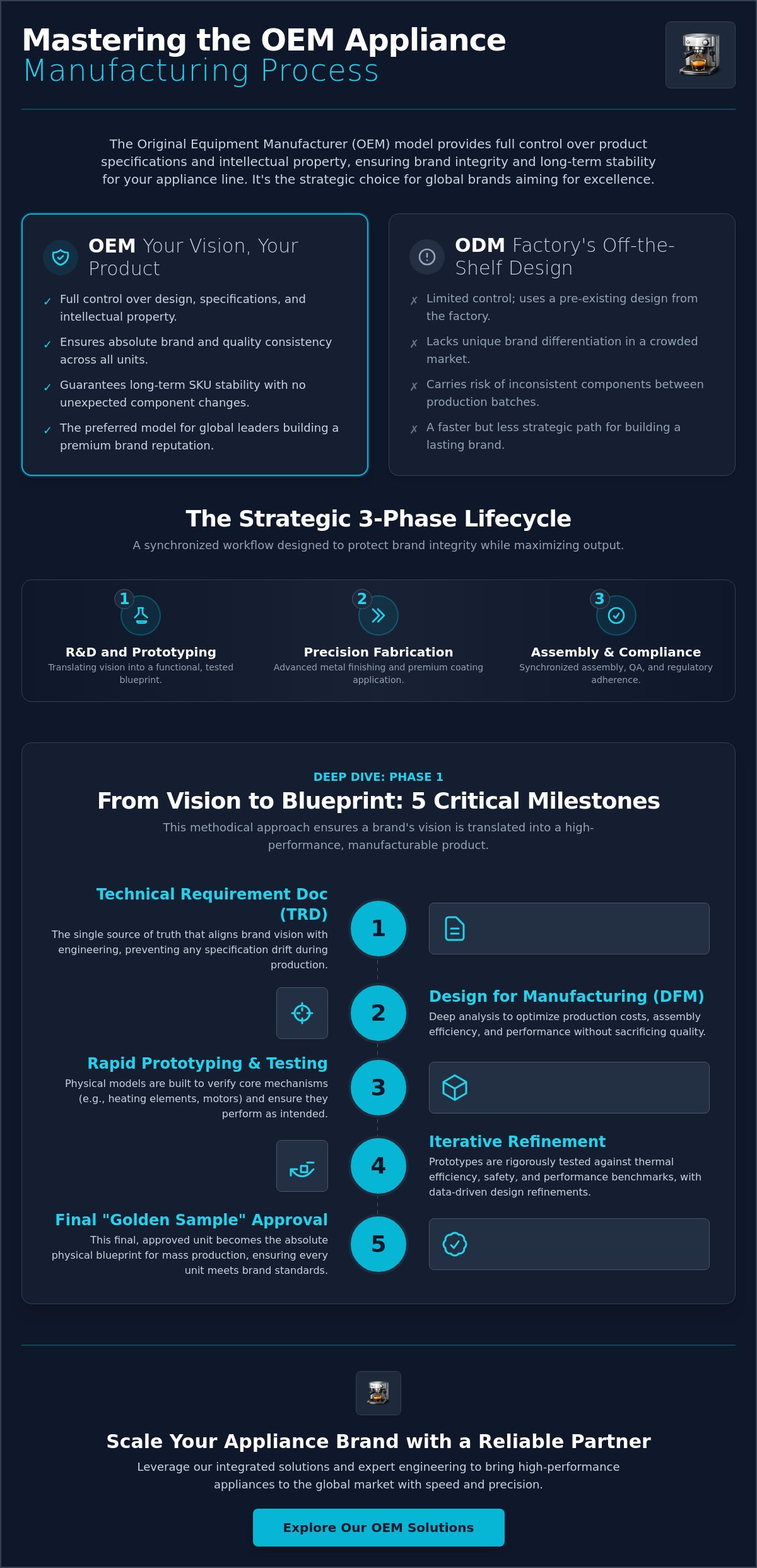
The foundation of a successful OEM appliance manufacturing process begins long before the first unit rolls off the line. It requires a methodical approach to translate a brand's vision into a high-performance product. This phase is defined by five critical milestones:
Step 1: Technical Requirement Document (TRD) alignment. This document serves as the single source of truth between your brand and our engineering team, preventing specification drift.
Step 2: Design for Manufacturing (DFM) analysis. We analyze the product to optimize production costs and performance without sacrificing quality.
Step 3: Rapid prototyping and functional testing. We build physical models to verify core cooking mechanisms, ensuring they perform as intended.
Step 4: Iterative refinement. We test prototypes against thermal efficiency and safety benchmarks, refining the design based on data.
Step 5: Final Golden Sample approval. This unit becomes the absolute blueprint for mass production, ensuring every unit meets your standards.
To successfully strategize for the new manufacturing era, brands must prioritize this rigorous R&D phase. Skipping these steps often leads to quality inconsistencies or unpredictable lead times during the transition to mass production. This iterative refinement is a cornerstone of the modern OEM appliance manufacturing process, ensuring your brand stays competitive and compliant with 2026 standards.
Engineering for Thermal Performance
Precision engineering is non-negotiable when designing heating elements for roaster ovens and kettles. We ensure these components meet specific wattage standards while maintaining long-term durability. For air fryer prototypes, we focus heavily on balancing airflow dynamics. Even a slight variation in fan placement can lead to inconsistent cooking results across the basket. We also prioritize material selection, choosing specialized alloys that can withstand repetitive thermal cycling without warping or degrading.
The Role of R&D in Private Label Differentiation
Effective R&D allows you to customize aesthetics without compromising the internal mechanical integrity of the appliance. You can introduce unique color palettes or ergonomic handles while relying on a proven, high-performance engine inside. We also help brands integrate smart features and digital interfaces into traditional designs, such as touchscreens for coffee machines or Wi-Fi connectivity for grills. Technical Appliance Development is the bridge between concept and reality. If you're looking to start a new project, our team can assist with product design & development to ensure your vision is manufacturing-ready.
Phase 2: Precision Fabrication and Advanced Metal Finishing Techniques
Once the Golden Sample is approved, the OEM appliance manufacturing process moves from the lab to the factory floor. This phase is where raw metal is transformed into the durable, high-performance chassis required for appliances like rice cookers and BBQ grills. We use high-tonnage hydraulic presses for metal stamping and forming. This ensures structural integrity and dimensional accuracy across thousands of units. For internal components or specialized parts that require tighter tolerances, precision CNC machining provides the exact specifications needed for mechanical assemblies. This stage is critical. Any deviation in the base frame can lead to alignment issues during final assembly.
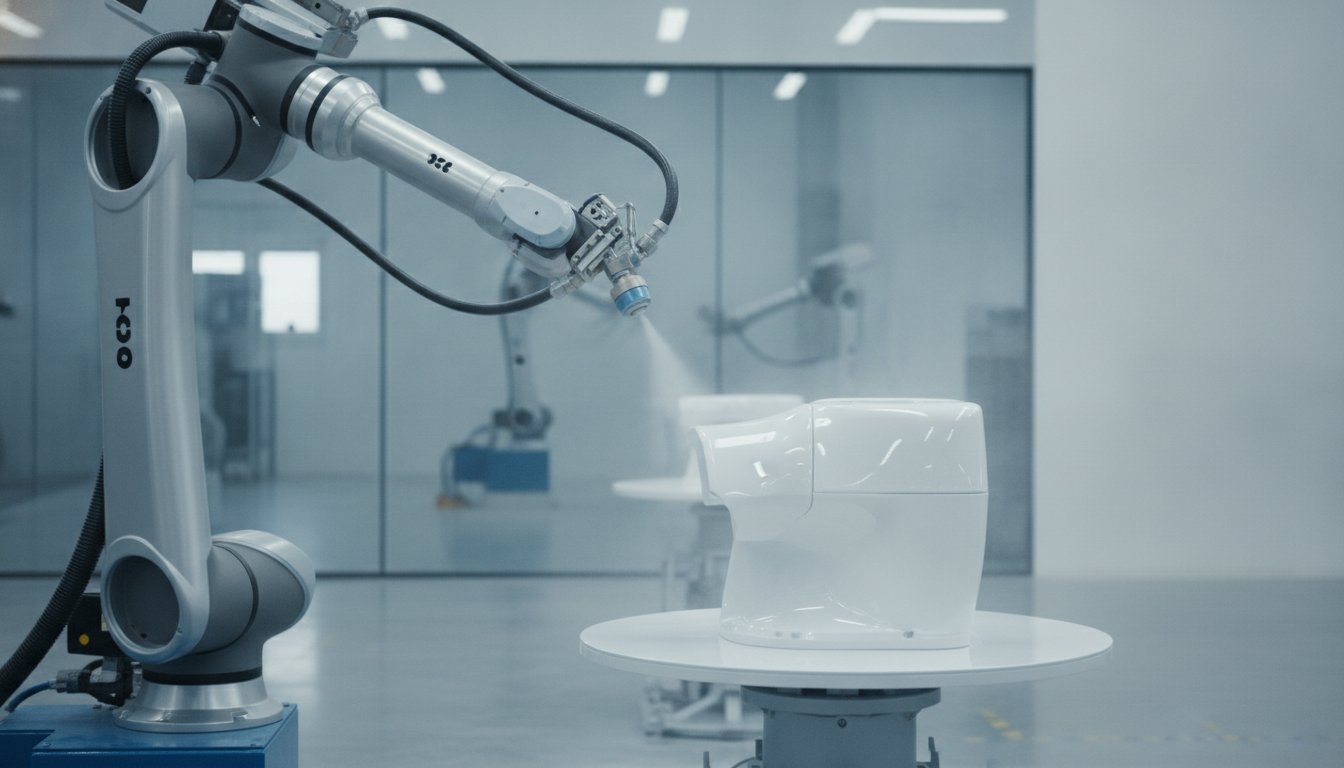
Finishing is more than an aesthetic choice. It is a functional requirement for longevity and safety. While some manufacturers rely solely on basic forging, a process-first approach incorporates advanced coatings to protect the substrate. Industrial enamel coating remains the gold standard for high-heat cookware and roaster ovens. It provides a non-porous, chemically resistant surface that doesn't leach or degrade under extreme temperatures. For external housings, powder coating offers superior impact resistance and color consistency. This combination of precision fabrication and specialized finishing ensures that your products don't just look premium but also withstand years of heavy use.
The Industrial Enamel Coating Process
Successful enamel application starts with meticulous surface preparation. We use chemical etching and sandblasting to remove impurities and create a specific profile for optimal adhesion. Depending on the appliance geometry, we utilize either wet or dry application techniques. Wet coating is often preferred for complex shapes, while dry electrostatic application provides high efficiency for flatter surfaces. The final step is firing and vitrification. We subject the coated metal to extreme heat, creating a permanent glass-to-metal bond. This process is what gives high-heat appliances their signature durability. You can explore our industrial enamel coating services for deeper technical specifications on these high-heat applications.
Durability Standards for Powder Coated Components
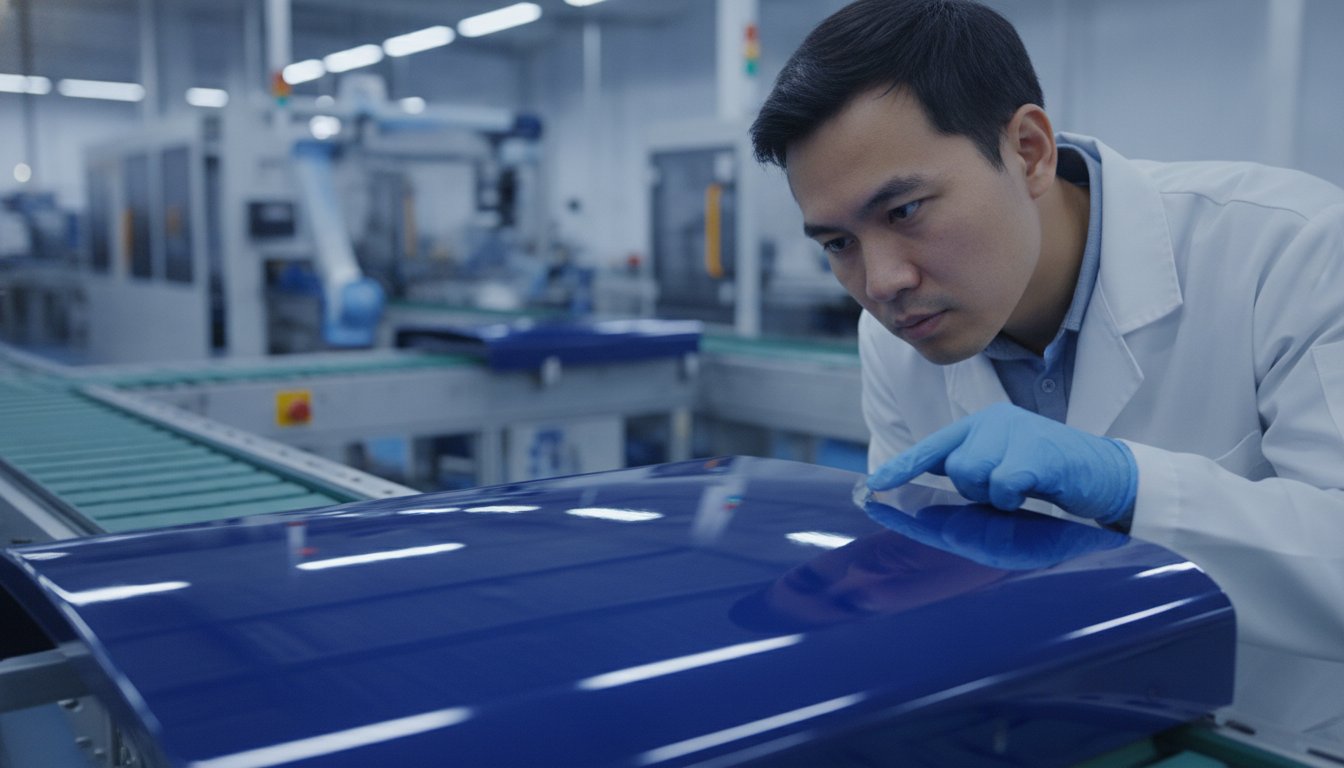
Consistency is the hallmark of a professional manufacturing partner. We maintain uniform powder thickness to ensure your brand colors remain identical across every production batch. This precision prevents the "patchwork" effect often seen in lower-quality manufacturing. To guarantee performance, we subject portable cooking equipment and grills to rigorous salt spray and UV resistance testing. These protocols help your products meet the high standards expected by the Association of Home Appliance Manufacturers (AHAM). By prioritizing these durability benchmarks, we protect your brand from the quality inconsistencies that plague unspecialized factories.
Phase 3: Mass Assembly, Quality Assurance, and Regulatory Compliance
Moving from the fabrication of individual components to mass assembly requires a high degree of synchronization. Electrical, mechanical, and aesthetic parts must flow together without bottlenecking. This stage is the most visible part of the OEM appliance manufacturing process. It's where the chassis, heating elements, and digital interfaces are integrated into a finished product. We manage these lines with precision to ensure that every air fryer or coffee machine meets the specific performance standards established in Phase 1. A single delay in the supply of internal sensors can stall an entire run, so we prioritize a methodical flow of materials.
Quality control isn't a final step; it's an ongoing requirement. Our assembly lines feature real-time monitoring of heating element resistance and sensor accuracy. If a component falls outside the narrow tolerance range, it's flagged immediately. This prevents defective units from reaching the final stages of production. Every unit undergoes final functional testing to confirm it meets the "out-of-box" performance promise. We verify that thermostats click at the right temperature and that fans circulate air at the correct RPM. This level of scrutiny is what separates premium manufacturing from generic assembly.
Navigating global safety certifications is essential for market entry. We ensure compliance with UL, CE, and RoHS standards. Specifically, for cooking appliances, we adhere to the 6th edition of the UL 1026 standard, which was updated and ANSI-approved on June 9, 2026. This standard covers household electric cooking and food serving appliances rated at 250V or less. Meeting these rigorous benchmarks is the only way to ensure your products are legally and safely sold in major international markets. We handle the technical documentation required to prove this compliance to retailers and regulators alike.
Rigorous Quality Assurance Protocols
We implement pre-shipment inspections (PSI) using Acceptable Quality Level (AQL) sampling methods. This statistical approach ensures that the entire batch meets your quality threshold before it leaves the factory. Beyond standard checks, we perform stress testing by simulating years of use in high-temperature environments. Quality standards in global production are non-negotiable for brand reputation. If you need a partner that prioritizes these standards, we offer comprehensive private label manufacturing services.
Packaging and Logistics for Global Distribution
Engineering protective packaging is as important as the appliance itself. We design drop-test certified packaging to withstand the rigors of e-commerce and retail shipping. Our logistics team manages bulk container loading to minimize transit damage for large appliances like roaster ovens. We also handle the documentation and compliance paperwork required for seamless customs clearance. This ensures your inventory moves from the factory to your warehouse without unnecessary administrative delays.
Optimizing Your Supply Chain with a Dedicated OEM Manufacturing Partner
Selecting the right manufacturing partner is a strategic decision that determines your brand’s long-term stability. Established global brands increasingly move away from generalist factories in favor of specialized partners. A generalist might handle basic assembly, but they often lack the deep technical expertise required for complex thermal management or advanced metal finishing. By contrast, a specialized partner understands the nuances of the OEM appliance manufacturing process for high-performance goods. This expertise ensures that your rice cookers, air fryers, and coffee machines perform consistently across every market. Specialized partners provide the technical backbone that allows you to focus on marketing and distribution while they handle the complexities of the factory floor.
Adopting a "Private Label First" manufacturing philosophy means your brand is the priority, not an afterthought. In this model, every stage of production is tailored to meet your specific brand standards and aesthetic requirements. This approach is essential for maintaining a premium market position. It also simplifies scalability. A dedicated partner helps you transition seamlessly from mid-volume market trials to high-capacity mass production. They possess the infrastructure to absorb increased demand without compromising quality or extending lead times. As global supply chain risks evolve, the location and industrial strength of your partner become vital. Reliable infrastructure and regionalized supply chains help mitigate disruptions, ensuring your inventory remains stocked even during periods of global volatility.
Selecting a Reliable OEM Appliance Supplier
When evaluating potential suppliers, look beyond the price per unit. Evaluate their factory R&D capabilities and their specific expertise in metal finishing. For example, a partner with a proven track record in specialized roaster oven manufacturing will have the equipment and knowledge to handle high-heat applications that other factories might struggle with. This is where oemhomeappliances (Keiteq) excels. We facilitate brand growth through technical excellence and a meticulous focus on precision. Our facility is designed to act as an extension of your own team, providing the quiet authority and industrial strength needed to empower your product line. We don't just manufacture; we provide the engineering solutions that make your brand a market leader.
Next Steps: Initiating Your Production Program
Starting a new production run requires a methodical approach to ensure alignment. We recommend structuring your Initial Inquiry with a clear Technical Requirement Document (TRD) that outlines your performance expectations and aesthetic goals. This clarity prevents delays and ensures a smoother transition through the R&D phase. The timeline from your first contact to the first shipment typically involves design finalization, prototyping, and rigorous safety testing. We manage this schedule with transparency to keep your launch on track. If you're ready to secure your supply chain for the coming year, contact oemhomeappliances to discuss your 2026 product roadmap. We are ready to help you master the OEM appliance manufacturing process and bring your next high-performance kitchen appliance to the global stage.
Scaling Your Global Appliance Strategy in 2026
The OEM appliance manufacturing process is a multi-stage journey that requires more than just assembly lines; it demands a partner capable of bridging the gap between initial R&D and global distribution. You've seen how technical requirement alignment and precision fabrication prevent the quality inconsistencies that often stall brand growth. By prioritizing integrated solutions and advanced metal finishing, your brand can stay ahead of regulatory shifts and market volatility. These strategic choices ensure your products don't just enter the market but lead it.
Mastering these production milestones is the only way to maintain brand integrity at scale. We offer dedicated R&D and prototyping solutions alongside specialized expertise in enamel and powder-coated metal components. Our facility is equipped for high-capacity roaster oven and air fryer production, acting as a reliable engine for your expansion. We focus on the technical details so you can focus on your customers.
Ready to secure your supply chain? Partner with a specialized OEM manufacturer for your next appliance line to ensure your products meet the highest industrial standards. We're ready to help you navigate the future of manufacturing with confidence and precision.
Frequently Asked Questions
What is the typical lead time for the OEM appliance manufacturing process?
Lead times for the OEM appliance manufacturing process typically range from 12 to 24 weeks for new product developments. This timeline accounts for technical alignment, prototyping, and rigorous safety certification testing. Repeat orders for established SKUs are significantly faster, often shipping within 30 to 45 days depending on component availability and current production scheduling. We provide a detailed project timeline during the initial consultation to help you plan your market launch with precision.
How do you ensure consistent quality in mass-produced kitchen appliances?
We maintain consistency through a combination of real-time in-line monitoring and statistical pre-shipment inspections. Automated sensors check heating element resistance and thermostat accuracy directly on the assembly line. Every batch is then subjected to AQL (Acceptable Quality Level) sampling to verify that the units meet your brand's performance standards before leaving the factory. This methodical approach identifies potential defects before they can reach your customers, protecting your brand reputation.
Can I customize the design of an existing OEM appliance model?
You can fully customize both the aesthetics and the functional components of an appliance. The OEM model allows brands to dictate specific materials, color palettes, and digital interfaces while utilizing our proven mechanical engines. This ensures your product stands out in the market without the need to engineer a new heating system from scratch. We help you balance these customizations with manufacturing efficiency to keep your production costs competitive.
What safety certifications are required for small kitchen appliances in 2026?
In 2026, small kitchen appliances must comply with the 6th edition of the UL 1026 standard, which was ANSI-approved on June 9, 2026. This standard is mandatory for appliances rated at 250V or less. Additionally, products must meet CE and RoHS requirements for international distribution, alongside the latest energy efficiency benchmarks. We handle the technical documentation and testing protocols required to prove this compliance to global retailers and regulators.
What is the difference between OEM and ODM in the appliance industry?
The primary difference lies in design ownership and intellectual property. In the OEM model, the brand provides the design and retains all IP rights, allowing for total control over the product's specifications. In the ODM model, the manufacturer designs the product and the brand simply adds its labeling. Most global brands choose the OEM path to ensure long-term SKU stability and to create unique products that aren't available to competitors.
How does enamel coating differ from standard powder coating in manufacturing?
Enamel coating is a vitrified glass-to-metal bond designed specifically for high-heat environments like roaster ovens and BBQ grills. It is chemically resistant and won't leach or degrade under extreme temperatures. Standard powder coating is a resin-based finish used for external housings. It provides superior impact resistance and uniform color but isn't suitable for direct food-contact or surfaces exposed to the intense heat of a cooking element.
What are the MOQs (Minimum Order Quantities) for private label appliances?
Minimum Order Quantities generally start at 500 to 1,000 units per SKU, depending on the complexity of the OEM appliance manufacturing process. These thresholds ensure that production remains cost-effective while allowing us to maintain high quality standards. For specialized designs or complex electronic components, MOQs may be adjusted based on the specific requirements of our component suppliers. We work with you to find a volume that supports your growth strategy.
How do you handle intellectual property (IP) during the R&D process?
We protect your intellectual property through legally binding Non-Disclosure Agreements (NDAs) and secure data management protocols. All design files and technical requirements are stored in encrypted systems accessible only to the specific R&D teams assigned to your project. This ensures that your proprietary designs, smart features, and unique mechanical improvements remain exclusive to your brand throughout the entire development and production lifecycle.

Comments