The Strategic Guide to Partnering with a Private Label Blender Manufacturer in 2026
A high-performance appliance brand is only as strong as its weakest internal component. If your current supply chain suffers from inconsistent quality or a lack of R&D support, you aren't just losing time; you're losing market share. Finding a private label blender manufacturer that understands the balance between industrial durability and bespoke design is the only way to scale in 2026. Many procurement officers struggle with communication barriers and technical gaps that stall innovation. You deserve a partner that acts as a dependable backbone for your growth.
This guide helps you identify and evaluate a professional manufacturing partner capable of building an elite appliance brand. We'll cover everything from assessing technical R&D capabilities to ensuring your products meet rigorous global safety standards. You'll learn how to bridge the gap between initial prototyping and final delivery without the typical supply chain delays. By the end, you'll have a clear roadmap for streamlining production and scaling your appliance line with confidence and precision.
Table of Contents
Understanding the Private Label Blender Manufacturing Landscape
Private label manufacturing is a strategic partnership where a brand hires a factory to produce goods under the brand's own identity. It is more than simple rebranding; it is an engineering collaboration. Understanding the Private Label Model reveals how this allows companies to control product specifications without owning the physical production facility. For any business looking to launch a high-performance appliance line, choosing the right private label blender manufacturer is the first step toward long-term market stability.
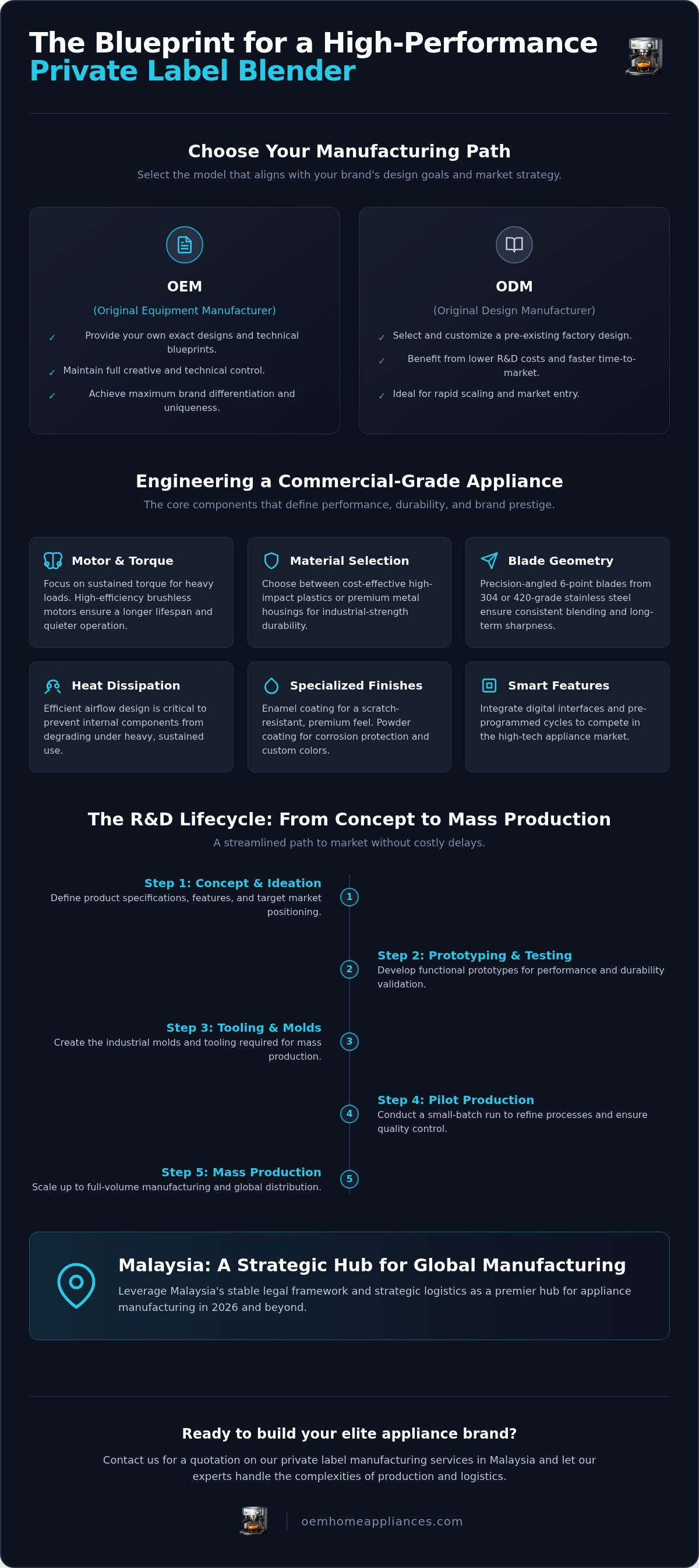
Brands typically choose between two primary models: Original Equipment Manufacturer (OEM) and Original Design Manufacturer (ODM). In an OEM arrangement, the brand provides the exact designs and technical blueprints. The manufacturer acts as the production engine. Conversely, the ODM model involves selecting a factory's pre-existing design and applying customizations. Both paths reduce capital expenditure significantly. They allow brands to bypass the massive costs associated with building industrial facilities and hiring large-scale labor forces.
The Shift from Generic to Bespoke Private Labeling
Generic appliances don't win in 2026. Consumers now demand specialized features that solve specific culinary problems. Modern branding requires moving beyond basic logo placement. Successful brands customize motor torque for commercial endurance or adjust blade configurations for specific textures. Differentiation often comes from the exterior as well. Utilizing specialized finishes like enamel or powder-coated metal components provides a premium feel that plastic competitors cannot match. These bespoke touches turn a standard kitchen tool into a luxury brand asset.
Why Brands Choose Contract Manufacturing
Contract manufacturing lets your company focus on what it does best: marketing and distribution. While you build the brand's presence, technical experts handle the complexities of production and logistics. This model mitigates manufacturing risks by utilizing established quality control protocols already in place at the factory level. It also offers unparalleled scalability. A dedicated partner can support your growth from initial small-batch testing to high-volume global distribution. You gain access to comprehensive product design and development services that would be too expensive to maintain in-house. This streamlined approach ensures a faster time-to-market and keeps your brand agile in a competitive economy.
Technical Requirements for High-Performance Blender Production
Engineering a commercial-grade blender requires more than assembling off-the-shelf parts. A professional private label blender manufacturer focuses on the synergy between motor efficiency and heat management. High wattage is a common marketing metric, but sustained torque determines how well a machine handles heavy loads like frozen fruit or nut butters. Manufacturers in 2026 often utilize high-efficiency brushless motors to reduce friction and noise while extending the appliance's lifespan. Without efficient heat dissipation and airflow design, internal components degrade quickly under heavy use. This leads to the quality inconsistencies and high return rates that plague lower-tier suppliers.
Material choice defines the brand's market position. High-impact plastics offer cost-effective durability for home use, but metal housings provide the industrial strength required for premium or commercial lines. Choosing a private label blender manufacturer with expertise in material science ensures your product meets the durability expectations of your target audience. Blade geometry also plays a vital role in blending consistency. Precision-angled 6-point blades made from 304 or 420-grade stainless steel ensure consistent vortex action and longevity. Integrating smart features, such as pre-programmed cycles and digital interfaces, allows your brand to compete in the high-tech appliance market.
Specialized Finishing: Enamel and Powder Coating
Aesthetics drive first impressions, but durability secures brand loyalty. Enamel-coated products provide exceptional heat resistance and a glass-like finish that is virtually impossible to scratch in a busy kitchen. For brands seeking versatility, powder-coated metal components offer a wide array of colors and textures while protecting the housing against corrosion. These specialized finishes elevate your product from a standard kitchen tool to a premium appliance. If you need help choosing the right finish for your design, you can consult with our technical team for expert guidance.
Electrical and Safety Compliance Standards
Global distribution requires strict adherence to safety protocols. In 2026, meeting UL, CE, and RoHS standards is non-negotiable for market entry. Motorized appliances also face rigorous electromagnetic compatibility (EMC) testing to ensure they don't interfere with other electronics. Because of strong U.S.-Malaysia Trade Relations, manufacturing in Malaysia provides a streamlined path for brands targeting North American and European markets. Ensuring all food-contact components meet safety standards protects both the consumer and your brand’s reputation.
Critical Selection Criteria for an OEM Blender Partner
Selecting a private label blender manufacturer based solely on the lowest quote is a high-risk strategy. In the appliance industry, price often correlates with a lack of technical support or unstable production lines. You need a partner that offers deep R&D capabilities to turn your unique concept into a functional prototype. A factory's ability to handle high-volume blender production without compromising on tolerances is essential for scaling. Direct communication with the factory floor is also vital. Middleman agents often obscure technical issues, which leads to delays and misaligned expectations.
Resilience is another non-negotiable factor. Evaluating a manufacturer's Global Supply Chain Strategy helps you understand how they manage raw material shortages or logistics bottlenecks. You want a partner with diversified sourcing for critical components like copper wiring and specialized steel. This stability ensures your production schedule remains intact even during global market shifts. A reliable partner doesn't just build a product; they secure your brand's future against external volatility.
Quality Management Systems (QMS)
Standard ISO 9001 certification is just the baseline. A reliable partner implements rigorous in-process quality control (IPQC) at every stage of the assembly line. This includes automated testing for motor performance and manual inspections for aesthetic consistency. Testing protocols must be exhaustive. Look for facilities that perform life-cycle testing, stress testing, and noise level audits. Verifying a manufacturer's track record with established global brands provides social proof of their commitment to these standards. You can explore our comprehensive product design and development services to see how we integrate quality at the engineering level.
B2B Focus and Conflict of Interest
A true partnership requires alignment of interests. You should prioritize factories that maintain a dedicated B2B focus and avoid direct-to-retail sales. If your manufacturer also sells its own brand in your target market, they become a direct competitor. This creates a conflict where your orders might be deprioritized during peak seasons. A partner dedicated to the "Trusted Expert Facilitator" role invests in your success rather than competing for your shelf space. This focus ensures that their innovations and capacity are always at your brand's disposal as a dedicated private label blender manufacturer. It protects your proprietary designs and ensures your intellectual property remains a competitive advantage.
The Blender R&D Lifecycle: From Concept to Mass Production
Moving from a product vision to a shelf-ready appliance requires a methodical engineering approach. A professional private label blender manufacturer doesn't rush into production. Instead, they follow a five-phase lifecycle designed to eliminate technical debt and ensure market readiness. This process transforms a rough concept into a high-performance machine capable of withstanding the rigors of a modern kitchen. Skipping these steps often leads to assembly line inefficiencies or, worse, product recalls after the brand has already launched.
Phase 1: Concept Development. Aligning technical specifications, such as motor wattage and housing materials, with the brand's target price point and performance goals.
Phase 2: Prototyping. Creating 3D models and physical samples to validate design aesthetics, ergonomics, and internal component fit.
Phase 3: Tooling and Mold Creation. Fabricating the precise steel molds required for custom plastic jars, metal housings, and internal mounting brackets.
Phase 4: Pilot Production. Running a limited batch on the assembly line to identify bottlenecks and ensure the manufacturing process is repeatable.
Phase 5: Mass Production. Executing full-scale manufacturing while coordinating global logistics to ensure timely delivery to distribution hubs.
Bespoke Design and Prototyping Solutions
Utilizing specialized kitchen appliance R&D services allows you to refine product performance before committing to heavy capital investment. During this stage, engineers conduct iterative testing to fine-tune motor torque and blade speed based on prototype feedback. It's a critical period for balancing high-end aesthetics with industrial functionality. You don't want a beautiful blender that overheats under load. Choosing a private label blender manufacturer with in-house design expertise ensures that your product's internal architecture is as robust as its exterior design.
Technical Validation and Certification
Before full-scale production begins, the product must undergo rigorous technical validation. This involves conducting pre-certification audits to ensure the final design passes third-party testing for safety and electromagnetic compatibility. This is also the time to finalize enamel or powder-coating specifications to ensure uniform application across thousands of units. Technical validation serves as the final gate before high-volume investment. If you're ready to move your concept into the engineering phase, you can request a technical consultation to discuss your specific requirements.
Malaysia as a Strategic Hub for Private Label Appliance Manufacturing
Malaysia's industrial landscape offers a unique advantage for global appliance brands. Unlike traditional sourcing hubs where rising costs and trade barriers create friction, Malaysia provides a stable environment with a highly skilled, English-speaking workforce. This clarity in communication reduces the risk of technical errors during complex production runs. Legal frameworks here are robust. They protect intellectual property and ensure contract enforcement. For a brand looking for a reliable private label blender manufacturer, these factors provide the necessary security for long-term investment. Proximity to major shipping lanes further enhances this value, making global distribution efficient and cost-effective. The local ecosystem also supports advanced technical requirements, such as specialized metal finishing and durable coatings, which are essential for premium kitchenware.
Partnering with oemhomeappliances in Malaysia
We act as a silent engine for your brand's success. By leveraging our proven private label kitchen appliance manufacturer strategies, you gain access to a streamlined R&D process. Our facility specializes in high-performance blenders and roaster ovens, utilizing advanced enamel and powder-coating technologies. We provide comprehensive kitchen appliance manufacturing solutions that cover every stage from engineering to final assembly. This B2B focus ensures that our resources are entirely dedicated to your growth. We don't compete with our clients; we empower them with technical precision and industrial scale.
Scaling Your Brand Globally
A Malaysian partnership facilitates simultaneous entry into Western and Asian markets. From a single production hub, we customize products to meet specific regional voltage and safety requirements. Whether you're targeting the 120V North American market or the 230V European sector, our engineering team ensures compliance. This versatility reduces the need for multiple suppliers. It simplifies your supply chain. The long-term value of a stable manufacturing partnership lies in this consistency. As your brand grows, your private label blender manufacturer should scale with you, maintaining the same high standards for every batch delivered to your customers.
If you're ready to expand your appliance line with a dependable partner, contact us today. We invite you to request a formal quotation for our professional manufacturing services provided within Malaysia. Reach out to our team to discuss how we can streamline your production from initial design to global delivery.
Secure Your Brand's Technical Future
Building a high-performance appliance brand requires more than a standard supplier; it demands a technical partner. Success in 2026 hinges on your ability to deliver industrial durability through specialized enamel and powder coating expertise while maintaining a streamlined supply chain. It's no longer enough to offer generic designs. You need products that stand out through precision engineering and elite aesthetics.
Choosing a private label blender manufacturer is a decision that defines your technical ceiling and long-term scalability. By partnering with a dedicated B2B manufacturing expert in Malaysia, you eliminate conflicts of interest and gain access to comprehensive R&D and prototyping solutions. This strategic hub ensures your products meet global standards while benefiting from stable logistics and professional communication.
Ready to scale your brand with premium appliances? Contact oemhomeappliances for a manufacturing quotation in Malaysia today. Our team is ready to facilitate your journey from initial concept to full-scale production. Let's build something exceptional together.
Frequently Asked Questions
What is the typical MOQ for a private label blender manufacturer?
Minimum order quantities (MOQs) vary based on the level of customization and the specific components required. Standard units typically have lower entry points; however, bespoke designs involving custom molds or specialized finishes require higher volume commitments to ensure production efficiency. As a dedicated private label blender manufacturer, we focus on scalable solutions that align with your growth. We help you balance inventory risks with the cost benefits of high-volume manufacturing.
Can a manufacturer help with the design and R&D of a new blender model?
Yes, a professional partner provides comprehensive product design and development services. This includes technical specification alignment, 3D modeling, and ergonomic validation. We act as an expert facilitator to turn your initial concept into a functional, market-ready prototype. This collaborative approach reduces technical debt and ensures the final appliance meets your specific performance benchmarks before you commit to high-volume mass production. It's a critical step for brand differentiation.
What safety certifications are required for selling blenders in the US and EU?
Selling motorized appliances requires compliance with regional safety and electrical standards. For the US market, UL or ETL certification is typically required. In the EU, products must carry the CE mark, indicating compliance with health, safety, and environmental protection standards. Additionally, RoHS and EMC testing are essential to ensure your blenders are safe for global consumer use. We ensure all components meet these rigorous standards during the engineering phase.
How long does the prototyping process take for a custom appliance?
The timeline depends on the design's complexity and the level of customization required. Initial 3D models and aesthetic samples can often be produced within a few weeks. However, functional prototypes that include custom motor specs and housing materials take longer to refine. This iterative phase is critical for validating durability and performance before investing in expensive tooling and molds. It's the only way to avoid costly errors during the mass production stage.
Is it better to use a manufacturer that also sells their own brand?
It's generally safer to partner with a factory that maintains a dedicated B2B focus and avoids selling its own brand. Manufacturers that compete in your target market often create conflicts of interest regarding production priority and design protection. A professional private label blender manufacturer acts as an expert facilitator for your success. This ensures all R&D and production resources are committed to empowering your brand rather than competing with it for market share.
What are the benefits of enamel coating for kitchen appliances?
Enamel coating offers superior durability and heat resistance compared to standard finishes. It provides a non-porous, glass-like surface that resists scratches, chemical corrosion, and high temperatures. This makes it ideal for premium kitchen appliances that face heavy use. Beyond functionality, enamel provides a high-end aesthetic that elevates your brand's market position. It offers a level of sophistication that plastic or basic painted housings can't match, ensuring long-term consumer appeal.
How does powder coating differ from standard paint in blender manufacturing?
Powder coating is a dry finishing process that creates a much thicker and more durable layer than liquid paint. It's highly resistant to chipping, scratching, and fading over time. In blender manufacturing, powder-coated metal components provide a premium texture and a wide array of color options. This process is also more environmentally friendly, as it produces minimal volatile organic compounds during application. It's an excellent choice for brands seeking both durability and aesthetic versatility.
Can I request custom motor specifications for my private label blender?
Yes, customizing motor specifications is a key part of the design and development process. You can specify torque requirements, RPM ranges, and wattage to suit either home or commercial use. Our engineering team helps you balance these specs with efficient heat dissipation and noise control. This level of customization ensures your product delivers the specific performance your target audience expects. It's how you build a high-performance brand that stands out from generic competitors.
If you're ready to launch your appliance line, we're here to help. Contact us to discuss your project and request a quotation for our manufacturing services provided within Malaysia. We're committed to being the reliable backbone your brand needs to scale globally.


Comments