The Strategic Guide to Selecting a Private Label Rice Cooker Manufacturer
Your brand's market position depends less on the logo on the box and more on the thermal efficiency of the heating element inside. Many businesses realize too late that poor insulation and high energy consumption destroy customer trust faster than any marketing campaign can build it. Selecting the right private label rice cooker manufacturer is a high-stakes decision that requires more than just a simple price comparison, especially as raw material costs for stainless steel and plastics continue to fluctuate in 2026. It's about finding a partner that understands the technical nuances of heat retention and specialized coating processes.
You're likely looking for a way to launch a durable, high-performance appliance line without the typical supply chain headaches. This guide will show you how to identify manufacturing partners that excel in energy-efficient design and advanced enamel or powder coating. We'll explore how a strategic partnership in Malaysia provides the scalability and precision your brand needs to stay competitive. By the end of this article, you'll have a clear roadmap for vetting manufacturers based on technical capability and reliable production standards.
Table of Contents
What is a Private Label Rice Cooker Manufacturer?
A private label rice cooker manufacturer serves as the technical engine behind many of the world's leading appliance brands. This relationship is more than a simple transaction; it's a collaborative partnership where the manufacturer handles the complexities of electrical engineering, material sourcing, and production. By outsourcing production to a specialist, your brand can bypass the massive capital expenditure required for factory ownership while maintaining full control over product quality. The manufacturer acts as your silent partner, providing the infrastructure needed to scale your operations without the overhead of maintaining a physical plant.
Distinguishing between white label and private label hardware is critical for brand longevity. White label products are generic, mass-produced items available to any buyer. They offer almost no room for differentiation. A dedicated private label rice cooker manufacturer, however, allows for significant modifications to the base design. You can request specific power ratings, unique exterior finishes, or improved thermal insulation to meet modern efficiency requirements. This level of private label customization ensures your product stands out in a saturated market where consumers prioritize performance over the lowest possible price.
OEM vs. ODM: Which Model Suits Your Brand?
The choice between OEM and ODM manufacturing depends on your internal resources and market goals. OEM (Original Equipment Manufacturing) is ideal if you have proprietary designs or specific engineering blueprints. The manufacturer acts as your production arm, executing your exact specifications with precision. Conversely, ODM (Original Design Manufacturing) is the better route for rapid market entry. You select from a range of factory-ready designs that have already been tested and certified. Your choice should balance your R&D budget against your desired time-to-market speed.
The Value of Specialized Kitchen Appliance Development
Modern consumers demand more than just basic functionality. They look for appliances with premium durability and superior heat management. Investing in specialized kitchen appliance development allows your brand to integrate high-end features like enamel-coated inner pots or advanced powder-coated housings. These materials don't just look better; they provide a distinct competitive advantage in terms of longevity and energy retention. By working with a manufacturer that understands these material sciences, you transform a standard kitchen tool into a signature product that justifies a premium price point and builds long-term customer loyalty.
Engineering the Energy Efficient Rice Cooker
Efficiency isn't a luxury; it's a baseline requirement for the 2026 global appliance market. Consumers now scrutinize energy ratings as much as they do price tags. A high-quality private label rice cooker manufacturer understands that engineering for efficiency begins with the internal architecture of the device. By optimizing the appliance manufacturing supply chain to include high-grade thermal components, brands can deliver products that significantly outperform legacy models in both speed and power consumption.
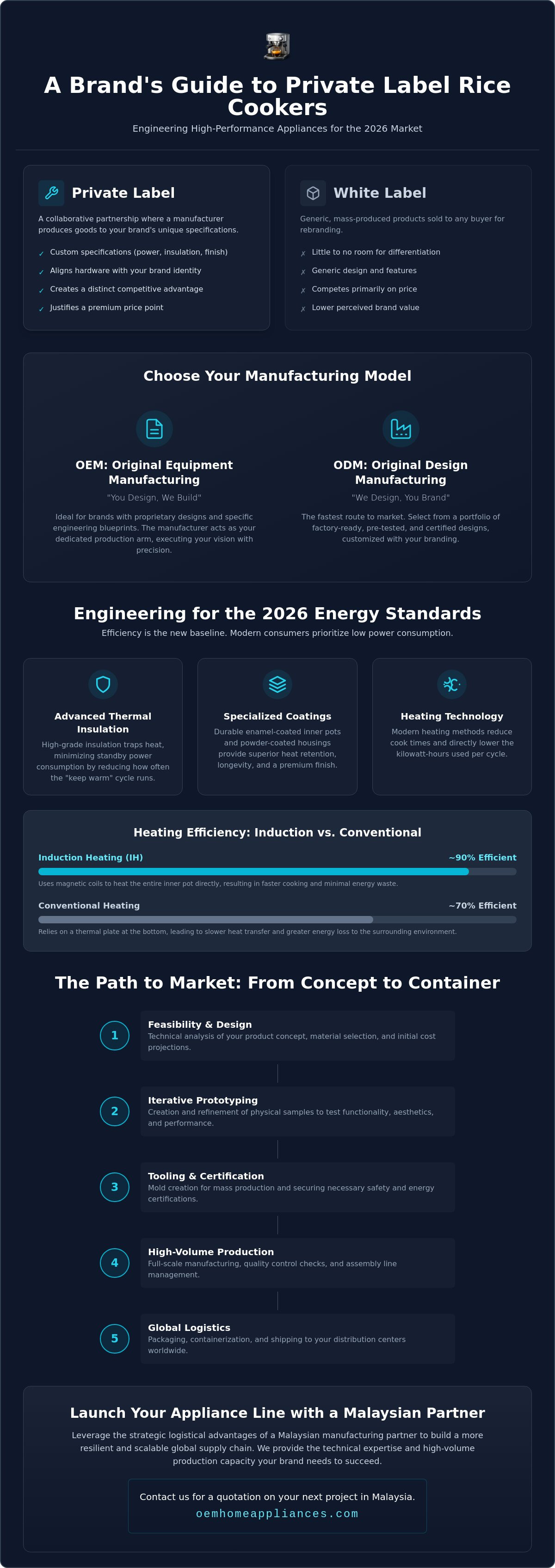
Thermal insulation plays a pivotal role in reducing standby power consumption. When a rice cooker loses heat through its housing, the heating element must cycle on and off more frequently to maintain the "keep warm" temperature. This creates a constant, unnecessary drain on electricity. Superior insulation ensures that heat stays trapped within the inner pot, allowing the device to enter a low-power state for longer periods. If you're looking to minimize these energy losses in your next product line, you can consult with our technical designers to explore advanced housing materials.
Material selection is equally important for thermal management. Powder-coated metal components aren't just chosen for their sleek appearance; they provide an extra layer of thermal resistance that protects the internal environment. When combined with high-performance heating elements, these materials can reduce total cook times. This speed doesn't just benefit the end-user's schedule; it directly reduces the total kilowatt-hours used per cooking cycle, making the appliance more attractive to eco-conscious buyers.
Induction Heating (IH) vs. Conventional Heating
Conventional heating relies on a thermal plate at the bottom of the unit. Induction heating (IH) uses magnetic coils to turn the entire inner pot into a heat source. This physics-based approach provides more uniform heat distribution and faster response times. While the initial production cost is higher, the precision of IH prevents energy waste from overshooting target temperatures. It's the gold standard for high-end private labels seeking to justify a premium market position through superior performance.
Smart Sensors and Logic Controllers
Modern rice cookers rely on intelligent sensors to prevent energy waste during the cooking and warming phases. Fuzzy logic is a micro-processor controlled system that adjusts heat levels and cooking times based on grain moisture and volume. This technology ensures the device only uses the exact amount of power required for the specific contents of the pot. Automatic shut-off features further protect the brand's reputation by preventing scorched rice and unnecessary power draw after the cycle completes.
Key Considerations for Private Label Appliance Partnerships
Identifying a reliable private label rice cooker manufacturer requires a deep dive into their operational infrastructure. It isn't enough to simply look at a sample unit; you must evaluate their ability to scale. High-volume production demands rigorous quality assurance (QA) protocols that catch defects before they reach the shipping container. Transparency throughout the assembly line ensures that every component, from the heating element to the external housing, meets your brand's specific performance benchmarks. Effective communication and technical support during the design phase prevent costly errors during mass production.
Regulatory compliance remains a significant hurdle for global appliance brands. Manufacturing partners must stay updated on evolving requirements, such as the U.S. Department of Energy (DOE) energy conservation standards. These guidelines dictate mandatory efficiency levels that directly impact product design and engineering. A manufacturer that understands these global benchmarks ensures your product line is ready for international distribution without the need for expensive, last-minute redesigns. This proactive approach to compliance protects your brand's reputation and bottom line.
Manufacturing Logistics and Global Reach
Malaysia has emerged as a critical hub for global brands looking to diversify their production and reduce reliance on a single region. Sourcing from a high capacity rice cooker factory in this location offers strategic advantages in terms of shipping lane access and favorable trade regulations. Managing kitchen appliance manufacturing logistics requires a partner that can navigate complex import rules while maintaining a steady flow of raw materials. This stability is essential for preventing stockouts during peak retail seasons and maintaining a reliable supply chain.
Customization and Aesthetic Finishing
Private label branding goes far beyond a simple logo printed on the side of a machine. It involves a cohesive aesthetic strategy that includes custom color palettes, specific logo placement, and bespoke packaging. Utilizing powder-coated metal components provides a premium hand-feel that signals quality to the end-user immediately. This finish isn't just for show; it offers industrial-grade durability that resists scratches and heat damage. Balancing these aesthetic choices with functional longevity creates a product that looks as good in the fifth year of use as it did on the first day.
The Manufacturing Workflow: From Concept to Container
Transforming a brand concept into a consumer-ready kitchen appliance involves a series of high-precision stages. A professional private label rice cooker manufacturer manages this timeline through a structured feasibility study and technical consultation. This initial phase identifies potential engineering bottlenecks before they become costly production delays. It ensures that your design requirements, such as specific powder-coated finishes or induction heating modules, are technically viable for mass assembly. By establishing a clear roadmap at the start, you ensure that the final product aligns perfectly with your brand's performance promises.
Once the technical specifications are locked, the focus shifts to mass production setup and tooling. This stage requires significant expertise to ensure that the transition from a single prototype to thousands of units doesn't compromise quality. Custom molds and specialized assembly lines are prepared to handle high-volume output while maintaining the precision required for modern electronics. This methodical approach ensures that every unit coming off the line meets the same high standards as the initial approved sample.
The R&D and Prototyping Phase
Prototyping is the bridge between digital blueprints and physical reality. During this stage, engineers create functional samples that undergo rigorous electrical safety testing. These prototypes allow you to verify energy efficiency claims in controlled lab conditions, ensuring they meet the strict 2026 standards your customers expect. You can review our full range of product design and development services to understand how we refine your hardware for peak performance. After iterative testing and refinements, the final design is frozen for the manufacturing phase.
Quality Control and Certification
Maintaining brand integrity requires more than just a successful first batch; it demands consistent adherence to global safety and performance benchmarks. Your manufacturing partner must facilitate compliance with international standards like CE, UL, and Energy Star. We implement both in-line testing during the assembly process and final batch testing before the products leave the factory floor. Every energy efficient rice cooker must undergo thermal stress tests to ensure long-term safety. This rigorous approach minimizes the risk of product recalls and protects your reputation in competitive retail markets.
Success in the appliance sector depends on a predictable and transparent production cycle. If you're ready to move from concept to mass production, reach out to our engineering team for a detailed technical consultation.
Why Choose oemhomeappliances as Your Manufacturing Partner?
Choosing oemhomeappliances as your private label rice cooker manufacturer means securing a partner that prioritizes your brand's growth over its own retail presence. Our dedicated B2B model ensures we never compete with our clients in the consumer market. Instead, we focus on providing the technical expertise and manufacturing scale required to turn your product vision into a market-leading appliance. Based in Malaysia, we offer a strategic logistical advantage for global shipping, helping you maintain a resilient supply chain while meeting the rigorous energy efficiency benchmarks of 2026.
Our facility integrates specialized production capabilities that few competitors can match. We don't just assemble components; we engineer them. With in-house expertise in enamel-coated products and powder-coated metal components, we provide the durability and aesthetic finishing that premium brands demand. This vertical integration allows for tighter quality control and more flexible customization options. It ensures your rice cookers stand out for both their thermal performance and their industrial build quality.
A Legacy of Professional Appliance Production
Our experience spans a wide range of kitchen technologies, including a deep history in portable cooking equipment OEM. This broad category expertise allows us to apply cross-industry innovations to your rice cooker project. Whether you're a boutique brand looking for a specialized first run or a global retailer requiring high-volume scalability, our production lines are designed to adapt. We provide the stability of a seasoned industry veteran combined with the flexibility of a modern innovation partner.
Partnering for Future Growth
Corporate reliability and long-term stability are the foundations of our service. We understand that your brand's reputation rests on the quality of the hardware we produce. By selecting oemhomeappliances, you're choosing a partner committed to precision, scalability, and the practicalities of global distribution. We invite you to leverage our industrial strength to expand your product catalog with high-performance, energy-efficient appliances that resonate with modern consumers.
If you're ready to enhance your product line with a reliable manufacturing partner, contact our team in Malaysia today for a personalized quotation. We're ready to provide the technical details and pricing structures you need to move your project forward. Reach out to us to learn how our Malaysian facility can support your brand's global expansion and provide the reliable supply chain your business deserves.
Scale Your Appliance Brand with Precision Manufacturing
Building a successful kitchen appliance line requires a partner that prioritizes technical performance over marketing hype. We've explored how energy efficiency standards and advanced thermal management define the next generation of consumer hardware. Success in 2026 depends on high-precision engineering and a resilient supply chain that can withstand global volatility. By utilizing specialized enamel and powder coating, your brand can offer the industrial-grade durability that modern consumers expect from a premium product.
Selecting the right private label rice cooker manufacturer is the most critical step in your brand's global expansion. A partner based in Malaysia provides the strategic logistical backbone needed for efficient international distribution. At oemhomeappliances, we act as a dedicated B2B manufacturing partner, providing the infrastructure and expertise to empower your business. Our focus remains on delivering scalable, high-quality solutions that align with your specific market requirements and long-term growth goals.
Ready to take the next step in your production journey? Request a Quotation for Your Private Label Project in Malaysia today. Our team is standing by to provide the technical consultation and supply chain logistics expertise you need to launch your next high-performance product line with confidence.
Frequently Asked Questions
What makes a rice cooker energy efficient in 2026?
Energy efficiency in 2026 is driven by advanced thermal management and precision electronics. Modern units utilize high-density insulation to prevent heat loss and induction heating for uniform distribution. These features ensure the device meets the latest global energy rating standards. By reducing standby power and shortening cook times, these appliances appeal to eco-conscious consumers looking for long-term utility savings.
How long does the private label manufacturing process take?
The timeline for a private label rice cooker manufacturer to move from concept to shipment typically spans four to six months. This includes the technical consultation, prototyping, and mass production setup. Tooling for custom designs often adds time to the initial run. Once the design is frozen and molds are ready, subsequent production cycles are significantly faster, allowing for a steady supply to your distribution centers.
Can I customize the heating technology for my brand?
Yes, you can specify various heating technologies based on your target market's price point and performance needs. We offer both conventional thermal plate heating and advanced induction heating (IH) systems. Customizing the heating element allows your brand to differentiate through superior temperature control or faster cooking cycles. This flexibility is essential for brands looking to position themselves in either the value or premium appliance segments.
What are the MOQs for private label rice cooker production?
Minimum Order Quantities (MOQs) depend on the level of customization required for your specific product line. Standard private label projects with basic branding usually have lower requirements than those involving custom molds or unique hardware configurations. We work with clients to find a balance between production efficiency and inventory needs. For a detailed breakdown of MOQs for your specific design, please contact our team for a consultation.
Why is Malaysia a strategic choice for appliance manufacturing?
Malaysia offers a robust industrial infrastructure and a strategic location within the global appliance manufacturing supply chain. The country's well-established shipping lanes and favorable trade agreements make it an efficient hub for international distribution. Choosing a manufacturer in Malaysia helps brands diversify their production and reduce reliance on a single region while maintaining high standards of engineering and quality control.
Do you provide certifications like Energy Star or UL?
We facilitate the certification process to ensure your products meet the safety and performance regulations of your target markets. This includes compliance with standards like CE, UL, and Energy Star. Our engineering team conducts rigorous testing during the development phase to ensure the hardware passes all necessary inspections. This proactive approach minimizes the risk of regulatory delays and ensures your brand enters the market with fully certified appliances.
What is the difference between enamel and powder coating for cookers?
Enamel coating is primarily used for the inner cooking pot because of its superior heat resistance and non-reactive properties. It's a durable, food-safe finish that withstands high temperatures. Powder coating is typically applied to the external metal components to provide a premium aesthetic finish and protect the housing from scratches. Both coatings are essential for creating a durable, high-performance appliance that maintains its appearance over time.
Can you help with the design phase or do I need my own blueprints?
We provide comprehensive product design and development services, so you don't need to provide final blueprints. Our engineers can work from a basic concept or a list of desired features to create a functional design. This collaborative process includes feasibility studies and prototyping to ensure the final product is ready for mass production. We act as your technical partner to transform your vision into a consumer-ready appliance.
Comments