The Strategic Lifecycle of Kitchen Appliance Prototyping in 2026
A kitchen appliance prototype isn't just a design milestone. It's a high-stakes risk-mitigation engine that determines whether your product scales efficiently or fails at the factory gate. In the competitive 2026 market, professional kitchen appliance prototyping serves as the bridge between an ambitious aesthetic vision and a durable, mass-producible reality. You've likely felt the pressure of high R&D costs and the frustration of lengthy timelines when trying to bring a new air fryer or coffee machine to life. It's a common challenge to find a partner who truly balances design flair with the cold realities of manufacturing constraints.
We've built this guide to help you navigate these complexities with confidence. You'll discover the precise industrial R&D stages needed to transform your concept into a scalable, market-ready product that protects your brand's reputation. We'll walk through a clear development roadmap, from initial technical drawings to the creation of functional prototypes that meet rigorous performance standards. By the end, you'll know exactly how to reduce technical risk during the manufacturing transition and ensure your next launch is both seamless and profitable.
Table of Contents
Defining Kitchen Appliance Prototyping in the B2B Ecosystem
Industrial prototyping is the iterative process of creating physical models to validate a concept before mass production begins. In the B2B ecosystem, kitchen appliance prototyping isn't a luxury; it's a technical requirement for ensuring long-term product viability. This phase allows engineers to test electrical safety and thermal efficiency in a controlled environment. Without these physical benchmarks, brands risk catastrophic failures once the product reaches the consumer's countertop. The process typically involves three distinct layers of validation:
Visual Mockups: These validate the size, shape, and user interface ergonomics.
Functional Rigging: This tests internal wiring, motor performance, and sensor accuracy.
Material Testing: This ensures technical finishes, such as enamel or powder coating, can withstand high temperatures without degrading.
There's a sharp contrast between design prototyping and engineering prototyping. Design models focus on visual appeal and help stakeholders visualize the final product. Engineering prototypes focus on functionality. They often utilize rapid prototyping techniques to test internal components under real-world stress. A professional OEM partner acts as the translator in this ecosystem. They turn a brand's aesthetic vision into a manufacturable unit that meets global standards while maintaining cost-efficiency.
The Role of Prototyping in Risk Mitigation
Prototyping identifies thermal bottlenecks in roaster ovens long before expensive tooling begins. If a heating element creates a hot spot that compromises the outer casing, it's discovered and fixed at the bench. For air fryers, prototypes allow engineers to test airflow dynamics to ensure even heat distribution and cooking performance. This rigorous testing significantly reduces the financial risk of large-scale manufacturing defects or costly product recalls. It ensures that the transition from a single unit to ten thousand units is technically sound.
Why Design Inspiration is Only the First Step
Consumer-facing platforms offer excellent aesthetic inspiration, but they often lack the engineering depth required for actual appliance production. A sleek concept might look stunning in a digital render, but it must function within strict power and heat constraints. Successful brands move beyond these initial ideas by grounding their designs in realistic manufacturing constraints. You must ensure that every curve and material choice is compatible with high-volume production lines. Explore our comprehensive OEM/ODM services to see how we manage this technical development for our global partners.
The 4 Critical Stages of the Appliance Prototyping Lifecycle
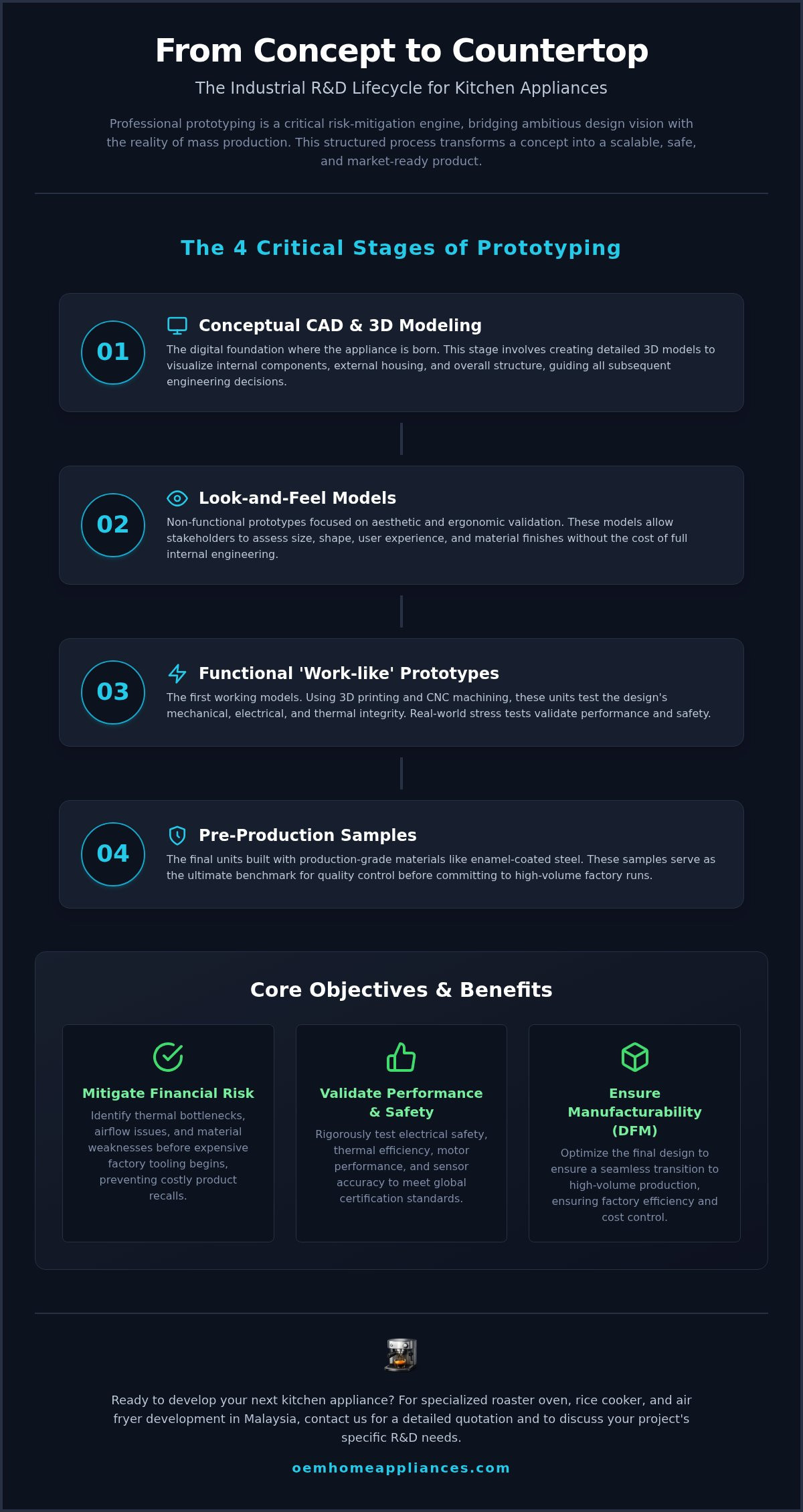
Successful kitchen appliance prototyping follows a methodical four-stage lifecycle. It isn't just about building a physical model; it's about refining the technical soul of the product through successive layers of complexity. Each stage serves a specific purpose in bridging the gap between a conceptual sketch and a high-volume production line. Skipping these steps often leads to expensive re-tooling mid-production or unexpected failures in the field.
Stage 1: Conceptual CAD and 3D Modeling. This digital phase allows for the initial visualization of internal components and external housing. It's the foundation for all subsequent engineering decisions.
Stage 2: Look-and-Feel Models. These non-functional prototypes focus on aesthetic and ergonomic validation. They help stakeholders assess the user experience, handle placement, and overall size without the cost of internal engineering.
Stage 3: Functional 'Work-like' Prototypes. Using 3D printing and CNC machining, these units test the mechanical and electrical integrity of the design. We create precise parts that mimic the strength of final components to allow for real-world stress tests.
Stage 4: Pre-production Samples. These are the final units built using production-grade materials, such as enamel-coated steel. They provide the ultimate benchmark for quality control before the factory starts high-volume runs.
CAD Modeling and Digital Simulation
Modern R&D begins with a digital twin. In this stage, we use advanced simulations to predict heat distribution in rice cookers, ensuring the heating element won't warp the internal casing or damage sensitive electronics. This digital environment is also where we optimize component placement for powder-coated metal housings, ensuring proper ventilation and structural integrity. By identifying these issues early, CAD modeling significantly reduces physical material waste in the early R&D phase. It's a critical step for any brand looking for a strategic guide to private label kitchen appliance manufacturing.
Functional Testing and Material Validation
Once the digital design is locked, the focus shifts to physical endurance. We conduct rigorous stress testing on hinges and handles for portable cooking equipment to simulate years of daily use. This stage is also where we validate the durability of enamel-coated surfaces under extreme temperatures. If a finish bubbles or cracks during a 500-hour heat test, the material formulation is adjusted immediately. This meticulous approach to kitchen appliance prototyping ensures your brand standards are met before the first consumer unit is ever packed. If you need technical assistance with your next project, you can consult our design and development team for expert guidance.
Functional vs. Aesthetic Prototyping: Which Does Your Brand Need?
Aesthetic appeal wins the showroom, but functional integrity wins the market. In the lifecycle of kitchen appliance prototyping, brands must distinguish between models built for visual approval and those designed for engineering validation. While an aesthetic prototype secures stakeholder buy-in, the functional version ensures the product won't fail during rigorous safety testing. Most successful product launches require both. They eventually merge into a "Gold Sample" that serves as the definitive benchmark for the mass production line.
Aesthetic Prototypes for Brand Identity
Aesthetic prototypes focus on the external experience. This stage is where you test the tactile quality of powder-coated metal components and the visual depth of different color palettes. For complex products like coffee machines, these models allow your team to evaluate the user interface (UI) and control panel ergonomics. You can determine if the button placement feels intuitive or if the digital display remains legible under bright kitchen lighting.
Refining these visual elements early prevents costly changes to the outer casing once expensive molds are created. It’s about ensuring the physical product matches the brand's premium positioning. For deeper insight into visual evolution, see our analysis on design trends in modern roaster ovens. This phase confirms that the "look and feel" aligns with consumer expectations for 2026.
Functional Prototypes for Performance Standards
Functional prototypes are the workhorses of the R&D department. They often look unpolished, sometimes featuring exposed wiring or 3D-printed internal brackets, but they must perform exactly like the final product. These units are essential for measuring wattage consistency in electric kettle prototypes or testing the thermal recovery times in air fryers. Their primary goal is to meet the rigorous demands of UL, CE, or other global safety certifications.
Engineering teams use these models to ensure compliance with global food safety standards, particularly for internal coatings that come into direct contact with heat and steam. Our technical guide to industrial enamel coating processes details how these finishes are validated for durability. A prototype doesn't need to look perfect to function correctly; it needs to prove that the internal architecture is safe and efficient. Once the internal performance is locked and the external aesthetics are approved, the two are combined into the final pre-production sample. This consolidated approach minimizes technical risk and streamlines the transition to the factory floor.
Transitioning from Prototype to Mass Production: The DFM Phase
Design for Manufacturing (DFM) is the technical optimization of a prototype to ensure factory efficiency. It's the critical bridge between a working lab model and a high-speed assembly line. During kitchen appliance prototyping, we often find that a design works perfectly in a lab but presents significant challenges for assembly at scale. DFM identifies these friction points. It focuses on adjusting parts for high-volume injection molding, ensuring every plastic housing or internal bracket pops out of the mold without structural defects or aesthetic warping.
The prototype serves as the master blueprint for your tooling. If the prototype isn't optimized for manufacturing, the resulting molds will be inefficient and prone to failure. DFM ensures that the transition to bulk production is seamless, reducing the need for costly mid-production adjustments. It's about grounding your vision in the practicalities of industrial engineering.
Optimizing for High-Volume Manufacturing
In air fryer production, reducing the part count is a primary DFM goal. Fewer parts mean lower assembly costs and fewer potential points of failure in the field. We look for ways to integrate components or use snap-fit designs instead of traditional fasteners. This optimization requires a deep understanding of material science. You must balance the cost of raw materials with the premium feel of technical finishes like enamel coatings. If you're building a new brand, leverage these R&D resources for private label air fryer brands to see how we manage this transition effectively.
Tooling and Pre-Production Inspection
The prototype dictates the final mold design. We distinguish between "soft tooling" used for initial prototypes and "hard tooling" required for mass production. Soft tooling is faster and cheaper, allowing for final tweaks before the design is locked. Hard tooling is a significant investment in precision steel molds that can produce hundreds of thousands of units with minimal wear.
Before we pull the trigger on hard tooling, we finalize quality control (QC) checklists based on the prototype’s performance. This ensures consistency across high-volume blender manufacturing runs, where every unit must meet identical torque and heat resistance standards. Transitioning from a single sample to bulk production also tests your supply chain resilience. You need to ensure that materials like powder-coated metal components are available in large quantities without quality fluctuations. If you're looking for expert manufacturing support in Malaysia, reach out to us for a detailed project quotation.
Partnering with a Malaysian OEM for Kitchen Appliance R&D
Malaysia's position as a global manufacturing hub provides a strategic edge for brands entering the kitchen appliance prototyping phase. The region's industrial ecosystem is built on decades of expertise in precision engineering and high-volume assembly. For international businesses, this means a more reliable transition from initial concept to a market-ready product. A dedicated partner in this region doesn't just build a model; they provide the technical backbone required to navigate complex global supply chains and regulatory environments. Our approach to kitchen appliance prototyping focuses on scalability from day one, ensuring your designs are ready for the demands of the 2026 market.
We focus our expertise on specialized categories like roaster ovens, air fryers, and rice cookers. By concentrating on these niches, we've refined our R&D processes to handle the specific thermal and electrical challenges these appliances present. Our B2B-only model is a cornerstone of our partnership philosophy. We exist to empower your brand, not compete with it. This clear boundary ensures your intellectual property remains secure throughout the entire development cycle, from the first sketch to the final assembly line.
Why Malaysia is a Strategic R&D Choice
Choosing Malaysia for your R&D needs offers several distinct business advantages that directly impact your bottom line. The country's strong logistics infrastructure and trade agreements make it an ideal base for global distribution. Key benefits include:
Advanced Technical Finishes: Access to sophisticated enamel and powder coating facilities ensures your prototypes meet the durability standards required for high-heat kitchen environments.
Logistics Infrastructure: Malaysia's robust shipping and air freight networks allow for rapid distribution of samples and final products to global markets.
Flexible Development Models: Whether you require a full ODM solution or a specific OEM private label execution, the local expertise supports both paths with equal precision.
Next Steps for Your Appliance Brand
Moving from a conceptual idea to a physical prototype requires a structured approach. To begin, you should prepare a detailed design brief that outlines your aesthetic goals, functional requirements, and target price points. This brief serves as the foundation for our initial prototyping consultation. We invite you to explore our bespoke manufacturing workflows, which are designed to integrate seamlessly with your existing brand standards. Our team is ready to help you reduce technical risk and accelerate your time-to-market with precision-engineered solutions.
If you're looking for a reliable partner to handle your next project, we provide comprehensive support right here in Malaysia. Request a professional quotation for your project in Malaysia to start your development journey today.
Mastering the Transition to Scalable Manufacturing
Successful product launches in 2026 require more than just a good idea; they demand a rigorous approach to kitchen appliance prototyping. By systematically navigating the four stages of development and integrating Design for Manufacturing (DFM) early, you mitigate technical risks and avoid costly production delays. This methodical process ensures that every unit, from the initial sample to the tenth thousand, maintains the structural integrity and aesthetic quality your brand promises.
We provide specialized expertise in roaster oven and air fryer R&D to empower your growth. Our team delivers high-quality private label appliances globally, backed by advanced enamel and powder coating technical solutions that ensure long-term durability. We're committed to acting as your reliable industrial backbone throughout the entire lifecycle. Our focus remains on precision, scalability, and the protection of your brand's intellectual property. We prioritize your success by grounding every design in realistic manufacturing constraints.
Contact our Malaysia-based team for a kitchen appliance prototyping quotation to discuss your project requirements and secure a streamlined path to market. We look forward to building a successful partnership with you.
Frequently Asked Questions
How long does the kitchen appliance prototyping process typically take?
The timeline for kitchen appliance prototyping typically ranges from 4 to 12 weeks. Initial CAD modeling and 3D mockups move quickly, often concluding within 14 days. However, functional testing for electrical safety and thermal efficiency requires more time. Complex appliances like roaster ovens need rigorous validation of technical finishes. We focus on hitting milestones efficiently so your time-to-market doesn't slip while maintaining safety.
What is the difference between a functional prototype and a pre-production sample?
A functional prototype focuses on internal mechanics and electrical performance, often using temporary housing materials. Its primary goal is to pass safety and performance benchmarks. In contrast, a pre-production sample is the final "Gold Sample" manufactured using actual production-grade materials like enamel-coated steel. This sample represents the exact quality consumers will receive. It serves as the definitive quality control benchmark before we begin high-volume factory runs.
Do I need a finished CAD design before contacting a manufacturer for prototyping?
You don't need a finished CAD design to start the consultation process. While a complete file accelerates the timeline, our team frequently works from rough design briefs or aesthetic sketches. We provide the engineering depth required to turn a visual concept into a manufacturable digital twin. This collaborative approach ensures that your initial ideas are grounded in realistic manufacturing constraints and thermal requirements from the very beginning.
Can prototyping help reduce the final unit cost of my kitchen appliance?
Prototyping is a primary tool for cost reduction through Design for Manufacturing (DFM) optimization. During this phase of kitchen appliance prototyping, we'll identify opportunities to reduce part counts or simplify assembly workflows without affecting quality. For instance, optimizing the internal bracket design of an air fryer can lower material costs and assembly time. These refinements ensure that your final unit cost remains competitive while maintaining your brand standards.
What materials are best for prototyping high-heat appliances like roaster ovens?
Selecting materials for high-heat appliances requires a deep understanding of thermal stress. We use high-temperature resins for initial functional parts and move to steel components for advanced testing. Technical finishes like enamel and powder coating are essential at this stage to validate heat distribution and surface durability. These materials ensure that your roaster oven or BBQ grill remains safe and functional during prolonged usage at maximum temperatures.
How does oemhomeappliances protect my brand's intellectual property during R&D?
We protect your intellectual property through a dedicated B2B-only business model. Unlike manufacturers who also sell their own brands, we don't compete with our clients in the retail market. This structure eliminates conflicts of interest and ensures your proprietary designs remain confidential. We use strict non-disclosure agreements and secure data management protocols throughout the entire R&D lifecycle to safeguard your brand's unique innovations.
Is 3D printing sufficient for testing a functional kitchen appliance?
3D printing is excellent for validating ergonomics and component fit, but it's rarely sufficient for full functional testing. Standard 3D printing materials often can't handle the high temperatures generated by appliances like rice cookers or kettles. You must transition to CNC-machined metal parts or specialized heat-resistant polymers for accurate thermal validation. This step is critical for ensuring your product meets international safety certifications like UL or CE.
What are the common mistakes brands make during the prototyping stage?
The most common mistake is prioritizing aesthetic design over industrial manufacturability. Brands often fall in love with a visual mockup that's impossible or too expensive to produce at scale. Another error is skipping rigorous functional stress tests for technical finishes. This oversight leads to surface failures or overheating issues once the product reaches the consumer. We help you avoid these pitfalls by balancing design vision with practical engineering.
If you're ready to begin your next project, our team in Malaysia is available to provide technical guidance and pricing. Contact us today for a detailed kitchen appliance prototyping quotation tailored to your brand's specific needs in Malaysia.


Comments