The Strategic Role of an Appliance Component Coating Manufacturer in 2026
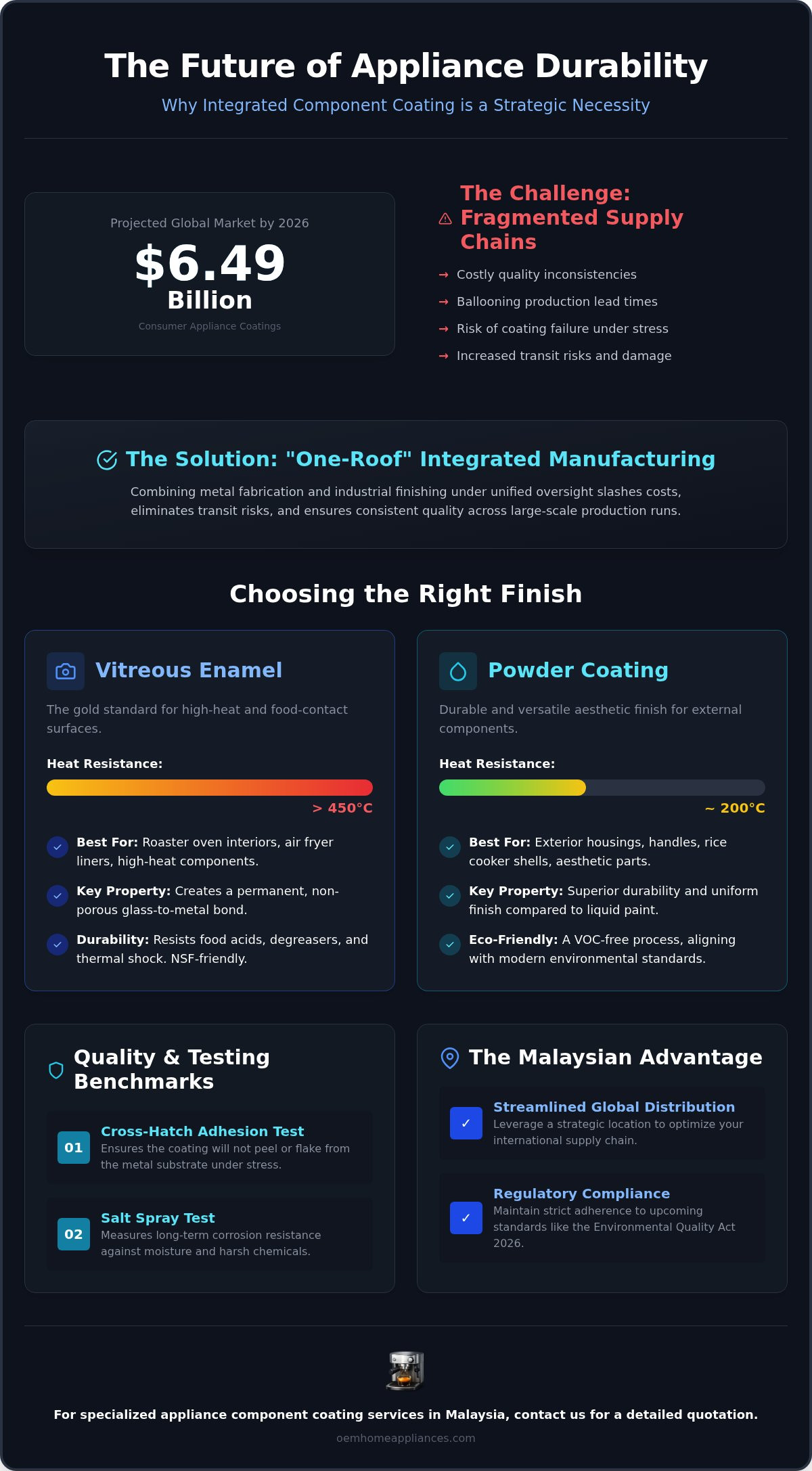
By 2026, the global consumer appliance coatings market is projected to reach $6.49 billion; however, many brands still face costly quality inconsistencies due to fragmented supply chains. You likely understand the frustration when a roaster oven interior fails under high heat or a multi-vendor setup leads to ballooning lead times. Finding a reliable appliance component coating manufacturer is no longer just about aesthetics. It's a strategic necessity to ensure your products survive the rigors of daily use while maintaining the precision and scalability your brand requires.
Discover how specialized enamel and powder coating processes directly enhance appliance durability and why an integrated manufacturing partner is essential for global brands. We'll show you how a "one-roof" approach to fabrication and finishing can slash production costs and extend product lifespans. We'll also preview critical regulatory changes in Malaysia, such as the Environmental Quality (Amendment) Act 2026, that are reshaping how appliances are built. By the end of this article, you'll have a clear roadmap for streamlining your operations and securing a competitive edge in the 2026 market through expert OEM services.
Table of Contents
What is an Appliance Component Coating Manufacturer?
An appliance component coating manufacturer serves as a specialized partner that bridges the gap between raw metal fabrication and high-performance finishing. This role involves more than just painting a surface; it's a complex engineering process where metal parts are shaped and then treated with industrial-grade layers. Brands require components that can survive the intense thermal cycles of roaster ovens and air fryers. These coatings are essential for heat management, ensuring that internal temperatures remain consistent while protecting the appliance's exterior from becoming a safety hazard.
The distinction between aesthetic finishes and functional industrial coatings is sharp. While a decorative finish might focus on color, an industrial coating must provide chemical resistance and thermal stability. This performance starts long before the coating is applied. Surface preparation is just as vital as the material itself. Without meticulous cleaning and pre-treatment, even the highest quality enamel or powder will fail to adhere, leading to peeling and product recalls.
The Impact of Coating on Appliance Longevity
Kitchen environments are notoriously harsh. High moisture levels and frequent cleaning with abrasive chemicals create a constant risk of oxidation and corrosion. A professional coating acts as a shield, preventing rust from eating into the structural metal. For high-heat appliances, thermal resistance coatings are non-negotiable. They protect the structural integrity of roaster oven liners, preventing the metal from warping under stress. Additionally, these finishes improve the user experience. Easy-clean and scratch-resistant surfaces ensure the appliance looks and functions like new for years, which is a key driver for consumer brand loyalty.
Core Materials and Substrates in Appliance Production
Most modern appliances rely on cold-rolled steel, aluminium, or stainless steel for their core structures. Each substrate has unique bonding requirements. Powder coating is frequently chosen for exterior metal components because it offers superior durability and a more uniform finish than liquid alternatives. To achieve this, the manufacturer must use a pre-treatment phase to strip away factory oils and residues. This ensures a "clean" surface for the coating chemistry to bond with effectively. By utilizing integrated manufacturing services, global brands can ensure that every step, from the first metal cut to the final cure, is handled with unified oversight.
Industrial Enamel vs. Powder Coating: Choosing the Right Finish
Selecting the appropriate finish is a critical decision that impacts both the manufacturing budget and the end-user's experience. An expert appliance component coating manufacturer evaluates each part based on its thermal exposure and chemical contact. While both enamel and powder coating offer durability, they serve distinct purposes in the kitchen. Vitreous enamel remains the gold standard for high-heat surfaces, whereas powder coating provides unmatched versatility for external housings.
The primary differentiator is the heat threshold. Enamel can withstand temperatures exceeding 450°C without degrading; powder coatings generally begin to soften or discolor once they pass 200°C. For internal components like roaster oven liners, enamel is mandatory. For external handles or rice cooker shells, powder coating suffices while offering a wider range of textures and colors. Environmental factors also play a role. Powder coating is a VOC-free process, aligning well with the Environmental Quality (Amendment) Act 2026 in Malaysia. Enamel, however, offers ultimate permanence; its glass-like surface won't peel or fade over decades of use.
The Advantages of Industrial Enamel for High-Heat Appliances
Enamel-coated products are the preferred choice for roaster oven interiors because of their unique molecular structure. During the firing process, the enamel frit melts and fuses to the steel at temperatures above 800°C, creating a permanent glass-to-metal bond. This surface is non-porous and incredibly hard. It resists food acids, harsh degreasers, and the repetitive expansion and contraction of high-heat cycles. Meeting NSF certification standards is significantly easier with enamel, as it doesn't harbor bacteria and remains chemically inert even under extreme stress. It's the most reliable way to ensure the interior of a cooking appliance stays safe and easy to maintain for the consumer.
Powder Coating for External Appliance Components
External components require a different set of properties, prioritizing impact resistance and brand aesthetics. Custom powder-coated metal components allow brands to achieve specific color matches and textures, from high-gloss finishes to matte or sand effects. Powder coatings held a 54.3% market share in 2025, largely due to their cost-efficiency for high-volume production runs. This is because overspray can be reclaimed and reused, which minimizes material waste. Unlike enamel, powder coating is flexible; it can withstand minor dings during assembly or shipping without cracking. Partnering with a skilled appliance component coating manufacturer ensures these external parts maintain their finish throughout the product's lifecycle. If you're unsure which process fits your specific SKU, reach out for a technical consultation to review your component specifications.
The Efficiency of Integrated Component Manufacturing
Brands often struggle with supply chain fragmentation. Shipping raw metal parts from a fabricator to a separate coater introduces significant transit risks. Scratches, oxidation, and contamination often occur during transport. An integrated appliance component coating manufacturer eliminates these variables by managing the entire lifecycle under one roof. This unified oversight ensures the metal substrate is prepped and coated immediately after fabrication; this is critical for long-term adhesion and preventing flash rust on bare steel surfaces.
Relying on a single partner builds supply chain resilience. You won't have to manage multiple lead times or mediate disputes between vendors when a part fails testing. This consolidated approach allows for a faster time-to-market, which is vital in the competitive 2026 appliance market. For a deeper look into choosing the right partner, consult our Strategic Guide to Selecting a Private Label Kitchen Appliance Manufacturer.
Reducing Quality Variances with Single-Source OEM
Contamination is the primary enemy of industrial coatings. When fabrication and finishing happen in separate facilities, raw parts are exposed to oils, dust, and humidity during transit. Integrated production prevents these issues by moving parts directly from the press to the pre-treatment line. Our facility maintains unified accountability for coating thickness, adhesion, and color matching. By removing the need for third-party logistics, we also eliminate the documentation and inspection overlap that typically slows down multi-vendor projects. This level of control is particularly important for high-spec items like roaster ovens that require a flawless, heat-resistant finish. You can learn more about our specific Industrial Enamel Coating Process for Roaster Ovens to see how we maintain these rigorous standards.
Streamlining Private Label Production Workflows
Efficiency isn't just about speed; it's about collaborative R&D. When the design team works alongside the coating specialists, they can engineer parts specifically for better coverage. This might involve adjusting a radius to prevent powder buildup or optimizing drainage holes for enamel dipping. These small design tweaks lead to significant cost savings by reducing material waste and manual handling time. By choosing an integrated manufacturing partner, brands simplify their logistics and reduce total production costs. This strategy is part of a broader set of Kitchen Appliance Manufacturing Solutions designed to help global brands scale with precision and reliability.
Quality Standards and Testing for Appliance Coatings
Verification is the only way to guarantee that a finish survives years of consumer use. A reputable appliance component coating manufacturer implements a multi-stage testing protocol before any batch leaves the facility. These tests simulate the extreme conditions of a modern kitchen, from high-heat cooking to high-humidity storage. Without these benchmarks, brands risk high return rates and damage to their market reputation.
One of the most critical assessments is the cross-hatch adhesion test. By creating a grid of incisions in the finish and applying pressure-sensitive tape, technicians ensure the bond between the metal and the coating is permanent. For components exposed to moisture, salt spray and humidity testing provide benchmarks for corrosion resistance. We also conduct thermal shock testing. In this process, parts are subjected to rapid heating and cooling cycles. This ensures that the enamel or powder layer won't crack or delaminate when a roaster oven is switched from maximum heat to off. These protocols are non-negotiable for high-performance kitchen equipment.
Compliance and Regulatory Standards in 2026
Compliance is a moving target that requires constant vigilance. By August 1, 2026, new ceramic ware regulations in Malaysia set stricter limits for lead and cadmium in cooking ware. Our coatings meet these updated safety standards as well as global REACH and RoHS requirements. For internal surfaces in air fryers and rice cookers, we adhere to strict FDA and EFSA requirements for food-contact safety. This ensures that no hazardous chemicals migrate into the food during the cooking process. You can review our specific Quality Standards in Global Roaster Oven Production to see how we manage these complex certifications for our international partners.
Visual and Aesthetic Inspection Protocols
Performance matters, but brand identity relies on visual perfection. We use precision gloss meters and colorimeters to maintain a Delta-E consistency of less than 1.0 across different production batches. This ensures that every handle and housing matches perfectly on the retail shelf. Our inspection protocols also target surface smoothness, eliminating "orange peel" textures or microscopic pinholes that could lead to premature failure. These rigorous benchmarks apply to all our powder coated metal components, ensuring a premium look and feel for your brand. If you need to verify our testing results for your current product line, request a formal quotation and quality report from our technical team in Malaysia.
Partnering with a Malaysia-Based Coating Manufacturer
Malaysia has solidified its position as a central hub for global appliance exports. In 2026, the Asia Pacific region continues to dominate the market with a 41.7% revenue share, and Malaysia's industrial infrastructure is a primary driver of this growth. Choosing a Malaysia-based appliance component coating manufacturer provides brands with a strategic logistical advantage. The country's advanced ports and established trade agreements facilitate seamless distribution to both Western and regional markets. Brands are increasingly diversifying their supply chains toward reliable Southeast Asian partners to mitigate geopolitical risks and benefit from a more resilient manufacturing ecosystem.
Cost-efficiency in high-volume production doesn't mean sacrificing technical precision. Malaysian manufacturers have invested heavily in automation and advanced application technologies. This allows for the mass production of powder-coated metal components while adhering to the strict Environmental Quality (Amendment) Act 2026. Local engineering expertise in both vitreous enamel and powder applications ensures that components meet rigorous durability standards without the overhead costs typically found in European or North American facilities. This balance of cost and quality is essential for brands looking to maintain healthy margins in a competitive global market.
Bespoke Solutions for Global Appliance Brands
Modern brands require more than off-the-shelf finishes; they need customized coating formulations that align with unique brand color palettes and textures. A versatile manufacturer offers scalability that supports your business from the initial prototyping phase through to large-scale bulk orders. We recommend that procurement officers request a facility audit to verify integrated coating capabilities firsthand. This transparency ensures that the "one-roof" advantage is fully realized, preventing the quality gaps that often occur when fabrication and finishing are handled by separate entities.
Next Steps for Your Appliance Product Development
Transitioning to an integrated partner starts with a clear technical specification for your Request for Quotation (RFQ). Providing detailed drawings and performance requirements allows our engineers to optimize the coating process for your specific SKU. We often begin with a prototyping phase to test new enamel or powder finishes on your component substrates. This ensures the final mass-produced part meets every aesthetic and functional benchmark. Partnering with an expert that understands custom roaster oven manufacturing ensures your high-heat appliances are built for longevity and safety.
If you're looking to streamline your production and enhance your product quality, contact us today. We provide specialized private label manufacturing and industrial coating services within Malaysia to help your brand scale globally. Reach out to our team to request a formal quotation or to discuss your specific component requirements.
Future-Proofing Your Appliance Brand with Integrated Coating Solutions
The 2026 market demands more than just basic assembly; it requires a deep integration of fabrication and industrial finishing. By consolidating your production with a specialized appliance component coating manufacturer, you eliminate the risks of contamination and logistics bottlenecks that plague fragmented supply chains. Whether you're utilizing vitreous enamel for high-heat roaster oven interiors or custom powder-coated metal components for brand-consistent housings, the "one-roof" advantage ensures unified oversight and superior product longevity.
Our specialized enamel and powder coating facilities in Malaysia provide the technical precision and scalability necessary for global brands. As a trusted partner for kitchen appliance manufacturers worldwide, we help you navigate evolving regulatory landscapes while maintaining cost-effective production. We're ready to help you transition from prototyping to large-scale bulk orders with ease. Contact us for a quotation on our Malaysia-based OEM services today. We look forward to empowering your brand's growth through expert manufacturing and finishing.
Frequently Asked Questions
What is the difference between enamel and powder coating for appliances?
Enamel is a glass-to-metal bond fired at high temperatures, offering extreme heat and chemical resistance. It's the primary choice for appliance interiors. Powder coating is a dry finishing process providing color variety and impact resistance for exterior housings. While enamel handles temperatures above 450°C, powder is better for aesthetics and cost-efficiency on external components. Choosing the right finish depends on the component's functional role and thermal exposure.
Why is enamel coating preferred for roaster oven interiors?
Enamel coating is preferred for roaster oven interiors because it withstands intense thermal cycles without degrading or discoloring. The vitreous surface is non-porous and chemically inert, making it highly resistant to food acids and abrasive cleaning agents. It ensures the structural metal doesn't warp or corrode under high temperatures. This durability is a critical safety requirement for portable cooking equipment and high-performance kitchen appliances sold globally.
How do you ensure coating adhesion on aluminium appliance parts?
Adhesion on aluminium requires rigorous pre-treatment to remove factory oils and oxidation layers. As an appliance component coating manufacturer, we use specialized chemical etching and cleaning phases to create a perfectly receptive surface. This process ensures the powder or enamel bond is permanent. We verify this through cross-hatch testing to prevent peeling or delamination during the product's lifecycle, ensuring long-term durability for every component we produce.
Are your appliance coatings food-safe and compliant with FDA standards?
All internal coatings for products like rice cookers and air fryers meet strict FDA and EFSA food-contact safety standards. We ensure our materials are chemically inert and don't migrate hazardous substances into food during high-heat cooking. Our processes also align with the 2026 Malaysian ceramic ware regulations, which set new safety limits for lead and cadmium in cooking ware to protect consumer health and ensure international compliance.
What are the benefits of sourcing appliance components from Malaysia?
Sourcing from Malaysia offers a strategic logistical hub with access to advanced ports and established trade agreements. Brands benefit from a resilient supply chain and high-volume production capabilities that meet global REACH and RoHS standards. The local engineering expertise in specialized coatings allows for technical precision at a more competitive cost than Western manufacturing centers. It's an ideal location for diversifying supply chains toward reliable Southeast Asian partners.
Can you match custom brand colours for powder-coated appliance housings?
We provide bespoke color matching for all powder-coated metal components to ensure brand consistency across your entire product line. Using precision colorimeters, we maintain a Delta-E consistency of less than 1.0. This allows global brands to achieve unique textures and palettes, from matte finishes to high-gloss effects. These custom formulations maintain the impact resistance and aesthetic appeal required for external appliance housings, handles, and control panels.
How does an integrated manufacturer reduce production lead times?
An integrated appliance component coating manufacturer eliminates the need for third-party logistics between fabricators and coaters. By handling metal pressing and coating under one roof, we remove transit risks and the administrative bottlenecks of multi-vendor setups. This "one-roof" advantage allows for immediate finishing after fabrication. It significantly slashes total production time and ensures unified quality oversight for every part, moving your appliance to market much faster.
What testing protocols are used to verify coating durability?
We utilize a multi-stage protocol including cross-hatch adhesion, salt spray, and humidity testing for corrosion resistance. For high-heat appliances like BBQ grills, we conduct thermal shock testing to ensure coatings don't crack during rapid temperature shifts. These benchmarks, along with gloss level measurements, guarantee that every component meets the rigorous quality standards expected by international appliance brands and global safety regulators in the 2026 market.
Looking for a reliable appliance component coating manufacturer? Contact us for a quotation on our Malaysia-based OEM services today.


Comments